Blame the Milk Maid

Sandby: A Milkmaid. ca. 1759, YCBA
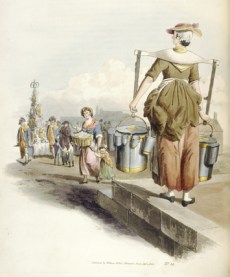
Pyne, Milk Woman, 1805, MoL
Pyne: Milk Woman, 1805, MoL

What do pewter and tin have to do with costuming? Well, aside from the many expensive buttons Mr S and the Young Mr wish to sport, I got interested in the milk maids’ pails because of their similarity to the tinned kettles used by RevWar reenactors. The uses converged in December in a conversation I had with a colleague about Carl Giordano’s beautiful kettles. (He made my wash basin, but my kettles came from Missouri because I needed them very quickly; the fur trade & rendezvous reenactors have similar material culture interests and needs, because of time period & culture overlap.)

1793: Milk Below Maids, V&A
Milk Below Maids, 1793, V&A

The milk pails look like tin, don’t they? One from ca. 1759, the other from 1805, and both appear to be carrying shiny, seamed metal buckets with brass details at the base and rim. The captions call them pewter, though. So I went to the V&A and the Museum of London looking for pails, but only found more milk maids.

I began to wonder: if the pails were really made of pewter, wouldn’t they be awfully heavy? And wouldn’t there be extant examples? Pewter is highly collectible. There’s a George II pewter milk pail on Worthpoint, but it looks nothing like the pails in the images. Is pewter ever so…shiny? And I’ve never seen seams in pewter the way they appear in the Pyne illustration.
Here’s something that reminds me of that George II milk pail.  I think I trust the Met more than I trust an online seller. On the right is a “bucket carrier” from the National Trust (UK) Collections.

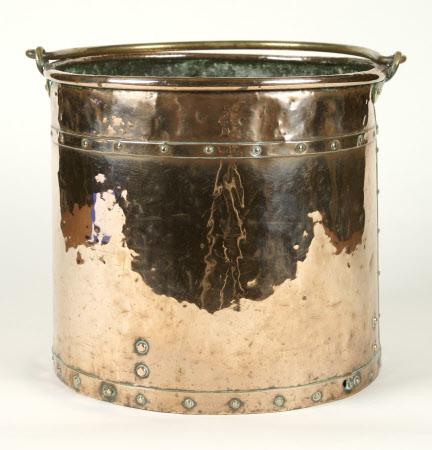
Mid-18th century dinner pail with cover, MMA
Mid-19th century bucket carrier, NTC (UK)

Google defines pewter thus:

pew·ter

/ˈpyo͞otər/

Noun
  1. A gray alloy of tin with copper and antimony (formerly, tin and lead).
  2. Utensils made of this.
Synonyms
tin
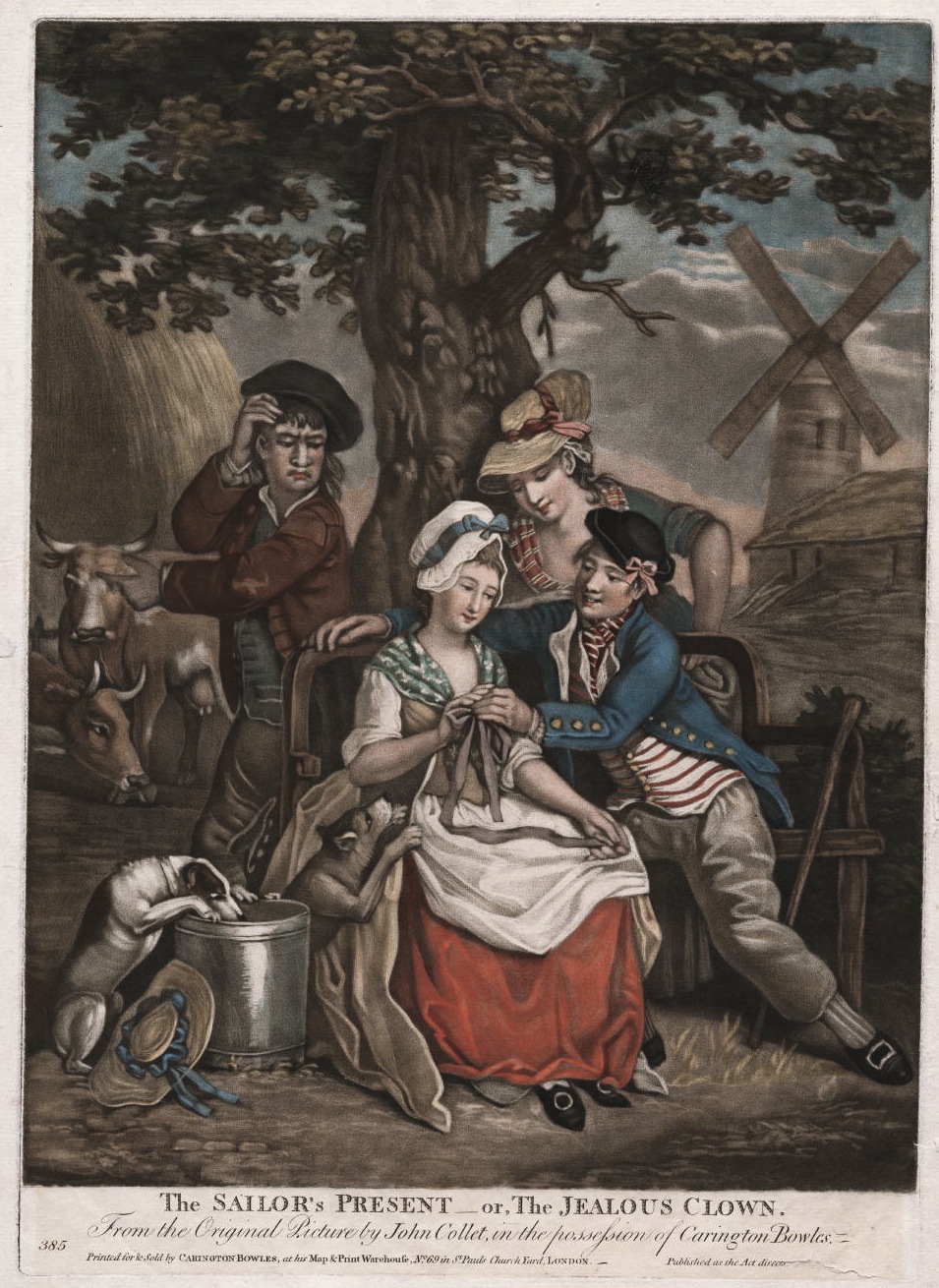
178, Collet: The Sailor's Present, LWL
178, Collet: The Sailor’s Present, LWL
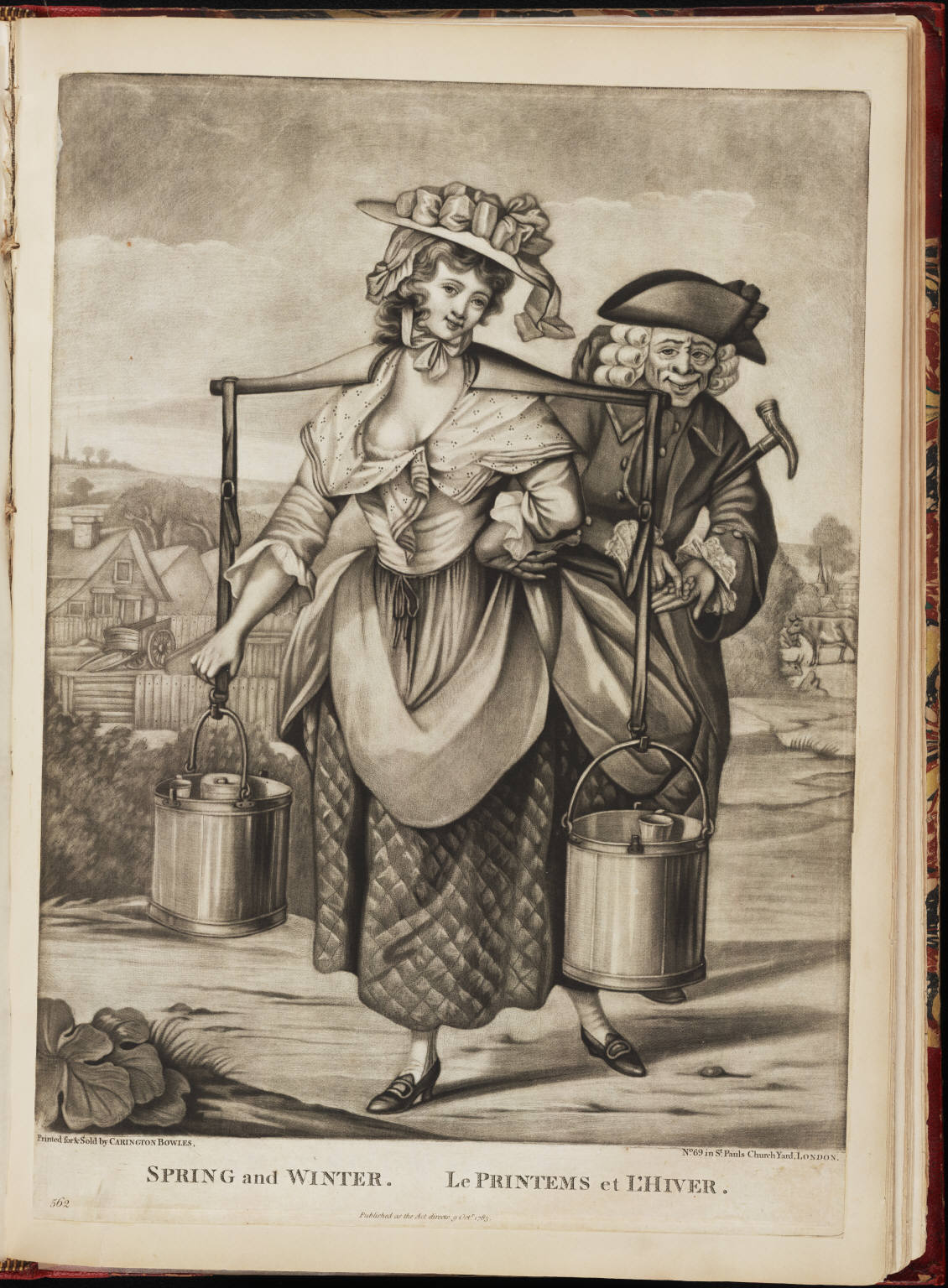
1785: Spring & Winter, LWL

Synonym: tin? That’s pretty interesting, even though I don’t trust Google with etymology.  But don’t these tin kettles look a great deal like the milk maids’ buckets?
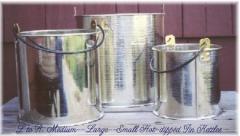
Carl Giordano Tinsmith: Kettles

The Giordano tin kettles can be made with brass ears (that’s the part the bail, or handle, goes through). Look at the ears in the photo, and at this detail from “Spring and Winter:”

Detail, Spring & Winter, 1785, LWL

The ears may be the best lead to follow. There are plenty of ears (handle attachments) if you search the Met for bucket or pail and limit the search the metalwork… but they’re bronze, and Roman. The National Trust (UK) doesn’t turn up much, or the Museum of London (yet).

ca. 1750: Silver cream pail, MFA

There’s a silver cream pail at the MFA, and it sort of looks like its handle attaches with ears, but not in the riveted-on kind of way, but in a purposeful and elegant way. This is just about where I start to ask myself why I care, but then a number of other questions present themselves, like:

  • Where are the milk pails? Are there really no milk pails in museum collections? (Yes, this could be true)
  • Was this pewter milk pail with attached measures specific to London, as my colleague thinks?
  • How does milk taste when it spends quality time in pewter (or tin)?
  • How heavy would a pewter milk bucket be?

Things to ponder as we prepare for heavy snow… In this state, that means dashing out for “French toast supplies.” I’m not originally from here, and I solemnly swear we are legitimately out of bread, eggs, and milk.

Sandby’s Women

20130109-061710.jpgSara Hough’s date of ca. 1805 piqued my curiosity and Cassidy was suspicious, too. So I went looking into Paul Sandby a little bit more.

Many of us know him for the sketches and watercolors of working people in mid-18th century England. They’re oft-used references for people doing Rev War reenacting as they’re full of the kinds of details seen in the watercolor of Sara Hough. I hadn’t thought of Sandby for later 18th century references, which shows how little I was thinking.

Sandby: Figure with Lute & Tamourine, YCBA

Thanks to the 18th Century Material Culture Resource Center, I found the Sandby “People and Places” presentation, which led me back to the Yale Center for British Art, and this image of musicians, horses and women. There’s no date in the record, though the presentation calls it ca. 1785. There seems to be a series or portfolio of Sandby sketches similar in size and type from about 1785, so it’s a reasonable assumption…with the usual caveat about assumptions, but no aspersions on the compiler of the presentation.

Sandby, detail, YCBA
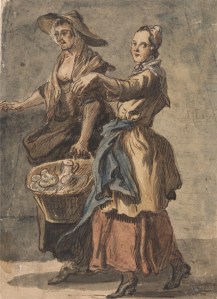
Sandby: Two Women and a Basket, YCBA
Sandby: Two Women and a Basket, ca. 1759 YCBA

Let’s look at a detail of the women in the drawing. Their waists are higher than we see in earlier Sandby drawings, and their profile slimmer, more classical, particularly the figure on the far right. Her bodice looks to me like a late 18th-century bodices.

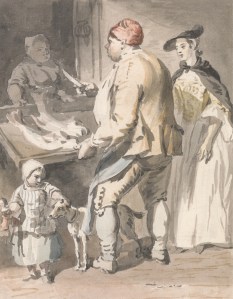
Sandby: A Fishmonger, YCBA
Sandby: A Fishmonger, ca. 1759 YCBA

Sandby had the skill to depict clothing with minimal gestures, as he does below in A Fishmonger, part of the London Cries series.

It’s that circa that gets you. I believe it for the ca. 1759, all the way. The figures fit into the visual continuum of Sandby’s mid-century work as I know it. (You’ll just have to trust me that I have a visual memory, and that, for once, the years of art school matter.)

And I kept wondering if he really had worked late into the 18th century, and then I found this:

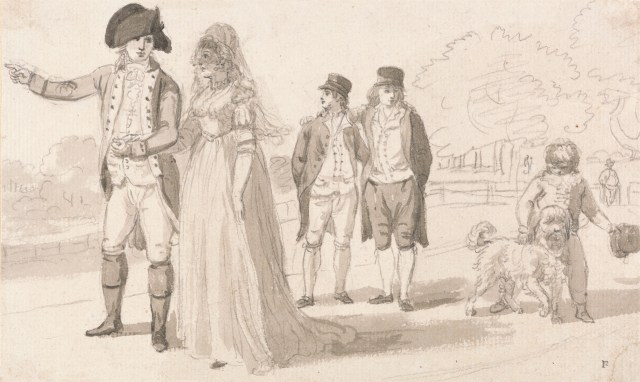
Sandby: Family in Hyde Park, YCBA

Again, no date, but there are distinctive markers to tell us this is post-1780, even inching to the early 1790s. The waistcoats on the adolescent boys are shorter and double-breasted. The shape of the boy’s hats has changed: these aren’t cocked hats, and they’re not soft round hats. But look even closer and you’ll see the ties at the knees of their breeches, very typical and fashionable for the 1790s. All this before we’ve even gotten to the woman! Look at what she’s wearing: that’s certainly a plausible ensemble for 1794, isn’t it? The waist has moved up, the skirts are lighter, likely mull or muslin, and the skirt of what I interpret as an open robe, much like Sara Hough‘s, is trained on the ground. If this is a Sandby drawing, which I don’t doubt, then I think we definitely see him working into the mid-1790s.

And just for one final kick, I checked the Met again, where they have a Paul Sandby drawing dated 1798-1799. I wonder…but the coat collar and waistcoat might have it.

Sandby, Group of 4 Children and a Dog, MMA

I’m still not sold on ca. 1805 for Sara Hough (why no ‘h’ on Sara when the drawing is inscribed by Sandby, “Sarah Hough…”?) but I’d endorse 1795. The tricky part, as always, is the circa: so much depends on how a museum interprets ‘circa.’ For some, it’s 5 years either side of the date; for others, it’s 10. When I see a circa date, I get skeptical, and start doing math.

Light & Night

Morland: Woman Reading by a Paper-Bell Shade: YCBA

Winter’s hard for me. I don’t like the lack of light, I don’t like the shortness of the days and how the sky is pale and stretched in these months. But this is a good time to think about basic needs, like light and heat and warm clothing.

The New York Times came to my rescue this morning with the article by Holland Cotter (and others) on “Artworks That Shine in New York Museums.” Cotter is one of my favorite critics and writers, and he, along with Karen Rosenberg, Roberta Smith, and other NYT critics, have selected some interesting pieces.

De La Tour: Penitent Magdalen, MMA

Ken Johnson leads with Georges De La Tour’s Penitent Magdalen. It’s earlier than my usual era but I was attracted to the image of the flame in the mirror; it’s not just a lighting device, of course, it’s a metaphor, but the rendering of the candlelight, and the use of the mirror to boost that light, tells us about how 17th and 18th century painters saw light, and how light was manipulated. We know from our simple experiments at work that mirrors really do amplify light, and that large stately rooms would only glitter with lots of candles and lots of mirrors. Light gives us a window on economy and wealth, as a precious commodity that cost money or labor to have.

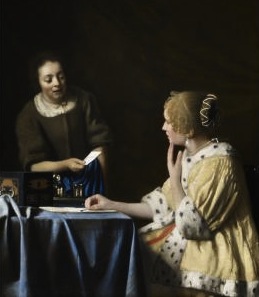
Vermeer: Mistress and Maid, The Frick

Cotter looks at Vermeer’s Mistress and Maid at the Frick, and notes the lack of obvious natural light or other light sources, and the overall dark mood of the scene. But Cotter’s writing shines, as he concludes the little essay: Whatever Vermeer’s anxious thoughts, light stayed on his mind. It scintillates in the pearls the woman wears in her hair and shines in the butter-yellow silk of her jacket. And the blacked-out space the women occupy turns out to have sunlit windows after all. We see them reflected in glassware on the writing table as tiny lozenges of light, far in the distance, as if at the end of a tunnel, but there.

Writing like that is its own kind of light, a joy to have in the daily newspaper on a cold, short day. In all, four critics look at five paintings each from a range of cultures and time periods. It’s enough to make one want to hop a train south.

Winter Holidays

NGA-The Skater
NGA-The Skater

Family’s here (OK, my mother; we’re a small family) and it’s time to pay attention to the people in the room instead of writing. So to celebrate winter, and the shorter days (tell that to a child waiting for Christmas), here’s one of my favorite paintings by Rhode Island native Gilbert Stuart.

NGS- The Skating Minister

It has a cousin here, by Sir Henry Raeburn. The selection of Raeburn’s portraits online (there are 25 in the National Galleries of Scotland) is stunning. What a treat for wintery days in these dark but luminous works.