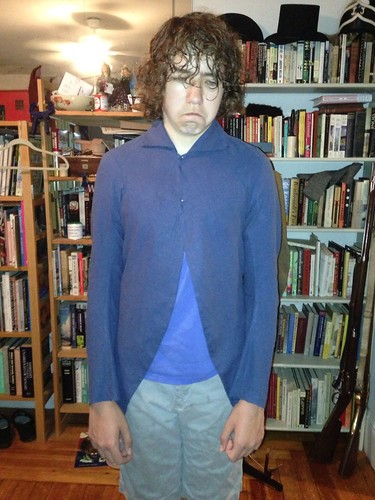
He doesn’t always look this horrible, but when the Young Mr sets out to look like death, he does it very well. Dressing 18th Century style comes at the price of fittings, and while we like to cut a fine enough figure at an event, we want no part whatsoever of the process. Even the promise of playing with a dog won’t get us to a fitting. And he dearly wants a dog…so you know fittings are a trial.
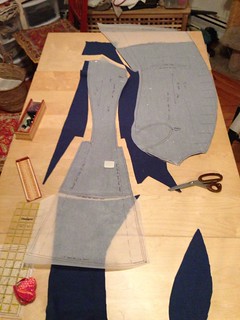
Cutting Out on Sunday
The pattern is by Henry Cooke, based on both a Rhode Island original in a private collection and a jacket in the collection of the Connecticut Historical Society. It is solidly 1770s-1780s, unlined, and both originals made up in brown linen. (From the pattern notes and what I know of the CHS jacket, accession number 1981.110.0; their catalog links are unstable, search for 1981.110.0.)
It goes together well; I started without directions, but as I am more idiot than savant, I got myself confused. I did have to alter the sleeve for the Young Mr, as he has long, thin arms. The rest of the pattern seemed to fit him pretty well, all in all, but a few untoward things happened between measuring, mock-up, basting and fitting. Still, it can be worn, with improvements made next week after he wears it in Cambridge this Sunday.
Faith & Freedom Case 2: EstablishmentFaith & Freedom Case 2: Establishment
It starts with words on a wall, and then we bring in the objects. They get hung up, placed, arranged, listed, reported. They’ve already been photographed and cleaned.
Faith & Freedom Case 4: Thomas Wilson Dorr
This might be my favorite case, though it is very brown. We’re adding a daguerreotype today. The Dorr Rebellion was a local phenomenon, but then, all politics is local.
The biggest goal this time? Washing the inside of the glass!
If you think you don’t like military history, think again. A friend of mine is working on a French and Indian War 250th Anniversary project in Boston, and in the course of his research he got interested in a red velvet grenadier’s cap that I happen to be adjacent to from time to time.
UBM 2006-08-53
One thing led to another, fortunately for him and not me, and he ended up calling on the National Army Museum in London. There a curator after my own heart distracted him with one of the coolest things I have ever seen: A Lady’s Pocket made from the decorative panel of a mitre cap, or as they call it, Mitre Pocket.
Here’s their description:
“Front section of a mitre cap made into a ladies pocket, 1760 (c); wool and cotton; on front the emblems for the 70th Regiment of Foot, all sewn as for the period, 1760 (c); back is made of brown cloth; front is bound with red cloth binding.
Note: Hanoverian white horse and ‘Nec Aspera Terrent’ used by 8th (The King’s) Regiment of Foot, later King’s (Liverpool Regiment), which might make the L an initial not a numeral and the XX a company number rather than part of the regimental numeral.”
Grenadier’s cap, 1833.1.1, RIHS
One of the most charming things about the email is that the woman at the NAM sent my friend an image of a gown and pocket, just so he’d be clear about how it would have been worn. He knew anyway, but I thought that was a very nice thing to do.
The cap we’re looking into is this one, said to have been picked up at Bunker Hill. Not for nothin’ (as the locals say), but this cap would make a lovely pocket.
An Old Woman Cooking Eggs, Diego Velazquez, 1618. National Gallery of Scotland, NG 2180
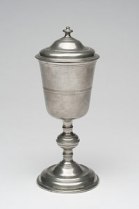
…could be pewter. Or do I mean tin? Carolina had excellent points about pewter being, yes, that shiny, though we think it is not. Our perception is probably based in large part upon the extant items in museum collections. And museums don’t polish their pewter–at least we don’t, and I don’t know anyone who does. Is it because we’re so unaccustomed to using pewter daily that we no longer know how to care for it?
Covered chalice, pewter, c. 1756-1780. Philadelphia Museum of Art, 2008-110-1a,b
I thought it could be interesting to experiment with polishing pewter (not in the collection) so I turned for advice to that touchstone of housework past, Hannah Glasse. In The Servants Directory, Part V: The Scullion Mrs Glasse lays out To clean Pewter, Tin, and Copper.
Take a pail of wood-ashes (either from the baker’s dyer’s, or hot-pressers; the latter is the best) half a pail of unslack’d lime, and four pails of soft water; boil them all in a copper together, stirring them; when they have boiled about half an hour, take it all together out of the copper into a tub, and let it stand until cold, then pour off the clear, and bottle for use.
When you clean your pewter, lay a flannel on the dresser; set your dishes one on another by themselves, the plates to likewise; then heat liquor according to the quantity you have to clean, pour some on the uppermost plate and dish, and as you use them pour it on the other. Take a piece of tow to rub them with, then having two little basons of red sand, pour some of the liquor on each; with the first scour your plates well, and rince them in cold water; with the second clean them, rince them into two waters, set them to dry, and they will look like new. Thus you may clean them at any time with very little trouble.
Very little trouble for you, Hannah Glasse! The red sand is definitely something museums won’t do: we have this prejudice about not abrading the collections, or applying chemicals, so the lime/ash/soft water mix probably won’t appear in our workroom either.
Willem Claesz.Heda, Still life with gilt goblet, 1635. Rijksmuseum, Amsterdam
I also took a look in my books for paintings that showed pewter with sheen, and for objects. I suspect that pewter’s softness will not allow it to achieve the high-gloss shine of tin, but that it can be brought to brightness. I do think the best way to find out is to start polishing, so I’m in the market for some wood-ashes from the hot-pressers, and a good place to lay a fire and boil some chemicals. Who wouldn’t volunteer for open-fire chemical boiling?




 Kirsten Hammerstrom
You must be logged in to post a comment.