Dating Mr Darcy…

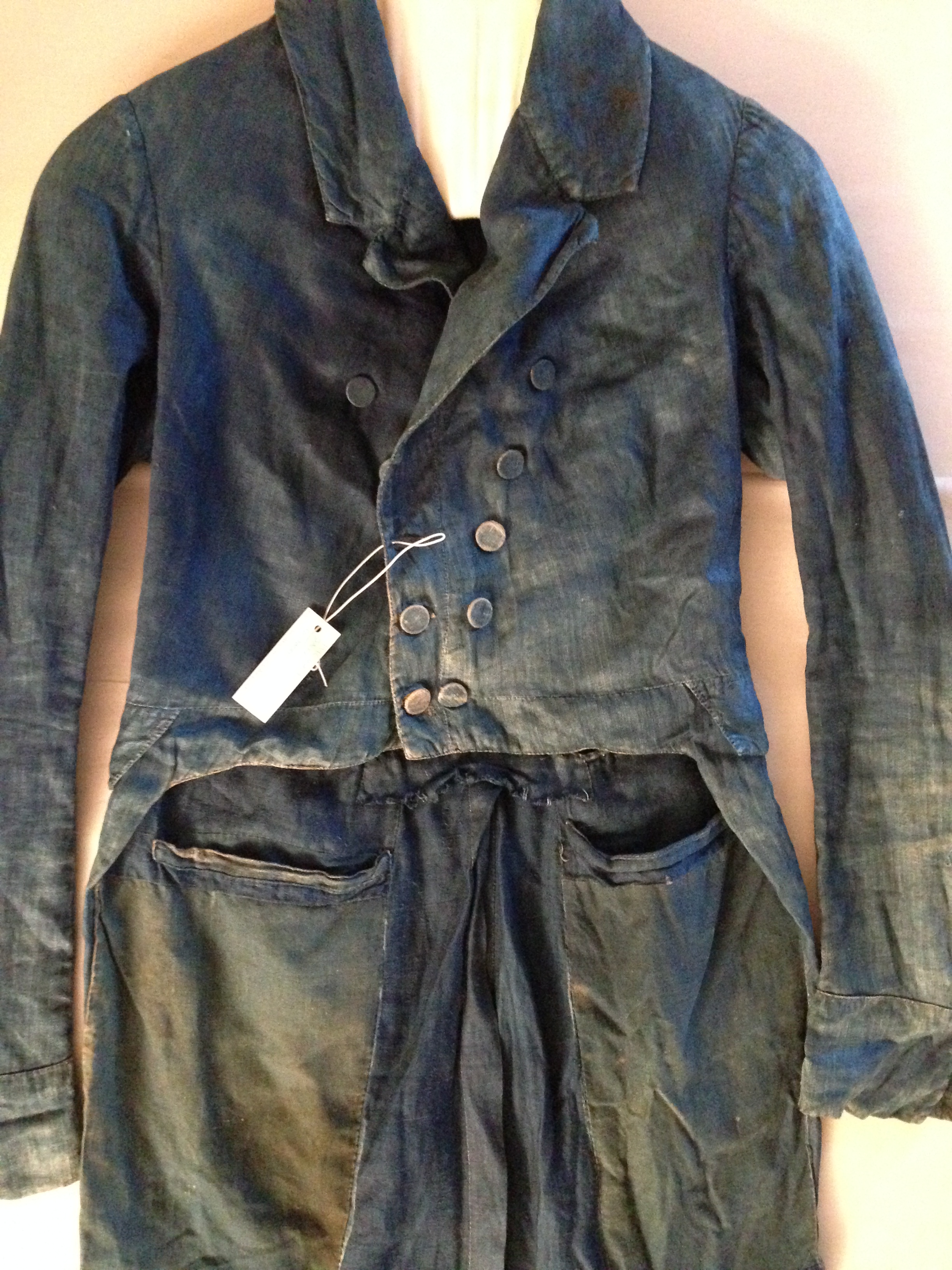
1996.66.4, RIHS Museum Collection

Or at least his coats.

I don’t know about you, but as the summer weather warms up, I like to think wool. I’ve got menswear to sew and desires beyond my knowledge, skills and abilities. Making a wool coat for an event in August seems like a patentable Bad Idea, so it’s a good thing that I have a nice piece of Italian linen-cotton denim-like fabric that I’ve set aside to make a summer-suitable coat for Mr S.

There is a Rhode Island coat, in a Rhode Island collection, of which I am particularly fond. I’ve had this coat in mind for some time now, and have inflicted it upon have shared it with experts several times.  It has a lot to recommend it: a soil mark on the collar, extensive damage and repairs to the left sleeve, fading and wear on the back, fragments of botanical material in the pocket lint, and the nicest linen fabric I’ve ever felt.

This is the coat I wanted to make for Mr S, but then I started thinking about that waist seam, which eliminates this from the style competition for 1812. Rats! But, OK, no reason that we can’t use this as inspiration and make a coat using the fabric but not the waist seam.

1956.9.3, RIHS Museum Collection

So I looked at another coat that just happened to be handy (I know, I am very lucky, and that’s part of why I’m sharing this with you). At first glance, I thought I was good. And by glance, I mean extended looking. But look again: there is a waist seam, it’s just harder to see. So much for the iPhone and lousy light, right? (I noticed the seam today, in even less light, so go figure.) This coat is made of a single twill off white wool can easily be mistaken for plain weave and that is rather light. Very summery, in a way.

Coat style found? Maybe. But I was wondering about the sleeves. I spend a great deal of time looking at sleeves and backs of much earlier coats, so I’m accustomed to a smooth sleeve head. That’s not what you’ll find on this garment, though. This one has gathers, and I thought that was pretty exciting. My closest expert probably had a weird twinge at that moment that he will soon learn to associate with an incoming email from me…

Sleeves, 1956.9.3 RIHS Museum Collection

This is a nice detail, but one I’m not familiar with. The fashion plates on Serendipitous Stitchery’s post do show increasingly full sleeves in the early years of the 19th century, but that detail didn’t fully register with me until I looked at this coat and processed what Mr C had told me about sleeves and shoulders. Seeing an extant example always makes principles more real.

So what next? At work, I’ve started updating the catalog records for these coats, and they’ll go live early next month. Every time we learn something new, we try to update and correct records so that everyone can benefit. That’s the easy part.

The hard part is reconciling style details for Mr S’s coat. In comparing these examples with fashion plates, I think it’s clear that they are both later than 1812 (waist seam) and nodding to but perhaps not fully embracing high style (see the gathers on the white coat, but the blue coat has only one gathered sleeve, which I attribute to maker error). Plausible dates for both might be 1818-1826, bearing in mind that these will be interpretations of styles, the way Old Navy knocks off adapts its sibling Banana Republic’s styles.

I may be back at that fabulous checked linen coat at the Met, with inspiration drawn from Providence’s plainest blue coat. The process always seems a compromise, in part because I do not think Mr S wants a checked coat, and in part because I’d like to use fabric I already have. Still, there is yet another coat to think about…but tomorrow is another day.

Visual Illiteracy

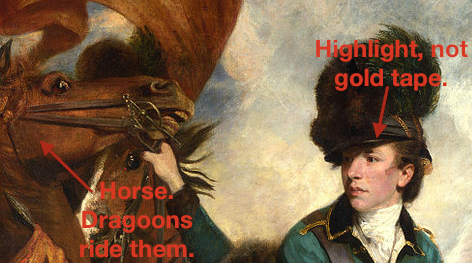
Banastre Tarlteon by Joshua Reynolds
Portrait of Sir Banastre Tarleton (1754-1833) by Joshua Reynolds, 1782. National Gallery (UK)

See update below!

By 9:00 on Sunday, I was asleep and missed “Turn,” which Mr S wasn’t even watching because, as he declared, “It’s just a bad show.” On Monday evening, I made it through the opening of the show and gave up for good. But those minutes made me think of the Banastre Tarleton portrait by Sir Joshua Reynolds, and the suggestion on Twitter that “Turn” had no historical consultant.

It occurred to me, as I stared at the rather curious headgear worn by Captain Tallmadge (I think it’s stretch lycra over a “Roman” gladiator costume helmet glued to a baseball cap visor and edge-taped with gold foil) that perhaps the people doing the costumes simply lacked visual literacy. This could explain the refugees from Fort Lee who looked like they stepped out of an Emma Lazarus poem, and it could explain the very unfortunate helmet.

Tarleton_notes

Let us look at Banastre Tarleton, hunky bad boy of the British dragoons: he came to mind on Monday night, and what visual relief he is.

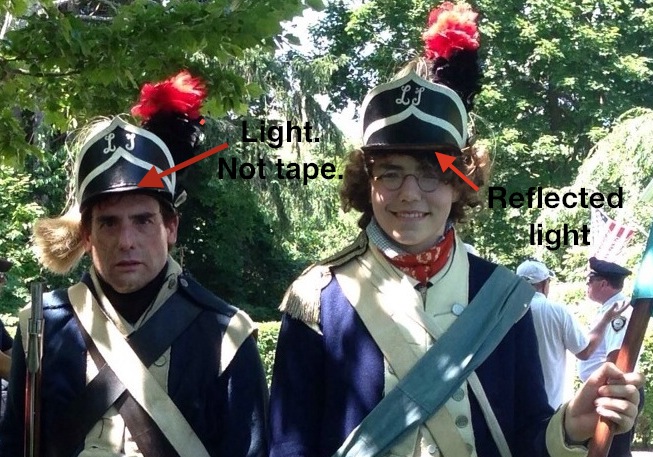
Note the light edge of the visor: this is a highlight. The leading edge of a polished surface will shine, and helmets, even of leather, will be reflective. Over time, the edges will polished by wear if not on purpose. I cannot speak to the helmet habits of the horse-mounted, but I know from paintings, and that edge is a highlight.

The Boys last July. Look, shiny, not-taped visor edges.

Reynolds painted what he saw, and just as the Young Mr’s cheekbones are reflecting light off the underside of his visor and Mr S’s helmet edge is shining in the direct light, so too is Colonel Tarleton’s helmet edge shining.

(Yes, there are both mounted and unmounted dragoons within a unit; but I just can’t help feeling that an officer would be mounted more often than he has appeared to be thus far.)

ETA: Heather has graciously pointed out a very nice blog on Turn, which is doing a far more even-handed and informed job of watching and commenting on the show. Thank you, Heather!

Criss Cross

Dolly Eyland, by Alexander Keith, 1808. (c) The New Art Gallery Walsall; Supplied by The Public Catalogue Foundation

I like Dolly. The colors, the textures, the style of her gown, shawl and cap all please me. She’s rocking some serious class for a woman headed towards a certain age. And she’s wearing a cross-front gown, which is what I settled on for my Quaker costume. 

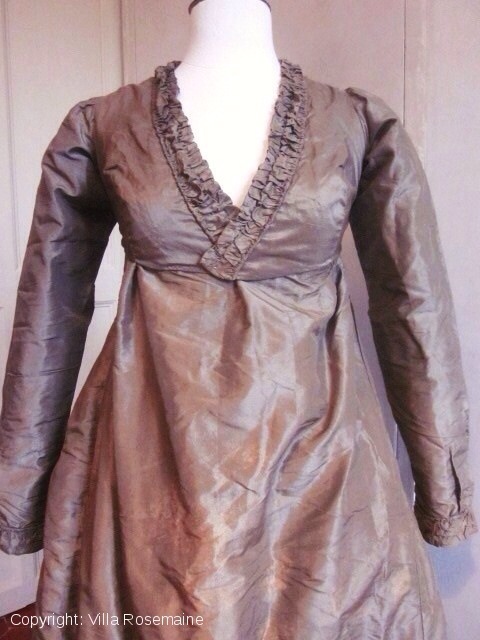
Taffeta dress, ca.1800-1810, Originally found on Villa Rosemaine site, where it does not appear now.

The trouble with making a gown based on an artistic sketch in a book is that you don’t have the most complete sense of what that garment looks like, or how it goes together.

Not to worry, I went ahead anyway, because this is as close to Everest as I will ever get.

But I wanted comparable garments to help guide me. Ages ago I found the gown at left on a French costume site. That’s helpful, in that it explains the trickiness of assembling and wearing this style of garment. Three pieces coming together in the front may be one piece too many. 

In making up my pattern, I used the pattern for the Spencer as a starting place because I knew that the set of the sleeves and arm scye were what I wanted. No reason to re-invent that process!

That left me with the luxury of concentrating on the neckline.

That took a few goes with the tracing paper and muslin:  I did lose count after a while. There may have been tears, there definitely was swearing. Mr S at one point made jokes about this process appearing on the Discovery Channel’s “How it’s Made” as “the Quaker dress.” He’s really very patient, and I do understand the selective deafness he’s had to develop as a defense against the dark arts of sewing historic clothing.

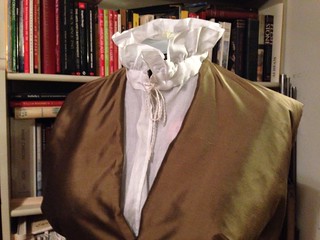
Thank you, Cassidy, for the chemisette!

Eventually, I had a decent lining and even some silk bodice fronts. I fiddled with the fronts, and settled on gathers instead of pleats, but couldn’t quite figure out where the casing went. Some days I can process drawings into objects, some days I can’t. I’d just about reached the point of cutting it all up into the gown I always make when I discovered that the excellent women of the 19th US had patterned the gown from the drawing, too. (If you don’t already use this site, I highly recommend it. Excellent work.) Those pattern pieces look like my pattern pieces, so I decided it was worth carrying on with what I have.

The Difference is…

I make this look good.

Robe à la Polonaise ca. 1775 British silk Length at CB: 56 in. (142.2 cm) Purchase, Judith and Gerson Leiber Fund, 1981 MMA 1981.314.1

Scrolling through Pinterest lately, I was struck by how different two presentations can make one gown look.

Above, a lovely Ikat-type silk gown with en fourreau back and trim, center front closing and probably a little closer to 1778 or 1780 than 1775.

It’s presented on a mannequin that supports the gown for photography and allows us to see it clearly, from the trim at the neck to the pleats down the back and the pleasant fullness of the skirt.

The gown is shown, we get the details.

And then, in another image, another view.

Robe à la Polonaise ca. 1775 British silk Length at CB: 56 in. Purchase, Judith and Gerson Leiber Fund, 1981 MMA 1981.314.1

In this image, the gown (and its companion) have been styled and accessorized, fichus, hats, ribbons, sashes. The skirt is more fully and completely supported, showing off the silk to even better effect. We lose the trim and pleating details, but the gown is much more attractive in this view.

This is not meant to criticize the images or the handling of the costumes, but to point out that you have to look past the plain record shots in museum databases, and see the gown as it would have been worn. Working with database images, and re-creating garments from those images, requires a leap of imagination.

The more you look (at database photos, exhibition photos, extant garments, fashion plates, other re-creations) the better you will be able to imagine the garment as it might have been, and to make it yourself.

To be fair, original garments cannot always be mounted in stylish and appropriate fashion, but they can still tell us something. The more you look, the more you’ll see.