The Museum of Crap

After an intense three days spent thinking about museums, we went to the antique mall on Sunday. It did not disappoint, being stuffed with a variety of material goods.

image

We had not gone past the first round of booths when it occurred to me that what I was walking past a series of touchable period rooms or installations, a kind of non-judged science fair of historical displays, each one trying to convince me to literally buy its message.

This came home when I saw the booth on the left, arranged much the way a period room in a museum is arranged, with the desk suggesting that someone has just walked away from it.

I’d seen this at a house in Boston, and I’ve seen it at home: it’s not enough. At least at antique mall, you can touch everything. At the museum, unless that desk and room are jam-packed*, we are not going far enough.
image

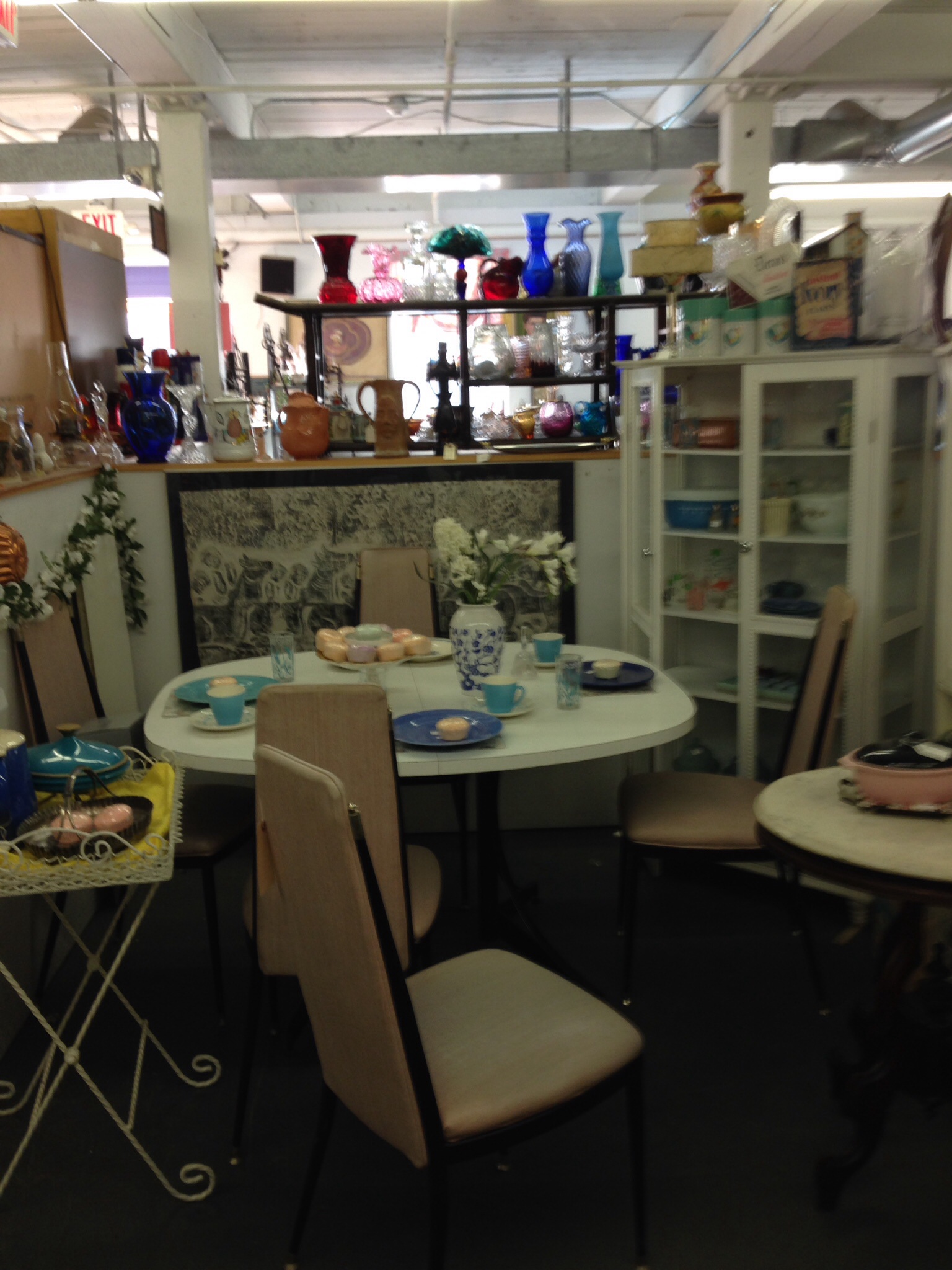
In this vignette, you can step into a dinette and sit at the table. Feel the linens, touch the dishes (I’d avoid the glittery cupcakes, myself) and pretend you are home.

This kind of interactivity is reserved for children’s museums, with varying degrees of success, often oversimplified based on an assumption that children need streamlined displays to “get” the exhibit message. Sometimes I feel a similar lack of sophistication in the presentations at the Museum of Crap, a lack of deep consideration– it is, after all, just a booth at a mall.

image

There are also the booths that really capture the deathly “Sunday dinner with the stiff relatives” feeling of some historic house museums and bad summer vacation memories, or perhaps for you it’s “tense Thanksgiving dinner with the in-laws,” or even “happy birthday tea with auntie,” and it’s a pleasant memory.

Antique malls clearly offer an array of display techniques, just as an major (large) museum with a variety of galleries.

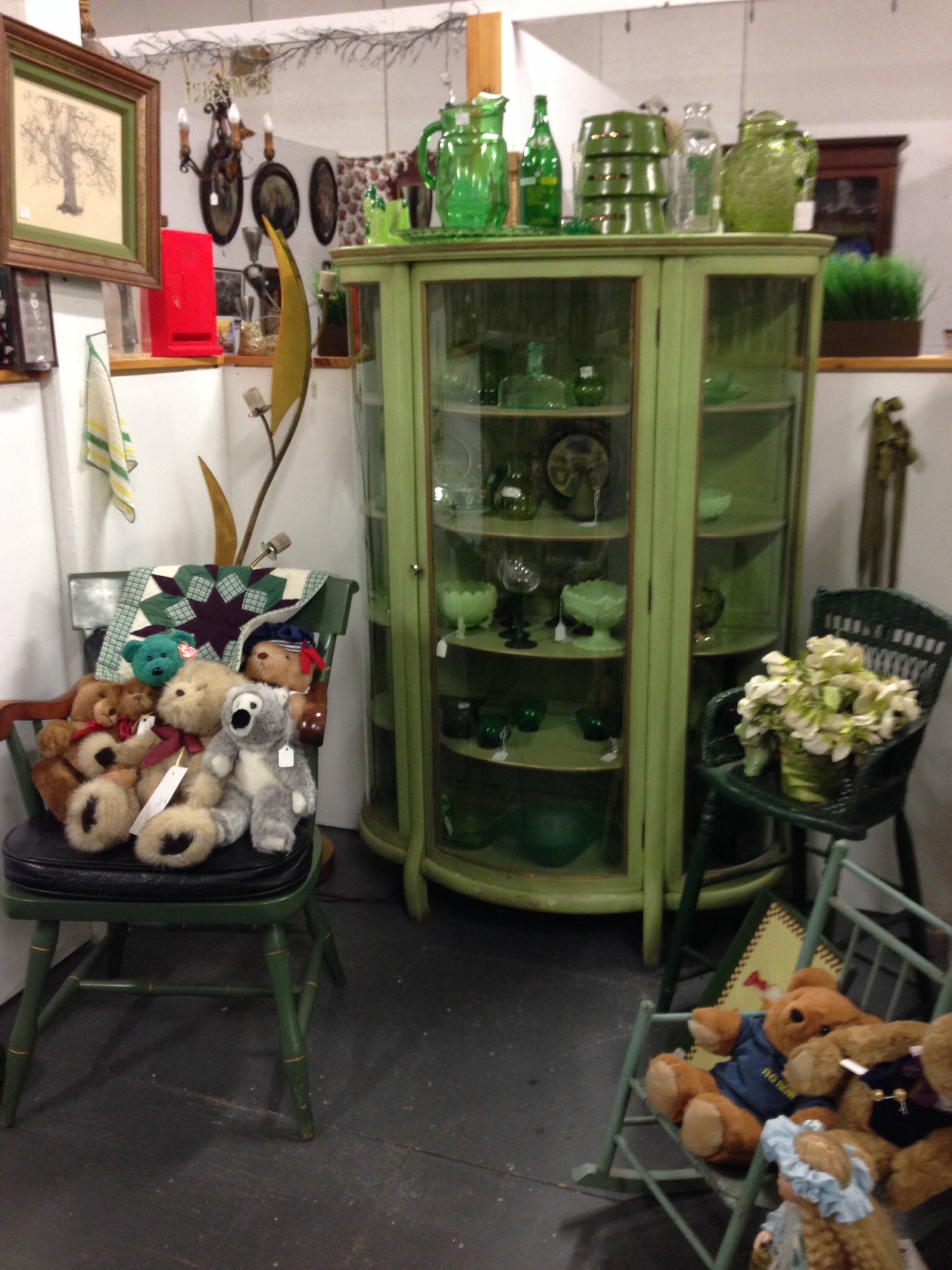
Martha Stewart Living taught us about sorting things by color back in the 1990s, and it also taught us about the power of similarity: grouping like with like can create powerful visual displays and be quite attractive. Here’s the Gallery of Green. There was even an faux spongeware cat figurine, with a green sponge glaze. Details matter: difference stands out: that’s why the teddy bears pop in this booth.
image

image

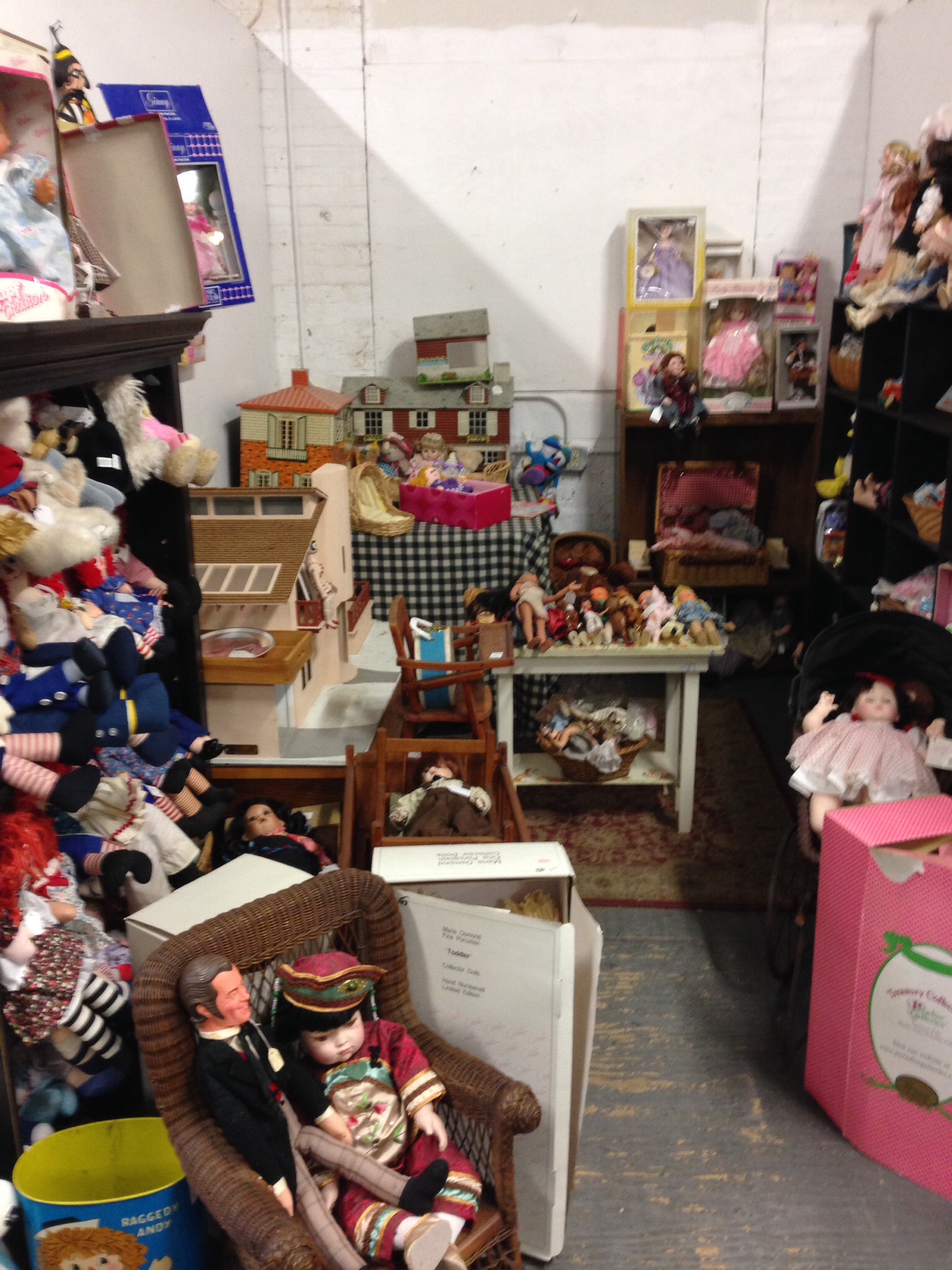
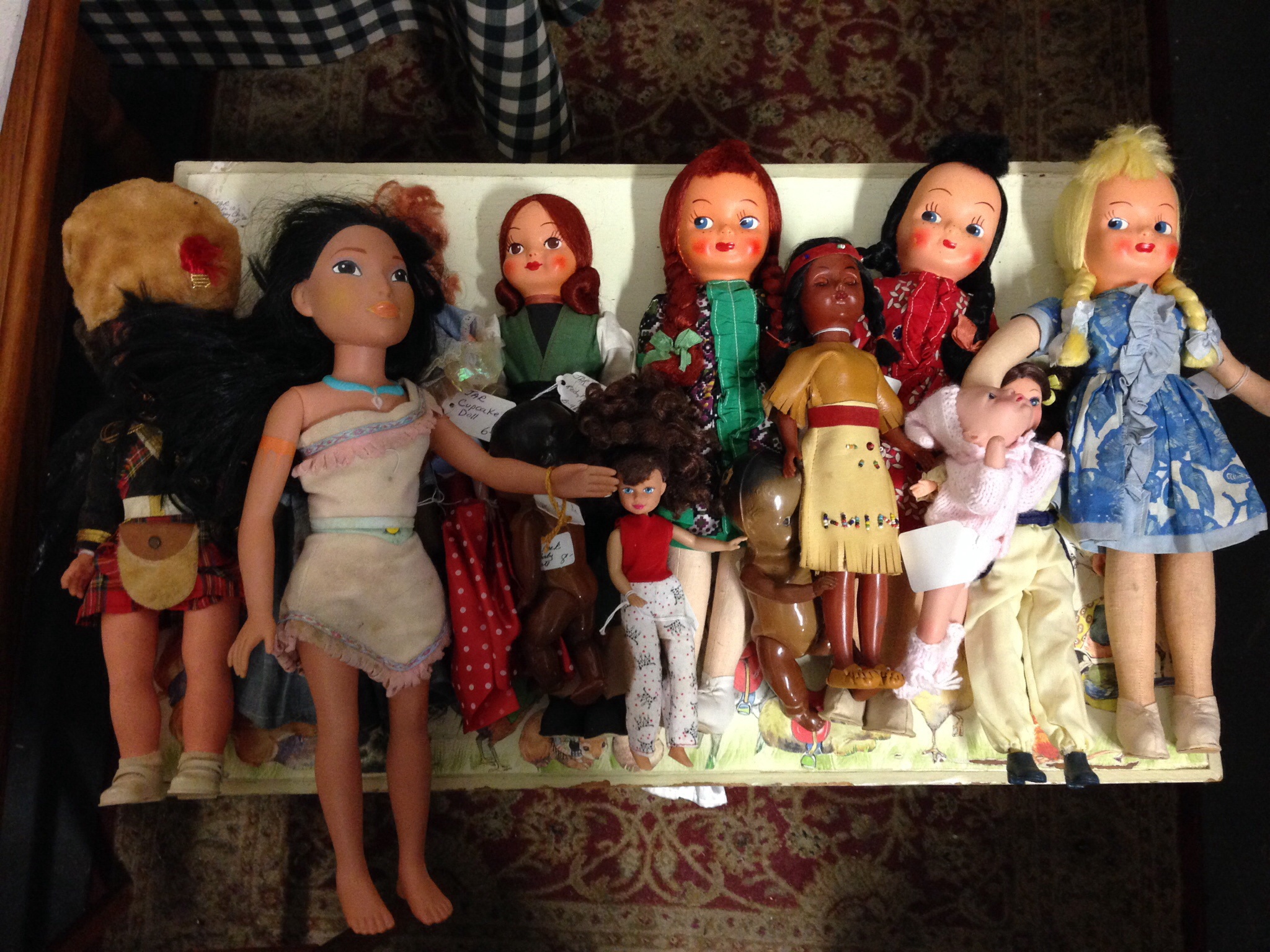
Perhaps you prefer the natural history museum, or a medical museum? There are doll morgues for you folks. This proved quite popular with women of a certain age, thankfully still a little older than I.
image

There are displays for (almost) every taste. Couples go through these emporia, often at a similar pace (Mr S and I usually split up, and come together only occasionally to compare and share reactions) but not necessarily in unison.


Here’s an entire case that might come to life in an episode of Futurama, but it’s full of stuff for nostalgic guys: G.I. Joe in Crash Team suit, Planet of the Apes figures, Captain Kirk, and the Indian Scout Rifle and Bandolier. Cars, trucks, a flying circus: here’s a man’s past for him to admire without the responsibility of keeping it up. These are social experiences, where people wander through and talk about their objects, the things they owned, or coveted, the memories they have, the future they imagine.

image

We’re consumers: our lives are all about stuff these days (having it, getting it, curating it, getting rid of it– even minimalists are about stuff) and whether you think that’s sad or not, it’s true. We express ourselves through things. Antique malls give us access to the things of the past in immediate, tangible ways. We can talk, remember, and play in these compendia in ways that we cannot in museums.

There are some unlikely display techniques. This is not an arrangement I would have come up with, but I enjoy it. It caught my attention. I can imagine that I know some folks who would have come up with this display, and had they done so in a museum under my purview, I would have undone it. Maybe that wouldn’t be right. It certainly stopped me and Mr S, and we both made certain the other saw it.

image

The carriage, while heavy, had an amazingly smooth suspension system unlike any pram I’ve ever pushed at home or elsewhere. I couldn’t tell you what Mary and Jesus and a plush Persian cat were doing in a pram, but I do recognize the care with which they have been arranged, and the whiteness of the display, which speaks perhaps to the universal innocence of this trio. Someone chose this, deliberately. This isn’t art, or hipsterism, this is as genuine as the doo-wop songs on the 1950s radio station chosen by the antique mall.

It’s all so sincere: the nostalgia, the Everly Brothers crooning through the ceiling speakers in the converted mill, the soft, smoothing touches of consumers handling the goods. As sincere as we are in museums, we’re missing something by keeping all of our collections out of reach, and by cloistering all of our galleries in silence.

I’m a huge fan of silence, but what would happen if we did play music in galleries? Would removing the silence allow people to talk more, between their companions and even strangers? I get the marketing spin of doo-wop soundtrack, and I get how wrong it would sound in Nathan Hale’s homestead…but wouldn’t it be interesting to try it now and then? Exile on Main Street resounding in the halls of the period mansion is how the staff sometimes experience it, and we love the places where we work. Why not show the public how we see the houses sometimes, instead of insisting on a false, and silent, objectivity?

*Exceptions made for displays of minimalist architects’s homes, with documentation. What would Corbu’s house musuem look like?
Mad for Plaid and Patches

Yesterday, I went to visit another collection, this time at the University of Rhode Island. I don’t have thoughts about replicating coats- they didn’t ask me any hard questions about making coats, they just let me work– but I did see a lot of amazing garments.

I’m focused primarily on men’s clothing at the moment, largely because I’m stumbling towards an exhibit or a paper or maybe a better blog post, and because thus far I have not found any examples of women’s garments made from locallly-woven checks or stripes in local collections.*

What I concentrated on at URI were two very lovely examples of the kinds of clothing worn by everyday people in Rhode Island and Southeastern Connecticut, both collected by a woman who lived in the village of Lafayette on the Victory Highway. Mrs Muriel Buckley was born in Exeter, RI in 1884, and started collecting clothing of all kinds in 1900, when she married; by the mid-1950s, she was known as a “one woman historical society,” according to a Providence Journal article, and hosted parties where she and her guests dressed up in the clothes and cooked colonial recipes in early ironware. **

As my late landlady’s husband used to say, “Cut the cackle, let’s eat some grub.”***

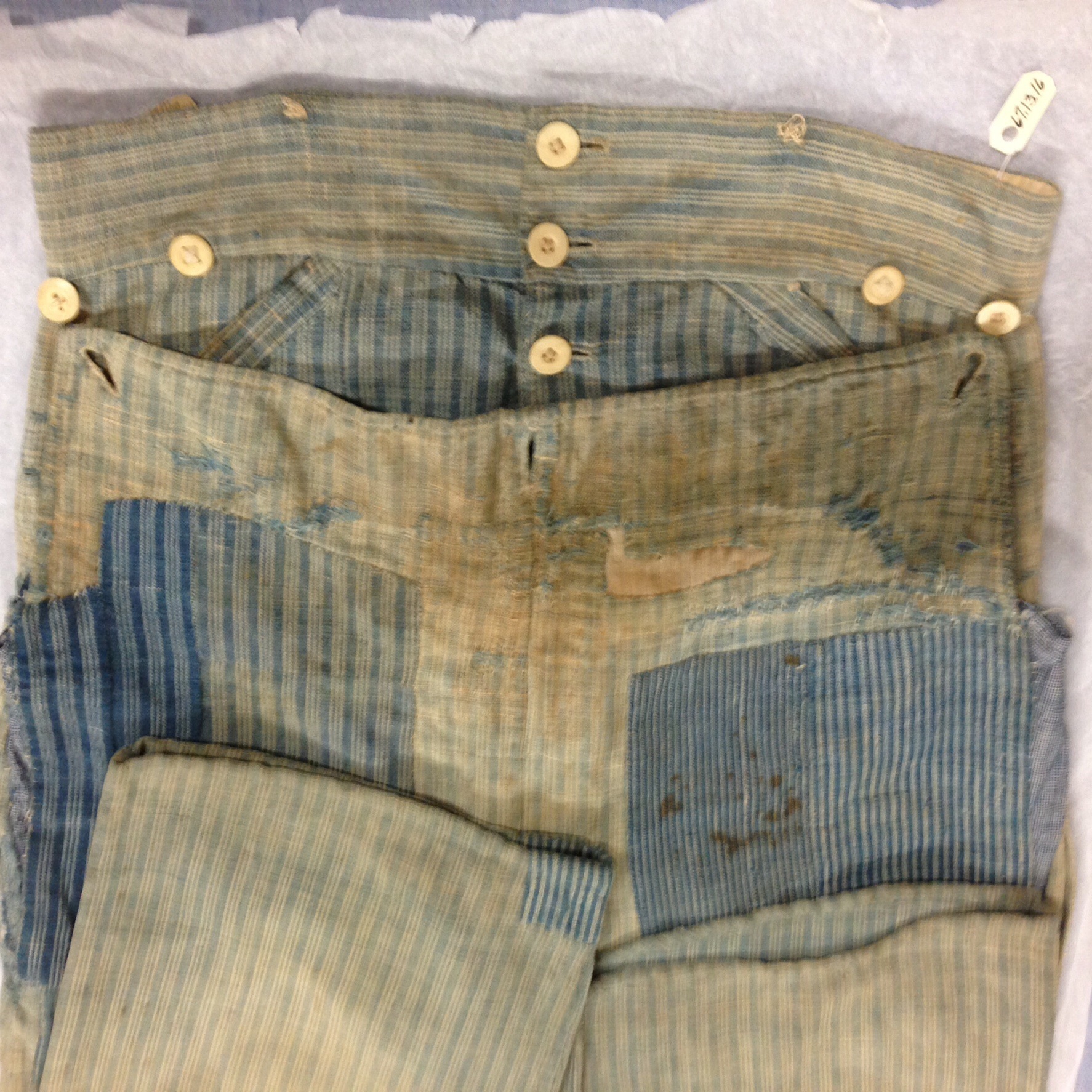
Blue and white striped linen fall-front trousers ca. 1830, URI 1967.13.16

11967.13.16, trousers ca 1830. Gift of Mrs Muriel Buckley, URI Textile Collection.
1967.13.16, trousers ca 1830. Gift of Mrs Muriel Buckley, URI Textile Collection.

These are pretty interesting, with about a dozen patches of various sizes and fabrics. The main fabric is a blue and white stripe linen of 42 threads per inch. The fall-fronts have pockets built into the bearers, with a welt cut on the grain but set on the bias for a snazzy little graphic moment. The button holes appear to be slightly rounded at the ends in a way that siuggests intent and helps confirm the date. The buttons are not all the same design, but are all four-holed bone buttons. The trousers have a 31″ waistband, a 19.5″ rise, and a 26″ inseam.

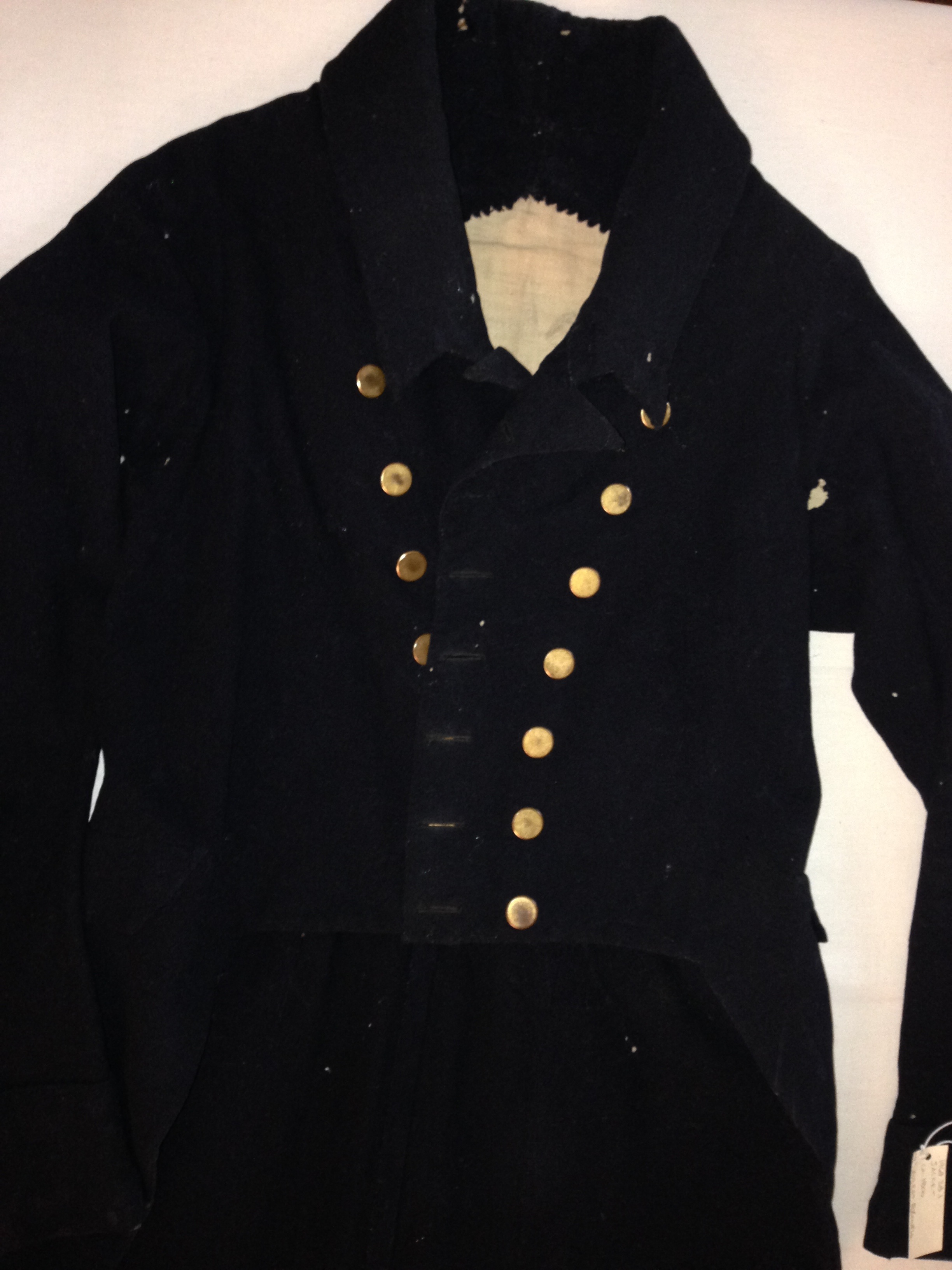
The other truly fabulous piece I saw was a coat in a blue, white and orange check “Stonington Plaid” ca. 1800, URI 1967.13.17.

This is a double-breasted, self-faced tail coat with self-covered buttons and notch collar lapels, false pocket flaps on coat body and pockets in the tails and left breast. The unlined, folded-back cuffs are tacked to the sleeve and may have been shortened. The overall length at CB is 36″, sleeve length is 25.5″ and the chest is about 34″.

1967.13.17, "Stonington Plaid" linen check coat, 1800-1810. Gift of Mrs Muriel Buckley, URI Textiles Collection.
1967.13.17, “Stonington Plaid” linen check coat, 1800-1810. Gift of Mrs Muriel Buckley, URI Textiles Collection.

When I opened this coat and looked at the seams, I was struck by the construction method, not because it was different, but because it was so typical. (I also peeked inside two wool broadcloth coats in the cupboard: same construction as the woolen coats I’d seen before.) It;’s nice to see conventions in action, and recognize what you’re seeing.

The collar on this coat has some little anomalies suggesting a less-experienced hand, or perhaps a foray into a new type of collar; judging by the pad stitching, I’m more inclined to guess less experienced hand, though not home manufacture. Someday I’ll track down the South County and eastern CT tailor’s books…

1967.13.17, back view of "Stonington Plaid" checked linen coat. Gift of Mrs Muriel Buckley, URI Textiles Collection.
1967.13.17, back view of “Stonington Plaid” checked linen coat. Gift of Mrs Muriel Buckley, URI Textiles Collection.

In the meantime, what amazing clothes and fabulous fabrics! The past looks nothing like what we imagine unless we can look past fashion plate elegance to the riot of stripes and checks and prints that must have existed in almost every village and town in Rhode Island.

*With the exception of a pocket at Mystic Seaport and a gown at the Smithsonian: accessory in the first case and very not local in the second case, making in hard to study in a day trip.

**Having palpitations yet? Your heart will really race if I can track down the photos to prove all this. In other news, I know a couple of gentlemen who are currently “one person historical societies.” The collecting instinct in wired into some folks.

***Jack and Harriet: she survived the 1938 Hurricane, and their overweight black-and-white polydactyl cat, Bonnie, followed them around the corner to church every Sunday.

Fashionable Friday: Floral Embroidery Galore

Colonial Wedding dress altered 1830
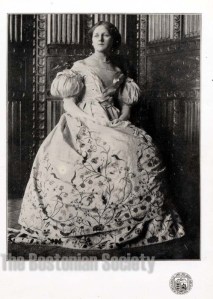
Elizabeth Bull Price’s Wedding Dress. Bostonian Society, 1910.50.35

On Tuesday evening, sensibility won over sense as my friend and I boarded the T for Boston to make a long day longer. The trip was worth it, though, for the One Night Only engagement of Elizabeth Bull’s wedding dress at the Bostonian Society. In truth, I bought the tickets for the event before I was even back at work and navigating our Fair City on my own– and who wouldn’t? That dress is amazing! (Tons more images of the embroidery are in the catalog record.)

Perhaps even more wonderful than the 14-year-old ElizabethBull’s needle skills is that the dress remains with us today. Kimberley Alexander and Tricia Gilrein reminded us on Tuesday of the many ways this dress, and other remnants of Bull’s wardrobe (oh, the petticoat, and the wonderful kerchief) connect us to the past in surprising ways. Elizabeth Bull was wealthy, married to Roger Bull, a Church of England official 22 years her senior: though they lived in Boston, they were British. (They were married in the 1730s, and Elizabeth died in 1780 at about 67.)

It’s a little hard to see past the 1830s alterations, but the embroidery of the gown helps chart that course, as well as the petticoat. As important to remember is that this wedding gown was not white: it has faded from a celadon green to its current off-white color. Wedding dresses weren’t white in the 18th century, or even long into the 19th, and it’s helpful to remember that as we look at what remains and reconstruct this in our mind’s eye.

It’s easy to forget we were British first here in the United States, and that the American War for Independence did not have a foregone conclusion. We forget, too, that churchmen and their wives were socialites as much as they were people of the cloth. Put Mr Collins out of your mind, and remember (my favorite minister & fashion maven) Reverend Enos Hitchcock and his pink satin waistcoat and suits of black silk.

Photograph of the altered gown. Bostonian Society, 1910.0050.057

Like many 18th century gowns, this one was remodeled in the 19th century, its shape altered to reflect the current fashion. We are lucky to have so much preserved, not just in the gown but also in the petticoat. Paths to understanding of women’s education, the customs and habits of Boston’s colonial elite, and the persistence of past can all be found within this object.


Gentlemen Prefer Blue

Blue wool coat c. 1800. RIHS Museum Collection 1968.38.1

Continuing the theme of wool coats that will make you itch in August, I present you with another Rhode Island coat. This coat has features I’m more familiar with: a smooth sleeve head, slightly fuller tail pleats, and tail pockets (I love secret pockets). The notched collar with its fine beak-like points makes me think this is later than 1790-1800, as the style heads in the direction of the white wool coat from yesterday’s post.

Slit cuff with two buttons, RIHS Museum Collections, 1968.38.1

There’s no waist seam, so we can be pretty certain that this coat is earlier than 1818, if not 1810. Another telling measure of age is cuff treatment. This slit cuff seems to start in the 1780s or 1790s and persist into the early 19th century, (and beyond: gentlemen, check your coat sleeves and you’ll see what I mean).

That’s an awfully long range, 1780s to forever, but the smooth sleeve head and lack of waist seam help narrow the time frame. I’d hazard– and this is a hazardous business– ca. 1805 date for this coat, which would give me leeway for a common man to wear this into 1812, though make it more difficult for him to wear it in 1799/1800. (You can look back in fashion, but high style on the lower sorts is a tricky business and requires a lot of thought.)

1925.11.1A, RIHS Museum Collection

For travel to 1790-1800, I have another coat in mind, though it will probably be a long time before I get it made. This, too, has classic markers of its time, though the collar’s stand-and-fall style makes me think it is closer to 1790 than to 1800.

The lining of this coat is a particular treat: every time I’m able to pull this out for viewing (and since it’s boxed right now, that’s not happening), that blue glazed wool is a treat. The wear mark on the left proper tail lining is intriguing, too: sometimes those start as moth holes and progress, and sometimes they’re wear that’s later found to be delicious and expands by chomping. (Wool and silk and protein, and delicious treats for pests.)

I find these coats really exciting, and often feel a little “Make All the Coats,” but of course I can’t, not quickly, anyway. And these two don’t really solve my August in 1812 problem, as the clock ticks on…but I think there is a solution, thanks to Sharon Burnston and Fitting & Proper.