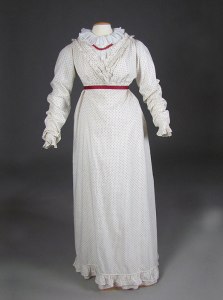
Dress, cotton, United States, private collection; reproduction chemisette, private collection; coral necklace courtesy of Dames à la Mode.
I get ideas. And like a cat I once knew, once I have an idea, it’s hard to shake. Luckily for me, my judgement is better than the cat’s– he had a tendency to pounce without regard to results, and scars do show on furry white noses. But in this case, at least, there are no scars, just some pricked fingers.
Like so many of us early-Federal era obsessives, I fell in love with An Agreeable Tyrant, and demanded the book for Christmas. It’s not just the essays or images, it’s the patterns. Scaled patterns take at least some of the guess work out of recreating historic costumes, but not all of it. And never for me– if there’s something to mess up or guess wrong, I am right on top of it– which is to say, I learn to adapt my errors and adjust my methods to fit my materials.
Surplice-front gowns have teased and delighted me for years: My first foray was with the silk “Quaker” gown of three (!) years ago, a gown I based on digging into Quaker portraits and Nancy Bradford’s Costume in Detail. It worked well enough then– not brilliantly, but close enough for my purposes. But then the polka dot dream appears, and of course, I need one to fulfill my dream of living Persuasion and having a morning dress to breakfast in. Beats the heck out of what I eat breakfast in now, and perhaps the company would improve as well. (I’m looking at you,cats.)
Dolly Eyland, by Alexander Keith, 1808. (c) The New Art Gallery Walsall; Supplied by The Public Catalogue Foundation
Courtesy Newport Historical Society
Well, so, what to do? Attempt my own, of course, since I found some fabric that seemed plausible enough and matched the color my dried blood. It’s a sheer block print cotton from India, more sheer than the original fabric, but capturing the feel well enough– and better, I suspect, than the stiff quilting cottons one is likely to find with polka dot prints. Construction and patterning fun next time on “True Confessions of the Frivolously Fashion Obsessed.”
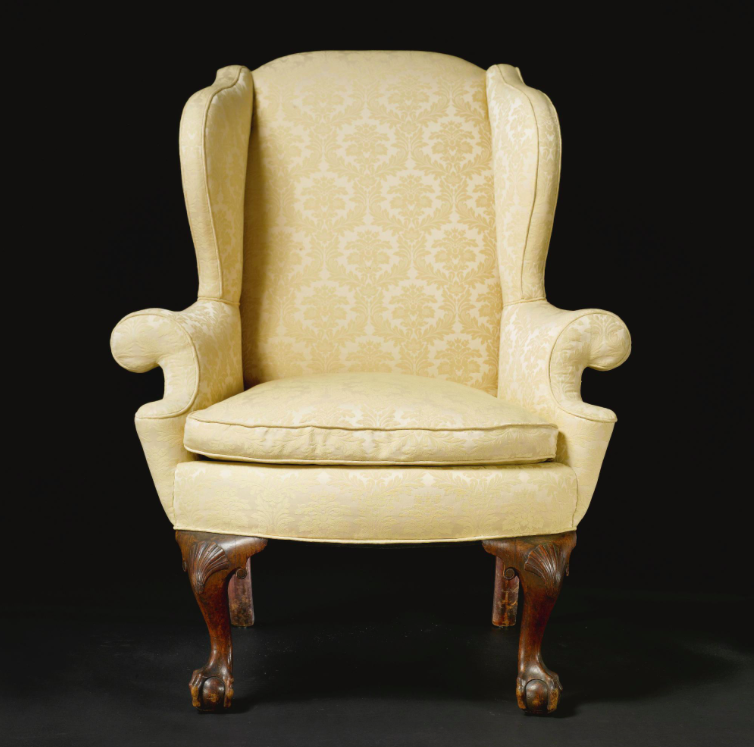
Sotheby’s Sale 8446, Lot 20. Easy Chair, Philadelphia ca 1770
We’re taking a brief break from this week’s nightlife programming to bring you this special report. Regular snark resumes with the next post.
It’s not a secret that I work in a museum. I operate in a world of objects that cannot be touched, sat upon, slept in, worn– you get the idea. Well, sometimes things that I believe belong in a museum don’t end up in one. Sometimes beautiful objects with great stories and deep resonance with the museum I think they belong in don’t make it there. Sometimes museum professionals take phone calls from irate family members who are incensed that you’re even talking to someone in the family about how to organize their materials. Sometimes objects do make it, but then, before the paperwork is executed, the gift is rescinded. People get weird about stuff.
Sometimes they get weird about stuff because of what it’s worth. Eleven years ago, a family chose not to fight over objects, but instead sold their family furniture. They grossed nearly $13 million. Thirteen Million Dollars: Enough for a baker’s dozen of Dr. Evils. With chairs that sell for $204,000 (Sale 8278, lot 586), it’s no wonder people get weird about stuff because of money.
Lot 586. It’s a pity the catalog is no longer available online, but even Sotheby’s has to conserve server space. It was a beautiful chair: a 1763 upholstered easy chair– upholstered by Plunket Fleeson of Philadelphia.* I pored over that catalog page in the Important Americana sale catalog. It would have come in just before Christmas, or just after, slick clay-coated pages printed with fine ink. When the auction catalogs arrive at work, we stand in the kitchen-mail room and bury our noses deep in the gutter: smells like money.**
Staircase Group (Portrait of Raphaelle Peale and Titian Ramsay Peale I) Charles Willson Peale. Philadelphia Museum of Art, E1945-1-1
I wanted that chair, Lot 586, that walnut easy chair made in Philadelphia. Wrong town, you say? Mais non, Philadelphia was the place to buy fancy goods– especially upholstered goods– in the 18th century. Providence merchants were trading with Philadelphia, the town that set the style for the colonies.*** It was sophisticated, urbane, refined. So, when Sarah Brown was pregnant with their first child, John Brown sent to Philadelphia for an easy chair. It would be the best.
He’d already ordered a tea table and roundabout chairs from Newport at the time of his marriage in 1760. These objects were about more than function: they were signifiers of taste and sensibility as much as wealth. So, as the time came closer for Sarah’s confinement, John Brown became increasingly agitated with Plunket Fleeson, who was delaying the delivery of the chair. John Brown was concerned for Sarah’s comfort postpartum, and said so in a letter. I can’t quote or link to it, because it’s in private hands, quoted in the catalog entry for lot 586.****
So what about that chair? Well… I got permission from the Authorities (a Board-level committee, with the support of the Executive Director) and we bid on the chair by phone. You know already we were not the winning bid. We were willing to bid a lot– really, a lot of money for us– for this chair.
Why?
Not because it’s worth so much. Not because of Plunket Fleeson, or the quality of the carvings, or the craftsmanship, really.
Because Sarah Brown sat in that chair cradling her son, James Brown, in 1763. She sat in that chair with the children who came after him, the babies who lived, and the babies who died.
Because that chair told a story about a family, about a relationship between a husband and wife, a man and a woman, at its most basic level.
That chair told a story about love.
Even I am a sucker for love.
Love is why people get weird about stuff, about the chairs, the family photos, the workbaskets, heck– the drill presses. We imbue objects with meaning, with memories, that substitute for the people we love when they’re gone. Sometimes it’s a t-shirt that smells of a lover. Sometimes it’s sewing basket used by three generations of women. And sometimes it’s a chair.
In the case of the easy chair, imagining the cradling comfort of the chair and the memories it recalls is simple. In the case of, say, shield back side chairs, the leap is a little harder. But perhaps– just perhaps– arranged around a festively set table, those chairs conjure memories of holiday meals, birthday dinners, graduation parties. Maybe those chairs take you back to the people and times when you felt loved.
Or maybe they’re worth $100,000, and you consign them to auction.
But if you value the story as much as the object, here’s the funny thing: you can keep that memory forever, and share the story with everyone, if you give that object to a museum.*****
When people really love an object and are fighting with their families over who gets to keep the things, I don’t play Solomon. I tell them a story about memory, and preservation, and about endurance. Sometimes I can convince them. Sometimes I can’t.
When I can’t, I tell them I understand, and that my priority– and my institution’s priority– is not things, but people. They can keep their object: we’ll be here when they’re ready. It’s all true, and I do mean it.
But inside, I feel like Indiana Jones, soaking wet on the deck of a pitching ship.
That belongs in a museum.
*If money were no object, I’d buy it for that name alone.
**The quality decreased in 2008, when the financial crisis hit everybody hard, but the paper weight and ink have been creeping back up in quality of late.
***I know, it sounds crazy now, but it was true. At the time of the American Revolution, it was the second largest English speaking city in the world, after London.
****You are correct, sir: I’d like the letter book it’s in, too.
*****Subject to acceptance. Some rules and regulations apply. Leaning is touching. Don’t lick it.
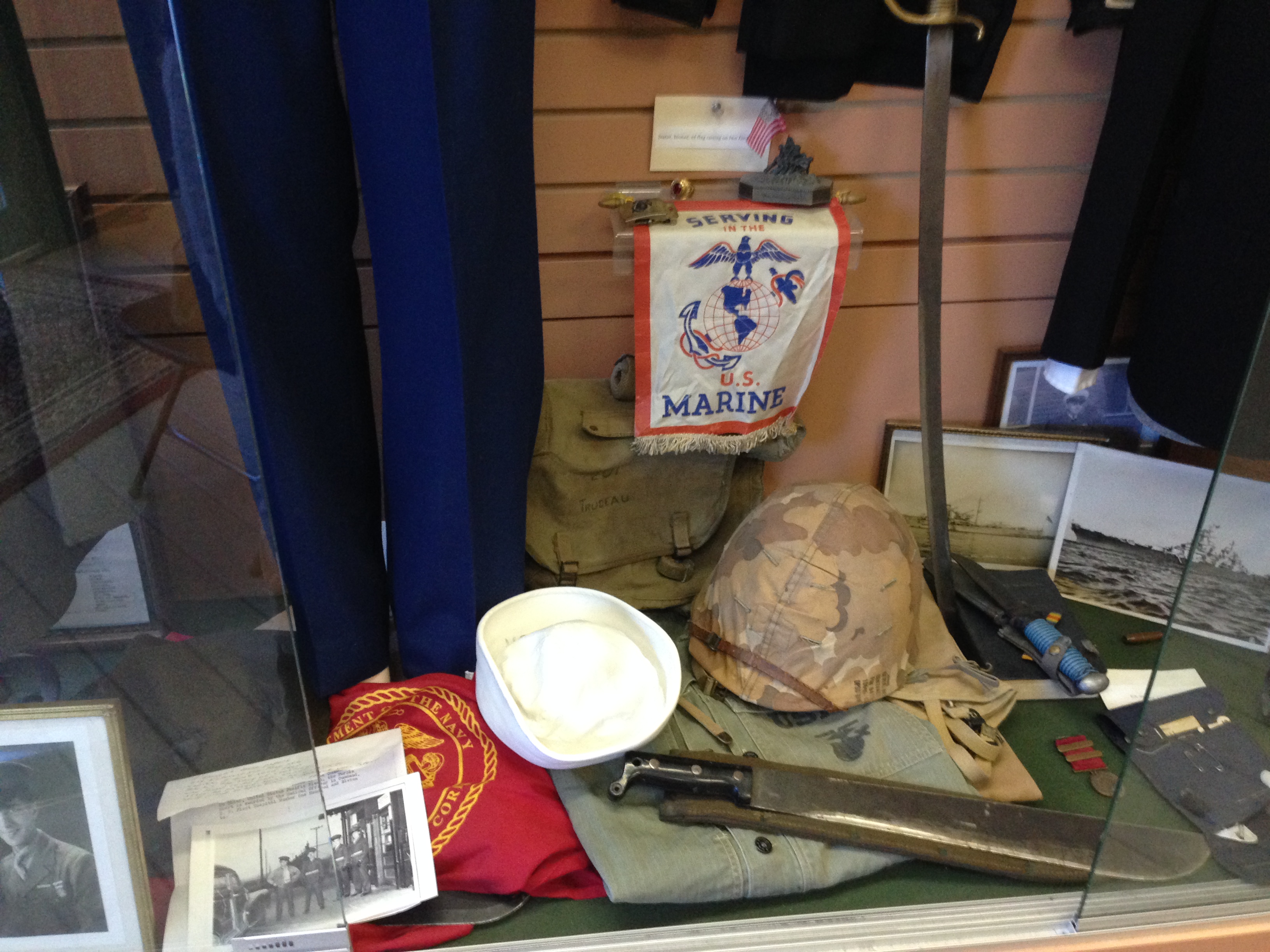
We are inventorying a collection of militaria currently on display at a museum in the northern part of our tiny state, and while I recognize most of the things, I don’t have the intensive knowledge that some of my friends and acquaintances have to recognize the subtle changes in accouterments over time. Fortunately, plenty of things are marked: the military tends to do that. And fortunately, there are books and the Google and I remember enough of what I learned to ask the right questions.
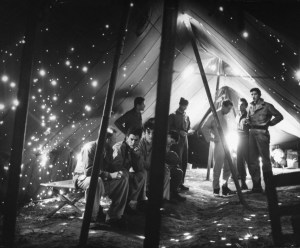
American soldiers inside hospital tent riddled w. holes caused by German schrapnel from long range gun attacks which killed 5 & wounded 8 patients in the tent. Photograph by George Silk. Life Magazine
The most meaningful items are the ones that have been personalized in some way, or that were never issued at all. There were, for a long time, two small shells picked up at Anzio and Nettuno, each white interior curve labeled in ink, one Anzio and one Nettuno. I could only guess at their significance, as you probably can too: what I did not know was that the soldier who picked them up was only 18 in January 1944—and how appropriate it is to have returned them to his daughter this month.
Not about Anzio, but this is a typical case.
The cases are packed with things he and his friend collected, all of which had some meaning to them: that guy, this place, that story, these memories. The soldier who picked up the shells could never tell his daughter or granddaughters any of what he had seen, though later on, he began to tell his nephews. But he assembled this collection and in that, I think, he was telling us all. Our job at the museum is to translate mute, general issue objects into meaningful individual narratives.





 Kirsten Hammerstrom
You must be logged in to post a comment.