Reap what you Sew

Too big!

Lampshade: She’s been the Holy Grail of bonnet making.

There were several failures in the winter of 2016, and some revisiting of the Whale-Safe Bonnet as I tried to figure out the brim and the caul. My first efforts made a caul that was waaaaay too small. That’s not necessarily a bad thing, as I’ve made plenty of too-big bonnets. (Too small did not make the move from RI to VA, but trust me: too small a caul was far too small.)

This morning, I took another look at George Stubbs’ paintings of working women. I know the lampshade-like bonnet is pre-1770, but where are we at the end of the Revolutionary War period? Well, BIG was in, obviously. (We can have a healthy debate about the likelihood of these gowned women depicting actual working women, but for now, let’s stick to bonnet brim shapes.)  They’re a little cone-like, aren’t they? With generous (yuuuge) cauls, though.

Now, I have gone about this all a bit backwards, which is to admit that I picked up the shellacked brim of yesteryear that did make the move down to VA, and decided to make it up as a bonnet yesterday. The brim is easy– trace and cut with a seam allowance– but the caul? I winged it, using a selvage edge for the inside of the back drawstring (I like my headwear to be adjustable and pack flat) and economized on fabric to leave plenty of taffeta left over. So there’s nothing particularly well-researched about this, except for all the years of looking and thinking and drawing and making that came before the moment I threw this all together yesterday afternoon watching North by Northwest and drinking a Manhattan.*

Making this up raises more questions: how individually fitted were bonnets to wearers? Did caul and brim size vary depending on wearer? What’s the class line below which a woman doesn’t have a bonnet, but only a hat? How quickly did styles change? The sort-of-conical black bonnet is seen on “older” women in paintings well past the height of the style. But as I’ve asked before, what do we really understand about the portrayal of age in art? Are we really reading the symbols correctly? How well do we grasp the semiotics of the 18th century? All of those questions are present when we try to replicate the past using only visual sources. Yes, there is an extant 18th century black silk bonnet at Colonial Williamsburg, and we can use that in conjunction with images to make the things we wear. But pondering all of these questions makes me think it’s time for another troll through collections in Great Britain, just in case new cataloging has put old bonnets online.

*See my other blog, TipsyMilliner, for more.

Objectivity

Recently I’ve had more than my share of time to think about museums and objects, and what they mean to me and why I love them, and have dedicated my life to them, albeit a bit accidentally.

Transferware in open storage, Metropolitan Museum of Art, May 2013.

In the hours I spent alone in a curatorial office, listening to the murmur of school tours on the other side of the door, I began to see that curation and registration are means of managing the evidence locker of the future. We collect, tag, and maintain the means by which the future will understand the past, and it’s our job to be a neutral as we can—to refrain from laying the thumb of our prejudices on the scale—as we collect objects, images, and documents. It’s a game of forecasting, trying to guess what will best explain us and our time to the future, as well as Monday morning quarterbacking as we both weed and augment what was collected in the past to better reflect how we understand history now.

I was always a stickler for good data and record editing (and have raccoon-eyed photos of a catalog launch to prove it), and I make unkind sport of museum databases on a regular basis when I see misidentified and misdated objects. Good data matters—it’s everything, really—because if you don’t know what you have, and where it is, you might as well not have it. But more than that, compendia of data can show you things you didn’t expect to find.

RIFA Record 4925

Yale’s Rhode Island Furniture Archive is a good example of how a massive amount of data can be used. Take this record of side chair possibly made by John Carlile and Sons, and scroll down. That’s a lot of associated chairs. And they all look very similar. Examining the materials, especially secondary woods, of a labeled chair and comparing the style, make, and materials with other very similar chairs can help identify chairs, associate them with a maker, and provide a sense of Carlile’s production volume.

And Carlile’s easy! Looking at hundreds of pieces of furniture with some location provenance, reading probate inventories and other documents helped untangle James Halyburton or “Ally Burton” as a maker.


James Halyburton in the RIFA

When you can see enough things at once, you can discern patterns and better understand exactly what it is you’re seeing. Good data makes that possible, makes concrete what was once solely seen as connoisseurship, and helps bring unknown stories, unrecognized people, to light. Data analysis is a powerful tool for better understanding the past: that’s why museum collections matter, and why I think it’s so important for museums to make their data accessible. It’s one of the ways we understand our collective past.

Flipping a Lid

In a continuing effort to simultaneously destroy my hands and make all the bonnets, I set out recently to recreate a bonnet in the Met’s collection.

Silk Bonnet, British, ca. 1815. Brooklyn Museum Costume Collection at The Metropolitan Museum of Art, Gift of the Brooklyn Museum, 2009; Designated Purchase Fund, 1983 2009.300.1613

It’s a curious thing, isn’t it, with that flipped-up brim? It looks more 1915 than 1815. But a little looking turned up this fashion plate:

Items 2 and 6, while not of silk, show the turned-up brim seen in this example. (To be fair, the original black and white photo suggests some confusion about the bonnet’s orientation.)

My version is admittedly imperfect, but a home-made interpretation that gets as close as I can (for now). I started with a lightweight buckram frame, to which I stitched slim round caning.

The brim is covered in two layers of the copper silk, and edged on the bottom side with the contrasting silk trim. the crown, or caul, is a simple tube gathered to a silk-covered buckram circle. In the absence of matching (or even sort-of-close) ribbon, my choices are to trim what’s left of the fabric and piece it together…. or start an online-ribbon hunt. At least the extant example has ribbon that’s close but not a match, giving me some leeway if I decide to save my hands for other projects and click instead of stitch.

True Confessions of the Frivolously Fashion Obsessed

Skeptical cat is skeptical

I promised you something, didn’t I, the last time I wrote?

Well, set your skepticism aside for the cat, because here’s the scoop on the messy process of getting from page to pattern to garment.

I started with the pattern from the book, which furrowed my brow a few times until I became accustomed to the style. Everyone drafts and scales patterns a little differently; it’s like getting used to local idioms. (It’s a bubbla, here, not a water fountain and not a drinking fountain. Go figure.)

But I digress. It seemed pretty simple, especially since I have some experience scaling things up, both from Sharon Burston on taking a pattern from an original garment (plot your points like an archaeologist) and from architecture school (redraw Le Corbusier’s maison from these two tiny drawings, draft an axonometric, and make a model). With Corbu behind me, you’d think this would be a piece o’ cake.

Delightfully, you would be wrong. Creative swearing, brow furrowing, and endless distractions (yes, some 28mm 17th century soldiers will be wearing Timberlands) provided the usual soundtrack and experience. Challenging, not easy, which means I hope I might actually have learned something.

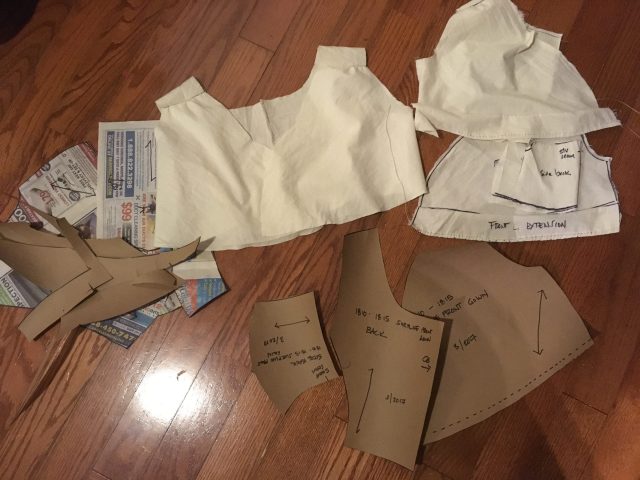
Kind of a mess, right? Here’s what I did: I scaled up the pattern in the book once I’d figured out that the measurements were, incredibly, just about what I make my Federal-era dress pieces. I used the newsprint ads that come in the mail because they are abundant and free. That’s more challenging than gridded or plain paper, but free is free. With a ruler and a pencil, you can make your own grid.

After the paper patterns were drafted, I checked them against the drawings in the book, and made free hand corrections. I’ve learned that my eye is sometimes better than my math whether I am hanging paintings or making patterns.

From the tweaked newsprint pieces, I cut muslins to stitch up and try on over my stays. You MUST fit over the proper undergarments, or the exercise is pointless. These resulted in some additional tweaks and alterations accomplished at first with pins, a Sharpie, and Drunk Tailor’s patient assistance.

What then? Another round with some adjusted pieces to yield another muslin. It’s from that final fitting muslin that I transfer changes to the newsprint and then, finally, to craft paper. I was ably assisted once again by the Most Dangerous Cat in the World.

That’s what you’re left with: scraps, a muslin that’s true, and the pieces to make it. But have I made real progress on real fabric? Of course! But that’s another post.