The best things turn up when I’m looking for something else entirely. First came the miniature, now in a private collection, with the lovely carnelian or coral jewelry and the bright yellow dress. I’ve got some yellow cotton with a red and black print pattern in the cupboard, so this dress seemed within reach.
And then, while looking for something else, I found the right fabric! Not that I can buy it, mind you. It’s already owned and in use, in a gown at the Philadelphia Museum of Art. And not that I haven’t spent some quality time searching the interwebs for similar fabric, which can be found if you look hard enough. Fortunately, better sense prevailed and no cupboard will burst with an additional five yards of block printed silk.
Woman’s Day Dress, English, ca. 1820. Yellow silk brocade exported from India. Philadelphia Museum of Art. 1996-164-1a,b
Still, the fun bit is finding two such similar thoughts, one in paint and one in cloth, without even looking. that means there are more bright yellow Federal or Regency gowns out there. All it will take is the looking.
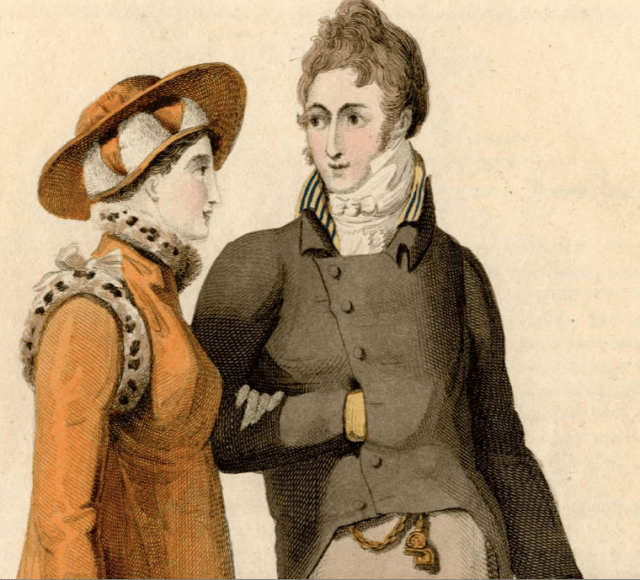
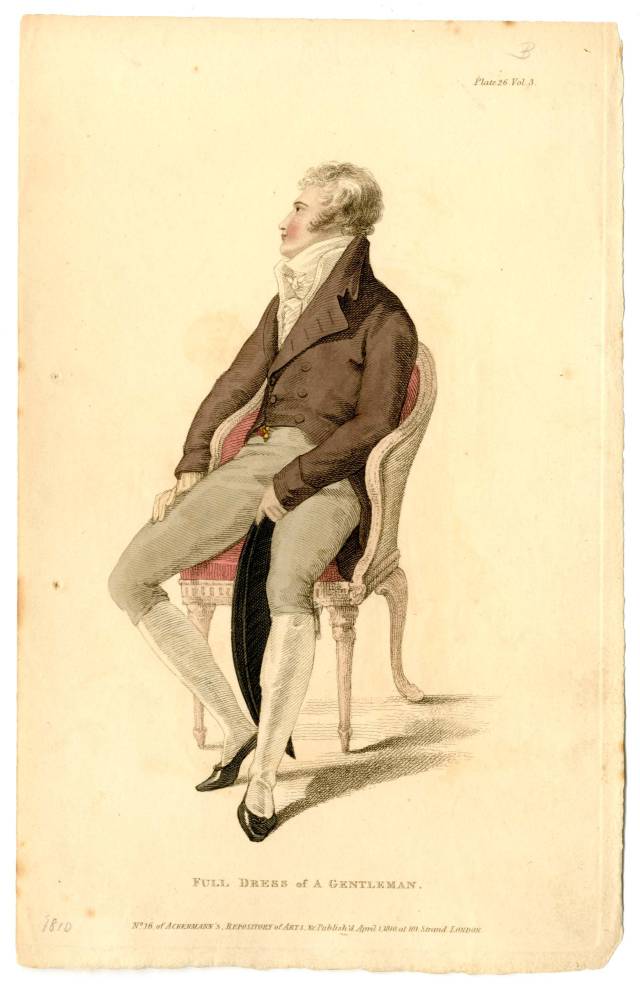
Whilst serving as the commandant for a research-paper writing prison*, I spent some time perusing the Met’s digital collections, in particular the Costume Institute’s collection of Men’s Fashion Plates, because, you know, stuff.
Men’s Wear 1790-1829, Plate 002, 1807. Gift of Woodman Thompson Costume Institute Fashion Plates Metropolitan Museum of Art
John Myers. Oil on canvas by Thomas Sully, 1814. MFA Boston 45.894 Gift of Maxim Karolik for the M. and M. Karolik Collection of American Paintings, 1815–1865
I stopped at Plate 002, because I knew I’d seen that coat somewhere before. Why, yes: at the MFA in the Art of the Americas Wing, where I recently spent a pleasant afternoon with the Drunk Tailor. After some initial joy at discovering dust on a teapot, we got down to the business of setting off proximity alarms, reading labels, and contemplating the occasional neck stock.
Mr Myers stopped me, though: what a handsome coat. High shoulder seams, long cuffs, buttoned all the way up. Nifty high-waisted grey trousers, too, and what seems to be a yellow waist coat. The portrait is dated 1814, and the fashion plate 1807.
Detail, 1807 fashion plate
Hmmmm…
Men’s Wear 1790-1829, Plate 005, 1807. Gift of Woodman Thompson, Metropolitan Museum of Art
The brown M-notch collar coat is clearly a thing in 1807. It’s popular in 1802. So popular. 1802 on the left. On the right, 1812.
Portrait of a Gentleman of the Society of the Cincinnati. Miniature by James Peale, American, 1802. Philadelphia Museum of Art, 2000-137-11
Portrait of a Young Man by James Peale, 1812. Philadelphia Museum of Art, 1944-47-1
And our friend Sully paints one in 1814.
After seeing Copley and other early American painters use English prints as references for portraiture, I wondered if Sully was at all influenced by fashion plates, and then to what degree American men and their tailors were influenced by published fashion plates.
Portrait of the Artist. Thomas Sully, 1821. Metropolitan Museum of Art, 94.23.3
Brown coats are clearly classic: Sully’s got one himself in 1821. I’m sure there’s a dissertation out there somewhere on the influence of fashion plates on American men’s fashion and representation in portraiture– I can almost remember stumbling across the reference. So that echoes and re-echoes and reflects through time even as I recall not just the the folk wisdom about brown suits, but the significance of well-tailored suit. Maybe from 1802-1821, brown is the new black.
*Ah, teenagers. The Young Mr failed to complete a paper by the due date, so I spent some quality time ensuring he got back on track.
Some of you may recall that I am a recovering artist with a fairly constant need to keep my hands busy. To encourage industry and the domestic arts, and to keep me out of trouble generally, a thoughtful friend provided me with a start to furnishing an early nineteenth century-style paint box. They’re hard to come by, these paint boxes, and extant examples fetch far more than we can afford chez Calash, being in somewhat reduced circumstances of late.
Thomas Reeves & Son Artists watercolor paint box c. 1784 to 1794. Whimsie Virtual Museum of Watercolor Materials
Researching paint boxes and miniature painting in the early Federal era has been a happy fall down a deep rabbit hole. It’s clear that Reeves watercolors were being sold in Providence in the early 19th century; Peter Grinnell & Sons include “Reeves watercolor boxes” among the extensive list of items for sale in an 1809 newspaper ad. Frames and cases were also to be had; John Jenckes, gold and silver-smith and jeweler, advertised gold miniature cases in 1800.
Distraction is always easy to come by, tunnels leading from main entrance to the warren. Painting manuals, scholarly articles, and extant examples, which prove most distracting of all. SO shiny.
George Catlin byJohn Wood Dodge, 1835, MMA 26.47
Searching the Met’s collection, I found a portrait of George Catlin, remarkably similar in pose to an image of a friend I considered copying, but had thought too modern. My assumption has been proved wrong, and I am delighted. And then I found the HIDEOUS checked neck wear, always distracting. Historic New England provided super-tiny-bowtie man, and then I really had to focus, since I’m only enabling, not making, neck wear.
My real focus, of course, is on female miniaturists, especially in Rhode Island (gallery of RI miniatures can be found here.) From the scant number of women I’ve found advertising in the local papers, (okay, two: Miss Mary R. Smith, in 1820, and Mrs Partridge in 1829) I’ll have to expand my search geographically. Nantucket Historical Association had an image attributed to Anna Swain, and ten attributed to Sally Gardner.
The Met, repository of so many wonders, has works by six women miniaturists, including Sarah “Wowza” Goodridge and Anna Claypoole Peale. For all we know, some of the works by unidentified makers might be the work of female painters. The extant miniatures in all collections, range in quality from excellent to amateur, giving hope to those of us unpracticed in portraiture, and regaining our hand.
I admired the Pragmatic Costumer’s post on painting miniatures, but recognized that my desire for immediate gratification was going to run headlong into the small workspace formerly known as our dining room, where it would crash into my lack of practice at painting and result in unhappiness for all.
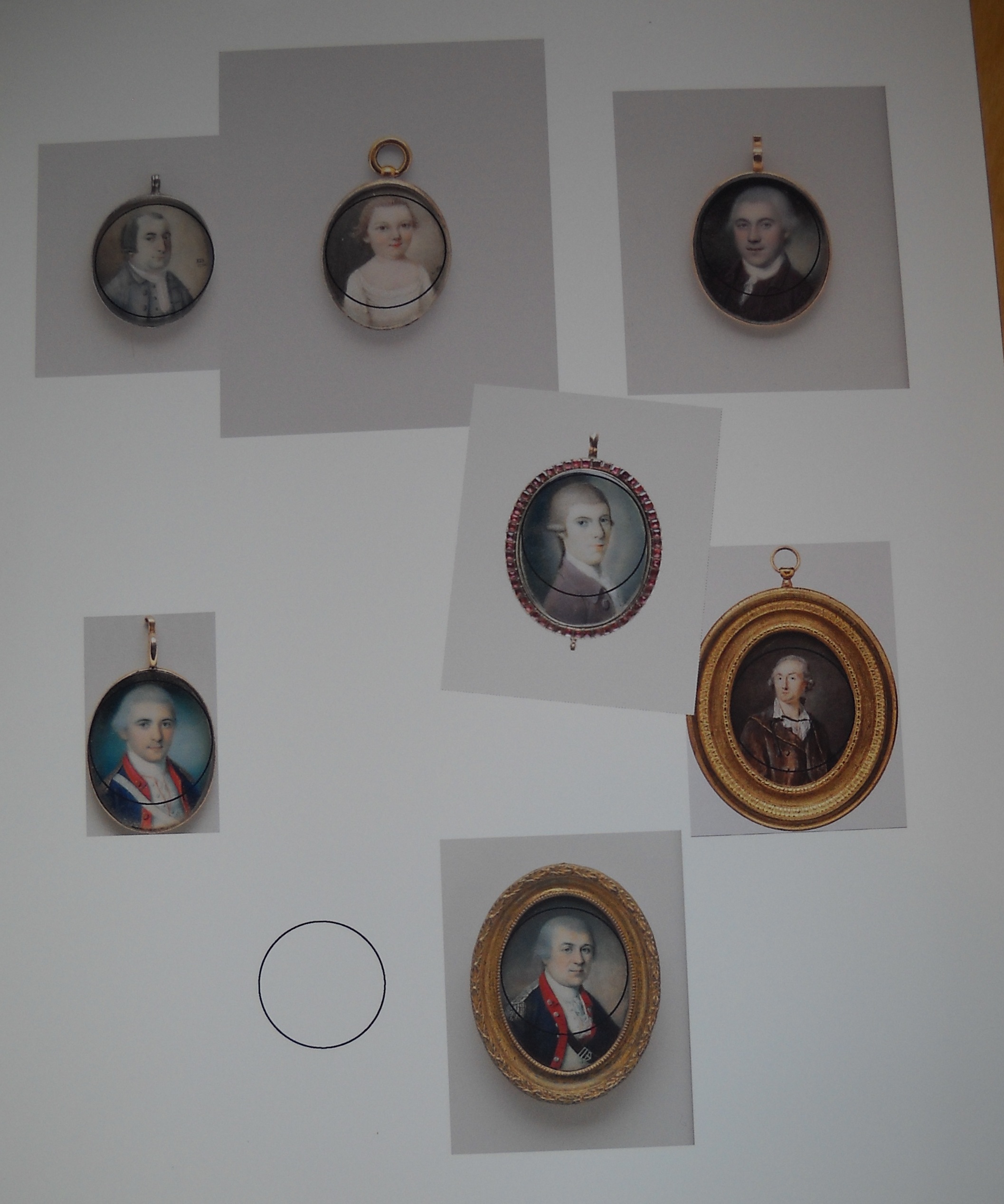
In recognition of my family’s right to peace in our time, I made like an ’80s artist and appropriated images.
Separated and ready for trimming
After selecting gentlemen and an infant from 1761-1776, I downloaded the files and placed them in Illustrator where I could size them to one inch diameter circles. Why so small? Because to test this plan, I used rawther cheap little cabochon kits from Michael’s, and they were only to be found in the one inch size.
After cutting the images out generally, I trimmed them to the black line I created in Illustrator. (I don’t yet have a non-Illustrator answer to this process; I am lucky enough to have an ancient copy of CS Dawn-of-Time; let me think about a workaround.)
Henry Knox, the first trial
Here’s Henry Knox, my first trial. I was willing to ‘sacrifice’ him because although I admire his fortitude in dragging artillery across Massachusetts, he was a beast to Joseph Plumb Martin about post-war bounty land in Maine. I’m Knox-conflicted.
Some squishing and fiddling with the self-adhesive fronts later, here are three of the four miniature miniatures.
Three sandwiched imagesFinished tiny miniatures
Yes, this is so ridiculously easy as to be evil.
What would I do differently next time?
I’d order proper cabochons and fronts in a larger size (I may convert these to bracelets).
I’d give painting a try, perhaps over the winter break at work. I’ll need time to get that right.
I’d string them on actual silk, and not polyester, ribbon. (It was handy, and the proper size).
But for a cheater’s way to miniature jewelry in under an hour, I suppose they could be worse.
Whatever you do, if you follow this example and “appropriate” images, don’t sell them. The Met may have millions in revenue, but it’s still wrong.





 Some of you may recall that I am a recovering artist with a fairly constant need to keep my hands busy. To encourage industry and the domestic arts, and to keep me out of trouble generally,




 Kirsten Hammerstrom
You must be logged in to post a comment.