I troll the interwebs in the fishing and not the under-the-bridge sense: there’s a lot to read out there. Still, I’ve kept one eye on the feather-and-flower kerfluffle that erupted in certain circles this week, but have been much more interested in documentation of one kind and another.
Miss Vernon is really my favorite image of feathers on hats, and I wish I could say that a) I have replicated this fabulous creation or b) that I have seen such a thing, but alas! I have not.
Still, scouring sundry repositories for tayloring manuals (more on that another time), I found this delightful broadside. We can’t use 1782 to document 1780, and no means of using any of these items is mentioned or implied. Still, there they are, those inflammatory terms: Feathers, Flowers.
1782 Broadside. Early American Imprints, Series 1, no. 45771 (filmed)
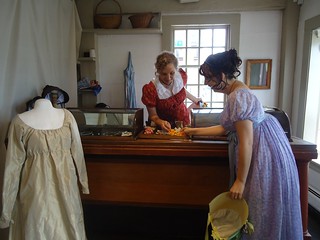
On Saturday last, Sew 18th Century and I set up a milliners’ shop for the Salem Maritime Festival. This was a fun event made even better by the opportunity to set up shop in an actual shop!
We started working on this project in the Spring, and kept working on it almost until it was time to pack for the trip.
Some of our goods, with the delightful Miss A
Milliners carried a wide range of goods designed to entice customers into the shop where they might purchase a new trim, ribbon or sash while admiring newer bonnet styles or fresh yard goods. Even in the 18th and 19th century, retailers new the value of repeat customers and impulse purchasing.
Customers of all kinds came to our shop, some for retail trade, and some for wholesale. Mr JS is a weaver, and has offered plain and check linens by subscription– and I think our shop can do well referring custom to him. He was far more genteel than the sailors who came in– three times they visited, offering us money, but not for our bonnets!
Fresh from a privateer, Mr G and his crew mate stomped up the steps and made several untoward propositions, even daring to shake a bag of coin! Later they tried to entice a studious apprentice to join them, but fortunately he is a dutiful and serious lad with a thought for his future, and he declined their offer. At last Mr S was forced to confront these sailors on the waterfront– I think we shall soon require a committee of safety to patrol our streets and regulate the ruffians.
Mrs B examines some of our trims
Other customers shopped for trims and accessories. Mrs B is always fashionable, and one of our best customers. She sets a standard for refinement and style in our town that few can match.
Her husband is an officer in the Navy, and I fear sometimes he is startled by the bills– though he always pays, I think he may be surprised to see how fashionable we have become in Salem.
The bandbox maker, Ms M, set up in our shop as well. I do highly recommend her boxes as the finest made and best decorated that can be had. Bonnets and hats do not come cheap, and you do well to protect them.
In the late morning, I paid a call to Mrs B, and took tea. The coffee jelly was exquisite, molded in the shape of fish– very clever indeed– with marzipan fish and a rice pudding. It was a delight to all the senses, though sadly I had to hurry back to the shop. It is a great responsibility to keep a shop.
Shop window at the West India Goods Store
Thank you so much for visiting and for trading with us! Do come back soon, as we are certain to have new goods of interest to delight you.
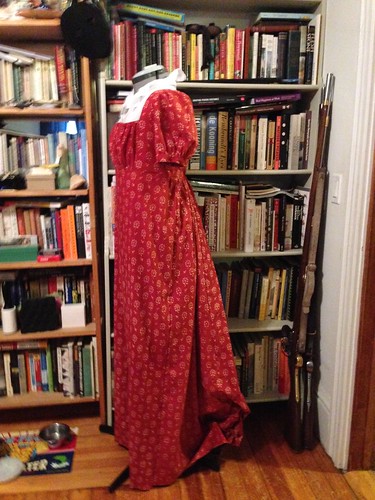
This was an easy gown to build up from a shoulder and back piece, once I did the math to scale it up to my size, and with the generous help of Sew 18th Century, who gave me the sleeve pattern I started from. This isn’t a drawstring sleeve, so the gown is not an exact copy of the GCV&M gown. I’m OK with that, since–as far as I can tell– it fits. It may be a little large, but that’s what an apron or sash is for. No, I don’t know when I’ll get the apron made.
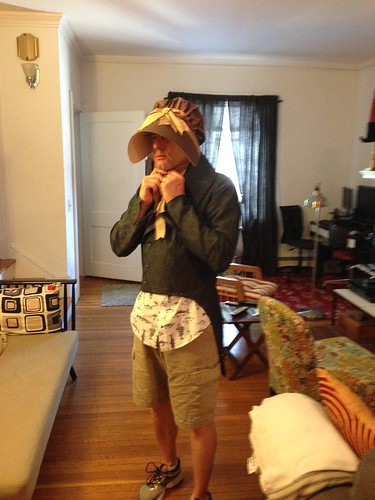
Mr S saves time by modeling *both* coat and new bonnet
There should also be a coat, and many bonnets.
Mr S’s coat seems to be working, and is now faced on the right side, leaving the left, the sleeves, and just a few buttons. He was excited about helping with button manufactory until he realized that the largest tool required was patience. But what are facings and buttons and buttons holes, among friends?
Bonnet Number I Forget
Another bonnet is in the works- can you ever have too many? I think not. It is in the prickly phase, while I work this evening on taking apart a waistcoat that must be altered for the Young Mister for this weekend at Stony Point. Bouncing between 1779 New York and 1812 Salem, when one is also considering 1765 and preparing for 1800 can make telling time a little challenging!
Like Sew 18th Century, I’ve been enjoying preparing for the August 2nd event in Salem.
I’ve not ventured too much into Regency bonnets, or into straw, but I did flirt with a 1794 bonnet. Now I’ve got hats on the brain, and the time to fully indulge my whimsy (though it runs out Sunday).
From the fashion plates, one would almost say, Anything Goes. Of course it doesn’t, really, but you can get a sense of the exuberance of bonnet trimmings in the illustrations, and the lavish use of ribbons, bows, feathers and flowers.
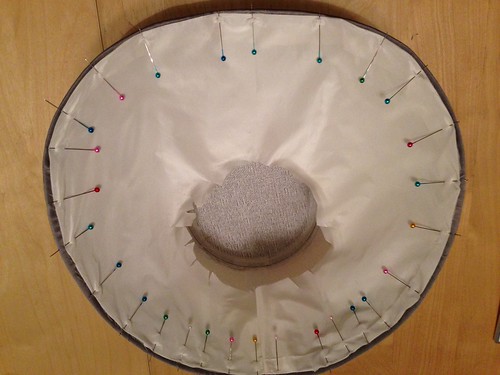
Not all straw bonnets were lined– in fact, they often weren’t– but the lining protects the straw and the wearer’s face, and finishes this off in a way I like. Pleating in my condition was, ah, challenging, but I figure it was good for my brain to have the exercise. The lining in the brim is white taffeta, but I used white linen in the main crown or tip portion of the bonnet. Instead of bagging the lining, or trying to fit it, I mimicked what Mr B does in the hats he’s made for us. The gathered linen closes with a drawstring and required slightly less effort to fit into the hat.
The velvet ribbons came from Lunarain Designs on Etsy, the ties are taffeta ribbon from Taylor’s Etsy shop, and the straw bonnet form came from Regency Austentation. While the finish work takes time and concentration, I do enjoy both making up and trimming bonnets, and look forward to several more.







 Kirsten Hammerstrom
You must be logged in to post a comment.