Black and Blue

Unlike some of my earlier posts, this Black and Blue refers to a different kind of historical effect: the purely aesthetic. (Yes, it is a departure for me. Moving below the Mason-Dixon line has been curious, as my encounters at the bank regularly make me wonder if I have stumbled into the Invasion of the Body Snatchers or Pleasantville. Surely real humans aren’t this nice! I thought the people of Rhode Island were just fine, but maybe my standards were warped by growing up in a Major Midwestern City.) In any case, times change and so do people. Onward, to the aesthetic!

First, there was the new waistcoat. That should be enough to refresh an outfit, right?
Wrong.

The armscye sits way back over the shoulder blades

The set of the armscye didn’t coordinate with the white gown I made two summers ago, so a new item would be in order. I thought this would be the case in the muslin, but when I basted up the blue silk (selected because I had enough material to make a waistcoat and a cap), it was clear something new would have to go underneath.

The original waistcoat’s date of ca. 1797 helped narrow down my choices, and a 1799 fashion plate helped as well. Blue over white: pretty snazzy. I sketched up the plan for the white wrap-front gown, re-imagined that when I got batiste after asking for voile, and figured I’d be fine. A blue silk cap trimmed in black wool lace or gold silk cord still seemed like a good solution.
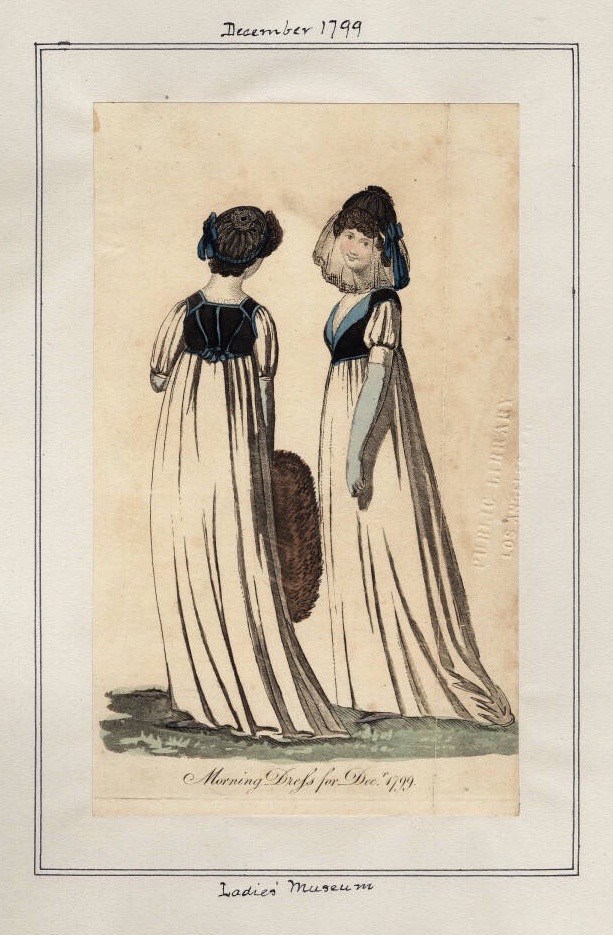

But the fashion plate showed a black hat or bonnet, and whilst trolling Etsy with a Manhattan in hand, searching for an 1830s-appropriate buckle, I took a look at one of my favorite shops, just to see.

Reader, I saw.

The “overly honest milliner” confessed that this style would not flatter everyone. Challenge accepted! In truth, though, I have a small head, and having cut my hair short for the summer, can (must) wear a slightly different kind of headware. I’ve also tried on enough of Anna’s millinery to know what will and won’t work for me, so I was pretty certain this bonnet would suit me well.

I trimmed it with some blue silk double-faced satin ribbon recovered from a failed bonnet attempt of several years ago, and then cast about for something else. Something different. Wednesday found me steaming feathers– as you do– while Drunk Tailor pulled KP duty. I hid the feather quills (more or less) with a ribbon rosette, and the considered fastening. Many early-nineteenth century bonnets don’t tie under the chin, and in any case, I didn’t have enough ribbon left to pull that off.

Parking lot selfie, with sweat, curls, and feathers. I like the way the feathers contrast with the curls.

The solution? Another rosette. On the feather side, I stitched the straight tail of the ribbon to the bonnet. The second rosette attached to the ribbon, which I then ran under my chin and pinned. Bonnet secured, more or less, though the feathers necessitate caution when exiting a vehicle.

Milliner’s Shop Redux: A big, visual project

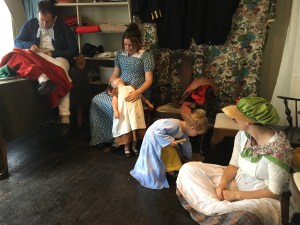
The complete ensemble, under supervision.

When I first moved to Providence, I lived in Fox Point, a slightly fringy-dingy neighborhood of Portuguese and Cape Verdean immigrants and their descendants that was cheap enough for students (and even today remains imperfectly gentrified: Providence, I love you dearly). As my then-boyfriend and I walked my dog, we passed a man whom I later came to know as the Block Captain, who remarked to my boyfriend, “Beeg wooman.” Any project I take on is, therefore, big, since I am nearly six feet tall.

Although I have schemes for a Big New Century Project (a complete 1585 ensemble), I’ll take a shortcut instead to my current enthusiasm and write about last weekend and the 1811 fashion plate reconstruction, which happily includes one of my favorite visual sources, early 19th century fashion plates — thanks to Scene in the Past’s albums and Ackemann’s Repository on the Internet Archive.

I’ve written about the canezou plate before, but not since I (mostly) completed it on the trip up to Salem. This 1811 plate appealed to me first because of the bonnet (checks!) and the necklace (lapis!), but then realized that the canezou and its petticoat were within my ability to complete.

The ensemble also seemed suitable for a summer day in Salem, which, while usually more humid than hot, calls for cool, lightweight, clothing that can withstand a potentially sweat-drenched day without melting.

From start to finish was three weeks: canezou, bodiced petticoat, necklace, bonnet, and shoe trims, all a vernacular rendition of a high-fashion image, adapted to the materials at hand– though I did have to order bonnet taffeta from India, which arrived just in time– much faster than I could have expected in 1811 Salem!

Setting up the shop for the fourth time was as much fun as the first time, and a little easier, given the practice I’ve had. I shared the shop with a tailor, Mr. B, of hat-making renown which made for a nice contrast interpreting men’s and women’s fashions and purchasing habits.

Packing up hat stands, bonnets, accessories, and furniture and driving them 470 miles is a kind of madness, but interpreting women in business and early shopping is one of my favorite historical enterprises.

Flipping a Lid

In a continuing effort to simultaneously destroy my hands and make all the bonnets, I set out recently to recreate a bonnet in the Met’s collection.

Silk Bonnet, British, ca. 1815. Brooklyn Museum Costume Collection at The Metropolitan Museum of Art, Gift of the Brooklyn Museum, 2009; Designated Purchase Fund, 1983 2009.300.1613

It’s a curious thing, isn’t it, with that flipped-up brim? It looks more 1915 than 1815. But a little looking turned up this fashion plate:

Items 2 and 6, while not of silk, show the turned-up brim seen in this example. (To be fair, the original black and white photo suggests some confusion about the bonnet’s orientation.)

My version is admittedly imperfect, but a home-made interpretation that gets as close as I can (for now). I started with a lightweight buckram frame, to which I stitched slim round caning.

The brim is covered in two layers of the copper silk, and edged on the bottom side with the contrasting silk trim. the crown, or caul, is a simple tube gathered to a silk-covered buckram circle. In the absence of matching (or even sort-of-close) ribbon, my choices are to trim what’s left of the fabric and piece it together…. or start an online-ribbon hunt. At least the extant example has ribbon that’s close but not a match, giving me some leeway if I decide to save my hands for other projects and click instead of stitch.

Frivolous Friday: Silken Cone of Shame

La famille Anglaise à Paris.Plate 11 to 'London und Paris', x, 1802 [1803]. Explanatory text, pp. 90-5. Copy of No. 11 in 'Le Suprême Bon Ton' series, see BMSat 9957. An English John Bull stands stolidly full face with clasped hands, a grown daughter on his right arm, his wife on his left arm. With them are two tiny little girls and a grown-up son, also stolid. A Frenchman and a lady attitudinize elegantly on the left. 1802 Hand-coloured etching. British Museum  1856,0712.605
La famille Anglaise à Paris.Plate 11 to ‘London und Paris’, x, 1802 [1803]. Explanatory text, pp. 90-5. Copy of No. 11 in ‘Le Suprême Bon Ton’ series, see BMSat 9957. An English John Bull stands stolidly full face with clasped hands, a grown daughter on his right arm, his wife on his left arm. With them are two tiny little girls and a grown-up son, also stolid. A Frenchman and a lady attitudinize elegantly on the left. 1802 Hand-coloured etching. British Museum 1856,0712.605

Mr JS and I have amused ourselves of late not just with thimble chatter, but with this satirical print of the English family in Paris.

I’m not nearly as funny as Mr JS, who pointed out that the bonneted girl on the far right is “I literally can’t even right now.” I think of her as Lisa Simpson, 1803. That’s the voice I hear reading the line texted to me: “I just want to pull this chemise dress over my head and die. Could someone with yellow fever cough on me?”

The father is Homeresque in his proportions, and nearly as befuddled. The artist is clearly mocking this poor family, contrasted with the graceful Parisians at left, but only the two youngest are aware, hiding in their cones of shame.

That deep coal-scuttle-like bonnet is mocked in other engravings; it is probably closer to the actual form of Julia Bowen’s cold scoop of 1799 than my approximation this fall. Julia would surely have known the shaming purposes of those grandiose and over-sized calashes: “Go sit in your calash and think about what you’ve done!” Mr JS quipped.

Appropriately enough, the silk I ordered to make my own calash of shame has arrived at the post office. Dark green taffeta envy lined with the bright magenta of embarrassment: clothes are so emotional.