“Now Selling at Prime Cost”

Although I’ve portrayed a milliner before, the earliest iteration has been as a shopkeeper in August, 1804, so I thought it best to refresh my knowledge of what 18th century milliners advertised. (Deep dives into bonnets help me focus on bonnets, but necessarily what else was being sold.)

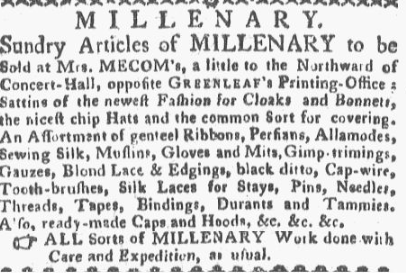
Pennsylvania [Philadelphia] Packet, January 15, 1772.

One of my favorite ads is from the January 15, 1772 Pennsylvania Packet. Mary Symonds of Philadelphia published an extensive list of goods, many of which will lead you down a rabbit hole. Three of the listings had particular appeal.

“Womens’ and childrens’ black and coloured silk, Dunstable and chip hats, and bonnets”

“Black and coloured silk” almost surely encompasses the range of colored silk bonnets seen in Boston advertisements, but what’s the difference between Dunstable and chip hats? Price, of course. What most of us think of, or call, “chip” hats should be called Dunstable or simply straw.

Chip hats like the one above in the Snowshill Wade Costume Collection, were made of plaited (woven) thin strips of wood, more like flat baskets or chair seats.

Straw hats, like the one above (also in the Snowshill Wade Costume Collection) are clearly finer than chip and do not need to be covered. The earliest description of the distinctions between hat types that I’ve found thus far is from 1815, in “An Encyclopæaedia of Domestic Economy, Comprising Such Subjects as are Most Immediately Connected with Housekeeping etc etc” which goes into some detail.


The most entertaining discussion I found was in  The Sessional Papers Printed By Order Of The House Of Lords, Or Presented By Royal Command, In The Session 4 And 5 Victoriae And The Session 5 Victoriae 1841. The recorded exchange resonates with current discussions of tariffs on imports, but the really revelatory bit is this:

Class distinctions expressed in materials and apparel are eternal.

“Tobines” were new to me (or at least forgotten) and have nothing at all to do with the bishop of Providence. Thankfully, Textiles in America has the answer: “A wide variety of dress materials from fine silks to silk and worsted, and linen and cotton combinations that have warp-float patterns of small flowers or intermittent stripes and dots.” (p 367). Once you’ve seen it, you realize you’ve seen it before.

Berch papers, Nordiska Museet.

“Childbed baskets” were also a new concept to me, but The Female Reader, Or, Miscellaneous Pieces in Prose and Verse; Selected from the Best Writers, … for the Improvement of Young Women illuminated the term; the current equivalent is a layette set that includes bedding, and goes beyond the crocheted sweater, cap and booties some of us came to fear receiving. (Mint green acrylic? really?)

It’s a wide range of goods for women to buy (including small accessories for the men and boys in their families), and somewhat beyond the bonnets-hats-jewelry-trimmings we typically associate with milliners. While I don’t have any plans to start manufacturing chip bonnets or making up childbed baskets, I am definitely intrigued by the possibility of expanding my “offerings.”

Making Plans….

I have set my sights on being at Van Cortlandt House Museum’s Second Annual History and Culture Fair on Saturday, September 21. This is a bit of a stretch: It’s farther than Philadelphia, where I’m scheduled to be the following weekend at the Museum of the American Revolution– and I want tweak that impression and its material culture a bit, too. Still: setting up a ca. 1777-1780 milliner and mantua maker or merchant display has been on my to-do wish list for years, and I’m pretty sure I can pull this off as long as I modify/upgrade items already in my closet.

There are enough images to provide good inspiration and ways to start accessorizing.

Several prints  from the British Museum provide guidance.

It’s clear– as I knew already– that my accessory game requires major upping. But this is solvable! It’s not ideal, being in a situation where I can’t buy new fabric, and I don’t have the time to make up the fabric I do already have in the garment styles I need. This is no time to start a new patterning project!

So this means making accessories to upgrade a gown and petticoat already on hand and known to fit (though they should be fit-tested once again before committing!).

Which dress? Why, Nancy Dawson, of course. She’s the brightest and most stylish gown I have. Thankfully, I have upgraded my cap collection, and could even– probably– manage a new cap in the time allotted.

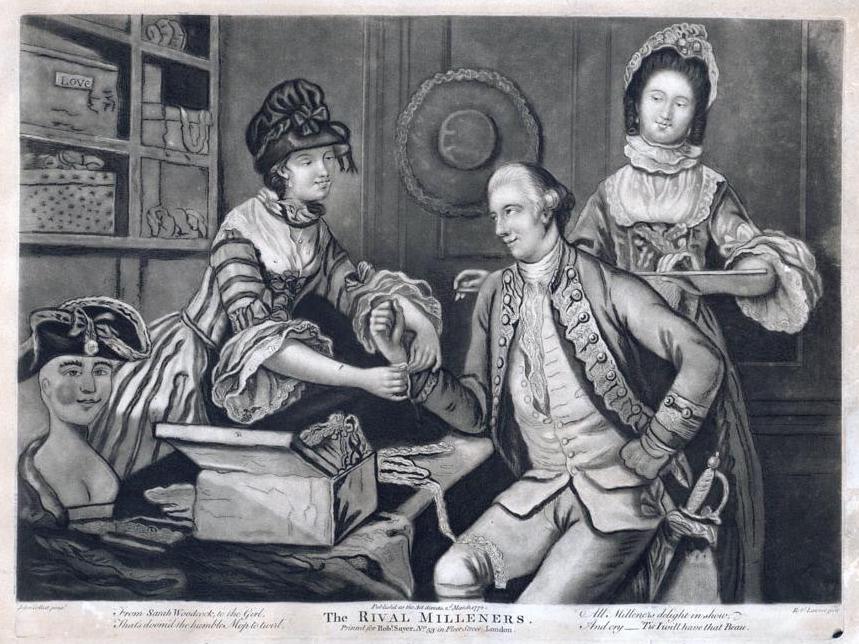
So what do I need? A well-decorated, possibly floofier cap, a LBB (™) of the kind worn in “The Rival Milleners”, a breast knot or bow, a new fine silk or cotton apron, and some kind of sleeve treatment.

The maid in the back of “A Morning Visit,” carrying in the tea tray, demonstrates the more understated upgrades I think I will be able to manage in the time I have. In a year, a trimmed silk gown can happen. In a month, it cannot.

The main upgrade I’d like to make is to add a red silk quilted petticoat, since they appear in so many prints with cotton print gowns, including a print of Nancy Dawson herself.

Miss Nancy Dawson, aquatint print. Victoria and Albert Museum. E.4968-1968

I almost assuredly have red silk in my stash: the question is, can I find it, back it, and quilt it in time? Probably not. So there are choices to be made, like the sensible one of simply upgrading sleeve finish and apron and adding bow knots.

Those are just the upgrades I hope to make to my personal kit! I need a dome top trunk (underway; I need the one I have for Elizabeth Weed), and there are inventory items to make that have been on the list for a while.

All of this has to get done while I’m splitting my 55-60 hour weeks between commissions and a retail gig (which I am trying to streamline!).

Once again, I start down the path of madness. Won’t you join me? I think it’ll be a blast!

A Little Black Bonnet


Practically everyone needs one, and like the Little Black Dress, the little black bonnet flatters practically everyone, too. In finishing up some inventory projects, I went back to basics and made up a black silk taffeta bonnet with trimming inspired by “The Rival Milleners.”

The Rival Milleners.

Really, it’s a look that’s hard to resist, the black bonnet with poufs and bows. I’ve always loved my black bonnets, but now I might need to trim another one up for myself– if I can only make the time. Up on Etsy if you want one for yourself (along with some other colors, too).

A Bonnet, Universally Acknowledged

Print made by James Caldwall, 1739–1819, British, A Ladies Maid Purchasing a Leek, 1772, Yale Center for British Art, Paul Mellon Collection

“It is a truth universally acknowledged that if a bonnet existed in the 1770s, it was black taffeta” has long been the rule reenactors have followed, particularly those wanting to adhere to the strictest standards of well-researched impressions based on primary source documents and period material culture. Truth examined is more subtle, showing that bonnet colours, materials, and shapes varied from decade to decade—and year to year—and that these factors seem to have varied by region. What worked in Boston would not be comfortable in the Carolinas, and people adjusted accordingly.

I was asked recently about Boston-area bonnets in the first half of the 1770s. My impression of this decade is that it is one in which there is a stylistic change in women’s headwear, as the “sunshade”* and “Bath” bonnet terms fade from use, giving way to plain “bonnet” or “chip” bonnets. These appear to have been made from “bonnet paper,” seen in both blue and white** in newspaper ads, though prints and paintings show brims in both boned and paper forms.

The Rival Milleners. Mezzotint after John Collet, 1772. Colonial Williamsburg Foundation, 1955-125

Brim shape and bonnet material— fabric and colour–  vary by period (and region). So let’s look at Boston in the first years of the 1770s. One tricky bit is that there are fewer indentured servants and enslaved people in Boston than elsewhere in the American Colonies in this period, so runaway ads are scarce, giving us fewer clues than we get in Pennsylvania and points south. Still, there are plenty of ads to help guide us.

As early as 1769, we see color variations, with the mention of “black, blue, green, white, and crimson bonnets” in Caleb Blanchard’s store. The year before, Joshua Gardner and Company advertised “black, pink, blue & crimson sattin hats and bonnets.” That means that on the streets of Boston and environs, by 1775, you’d see half-worn black, blue, green, white, crimson and pink satin bonnets.

The best statistics around for bonnets are currently tabulated for Pennsylvania, and definitely show the preponderance of bonnets are black (52 of 75 tabulated, or 69%). So don’t give up on black silk bonnets! They are the most common color. If we extrapolate these statistics, for a Pennsylvania event in the 1770s, of every 10 bonnets, seven should be black, one should be white, one should be green, and one should be blue. In larger groups, we’d also see red and brown bonnets, but again, just one in 20 or 30.

The Boston Gazette, April 4, 1774. Benjamin Franklin’s sister advertises “Sattins of the newest Fashion… for Bonnets.”
“A few sarsnet taffety bonnets,” in the Boston Evening Post, September 28, 1772.

For Massachusetts, statistics are more difficult to compile, given the dearth of runaway ads and the fact that I haven’t yet dived into inventory and probate records. Merchants’ ads give us some clues as to materials, and one thing I find is that “sattin” shows up, as well as “sarsnet taffety” or pelong. Sarsnet or sarcenet was a “think transparent silk of plain weave,” according to Textiles in America. Thicker than Persian, sarcenet was woven both plain and twill, and could be plain or changeable. Pelong is a kind of silk satin, again according to Textiles in America, and in The Dictionary of Fashion History, described as a kind of “thin silk satin,” but I have also seen it described as a ribbed silk. Joshua Blanchard advertised “Pelong sattins of all colours” in 1768. Where does that leave us with materials? Probably with the need for more bonnets to be made of silk satin than of silk taffeta, though the proportions are difficult to calculate yet.

Miss Theophila Palmer (1757-1848), oil on canvas, attributed to Sir Joshua Reynolds ca 1770.

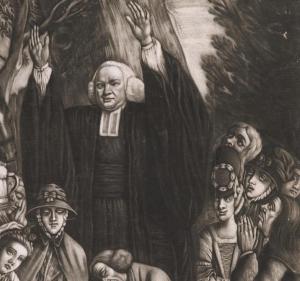
What about shape? For those dressing a la mode, we are past the deep-brimmed, small-cauled “lampshade” of the 1760s, and into a smaller, tighter bonnet with a larger caul and more trimming. In the portrait of Miss Palmer, we see how the brim stands away from the face, and the caul or crown poufs up. “A Lady’s Maid Purchasing a Leek” and “The Rival Milleners” (aee above) both depict women in similarly tight-brimmed and round-crowned bonnets trimmed with bows. These are shapes that I am confident appeared almost universally (with variations) in the American colonies in the first years of the 1770s. Now, there are different shapes to be sure, but these seem to predominate. I do think we need to see more brims that wrap around the head, as seen in the 1774 mezzotint of George Whitefield (Anglo-America’s most popular preacher) and his followers.

Detail, A Call to the Converted. Publish’d April 15, 1774, by W. Humphry . Lewis Walpole Library, 774.04.15.01+

So what’s the take away, if we are looking specifically at Boston and environs in the first half of the 1770s?

  1. Most bonnets (70%) were black, but a few white, green, crimson, and blue were seen.
  2. Most bonnets were made of silk satin, with others of taffeta or sarsnet (sometimes twilled silk).
  3. Most bonnets would have a shorter, higher brim that curves across the face just above eye level, with a high, rounded crown/caul and bow trims.
  4. Bonnet brims would vary between bonnet (paste) board and boned

Each place has a local style– which, if you think about it, is still true today. When I stand on the Metro platform in the red wool coat I bought in Providence, these folks know I’m not from here. The way we dress for the past should reflect the place and the time we are representing as best we can. And that means we need accessories to match those times and places, as well as clothes.

And yes, full disclosure, I sell researched bonnets on Etsy. If you want a bonnet for a particular time and place, that’s what I make.

* Known on this blog as “lampshade”
** Nope, don’t know what that means yet, haven’t looked into it