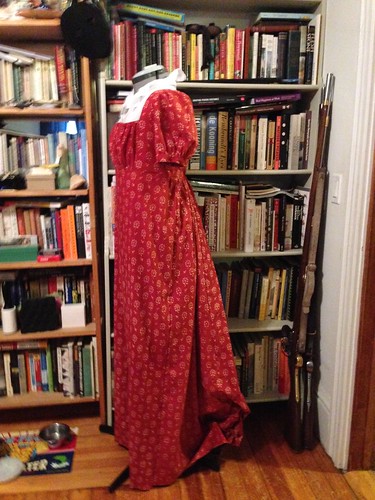
This was an easy gown to build up from a shoulder and back piece, once I did the math to scale it up to my size, and with the generous help of Sew 18th Century, who gave me the sleeve pattern I started from. This isn’t a drawstring sleeve, so the gown is not an exact copy of the GCV&M gown. I’m OK with that, since–as far as I can tell– it fits. It may be a little large, but that’s what an apron or sash is for. No, I don’t know when I’ll get the apron made.
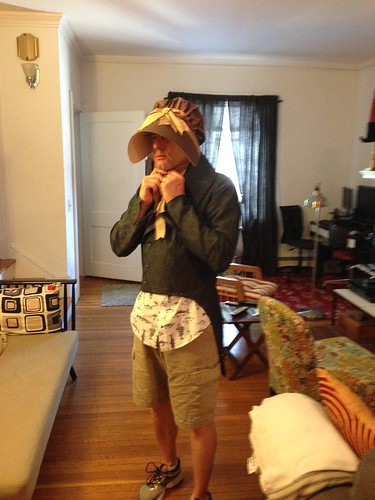
Mr S saves time by modeling *both* coat and new bonnet
There should also be a coat, and many bonnets.
Mr S’s coat seems to be working, and is now faced on the right side, leaving the left, the sleeves, and just a few buttons. He was excited about helping with button manufactory until he realized that the largest tool required was patience. But what are facings and buttons and buttons holes, among friends?
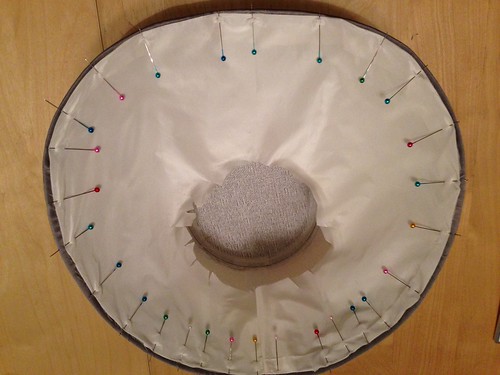
Bonnet Number I Forget
Another bonnet is in the works- can you ever have too many? I think not. It is in the prickly phase, while I work this evening on taking apart a waistcoat that must be altered for the Young Mister for this weekend at Stony Point. Bouncing between 1779 New York and 1812 Salem, when one is also considering 1765 and preparing for 1800 can make telling time a little challenging!
While pretty hats were pretty important parts of the milliner’s trade, many more things were sold in a millinery shop.
Colonial Williamsburg’s Margaret Hunter shop is probably the best-known living history milliner’s shop, and they provide a nice definition and explanation of the trade. But that’s never enough: what’s the primary source information for New England milliners?
While there is documentation of a Rhode Island milliner in the 1830s, and even a thesis on her work, Sew 18th Century and I are working on an earlier shop. I started with Rhode Island newspaper advertisements, because I like the sound of “lately arrived from Providence,” and because I understand that context.
The Rhode-Island American, December 25, 1810. III(20), p. 1
Here is Mrs. Sands, just returned from New York to Newport and vicinity, with a long list of things for sale, “selected from the latest European importations, an elegant assortment of the most fashionable MILLINERY.. viz,:–” (you have the love the punctuation, which is like the Chicago Manual of Style on New Republic crack)
What is she selling? In addition to what we think of as traditional millinery, the “variety of ladies’ Caps and Turbans, Straw, silk and velvet Hats and Bonnets; Straw Trimmings of various kinds,” listed at the bottom of the ad, Mrs. Sands carries:
Lace Shawls
Caps, Handkerchiefs and Whisks;
Infants’ Lace Caps
Plain and figured mull mull and jaconet
–Muslins, of a superior quality;
Handkerchiefs and Habit Shirts,
India and British book Muslins,
Plain and figured Lenos,
Long black, white and coloured Beaver and Kid Gloves;
Silk and cotton lace Armlets,
A large assortment of Ribbons,
Artificial Flowers, Featehrs and silver Wreaths
Tortoise Shell Combs of Various sizes;
Merino long Shawls
Worsted Tippets
Gentlemen’s Neck Pads
Whew! That’s a lot of stuff, and many different kinds of things, though all broadly in the ‘accessories’ or supplies range. I am delighted to see Habit Shirt on the list, as I buy my chemisettes, and I am intrigued by the range of handkerchiefs and by the Tortoise Shell combs, in part because I did not buy an assortment of them at a shop in western Rhode Island a month ago (kicks self).
Newport Mercury, December 11, 1811. L(2593), p.1
In the December 21, 1811 Newport Mercury, Mrs Sands again advertised her goods lately arrived from New York. This is a less exhaustive, but no less interesting, list. “Ladies elegant green velvet mantles, with and without spencers” is particularly intriguing for a Spencer fan, and not particularly clear to me.
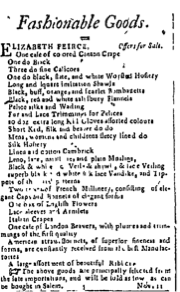
November 21, 1812. Essex Register
In Salem, which is where we will be in August, Elizabeth Pierce advertises her “Fashionable Goods” for sale. She, too, has a long list of things she will sell, from Canton crapes to imitation shawls, hosiery, lace sleeves and armlets, one box of English flowers, and American Straw bonnets.
I suspect that just as retailers do today, milliners of the late 18th and early 19h century probably had an assortment of things designed to bring buyers in to shop (new bonnet styles), and small items to tempt them into impulse purchases (English flowers). You can’t buy a new bonnet every week, but you can refresh an old one.

 While pretty hats were pretty important parts of the milliner’s trade, many more things were sold in a millinery shop.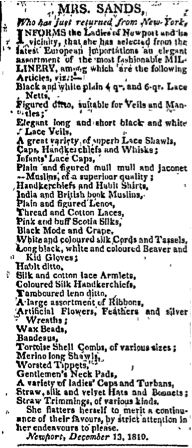

 Kirsten Hammerstrom
You must be logged in to post a comment.