Use it Up, Wear it Out, Make it Do

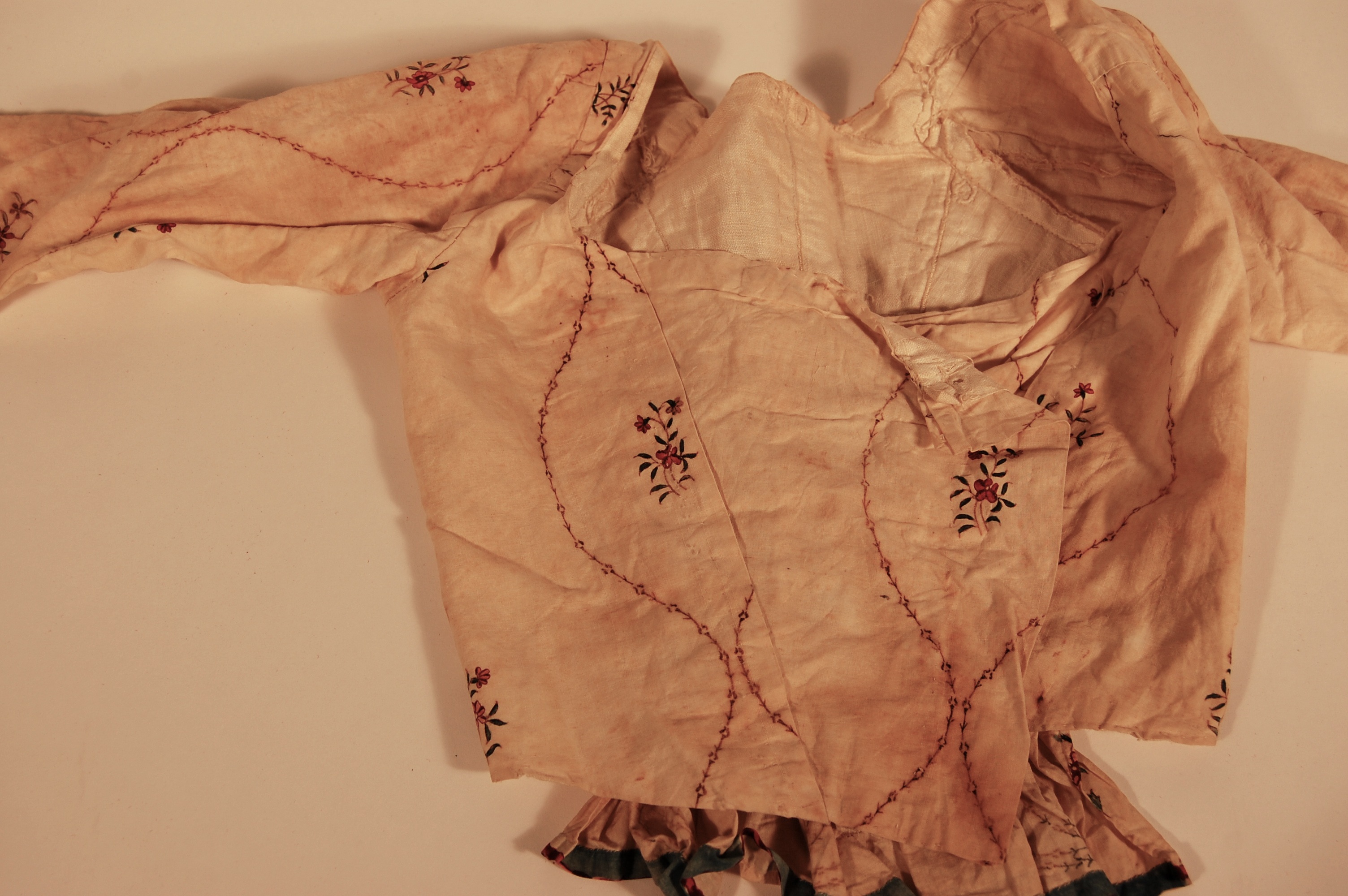
Bodice, painted Indian cotton, 1780-1795 RIHS 1990.36.27
Bodice, painted Indian cotton, 1780-1795
RIHS 1990.36.27

I’ve fallen behind again, as I spent considerable early morning time this past week working on a short presentation for a program in Worcester this past weekend. If you are among the people who do not wake at 4:00 AM panicking about the organization of your thoughts, or whom, exactly, might have worn a heavily-remade bodice, you are lucky indeed.

But I managed to present without falling all over myself, putting out someone’s eye, or causing mayhem and self-embarassment, so, phew! (I do this so much less often than I used to that my anticipatory anxiety is always high.)

Above you can see one of the items I talked about: a re-worked bodice from the collection of the Rhode Island Historical Society.
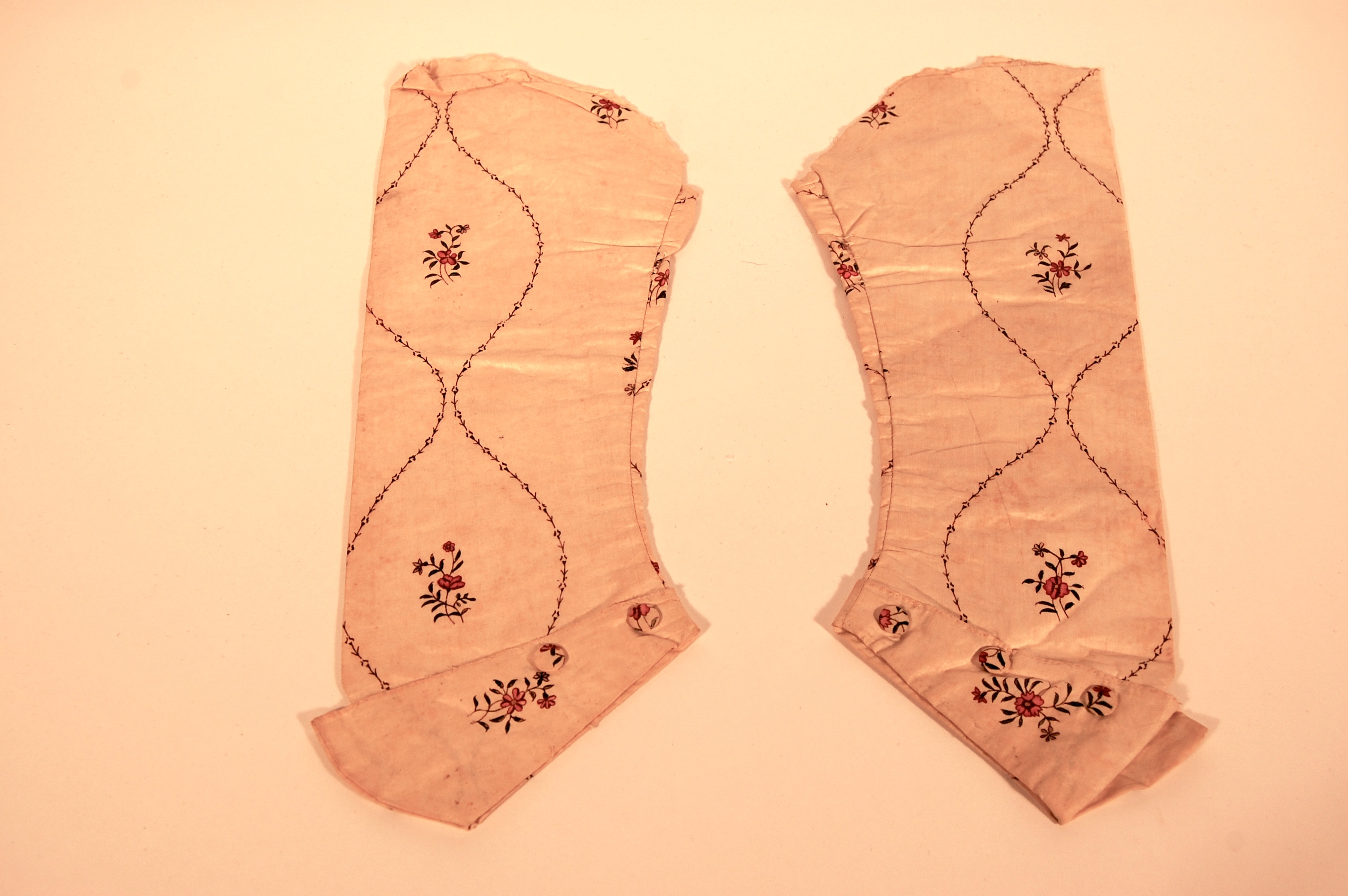
Sleeves, removed from bodice 1990.36.27. RIHS 1990.36.25A-B
Sleeves, removed from bodice 1990.36.27.
RIHS 1990.36.25A-B

I think, once upon a time, that bodice was part of a pieced-back closed-front gown with a matching petticoat.

And then I think someone decided (quite rightly) that the style was too passé for 1795, and altered the gown significantly.

Not only is there evidence of new sleeves being fitted into the gown’s armscyes, we have the sleeves-that-used-to-be. And my dear! No one is wearing sleeves like that this season!

I find these garments in limbo really fascinating. Was that bodice finished and worn with a matching petticoat? (Yes, there’s a panel of that left, too; what a lovely hem!)
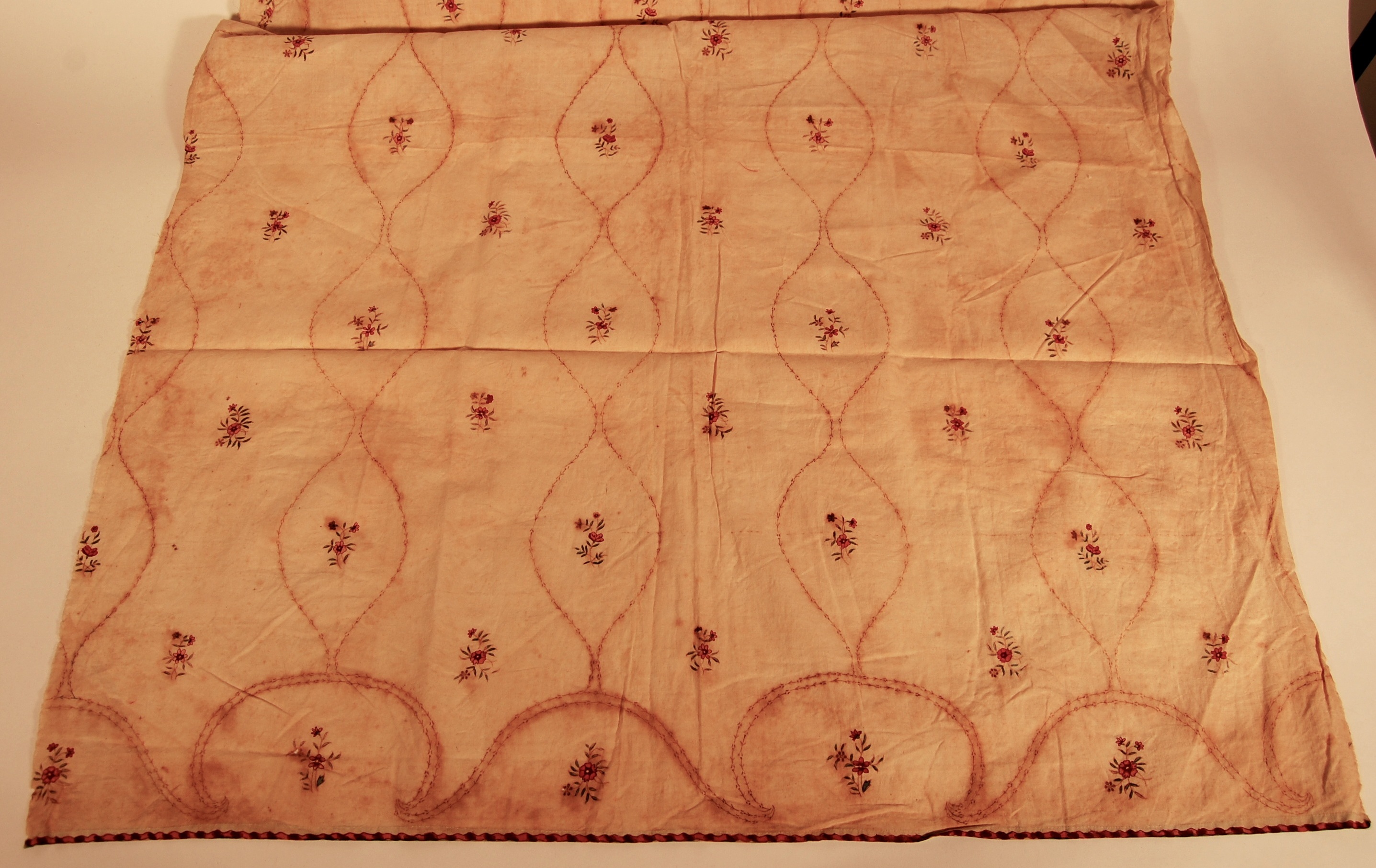
Skirt panel, painted Indian cotton. RIHS 1990.36.33
Skirt panel, painted Indian cotton.
RIHS 1990.36.33

Who wore the gown? Was the woman who wore it originally the same woman who wore it altered? I can only guess at this point, and may never find the smoking diary or mantua-maker’s bill. The alterations are not as finely done as the original gown, so I think there are two hands at work here– whose were those hands? There’s always more to think about and learn.

In case you’re wondering, thanks to the Met, we can see what the gown probably looked like in its first incarnation, and then what the alterations were meant to achieve. (Link to the gown on the left; link to the gown on the right.)

Pockets of Evidence

Or is it evidence of pockets?

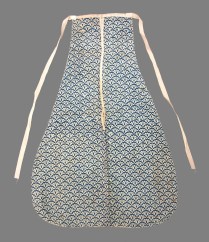
Pocket, 1770-1780 Rhode Island Linen, cotton and silk RIHS 1985.1.9
Pocket, 1770-1780
Rhode Island
Linen, cotton and silk
RIHS 1985.1.9

In any case, I thought it time to upgrade my pockets, since I have given so much attention to the rest of Bridget’s clothing. I have also been talking with a colleague about a pocket game activity, similar to the process I’ve used in thinking about Bridget: what is in your pocket? If I’m going to try that out in public, then I’d like not to be embarrassed about my pockets.

The first pocket I made was based completely on one in the RIHS Collection, and it annoyed the daylights out of me as it had exactly the same loop on top and twisted around under my petticoats, making the opening hard to find. I also realized that it was too small to be really correct for a woman’s pocket: those tend to be larger. Sew 18th Century has a really nice article on pockets here.

Pocket, 1789 American  linen  Gift of Miss Blanche Vedder-Wood, 1940  MMA Costume Institute C.I.40.159.4
Pocket, 1789
American
linen
Gift of Miss Blanche Vedder-Wood, 1940
MMA Costume Institute C.I.40.159.4

So I made a larger pocket based on this one at the Met, and made of a grey and cream striped linen with the slit bound in red calico. It’s dated to 1789, and technically that’s too late for my uses.

Pocket 1720-1730 block printed cotton and linen
Pocket
England, 1720-1730
Cotton; Linen
Winterthur Museum Collection 1960.0248

But the next one is too early.

Well, it has survived this long, and Wm Booth has that lovely shell print cotton, so what’s a sister to do? Pockets don’t take much fabric, so making a matched pair of printed pockets seems the thing to do.

Now the question is, what should be in those pockets?

Frivolous Friday

Robe à la Française 1778–85  French linen, silk  Purchase, Irene Lewisohn Bequest, 1965 MMA C.I.65.13.2a–c
Robe à la Française
1778–85
French linen, silk
Purchase, Irene Lewisohn Bequest, 1965 MMA C.I.65.13.2a–c

Yes, I give up. It has been a long week, I am tired of winter and tired of snow and packing books and carpets torn up and tired of bad communication. Fresh content? I am fresh out.

I spent Thursday beating my head against research into the Brown family textile collection, and Providence textiles in general, for a program I seem to part of next Saturday. I hope I’m prepared, but along the way to getting ready, I spent some time in many museum databases beyond our own.

The Met, as always, rocks the party and brings their largesse to us all with their online publications.

Get thee to their website, content-hungry pilgrim, and enjoy the downloadable fun. (Some of you already know this, but I keep losing the right link, so here it is again.)

(Not) Spencer Closure

Jacob Issacs by Ralph Earl, 1788. Dayton Art Institute

No, I still haven’t written to the museum in Sweden– I had fabric shopping to do. Well, not had to, but when someone offers to take you to a new den of iniquity crack house fabric store you haven’t seen before, you go.

Reader, I scored. Mr S will have a new fabulous and toasty waistcoat thanks to a 5/8 of a yard remnant of the coziest Italian double faced wool I have ever petted. It should be a kitten! Mr Isaacs here has a lovely black waistcoat and while I cannot achieve that fabulousness without a new pattern (sigh) and I think that waistcoat is silk, you get the general green-and-black idea. Mr S totally has that hat.

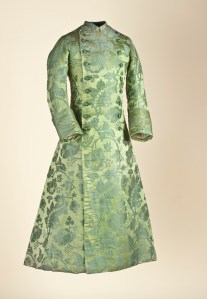
Coat, French, 1790s. MMA 1999.105.2

But in thinking about the Spencer issue (and yes, I scored some on-sale broadcloth so I can make another one on the way to cutting into that K&P wool), I asked Mr Cooke about clasps, since the Spencers I’m interested in are so very clearly grounded in menswear generally, and uniforms particularly. The answer was what I’d expected: buttons and buttonholes or braid loops on dragoons’ and hussars’ coats, hooks and eyes sandwiched between shell and lining on center-front closing uniform coats.

So I went back to look at menswear, because somewhere the phrase “miniature frock coat” rattled in my head, and I knew I wanted to re-draft the pattern for the front anyway, to get closer to the high stand and fall collar of the Swedish original.

The other collection that’s extremely useful is the LACMA collection, because they have patterns up on their website.

Man's Banyan Textile: China; robe: the Netherlands, Textile: 1700–50; robe: 1750–60 (M.2007.211.797)
Man’s Banyan
Textile: 1700–50; robe: 1750–60 (M.2007.211.797)

I’ve already started to crib a new two-part sleeve pattern from a frock coat pattern, so now I think the next step to getting the look I want is to crib from the LACMA banyan pattern. It’s earlier than the Spencer by some 30 years or more, but the neckline looks like a better place to start.

And, bonus, along the way I’ll learn more about menswear to the ultimate benefit of those guys I sew for.