In a continuing effort to simultaneously destroy my hands and make all the bonnets, I set out recently to recreate a bonnet in the Met’s collection.
Silk Bonnet, British, ca. 1815. Brooklyn Museum Costume Collection at The Metropolitan Museum of Art, Gift of the Brooklyn Museum, 2009; Designated Purchase Fund, 1983 2009.300.1613
It’s a curious thing, isn’t it, with that flipped-up brim? It looks more 1915 than 1815. But a little looking turned up this fashion plate:
Items 2 and 6, while not of silk, show the turned-up brim seen in this example. (To be fair, the original black and white photo suggests some confusion about the bonnet’s orientation.)
My version is admittedly imperfect, but a home-made interpretation that gets as close as I can (for now). I started with a lightweight buckram frame, to which I stitched slim round caning.
The brim is covered in two layers of the copper silk, and edged on the bottom side with the contrasting silk trim. the crown, or caul, is a simple tube gathered to a silk-covered buckram circle. In the absence of matching (or even sort-of-close) ribbon, my choices are to trim what’s left of the fabric and piece it together…. or start an online-ribbon hunt. At least the extant example has ribbon that’s close but not a match, giving me some leeway if I decide to save my hands for other projects and click instead of stitch.
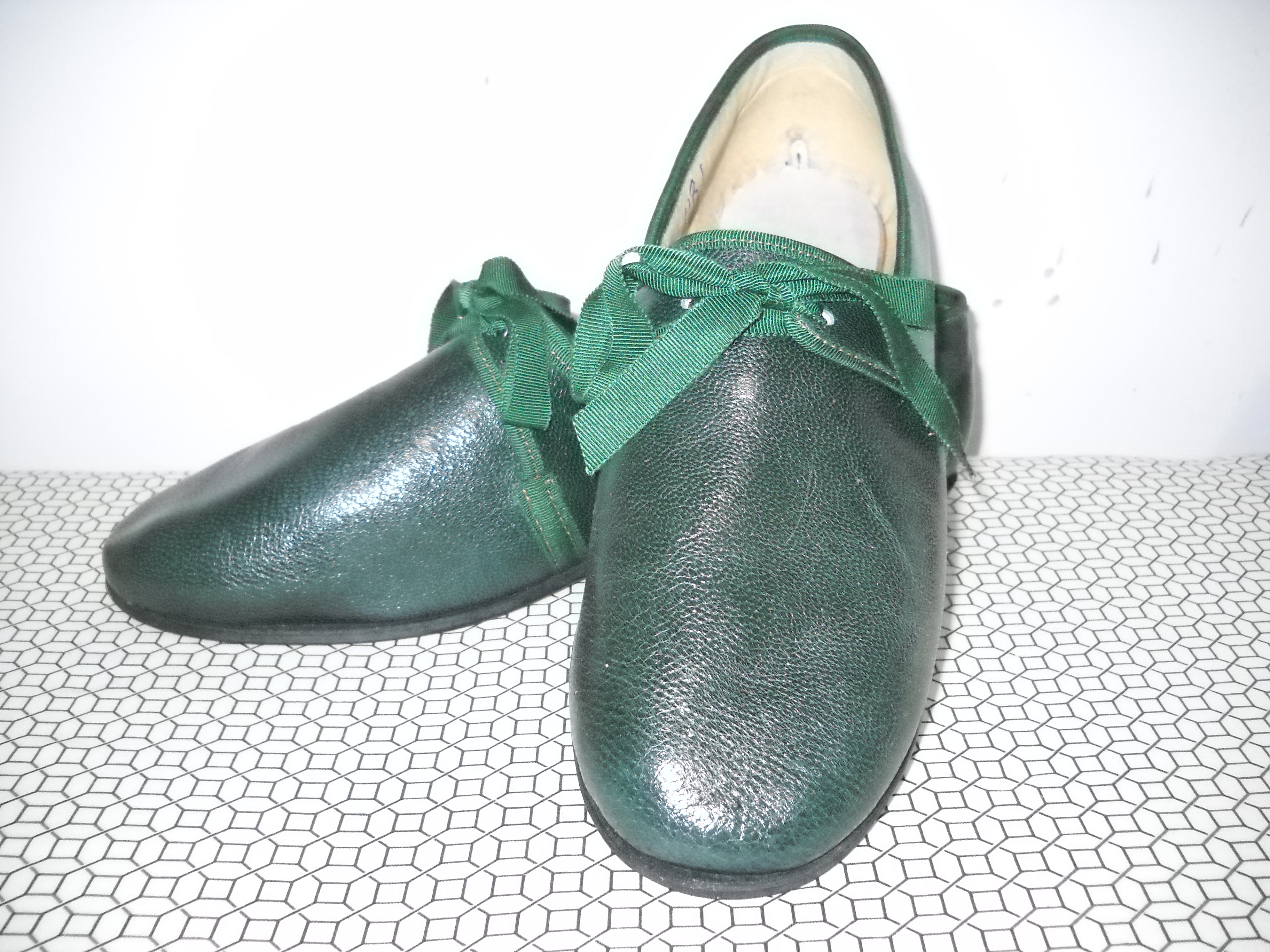
Shoes, 1810-1820. Gift of Miss M. Lee. T.385&A-1960, Victoria & Albert Museum.
Like my grandmother, I love shoes. Also like my grandmother, I have “problem feet.” Finding a pleasing ladies’ shoe in a size 11 narrow is no mean trick, and with arthritis and activity, fit becomes ever more important. Standing all day in ill-fitting shoes will not improve your ability to interact with the public in a pleasant way, nor will it improve your stamina, which you will need if you are cooking for a motley assortment of ‘gentlemen.’
Many reproduction historic shoes (and most contemporary shoes) just don’t fit me, so I can’t order from common suppliers and I can’t alter affordable fashion shoes. Like Cinderella’s stepsisters, the shoes don’t fit.
Robert Land’s Regency Lady’s Shoe
That means that sometimes my shoes are not quite-quite correct. For 1799-1800 events, I wear Robert Land’s 1812 shoe, which is modeled on a shoe in the V&A collection. I find Land’s lasts are long and narrow, he makes my size, and lo and behold! Last time I ordered, the shoes arrived in four weeks. My mileage has varied in that regard, and yours may, too. They aren’t cheap, but they are well-made, straight-lasted, and most importantly, they fit. (I’ve been wearing them to work this week, because their flatness is more comfortable than my modern shoes.)
Do I wish they came in silk? Yes. Do I wish he’d make ladies’ 18th century shoes? Yes. But I have a workaround for the 18th century that I debuted on Flag Day: Mules. They won’t work for every event– I don’t think these are the shoes for climbing Stony Point in July–but they have their benefits. For one thing, you can take them off. Barefoot is best (maybe not in Boston), and not having to wear stockings when it’s 80+ degrees is nice, though only permissible if you’re named Bridget and have a shirt problem.
Burnley & Trowbridge men’s mules
Burnley & Trowbridge shoes also run narrow, and their men’s mules work for me, because I like a very low, flat heel. In winter, wool stockings make up any size differential, and in summer, these flats are pretty comfortable and even walkable. They may not be perfectly correct (though documented here), but comfort plus documentation goes a long way in my book.
What I’d really like, at least for late War interpretations, are a pair of these red velvet shoes at the MFA. Latchets for buckles, low heels, and they’re red? While I wonder about the date, the features I like might outweigh any misgivings– except that I cannot afford Sarah Juniper‘s work, and I can’t make my own shoes (yet).
Pair of women’s shoes, 1780s. MFA Boston, 44.493a-b
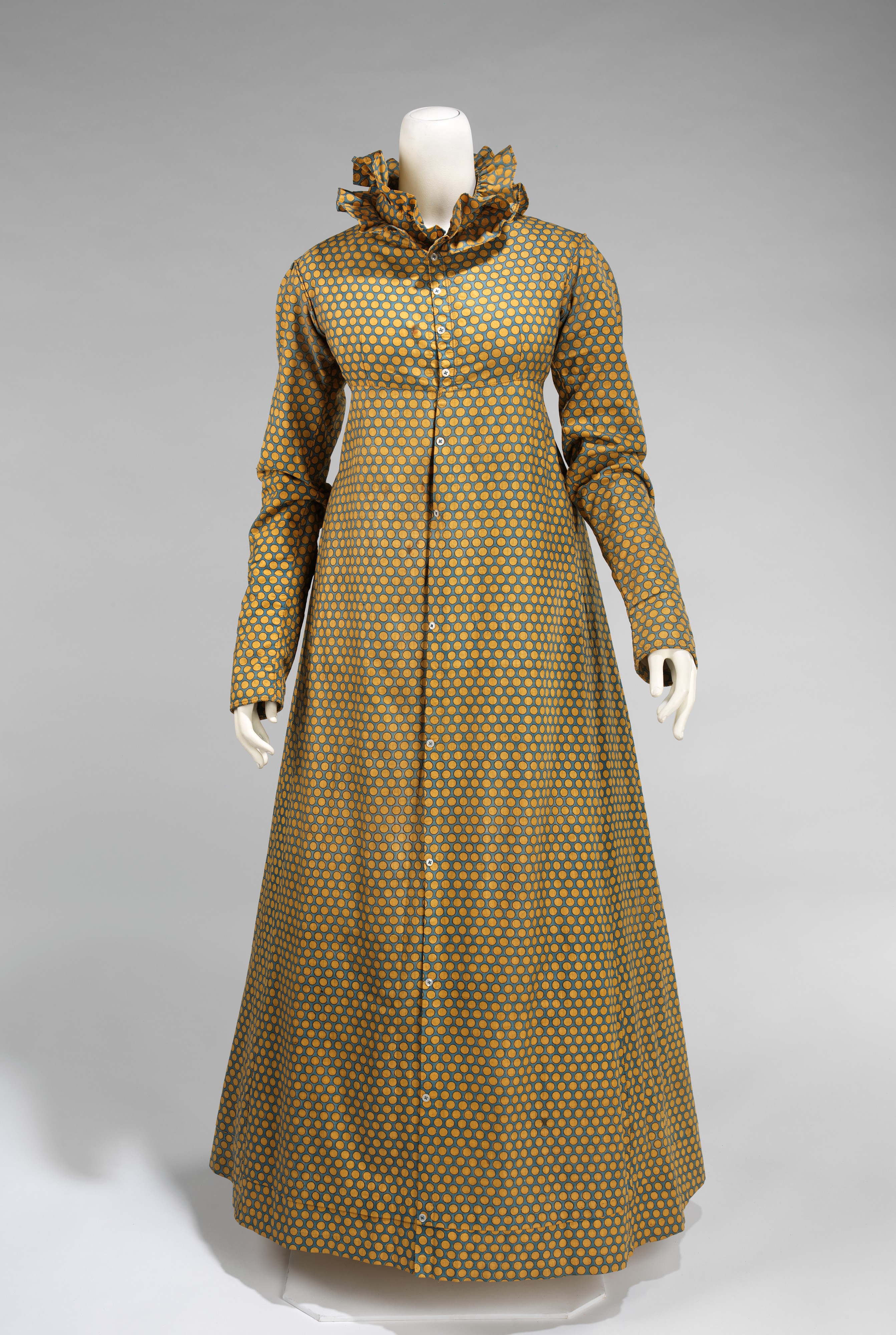
Dress Date: ca. 1815 Culture: American Medium: cotton Dimensions: Length at CB: 54 in. (137.2 cm) Credit Line: Brooklyn Museum Costume Collection at The Metropolitan Museum of Art, Gift of the Brooklyn Museum, 2009; Gift of Florence Inniss, 1970 Accession Number: 2009.300.943
In typical museum fashion, whilst looking for something else, I found something I didn’t know I wanted.
I’ve been asked to portray an 1812 milliner in Salem this coming August (which feels like next year but will soon be Ohmygoodness that’s TOMORROW) so I’ve been getting a start on images of bonnets and hats and gowns and things because you know I’ll have to have something new. Have to. And there at the Met was this garment, unassuming and bronze-looking in the thumbnail of catalog hits and ever so much more so when you get up close.
I recommend getting quite close to really appreciate the print. I’m pretty sure I’ve seen something similar in the quilting cottons, Amy Butler or Kaffe Fasset, and of course I’m tempted. Wouldn’t you be? How often do you get to mix historic costumes and Op-Art?





 Kirsten Hammerstrom
You must be logged in to post a comment.