Trousering

Looks like he’ll fall asleep any Minute, Man…it was late.

Nope, I did not attempt HSF # 6, stripes. I made some garters, so if the challenge was strips, I’d be set. Breeches mending, sewing gown sleeves and skirt hem,  and the kid’s jacket all took up my weekend, along with just plain living, so no pretty pictures.

I did think about how I choose what I wear, and how it’s a little tricky to sew for the guys, as they are engaged in a different way.

For one thing, they get told what to wear. 1778-1779 Rhode Island troops: you people are all set with your brighty-whities. You’re documented in your whitened towcloth overalls, shirts, and rifle shirts/hunting frocks. Happy marching in your thread stockings, you have broadsides and colonial records to tell you what to wear.
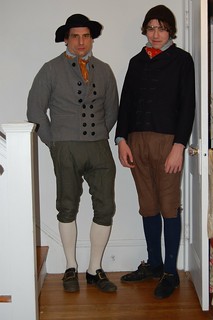
Would you trust these guys? I wouldn’t. 

And then we roll back in time to Lexington and Concord, and for Battle Road, what do you wear? Well, they went off in what they had. (By the time they left, the Young Mr’s jacket had one row of buttons and Mr S had better-fitting, mended linen breeches.)

Of course, they were the only guys in short jackets, and they were the guys with the most “lower sorts” impression. To be honest, I do not know enough about the composition of the Rhode Island militia under the command of Nathanael Greene in 1775. Bearing in mind that no Rhode Islanders were at the actual events of April 19, 1775, how should these guys dress? What sort of men comprised the Lexington and Concord area militia, and what would they have worn?

The only way to know for certain is by doing research. What’s the difference between the men in the RI militia and the men who served in RI’s continental troops? Were the militia better off than later enlistees? To what degree did the composition of the troops change over time? And oops, there we went the rabbit hole of history.

What’s in your pocket?

A typical rough linen lining

My son’s pockets used to be full of acorns: he collected them at the bus stop, but I don’t know if it was because he planned to feed the squirrels, or if he thought he was a squirrel. Later, he moved on to rocks. Now, rocks, fish hooks, a pocket knife, change and a hankie fill the pockets of his 18th century breeches.

We’ve had some moments of unhappiness when things have gone missing from the pockets, though we’ve usually found them again. When you look at the contents list, you wonder how the linen stands up as well as it does.

There’s a clever way to upgrade pocket bags in menswear, and it’s authentic: leather bags, instead of linen. Original garments have leather bags, probably deerskin, and they’re deliciously soft and very durable. Stuff all the heavy, sharp things you want to in that pocket, and it will probably take it.

1895.4.3A-C
1895.4.3A-C

Based on a suit in the RIHS Collection, I decided to modify the pocket bags on the Young Mr’s new workman’s jacket-in-progress, which I plan to have finished by March 11 for HSF #5, Peasants and Pioneers.

Made of a heavy, rough-finished brown broadcloth (possibly manufactured in New England), both jacket and breeches pocket bags are made of deerskin.

Pocket bag in progress.

To recreate this, I took a trip to the auto parts store, and purchased a large chamois.  Instead of cutting the bags from linen, I cut them from the chamois and trimmed the seam allowances: chamois won’t ravel, so the seam won’t need to be folded over at the top.

A little fuzzy, but you get the idea

I backstitched the bag seam, and in general, I’m pleased with the way it has turned out. I think I’ll look into additional leather options, but otherwise, it seems like a fairly successful experiment.

The real test, of course, will be user testing. How many sharp, heavy things can the kid load in a pocket before it gives out?

Bloody Overalls

Just started backstitching, already bleeding

But that’s still better than the story I heard yesterday about the incredibly authentic, effluvial-field dipp’d overalls that gave a mender dysentery…you come here for this, right, not the pretty dresses?

My thumb has split– yay, winter!–so everything will be a little trickier. Guess I’ll lay off handling white silk gowns at work, and documents, but the sewing will continue.

The Line of Truth

We went up to the Adjutant’s house yesterday, now that the roads are cleared again, and the lads got measured. Best of all, Mr S got fitted. He has what I ungenerously call “The Hump,” and what the Adjutant describes as “Shoulders Roll Forward.” The Adjutant has tact; I’m the wife, I calls it like I sees it.

It was really helpful. I knew the coat was too big (Mr S is built more like an 18th century soldier than a 21st century office worker), but I knew it had more wrong with it that too much fabric. At left, see the chalk line? The sleeve seam sits at the shoulder point, where I am told it will be uncomfortable as it rubs, which will also wear out the shirt faster. I knew what to do it the sleeve had been on a gown– unstitch it and re-align it under the shoulder strap, mark it and trim the excess off the head. In a way, that’s just what I will do here. There’s also excess to take out of the upper arm, but that’s not too bad for a garment that I made in a hurry and never really fitted to the wearer. And I have until mid-April to do it.

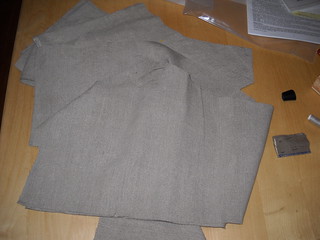
I have two of these greige stacks to transform.

At the same time, I also have to transform two of these piles of pieces into well-fitted, hand-sewn overalls. Despite the pride I’ll feel in accomplishing what I expect will, under guidance, be the best-fitted, most authentic garments I’ve made, saving my green checked apron, there’s a minor measure of terror mixed in to all this…hope those back stitches hold…

The Line of Beauty

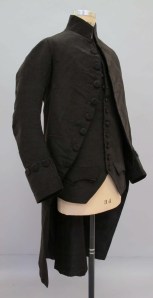
In considering menswear, I found this suit at the Met. Incredibly plain, it reminds me of classic Balenciaga: all about fabric and drape. It also reminded me of Hogarth’s Analysis of Beauty, and the serpentine line.

You could also call it the Ogee curve, and it’s found in the serpentine legs of 18th century tables, and does not come from, “Oh gee, that soldier’s got nice legs.”

In this variation on the theme, the contrasting lining emphasizes the lapel line, but the overall effect is less elegant. It’s about materials, too, not just cut. There’s so much to learn just by looking, really looking, at clothes and paintings from the past. There are subtleties we miss as we rush past, and miss because we haven’t read enough to understand what we’re being told.

So much hides in plain sight, because we don’t see the world the way the tailors and painters and engravers saw it. I don’t pretend to have the key to that world, but it’s worth looking for, mostly just by looking.