Objectivity

Recently I’ve had more than my share of time to think about museums and objects, and what they mean to me and why I love them, and have dedicated my life to them, albeit a bit accidentally.

Transferware in open storage, Metropolitan Museum of Art, May 2013.

In the hours I spent alone in a curatorial office, listening to the murmur of school tours on the other side of the door, I began to see that curation and registration are means of managing the evidence locker of the future. We collect, tag, and maintain the means by which the future will understand the past, and it’s our job to be a neutral as we can—to refrain from laying the thumb of our prejudices on the scale—as we collect objects, images, and documents. It’s a game of forecasting, trying to guess what will best explain us and our time to the future, as well as Monday morning quarterbacking as we both weed and augment what was collected in the past to better reflect how we understand history now.

I was always a stickler for good data and record editing (and have raccoon-eyed photos of a catalog launch to prove it), and I make unkind sport of museum databases on a regular basis when I see misidentified and misdated objects. Good data matters—it’s everything, really—because if you don’t know what you have, and where it is, you might as well not have it. But more than that, compendia of data can show you things you didn’t expect to find.

RIFA Record 4925

Yale’s Rhode Island Furniture Archive is a good example of how a massive amount of data can be used. Take this record of side chair possibly made by John Carlile and Sons, and scroll down. That’s a lot of associated chairs. And they all look very similar. Examining the materials, especially secondary woods, of a labeled chair and comparing the style, make, and materials with other very similar chairs can help identify chairs, associate them with a maker, and provide a sense of Carlile’s production volume.

And Carlile’s easy! Looking at hundreds of pieces of furniture with some location provenance, reading probate inventories and other documents helped untangle James Halyburton or “Ally Burton” as a maker.


James Halyburton in the RIFA

When you can see enough things at once, you can discern patterns and better understand exactly what it is you’re seeing. Good data makes that possible, makes concrete what was once solely seen as connoisseurship, and helps bring unknown stories, unrecognized people, to light. Data analysis is a powerful tool for better understanding the past: that’s why museum collections matter, and why I think it’s so important for museums to make their data accessible. It’s one of the ways we understand our collective past.

Ceci n’est pas une assiette

Historic American Buildings Survey, George F.A. Palmer, Photographer, 1937 DETAIL OF PARLOR FIREPLACE. – Jeremiah Dexter House, 957 North Main Street, Providence, Providence County, RI

Last weekend, Drunk Tailor and I delivered the Giant to his new life as a college student back in New England, and paid a call on of my oldest friends, a 96-year-old former OSS agent and descendent of the Dexter family. My eldest friend had something she wanted to give me: a souvenir of the Dexter House, in recognition of the hours I’d spent working with her identifying and organizing several hundred years of family papers.

In the photo at left, the coffee pot on the mantle is now in a museum collection, as are the miniatures, the bellows, and the pipe box (which is now on display in a historic house museum). What my eldest friend gave me is not in the image of the house, but resembles the plate to the left of the fireplace: a Staffordshire transferware “Village Church” pattern plate with a wild rose border, ca 1825.

Transferware soup plate ca. 1825. Unknown maker, Staffordshire, England.

I’m a fan of blue and white china, and while I prefer earlier Canton ware, this plate is more special to me than the ones I’ve bought at auction or in New Bedford antique shops: because of course it’s not a plate, it’s memory, or an emotion, made solid.

Drunk Tailor and I spent an early Sunday afternoon on my friend’s porch listening to stories about her children, in particular about her daughter Mary, now an artist living in Mexico. Is it a comfort or an annoyance to learn that schools have been misjudging children since schools were invented, trying hard to fit round pegs into square holes? Mary, always more interested in drawing than in lectures, once left a classroom when the teacher said, “If anyone doesn’t want to hear this lesson, then they can leave now.” Out Mary went, three other girls following her out to play on a beautiful spring afternoon.

That story, and many others, aren’t apparent in the plate with its crazed face and discoloration. Only my memories (and anything I write down and keep with the plate) make the associations. But it is always the stories about the objects that make them important (even big-ticket dec arts items, like Plunkett Fleason easy chairs.)

Last night, before Drunk Tailor and I watched The Maltese Falcon, we watched Adam Savage’s TED talk on his obsession with objects. The TED talk is worth a watch for anyone interested in material culture and objects. Our human fascination with things goes beyond the shiny surface of new things (tabernacle mirrors or iPhones) as they become repositories of memory, symbols of feelings or moments.

War correspondents and personnel of the Office of Strategic Services, leaving from the Railhead, Camp Patrick Henry, Virginia, enroute overseas. NARA. National Archives Identifier: 542171 Local Identifier: 336-H-17(E8671)
Creator: War Department. Army Service Forces. Office of the Chief of Transportation. 3/12/1943-6/11/1946

This: In my desk drawer, I have a buckeye Drunk Tailor picked up and handed to me in a garden in New Jersey. It’s useless: inedible, too light to be a paperweight, but it reminds me of that November afternoon, the soft green of the garden, and how shy I felt. Anyone cleaning out my desk would toss that bit of organic matter, even as I keep it as a talisman of one of our first dates: the places, the smells, and the feelings.

And this, too: My friend is 96. I may never see her again, though when I left her, she was healthy and cheerful, making plans for the fall with her children, grandchildren, and great-grandchildren coming to visit. Given my reticence and her old-fashioned New England reserve, I may never be able to tell her how much she means to me (I try), or how interesting I think she is. (“I’m not interesting, dear, I just worked hard,” is what she says when I try to convince her to donate her personal papers to an archive.) But I have a plate that was in a house that had a great deal of meaning to her, and my best guess is that her gift of that plate to me means she knows how much I like and admire her. It reminds me of her, and reminds me of how little time there is before all that’s left is the plate and my memories.

Style Council

National Gallery of Art furniture gallery, May 2017

One of the critiques leveled at historic house museums is that they’re often “frozen in time,” specifically a particular moment, rather than reflecting the changes that happened over time. This charge is sometimes leveled at period room installations as well, when all the furniture in a room is from a tight time span– a year, maybe five– when for most of us, the furnishings in our homes and the clothes in our closets reflect a number of years, rather than a tight twelve or eighteen months.

So, when we go out “into the field” (or the house or the milliner’s shop or the tavern), shouldn’t our belongings reflect the multiplicity of years of objects? If I’m a woman Of A Certain Age, won’t I have possessions, from jewelry to ceramics to clothing, from multiple decades? Well…. yes and no.

It’s true that as far as we can tell, John Brown moved his 1760 furniture into his 1788 mansion, but we also know he bought new furnishings, including a large (188+ piece) set of Chinese Export Porcelain (see above).

Up-to-date, stylish, expensive: table settings signaled wealth and sophistication as much as clothing and manners, so whatever JB had before 1788, he wasn’t setting his new table with it. What might he (or Mrs B) have done with it? Consigned it to use by grandchildren and servants? Given it to less fortunate relations? Possibly. And if they had creamware, it would not have been singularly out of place in 1788 or 1800 on any table– it was only 40 years old, and heaven knows my “best” china is from the 1930s– but would they have used earlier pottery, even in the kitchen?

All pottery is not the same: North Devon pottery, while imported to North America in the late 17th and early 18th century, is not what you would expect to find in a late-18th century farm kitchen. It’s here, sure, into the mid-18th century, but in 1799, it’s not the form you would expect to see. So what does that mean for living history folks? Does it matter what you use?

You know what I think: there ain’t nothing like the real thing and that means paying careful attention to details. If you’re portraying a camp follower in 1778, or tenant farmer in 1799, you are not likely to have, say, a Jackfield-type figured tea pot, just as you are not likely to have a salt-glazed squirrel-relief cream jug, no matter how much you adore it.

Time and style matter. The people of the past read each other the same way we read each other. Remember Clarice Starling, with her “good bag and her cheap shoes”? Get on a train anywhere, and you can read your fellow travelers: you can guess income and education levels, marital status, and sometimes interests and hobbies if you look closely. You make assumptions about people based on their appearance, whether you’re conscious of it or not– and so did the people of the past. To portray them accurately, and to help the public learn to read the past, the details matter.

Any Old Epaulet

Details: we sweat them in our historical clothing, our impressions, our writing. I try hard to pay attention to them, but in my work, I have a lot of details to manage. Some fall away– I can no longer tell the ranks of men in daguerreotypes immediately, or recognize a Colt revolver at 10 paces, but there was a time when I could. I have managed to retain at least a general understanding of how military units are organized, a general sense of various units from my state in wars before 1939, and the uniforms associated with those units. (And I know which side a man’s coat buttons on.)

What's wrong with this image? Missouri State Guard uniform coat of Col. Austin M. Standish (Confederate). Missouri Historical Society 1916-045-0001
What’s wrong with this image?
Missouri State Guard uniform coat of Col. Austin M. Standish (Confederate). Missouri Historical Society 1916-045-0001

This helps in my work: knowing what HBT is, knowing what various patches signify, knowing how units were structured and the campaigns they were part of helps me be a better cataloger, curator, and exhibit developer. My job is take the details and make them matter by telling stories about the people who wore the HBT or the machinists’ mate patch or carried an ensign or wore an officer’s coat as part of the 14th Rhode Island Heavy Artillery (colored) in the Civil War.

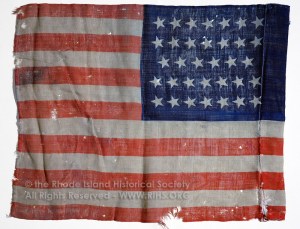
U.S. Flag, regimental. 14th Regiment Rhode Island Heavy Artillery. Belonged to Joseph Carey Whiting, Jr., 1st Lt., Co. B 14th R.I. Heavy Artillery. RIHS 1962.24.1

People matter more than things, but 154 years later, all we have are things those people owned, used, wore, and carried. The things now represent the people. So when someone working on a exhibit says, “any epaulets will do” while pointing at the shoulder boards on a Lieutenant’s coat, I’m not just taken aback, I’m upset, and reply, “If it’s just for color, you can buy them.” Because “any old epaulet [sic]” being loaned by a museum goes through a laborious process of loan approval, packing, delivery and installation. For that time investment alone, “any old epaulet” should not do: museums are not prop closets.

General's Epaulets of William Clark. Missouri Historical Society. 1924-004-0006
General’s Epaulets of William Clark. Missouri Historical Society. 1924-004-0006

I keep saying the same thing, don’t I? There ain’t nothing like the real thing.

We can’t assume that the public doesn’t know or doesn’t care– they often know more than we do, just think of the wildly detailed knowledge some of us have about very particular things– so we owe it to them, and to the people of the past, to use museum objects as more than visual accents.