Objects and Time

IMG_5416
An assortment of old things.

The antiques I own stretch back in time, objects passed from hand to hand, connecting me to the past. It is particularly fine when they connect me to America, a place my people came to more than a century after these things were made. A paste shoe buckle. A chair. A portrait. There was once a fad for fake ancestors, buying a past you did not inherit, and the objects I collect are something like that, only less ostentatious– if only because the portrait is a miniature and not full size. 

Let’s start with the chair, the most expensive piece of furniture I’ve ever bought. (My bicycles cost more, and were, for a long time, the nicest and newest things I’d ever owned. It’s weird to talk about money and things, and what those things cost; we’re taught not to. That makes it even more important to be honest about context, even if I never tell you what I’ve paid.)
IMG_3069
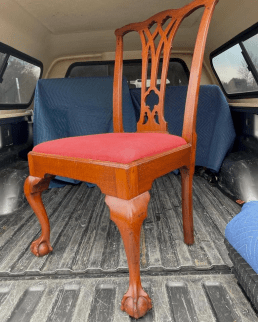
The chair as I first saw it.

The chair. 

I follow an antique dealer on Facebook, and in the spring of 2023, he posted a photo of a chair he’d just picked up from a collector in Delaware. It was a handsome chair, mahogany cabriole legs, ball-and-claw feet, shaped rear legs, pierced center splat, curved crest rail. It was marked on that crest rail: W. Hall. 

This was a Philadelphia chair, with classic signs in the shape and tension of the feet, the raised line around the arched piercings of the splat, the rhythm of the crest rail. It was simpler, plainer, cheaper, than a Thomas Affleck–the knees on those chairs— but the ogee (cyma) curves stepping down from seat rail to leg spoke of an eye for balance and for structure. There was elegance in the way that chair was built, an adherence to the style books but with a local flair. That was a Philadelphia chair. Delaware being close to Philadelphia, W. Hall was probably a Philadelphia man. 

There were not many candidates for W. Hall, despite the anodyne name. A few were laborers– they were unlikely to manage the fine, typographical incision on the crest rail, even if they’d once been able to afford a mahogany chair. Even less likely given that chairs like these were typically sold en suite, a set, two armchairs plus four or six or eight side chairs. Probably six; this wasn’t a Cadwalader-quality chair resplendent from the shop of Thomas Affleck with carving by James Reynolds and covers from the shop of Plunket Fleeson. 

So not a laborer’s chair. 

There was Richard Hall, a whitesmith, whose estate owned a lot on the east side of Second Street between Chestnut and Market Streets, on what was called Hall’s Alley, in 1777. There was Charles Hall, probably also a whitesmith, in Hall’s Alley, also in the Chestnut Ward. 

In the 1774 tax lists were James Hall, an innkeeper,  and John Hall, a tanner. 
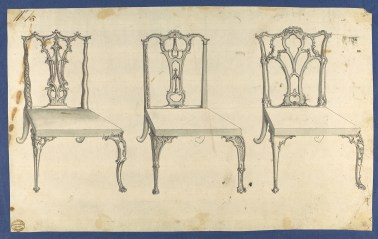
DP104146The chair was probably made in the mid-1760s, a decade or so after the publication of Thomas Chippendale’s Gentleman and Cabinet-Maker’s Director . . . of Household Furniture in the Gothic, Chinese and Modern Taste

In the 1750s, Philadelphia high-style Chippendale chairs typically had exuberant carving– furry knees, complicated, twisted pretzel splats, shells positioned like merkins in the center of the seat rail, along with their ball-and-claw feet.  But makers knew there was a market for good-quality affordable seating, and William Savery filled that bill. Is that where this chair comes from? Is it the mid-market, aspiring merchant’s or artisan’s chair? 
1959.1332 A
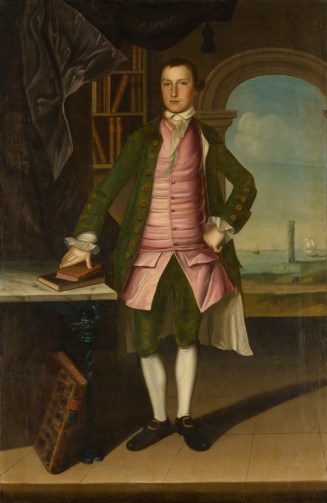
William Strahan Hall, by William Williams, 1766. Winterthur Museum 1959.1332 A

Because there is another W. Hall, William Strahan Hall, the son of printer David Hall. If David Hall seems familiar, that is probably because he was Benjamin Franklin’s partner. Franklin hired Hall in 1743 as a journeyman printer; by 1748, Hall was Franklin’s partner. Hall bought Franklin’s portion of the business in 1766, and established Hall & Sellers with Wiliam Sellers. After David Hall’s death in 1772, his sons William Strahan and David Jr. assumed his part of the business, maintaining government contracts and printing, among other things, Continental currency

1766. The year David Hall bought Franklin’s portion of the business. The year David Hall commissioned portraits of all three of his children (William, David Jr., and Deborah) from William Williams. Was this flush, banner year when David also ordered a suite of chairs from a Philadelphia maker? Were the chairs then bequeathed to William, the eldest son, who inscribed one, claiming ownership? Maybe. Maybe this chair was someone else’s chair, some other W Hall somewhere among the years it traveled from Philadelphia to Delaware to Maryland to Baltimore.  

The story is the thing that makes the chair, however you imagine it. I know enough to know that calling this chair “in the style of William Savery, possibly from the family of David Hall, printer,” stretches every truth I know. But that sentence lifts the curtain on the past, on the webs of kinship and friendship that connected makers, buyers, and users in late-18th-century Philadelphia. David Hall, on Market Street near 2nd Street in the High Street Ward, was around the corner from William Savery on the east side of 2nd Street in the Chestnut Ward. These wards were packed with milliners, ship captains, merchants, and artisans, all aware of fashion and change, all aware of the ways that consumer goods expressed their refinement and sophistication, whether chairs, paintings, books, or bonnets. This is the story the chair can tell, populated with real people and places. 
Suffrage Wardrobe

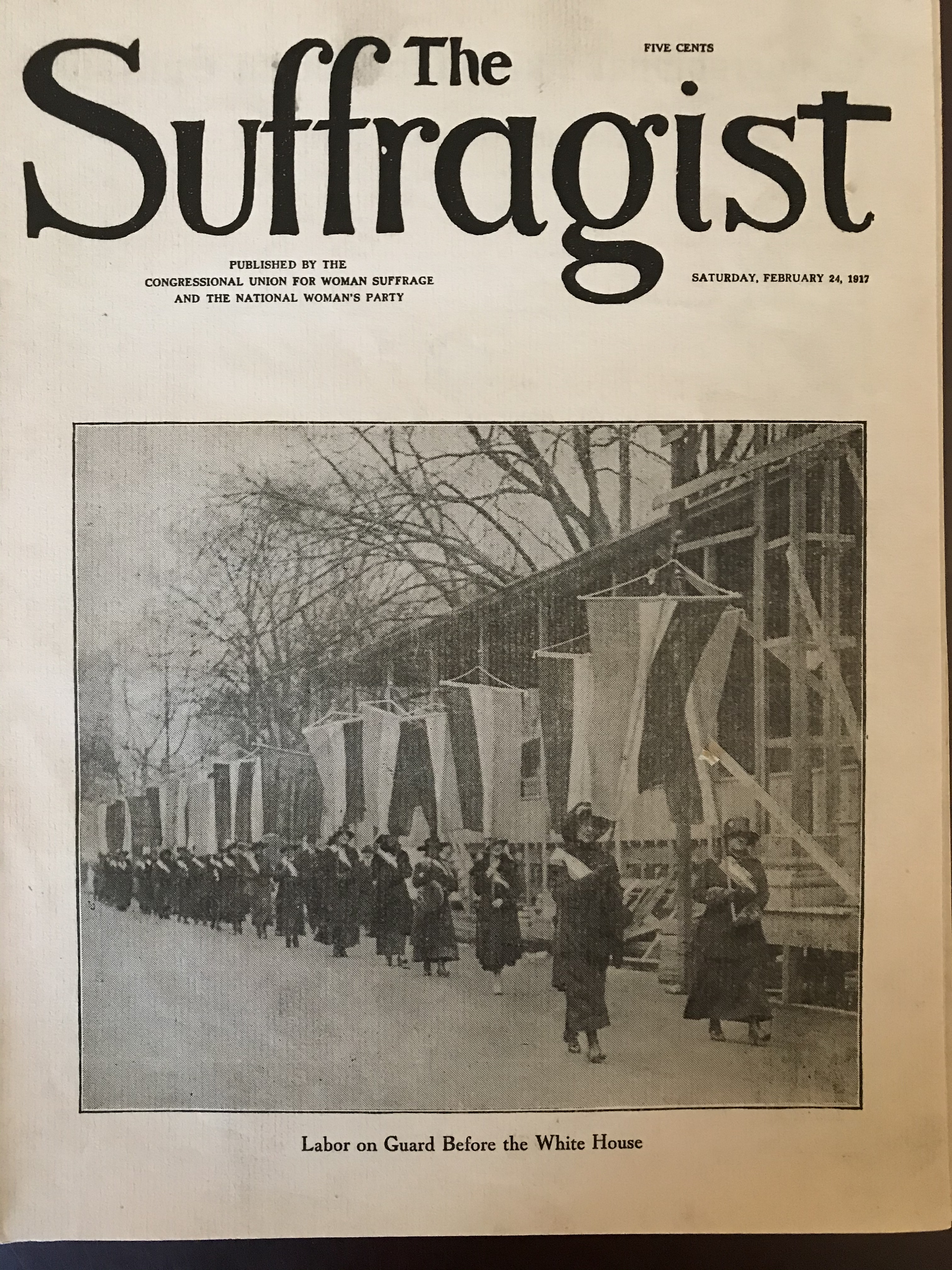
The weekly newspaper of the Congressional Union and National Woman’s Party

2020 is the Centennial of the 19th Amendment granting women in the United States the right to vote. Oddly enough, I am currently on a contract with the National Woman’s Party, founded by Alice Paul and Lucy Burns as an offshoot of the National American Woman Suffrage Association (NAWSA), and originally called the Congressional Union. The split was largely over tactics and splits continued over the years, again, mostly about tactics and mission. (In the post-suffrage years, splits continued, largely over how to pass the Equal Rights Amendment.)

I’m waiting to find out if the site has been awarded a grant I applied for in December so that I can produce a collections open house and living history event in late April designed to explore the material culture of the NWP’s protests. On the off chance that I’ll get the grant, and on the basis of a life-long obsession with the 1910s formed when I watched Testament of Youth on Masterpiece Theatre and promptly demanded the book, I have begun to consider the component parts of a suffragist’s wardrobe. (You gotta have something to think about on the Metro.)

Capes in violet and yellow were part of the costumes worn in suffrage parades and pageants

Here’s the preliminary list:

Chemise
Drawers
Corset
Stockings
Petticoat
Corset cover
Skirt
Blouse
Jacket or sweater (we’ll be indoors)
Boots or shoes
Votes for Women button

I am incredibly lucky to have found (separately) a silk blouse and a wool skirt that both fit me! I also have a wool skirt that is too small, but could be patterned, and a cotton blouse, that could also be patterned. But given what I have to accomplish by the end of April, I think it’s most likely I’ll need to wear the antiques.

Stylish suffragists in the capitol for a meeting

What do I have to make, if I get this grant and decide to be one of the costumed interpreters?

At a minimum:

Chemise
Drawers
Corset

Now, I could opt for a union suit of the kind Our Girl History made, but I’m not super convinced by my abilities to sew knits. Before she posted the union suit, I was planning to use the Dreamstress’s guide to 1910s underwear.

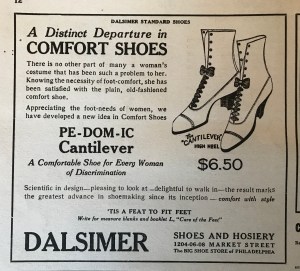
The Suffragist was funded in part by ads.

I have the Scroop pattern, and if I finish my projects and I get the grant, I’ll dive into this decade sometime in March. It’s hard to say whether I’d like to get it or not: there is always the “Oh crap, now we have to pull off this project!” factor with any grant award. It’s daunting, but at the same time, once those projects are finished, thinking about the who, how, and where of the making of suffrage banners and capes is pretty appealing for a material culture person.

In the meantime, while I’m at work, inventory projects provide lots of exposure to inspiration.

To Make a Standard

British wool bunting flag said to have been given to Tecumseh. NMAI Catalog number 23/730.

When I set out to “be” Rebecca Young, I thought I knew how flags were made in the 18th century– after all, I’ve made and seen a wide range of 18th and early 19th century items. But I was surprised when I got a look at a War of 1812 flag in the collection of the National Museum of the American Indian. (This was the closest, fastest option for getting a close-up look at an original, near-period flag in wool bunting, thanks to an inside connection.)

The questions I had were:

What materials were used? (My guesses were correct: wool bunting and unbleached linen thread)
What seam techniques were used? (See below)
How was a flag assembled? (Sequence of parts; see below)

The conservator shared the flag’s condition and treatment report with me in advance, and it was helpful:

My sketch of the Tecumseh flag

“Based on notes written by Phyllis Dillon, 1977(?): The flag is constructed of 9″
wide panels of plain weave wool bunting (24 threads/inch) sewn together with french seams (approx. 1/4″ wide) using beige (white/red) and brown (blue/white; blue/blue) 2-ply S linen threads in a running stitch. The canton is constructed similarly using strips of white and red bunting with similar thread count. The hoist (approximately 1 1/4″ wide) is made from a plain weave, coarse, undyed linen folded over the raw edges of the seamed rows of bunting and stitched with a beige (undyed) linen thread; there are three hand-stitched grommets/eyelets at the corners and the center of the hoist which appear to use the same type of linen thread as the hoist stitching. (See analysis section for fiber ID). The blue bunting at the lower and upper edges of the flag are selvage edges, the fly edge is folded over and stitched with a 1/2″ wide hem.”

The date of the notes (42 years ago?) concerned me, and I wondered about the french seams. Most of what we see in the period are felled seams, so it seemed possible there was some confusion about the terminology. I’m confused about it after looking at tutorials and descriptions online, but perhaps that’s just me– in any case, the only way to answer this was to go and look.

What did I find?

Mistress V shows visitors our modern wool bunting flag

Materials
Wool bunting and silk were the most common materials used to make flags, colo(u)rs, and standards in the 18th and early 19th centuries. Colours, as advertised by Rebecca Young, likely referred to regimental colours, though a naval “colour” could mean a national flag flown by the ship. During the Revolutionary War, there were state navies in addition to a Continental Navy, further complicating the issue. (This complication also existed in the army. There are parallels today in the state National Guard units, which operate under a state or commonwealth governor, unless called into federal service. It’s your state national guard that comes to dig you out of your car in a major blizzard, but they can also be called to serve in wars, as you may recall from such debacles as Abu Ghraib.) Bunting came from Sudbury, England, and was woven in narrow strips. The strips on the Tecumseh flag are about 9 ½” seamed, suggesting that the width was about 10” including selvedges. Narrow strips are more flexible for assembly, and allow extensive use of selvedges to make seams narrower and stronger, because they’re less likely to fray.

Techniques
The running stitches in the Tecumseh flag threw me, because I’d expected back stitches, or combination stitch at least, but when I started working with the bunting, I understood. The loose weave of the bunting will pull and distort if you apply too much tension, so a backstitch would, in the end, be less useful than a running stitch. I doubt this is true of silk flags, though; silk, being more tightly woven, would better withstand a backstitch.

Because the Tecumseh flag is mounted and framed in a plexiglas case, I couldn’t touch the seams, or see the backs, and the conservators don’t seem to have photographed both sides when the flag was being treated– or at least images were not available to me. This leaves open the question of exactly how the seams were done, but my best guess based on areas of loss is that the strips were stitched together with a slight offset, like a felled seam, and then the overlap was tucked under and stitched down with a running stitch.

women sewing
This is less efficient: one person assembling an entire flag alone.

Assembly
This was probably the most delightful part of the research: figuring out how all the pieces went together. Once you see it, you can’t unsee it: flags were assembled in component parts, which were then assembled into wholes. Once we were working on the flag at the museum, the reason became clear: it’s so much quicker and easier to have multiple people working on parts, with one person assembling these parts, than to have one person per flag. This is proto-assembly line work, and it existed in 18th century workshops from tailors to cabinetmakers. Specialization equals speed, and the key to making money as a contractor supplying the army was quantity.


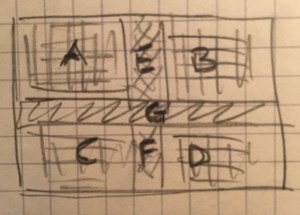
Canton components: A, B, C, D , E and F are assembled; AEB and CFD are sewn together to make two long rectangles, which are then sewn to the long sides of G.

In the case of the Tecumseh flag, there are three main components: the lower three strips, the upper three strips, and the canton, which is comprised of 7 parts. Each was assembled individually; then the canton and the three shorter strips were joined, and sewn to the long lower piece. After that, the hoist was attached and the far edge of the fly hemmed. Only then was the flag finished and ready for delivery.

Describing how strip(es) were assembled to become the Fort Mifflin flag.

The Fort Mifflin flag, 13 stripes of red, white and blue bunting, ending in red, would have been assembled in strips of two and then three, and then grouped and assembled. Working with Mistress V, the greater efficiency of assembling components became clearer. This hand-on quasi-experiment clarified some questions about how military contractors worked in the 18th century– at least the ones sewing. The system had to include multiple hands, working together in a shop or doing piecework at home for assembly elsewhere. There was just no other way to efficiently make the quantities of goods– 500 linen liners for light horse caps; 293 shirts; multiple standards and colours– at the speed the army required. The quantities also suggest that Rebecca Young was not just a widow-turned-contractor, but that she had working and organizing experience before she was widowed, along with a network of contacts who, along with some of her children, helped produce these goods.

Pilgrimage

Former President Barack Obama Oil on canvas by Kehinde Wiley, 2018. National Portrait Gallery (Washington, D.C.)

Note: This was written some weeks before the Kim Sajet’s piece in The Atlantic appeared. Upon reading that, I decided to publish this essay.

Kehinde Wiley’s official portrait of President Obama hangs on a partial wall fronted by a velvet rope. Stanchions create an approach to the portrait, and people are lined up as if they’re waiting for communion, waiting to approach an altar. Which they are. The portrait is more vivid, more alive, in person than in print or online. The line of people–still long, still rapt, months after the painting was installed– is as moving as the portrait itself.

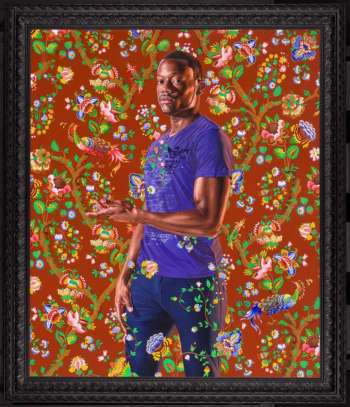
I knew I would like the portrait because I like the artist. The first Wiley I saw was at the MFA Boston, John, 1st Baron Byron hangs in a long hallway of a gallery, the chinoiserie background red and vibrant, loud the way 18th century wallpaper could be. Tendrils wrap around the subject’s legs, flat against the navy blue chinos, and without regard to the light that reflects from his palm. It stopped me in my tracks.

John, 1st Baron Byron. oil on canvas by Kehinde Wiley. Museum of Fine Arts, Boston.2013.633

Obama’s portrait pricked my eyes with tears, not only for what I missed– the cool intelligence, the restraint, the reasonable domestic policies–but for the line of supplicants. There was a crowd of people who were moved the way I was moved, by the representation of a person. They were moved because of what the painting stood for, and how it represented the embodiment of an idea.

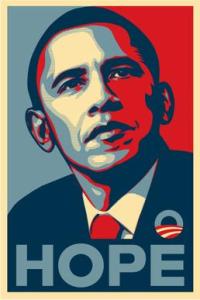
Shepard Fairey’s “Hope” portrait collage captures the beginning of the idea, Wiley’s portrait the mature realization. A copy of Fairey’s 2008 poster hung in my Providence living room, flatter than the original collage, stylized to a near caricature. Wiley’s portrait would suffer as a poster, print rendering the floral background lifeless, draining it of the light that saturates the portrait in person. The portrait glows on the gallery wall: Wiley has captured “hope” in paint and made it feel alive.

HOPE, by Shepard Fairey. Screenprint, 2008.

That light and life captivate viewers and draw them to the painting; they respond not only to what they know it represents, but to how the idea and accomplishment are represented. Watching people get in line to see a painting– no other presidential portrait, no other portrait, captured people’s attention and interest this way– proves not the popularity of a past president but the power of an object.

Wiley’s portrait, suffused with light, may be a modern altarpiece to the cult of celebrity, drawing crowds to worship an idol created by the media. Or it may be the physical representation of quintessentially American ideals of equality and progress, depicting a god of the mythical post-racial present. Or perhaps it’s a superficial representation of a superficial success, thin paint to match a thin pre-presidential resume. How we interpret an object is colored by our biases, but our response is not: our response is intuitive and automatic. That’s what I see in the queue to view Wiley’s portrait: people responding instinctively to beauty.

Sometimes I forget that no matter how interpretation and meaning layer an object, the first response is instinctive. It may be so fast we (almost) miss it, an impulse leaping across a synapse, but it is often the most honest response; the one we need to pay attention to so we can better understand how an object is presented to us or the public. The power is intrinsic to the object, whether an inlaid table or a portrait: the maker speaks to us through the object. Wiley’s portrait and the crowd who came to see it reminded me of that basic truth: the power is in the object. A curator’s label and presentation are secondary to the immediate response of the viewer to the object. There’s nothing like the real thing.