Massacres and Mondays

March 5, 1770: Sound familiar? The Boston Massacre.

Happened on a Monday, by the way: how ironic is that?

But here’s the thing: if the Monday is emphasized, the Massacre stands out. Focusing on the normal makes the unusual ever much more so. And in the case of Monday, March 5, 1770, the usual is actually unusual.
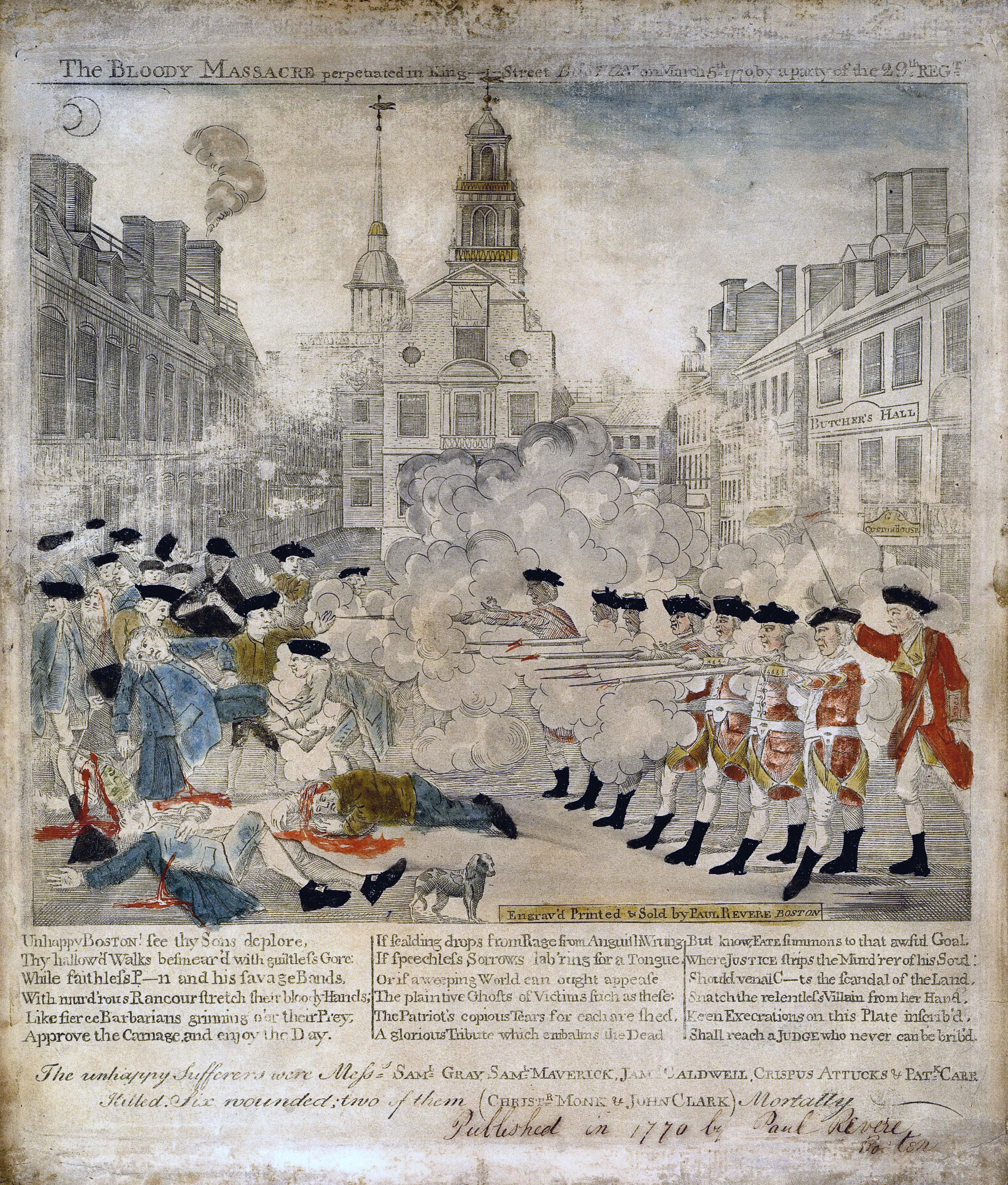
Paul Revere, “The Bloody Massacre in King-Street, March 5, 1770.” Boston, 1770

Over the course of the month leading up to Saturday’s event, Drunk Tailor and I spent a lot of time talking about the night watch, peddling, food supplies to Boston, population, and what I might call “the texture of everyday life” in a meeting at work. Any reading you do forces you to realize that the key to the Massacre is how very abnormal everyday life had become in Boston that winter.
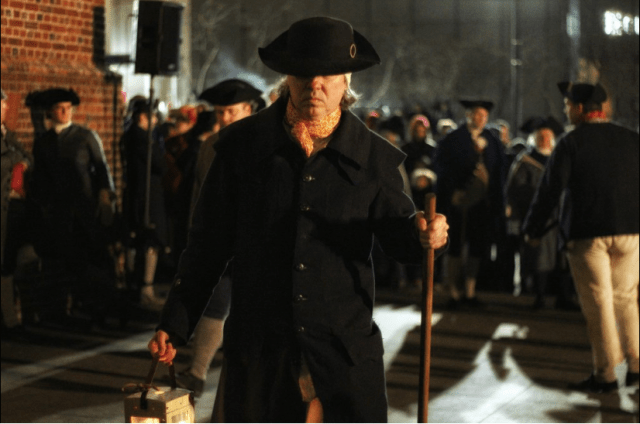
Edward Langford, disaffected nightwatchman. Boston Str
Edward Langford, disaffected nightwatchman. @BostonStrolls on Twitter

By 1770, Boston was an occupied city: Ferguson comes to mind, or Ramadi. Soldiers and watchmen patrol the streets, civil and martial structures clash, and the Sons of Liberty chafe under this control– or attempt at control. Scuffles, fights, brawls, break out. A boy is shot to death– accidentally– and tensions mount higher.  Sailors and soldiers alike commit acts of vandalism. Women are assaulted. Normal isn’t normal anymore, and Boston was always expensive to live in. Even in a city occupied by “friendly” forces, gathering supplies and going about one’s daily business became harder.

People are scared. This is a tense city. Lots of people are just trying to survive. Lots of those people are children. Roughly 16,000 people, and if the estimates are correct, 2,000 soldiers and 4,000 men (white, African, other, free, indented and enslaved), which means about 4,000 women and 8,000 children under 16. Let that one sink in: lots of children, lots of teenagers. I don’t know about you, but a city with a large population of teenagers is going to be tense under the best of circumstances, even in an era before the rise of youth culture. Hormones, man. The kid can’t help it.

So imagine this: instead of a mobile monument and a commemorative ritual that substitutes fists for muskets, the Massacre commemoration expands to include the day, and not just the night. Monday and a Massacre.

Townspeople hurry home as dark falls. Women lug laundry back to customers or to the washhouse, or trundle barrows home, empty, after a day of hawking cats’ meat, oysters, or fish. Tired cordwainers trudge the streets, hoping for meat at supper. A mother scavenges firewood to warm her rented rooms, keeping an eye out for the watch. Those are not Mr Hutchinson’s fence posts, truly.

Photo by Tommy Tringale (Claus' Rangers, 2nd NH, 3rdMA and HMS Somerset)
Photo by Tommy Tringale (Claus’ Rangers, 2nd NH, 3rdMA and HMS Somerset)

Women look over their shoulders, nervous at the sound of hobnailed shoes on the streets. Older men skirt closer to buildings, out of the way of soldiers in the street. Apprentices mock an officer, a sentry responds.

Insults, a scuffle, a boy knocked down. A mob, soldiers, a woman shoved, shots fired, men killed and wounded, blood on the snow.

Murder in the midst of the mundane. More horrifying (in truth, I have never heard Boston so silent as I did on Saturday night) within its context than set apart.
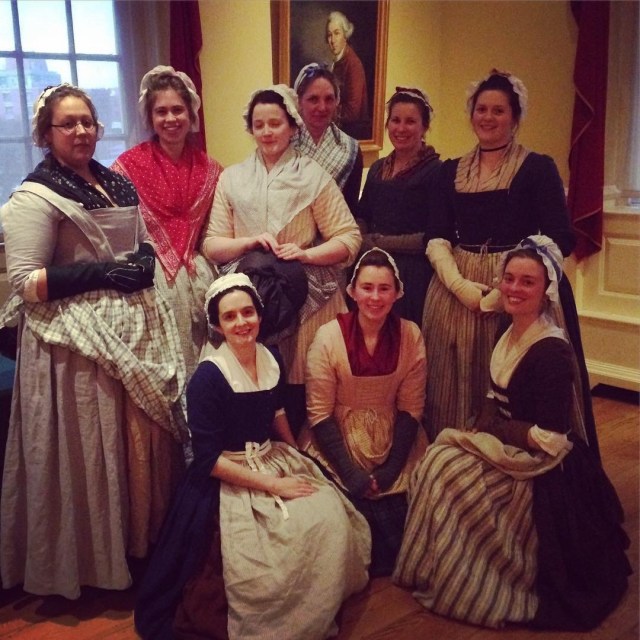
The Women of the 2017 Boston Massacre commemoration. Photo by Drunk Tailor at the behest of Our Girl History

The benefits?
A more complete picture of life in 1770 that puts the events of the evening of March 5, 1770 into deeper context and thus a sharper contrast.
A recognition that history isn’t just about men and conflict.
Understanding that what made living under occupation so hard was more the living– trying to be normal–than the occupation.
And, yes: more for women to do.
Shoot meat, win a target

That’s almost literally true: shoot a target, win a target would be a more accurate description of Saturday’s frivols in Massachusetts. At least the gentlemen seem to know they’re a little silly.

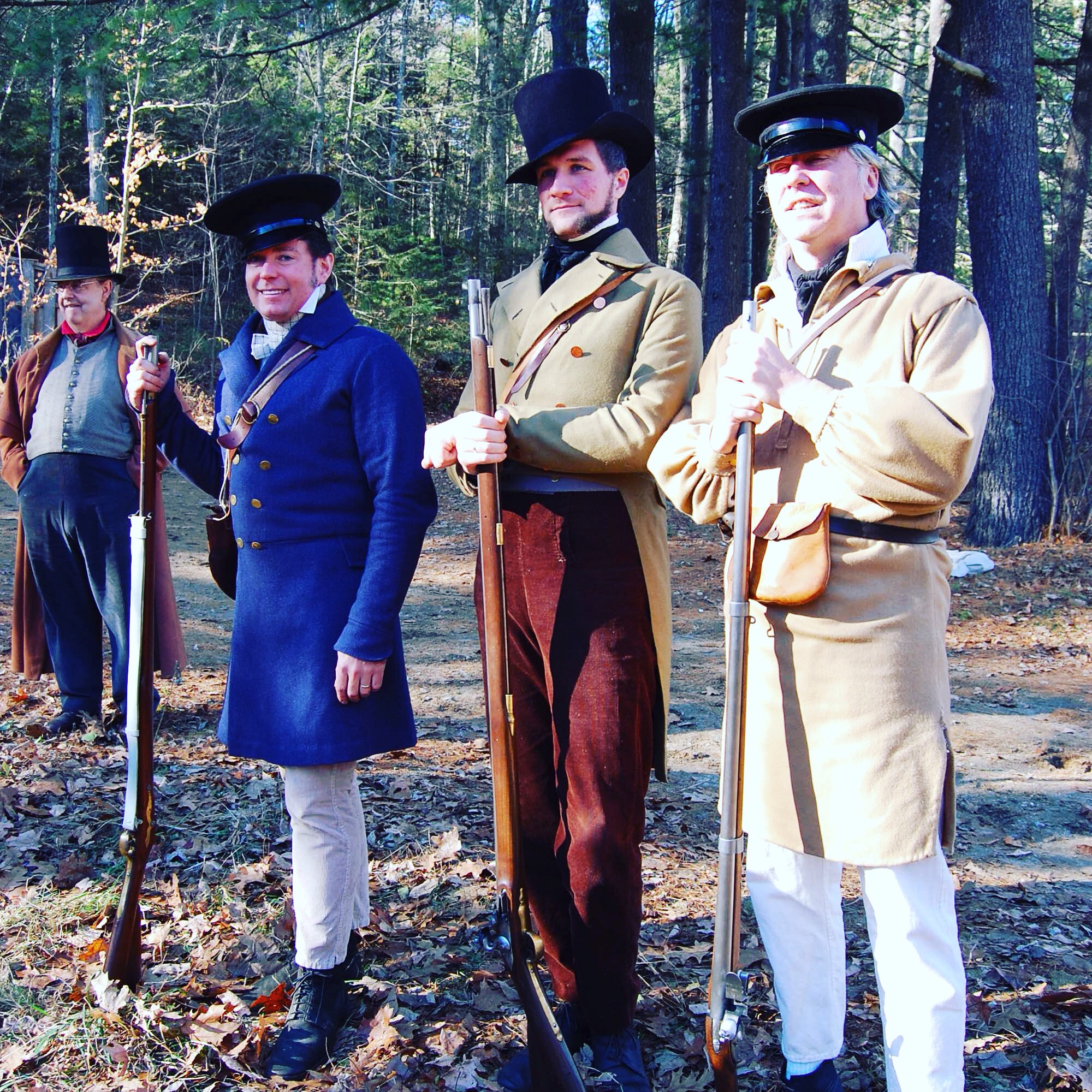
1830s  shooting party
Literal musketeers: Mr B, Mr K, and Drunk Tailor

Of course, this kind of event is typical of late autumn New England. My favorite version is the sqiral/skirl/sqwirl hunt.

Invitation to a squirrel hunt, 1759. MSS 9001-S , Rhode Island Historical Society

In 1759, Cousin Stafford was promised to be handsomely treated at a sqiral [sic] hunt. They would hunt for what looks like the astonishing and possibly sarcastic prize of “‘100 pound in money’ and 15 gallons of Rum and one baral of cider.” Good times in Coventry, Rhode Island that January– just not for sqirals, unless the Rum and cider were consumed before the hunt began.

Silly, in a way, though deadly for the creatures on the wrong end of the muzzle. I found this past Saturday to be suitably silly, and about the maximum level of Gun Show I can tolerate, if only because it has a greater resonance with its historical antecedants than the ritualized commemoration of battles portrayed without adhering to the turn of actual events, fortifications, or troops present. My quest for accuracy does not demand tethering turkeys as targets, and the painted wooden silhouettes with glued-on feathers presented challenging, somewhat light-hearted targets.

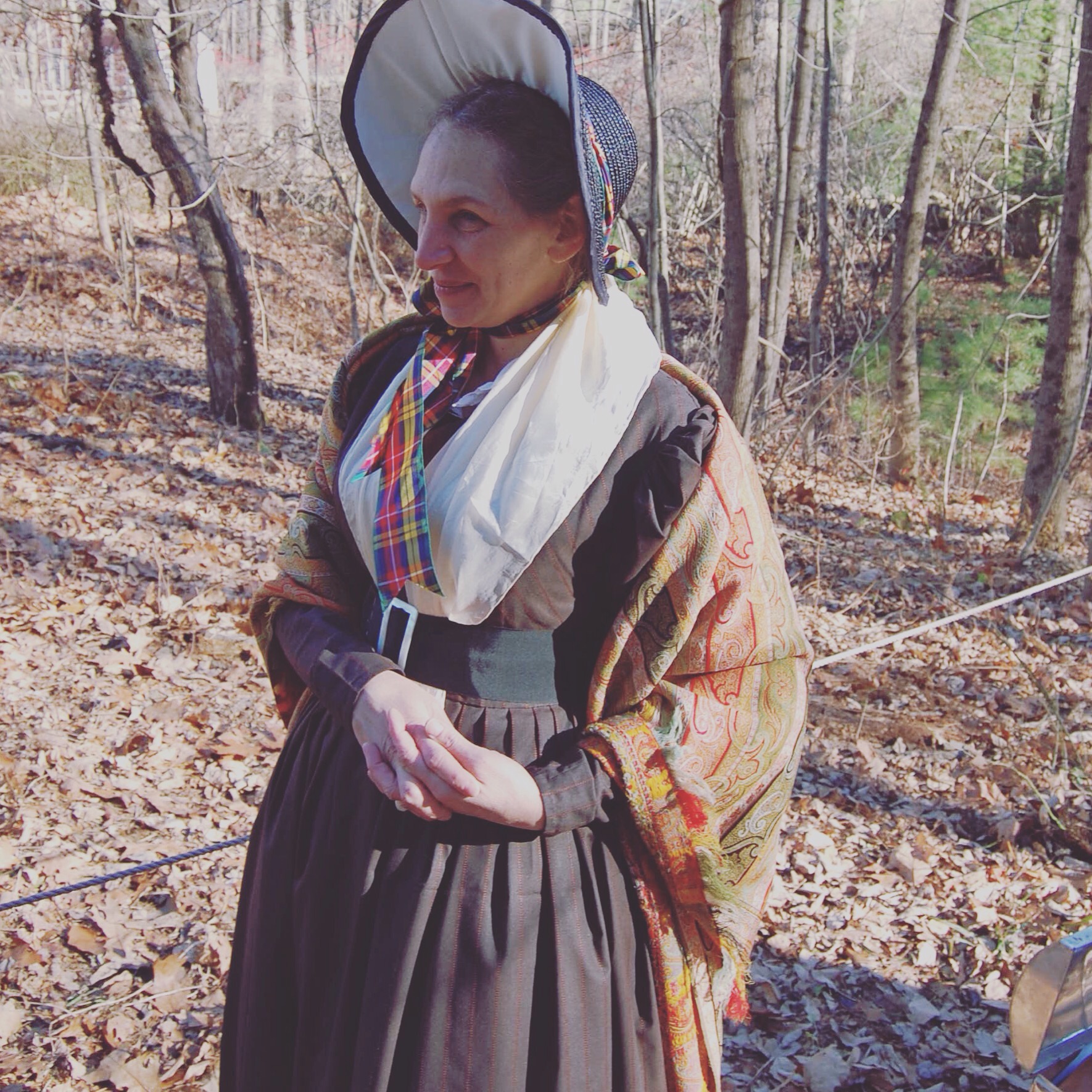
Silly bonnet, silly sleeves, original shawl

To finish out the silliness, sleeves o’ pouf, though hidden here under a shawl. If I’m going to keep doing these colder-weather events, I will need to invest (i.e. sew) wool shifts. I can definitely document one to Rhode Island circa 1830-1840, for whatever that’s worth. Happily, my lower half was plenty warm thanks to Mrs B’s  generous loan of a quilted petticoat (warm legs and a poufy skirt), so only my shoulders were cold by the end of the day.

Now that the last cutout has been hung and shot, and my poufy sleeves retired to the closet, I’m back to finishing up that woman’s winter waistcoat and another wool petticoat for next month. Turns out I have stocking issues I didn’t know I had– which is to say, I am in need of grippier garters (hello, mismatched wool tape!) and some quality darning time. Wool mitts may also be in my future, as I cannot locate either of my pairs of mitts– linen or wool/silk blend–among my things. I’ll be sorry not to have gloves or mittens, but as goes the documentation, so goes the frostbite and chilblains.

Packing Meat

If it bleeds, it leads.
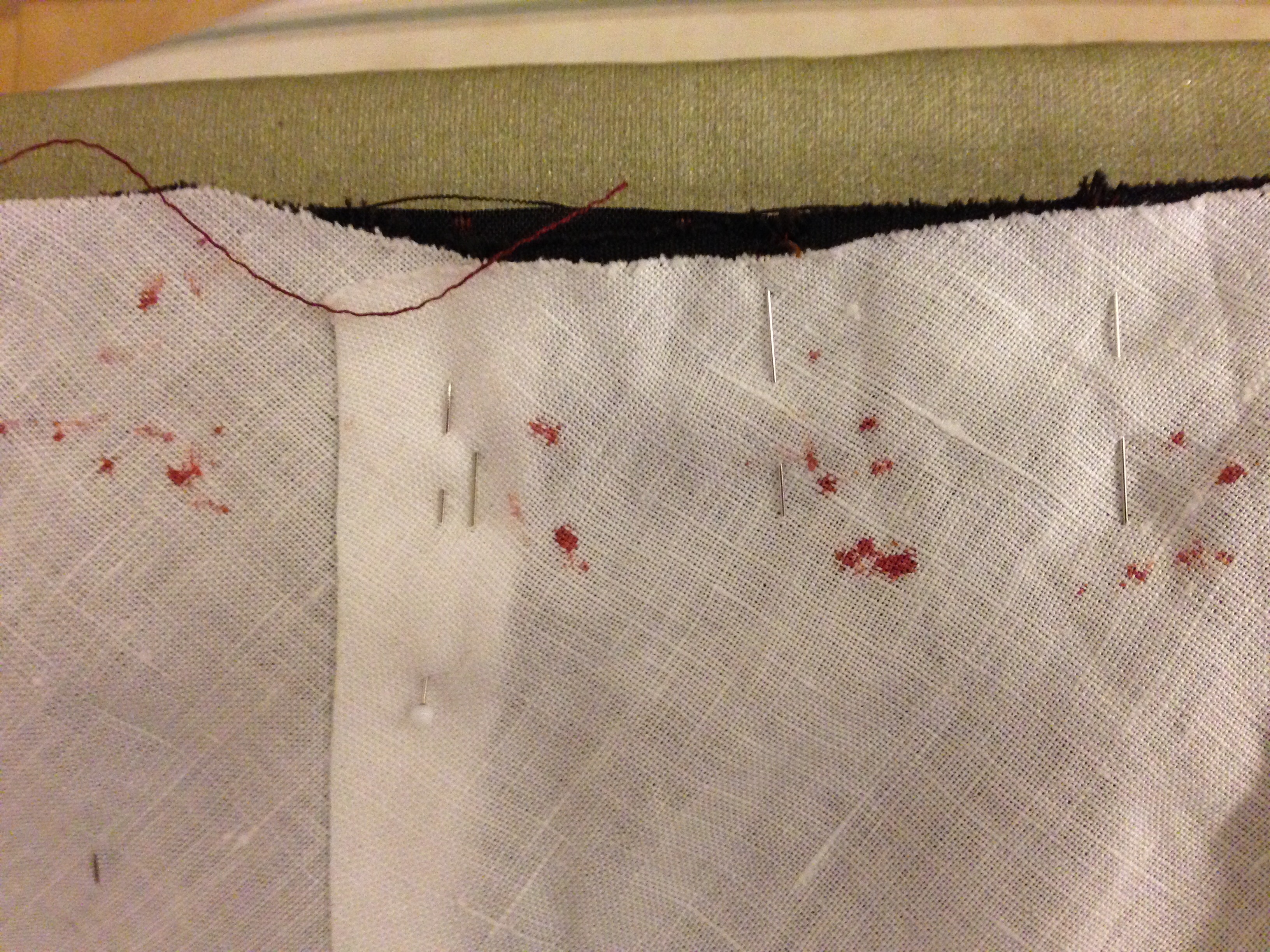
If it bleeds, it leads. Waistband pinning is surprisingly dangerous.

Sometimes you end up doing things for reasons you don’t entirely understand. Remember that brief flirtation with the 1830s? Well… we met again, and this time, I said yes to the dress.

Several friends are on the “shoot meat, win a target” program at OSV this weekend, and I agreed to go along. Yes, it’s a gun show. Yes, I’m compromising again.

Gentle reader, it gets worse. While I had not planned to dress, I rethought this choice last week. Awake in the early morning hours of November 11, I thought about dress patterns, wool petticoats, and the contents of the Strategic Fabric Reserve. One of my wool petticoats fit the waistline of my 1820s dress better than the 1800 dress I made it for, so I figured I was on my way towards being warm outdoors in November.

Spot the error. It's the dyslexic '30s.
Spot the error. It’s the dyslexic ’30s.

I have 1830s patterns, and a muslin was quick to make. Worse yet, once the muslin was made up and tried on over stays, it needed no alteration beyond a slight shoulder seam adjustment. Can you imagine? That hideous decade fits me? Doom or destiny, you be the judge: I had enough striped wool blend to cut a dress and a pelerine… so I did.

The other sleeve's stripes are just slightly off.
The other sleeve’s stripes are just slightly off.

The bodice went together quickly, and the sleeves were fairly easy at the shoulder and arm scye (I really enjoy setting sleeves). It was the length and width along the forearm that threw me, and I ended up having to piece on the lower sleeve. Twice.

The sleeves are where the meat comes in: you say pork chop, I say leg of lamb, the fashion plate says gigot. I did reduce the arc a bit, which makes this a more late-1820s style than firmly mid-1830s. Since some of the folks I’m going with will be wearing a mix of late 1820s and 1830s styles, slimmer sleeves seemed reasonable.

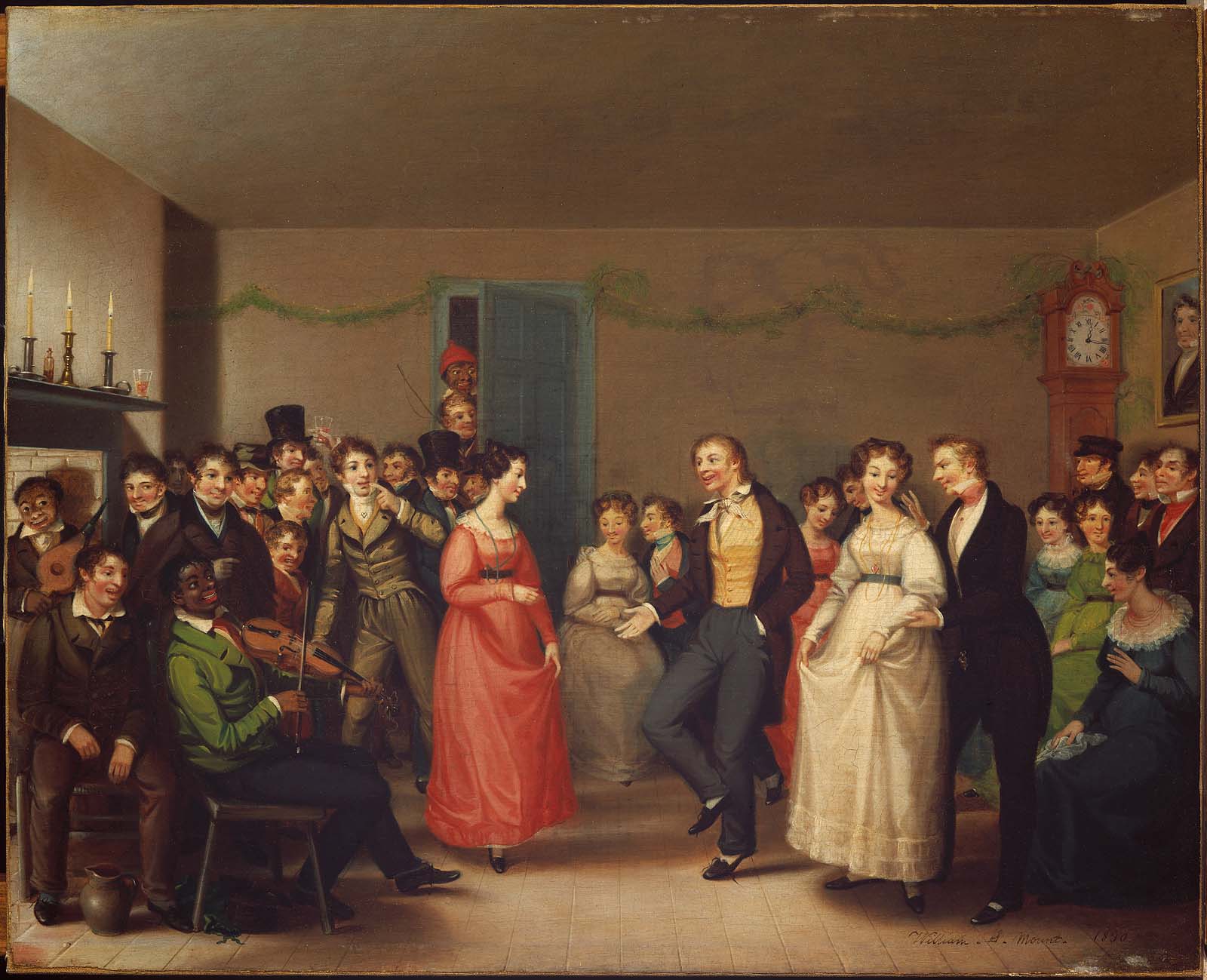
Rustic Dance After a Sleigh Ride, 1830. William Sidney Mount MFA Boston 48.458
Rustic Dance After a Sleigh Ride, 1830.
William Sidney Mount MFA Boston 48.458

More seriously, I’m taking cues from the William Sidney Mount painting I’m so fond of. The women in this 1830 painting have less flamboyant sleeves and possibly achievable hair. Honestly, the things I get into when I lie awake and think. I ought to know better by now…but every decade is a new adventure.

What remains to be done? Backstitching the waistband and waistband lining, hooks and bars at the back closing, the ever-popular hem of enormity, and a final pressing. Achievable, I think, with focus and some lunchtime sewing.

Afternoon in Cambridge

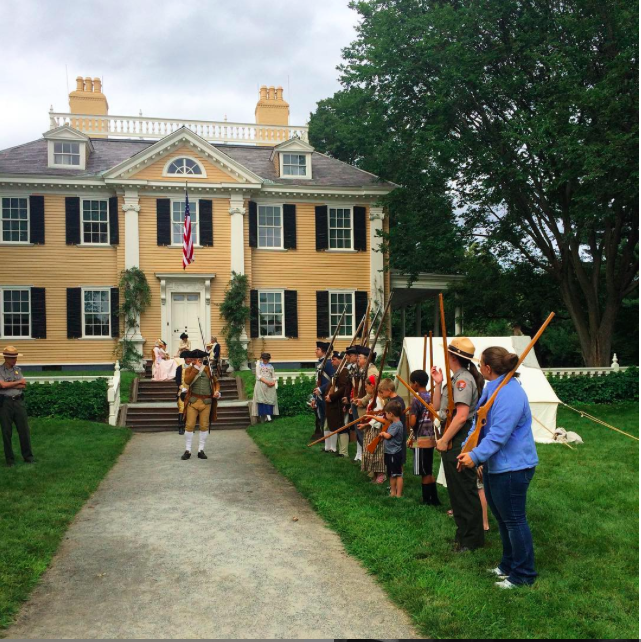
Cambridge. We’ve been there before to cause some mild lawn-based havoc and this year was much the same. We were on our own on the lower level, with just the six-plus-me of some abbreviated form of Soper’s company. Longfellow House is a very lovely site, and the lawn is large enough for a wall tent, drilling, eating, and general mischief.

Longfellow House, Cambridge. Photo from @longnps on Instagram

I packed our lunch in a series of linen bags in the wallet, and stuffed a gown skirt and sewing box in the other end, with a bowl and a mug. I brought the small pitcher and a glass, with the intent of selling ‘gin’ to the militia, but had only one taker. They got into enough trouble themselves with filthy faces, pilfering, and stealing the captain’s books.

unknown artist, 18th century, The Encampment in the Museum Garden, 1783, Aquatint, hand-colored, Yale Center for British Art, Paul Mellon Collection

It’s no immersion event, what with traffic on the street and tourists dressing in Mr Townsend’s best* but there are moments at any gathering when you become so engrossed in what you are doing that you forget where you are. This time was no different: I don’t recall how it started, but we took off down Brattle Street with Sergeant Cooke crossing the yard in hot pursuit– only to be stopped by the wall. He turned the stone barricade into a large and angry goose, neaatly solving solving the problem of not being able to scale the wall.

James Sowerby, 1756–1822, A Goose, undated, Watercolor and graphite on moderately thick, slightly textured, cream wove paper, Yale Center for British Art, Paul Mellon Collection

I don’t think I’ve ever bolted that fast in stays before, and it wasn’t the best idea I’ve ever had, but who cares? It can be done, running in stays, at least for short bursts.

There was much discussion of the filth of the troops, and their need to bathe; despite our best efforts, we could not quite get a satisfactory rise out of the officers, though some soldiers had clearly rolled in dirt. (It’s of a much better quality in Cambridge, you know, where you can wear the Harvard Yard.) There was an attempt at bathing at the Great Bridge, but in the end, one private’s face was washed with an apron corner dipped in ‘gin.’

Benjamin West, 1738–1820, American, active in Britain (from 1763), The Bathing Place at Ramsgate, ca. 1788, Oil on canvas, Yale Center for British Art, Paul Mellon Collection

Satisfying all around, really, from the recitation of Mr Pickering’s manual with its endless repetition of ‘butt,’ meaning musket, entertaining the simpler, uncivil soldiers, to the meal of bread, cheese and cherries, to the chasing. The audience was small, but well entertained if they were paying any attention.

*Oh, NPS, what were you thinking?