King of the Coats

Douglas, 8th Duke of Hamilton on his Grand Tour, © National Museums Scotland A.1991.156

He’s hard to miss, the 8th Duke of Hamilton, in his red coat. I’d hazard it wool, because of the contrast with the sheen of the blue coat his physician, Dr John Moore (at right), is wearing. Dr Moore’s coat gleams like silk; the Duke’s looks dull and woolen. (Look at the way the light strikes the Dr’s shoulder; another clue is the way the button holes are worked.)

The coat below is a simpler, provincial relative of the Duke’s coat. This is the Amos King coat, owned by Colonial Williamsburg. I love the description:

“Wool plain weave fulled and napped “broadcloth”; twill worsted “shalloon” lining; tabby linen lining center back. Pocket flap lined with twill worsted; sleeves lined with tabby linen; right lower pocket is linen; left pocket is leather; inside pocket on left breast is linen, with broadcloth welt.”
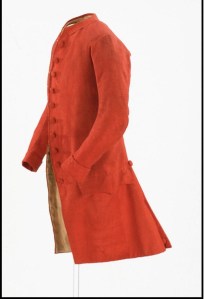
Man's Coat, red broadcloth ca. 1770, CW 1953-59
Man’s Coat, red broadcloth
ca. 1770, CW 1953-59

Shalloon. Tabby. Pocket leather. That paragraph is comprised of many of my favorite fabric and clothing words. And fabrics. And a leather pocket. As you may recall, I have a thing for fabric that is not at all about hoarding, and but rather about establishing reserves. When I see two yards of quality material at discount and purchase it, that yardage becomes part of the Strategic Fabric Reserve so vital to this nation’s safety. (We are all unsafe when a fabric addict is deprived of his or her fix. I’ve got a threaded needle, and I’m not afraid to use it!)
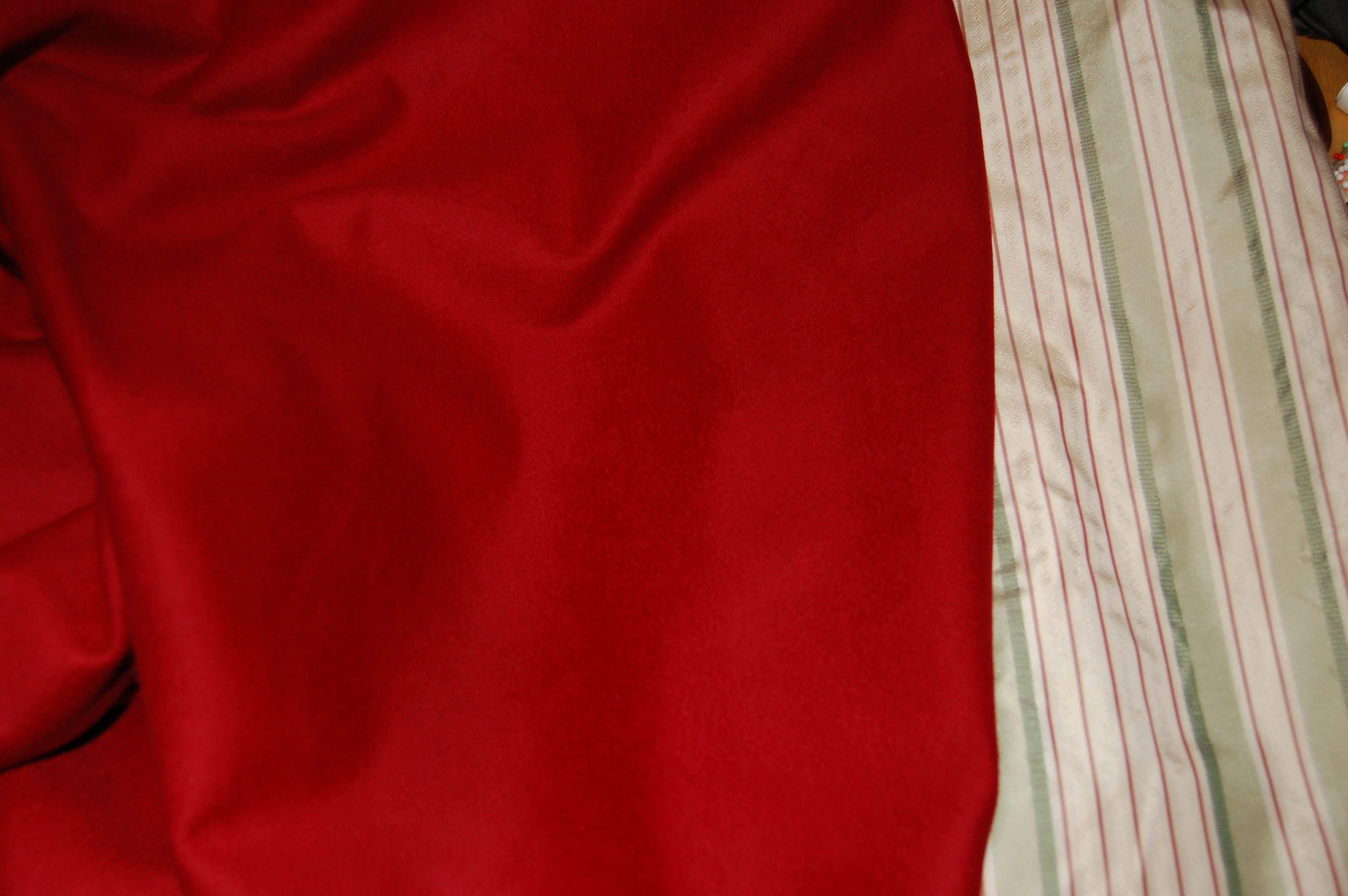
Part of this household's Strategic Fabric Reserve.
Part of this household’s Strategic Fabric Reserve.

Yardage arrived in the patriotic red, white and blue “if it fits, it ships” box on Wednesday, and when opened, we all proceeded to pet the lovely nap of the wool. Mr S wrapped himself in it, and I knew then that I would be making a red broadcloth coat of one kind or another.

It probably won’t be the “Quemans Pattern” coat John Buss mentions, not when I’ve got silk fabric for a waistcoat. The silk is from the remnant table at Artee Fabrics in Pawtucket. With careful cutting and a plain back for at least one waistcoat, there should be just enough to make both a 1770s and a 1790s waistcoat. We’ll get fancy around here eventually.

Brown Gown

Gown, ca. 1765. CW 1985-117,1

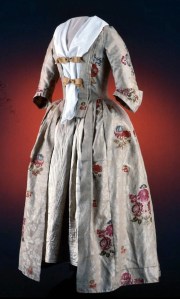
The very first dress in the Costume Close Up book matches my measurements pretty well, so I thought I’d be quite clever and pattern it up for my own use. I want a stomacher front open robe for Battle Road and a 1763 event this summer, so what better place to start than with an original ca. 1756-1760 gown?

I laced up my stays on Friday and spent much of the day measuring, drawing, cutting, and sewing. By mid-afternoon, I had a muslin with the devil’s own sleeve and a large measure of frustration.

Yes, I ate, it wasn’t just low blood sugar that caused all this unhappiness. For the public safety, there are no photos of the ensuing debacle. But the situation was not irreparable, as I have been in this miserable place before.

Patterned up from the little illustration.

( To add to the fun, my stays have stretched, and now give the impression that they slip down throughout the course of the day. They do this even while I am not especially active: I’d dismissed the sensation at Fort Lee. Oh, it’s the hours in the non-18th century seat, it’s running around the site, it’s one more lame excuse I’m making up. Nope. Suckers have stretched and will require attention. Also, for being slightly more than one year old, ought they to have wear marks from tying on petticoats? Next time, I’m using cotton, since it doesn’t stretch like linen.)

Gown, 1750-17651988-223, CW
Gown, 1750-1765,  CW 
1988-223

I got out the basic bodice block I’d patterned in June, and adjusted that to have a straighter, more horizontal waist line and made the bodice fronts narrower. The robings with be pleated to have a layered look, for which this Norwich wool gown at CW is the inspiration. I stitched up a muslin of the altered bodice block, and wouldn’t you know, it fit. It’s a relief to know that some measure of frustration eventually pays off. Maybe.

By Saturday night, I had the lining sewn up and Sunday morning, I attached the lining sleeves (I like to check the fit and have something to beat the fashion fabric sleeve against.) That meant I was ready for the terrifying step of cutting and sewing the actual wool. I have enough of it that I can mess up and redeem the problem, what I don’t have enough of is time. Certain gentlemen have garments in need of alteration, and creation, you see.

The back, with pleats sewn down, and skirts on their way.

Since this is the third or fourth or fifth time I have wrestled with the 18th century gown cut en fourreau, I know what I am getting in to. I know about the three hours for four pleats. I know the heartache of hand stitching the back only to realize you have introduced a wiggle. What I don’t know is how to keep this in perspective.

I followed along with Koshka the Cat’s en fourreau tutorial, which I found incredibly helpful. It won’t keep you from introducing a wiggle into your seams, but you will get the seams in pretty much the right place, as long as you’re honest about your measurements. It’s only a little bit Richard III up there in the center seam….

It’s good to be a perfectionist, but sometimes you have to just let go and sew. I’m still learning how to live with that.

Work, work, workman’s jacket

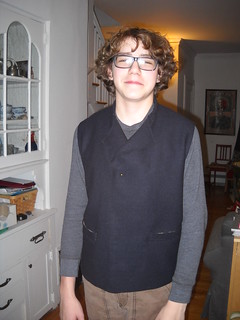
It fits! It might be painful, though.

Ah, yes. Work. It continues on the workman’s jacket for the Young Mr to wear at Battle Road, and for next week’s HSF deadline. There are some additional views of him in the same pose here. I tacked the lapels down because I have seen that detail on an original garment, and because if I don’t, they’re likely to bother the kid.

The nice thing about a workman’s jacket is that a waistcoat is optional underneath it. This short, only post-RevWar waistcoats look alright. So for Battle Road, long underwear may be in order. It wasn’t last year, but who knows?

Paul Sandby, A Sandpit. YCBA B1975.3.930
Sandby, Roslin Castle detail, YCBA, B1975.4.1877
Paul Sandby, Roslin Castle detail, YCBA, B1975.4.1877

The form is authentic, thank goodness, for working men’s clothes; on the left, in a detail from Sandby’s A Sandpit, is a jacket in blue. On the right, in a detail from Roslin Castle, Midlothian, is another jacket that looks short, worn without a waistcoat. It may not be as short, but I am encouraged by the lack of waistcoat, though I will insist on shoes…

The form persists for a long time, and is seen in military wear as well, in light infantry and dragoon troops, as well as in sailor’s clothing.


What’s in your pocket?

A typical rough linen lining

My son’s pockets used to be full of acorns: he collected them at the bus stop, but I don’t know if it was because he planned to feed the squirrels, or if he thought he was a squirrel. Later, he moved on to rocks. Now, rocks, fish hooks, a pocket knife, change and a hankie fill the pockets of his 18th century breeches.

We’ve had some moments of unhappiness when things have gone missing from the pockets, though we’ve usually found them again. When you look at the contents list, you wonder how the linen stands up as well as it does.

There’s a clever way to upgrade pocket bags in menswear, and it’s authentic: leather bags, instead of linen. Original garments have leather bags, probably deerskin, and they’re deliciously soft and very durable. Stuff all the heavy, sharp things you want to in that pocket, and it will probably take it.

1895.4.3A-C
1895.4.3A-C

Based on a suit in the RIHS Collection, I decided to modify the pocket bags on the Young Mr’s new workman’s jacket-in-progress, which I plan to have finished by March 11 for HSF #5, Peasants and Pioneers.

Made of a heavy, rough-finished brown broadcloth (possibly manufactured in New England), both jacket and breeches pocket bags are made of deerskin.

Pocket bag in progress.

To recreate this, I took a trip to the auto parts store, and purchased a large chamois.  Instead of cutting the bags from linen, I cut them from the chamois and trimmed the seam allowances: chamois won’t ravel, so the seam won’t need to be folded over at the top.

A little fuzzy, but you get the idea

I backstitched the bag seam, and in general, I’m pleased with the way it has turned out. I think I’ll look into additional leather options, but otherwise, it seems like a fairly successful experiment.

The real test, of course, will be user testing. How many sharp, heavy things can the kid load in a pocket before it gives out?