Miniature Miniatures

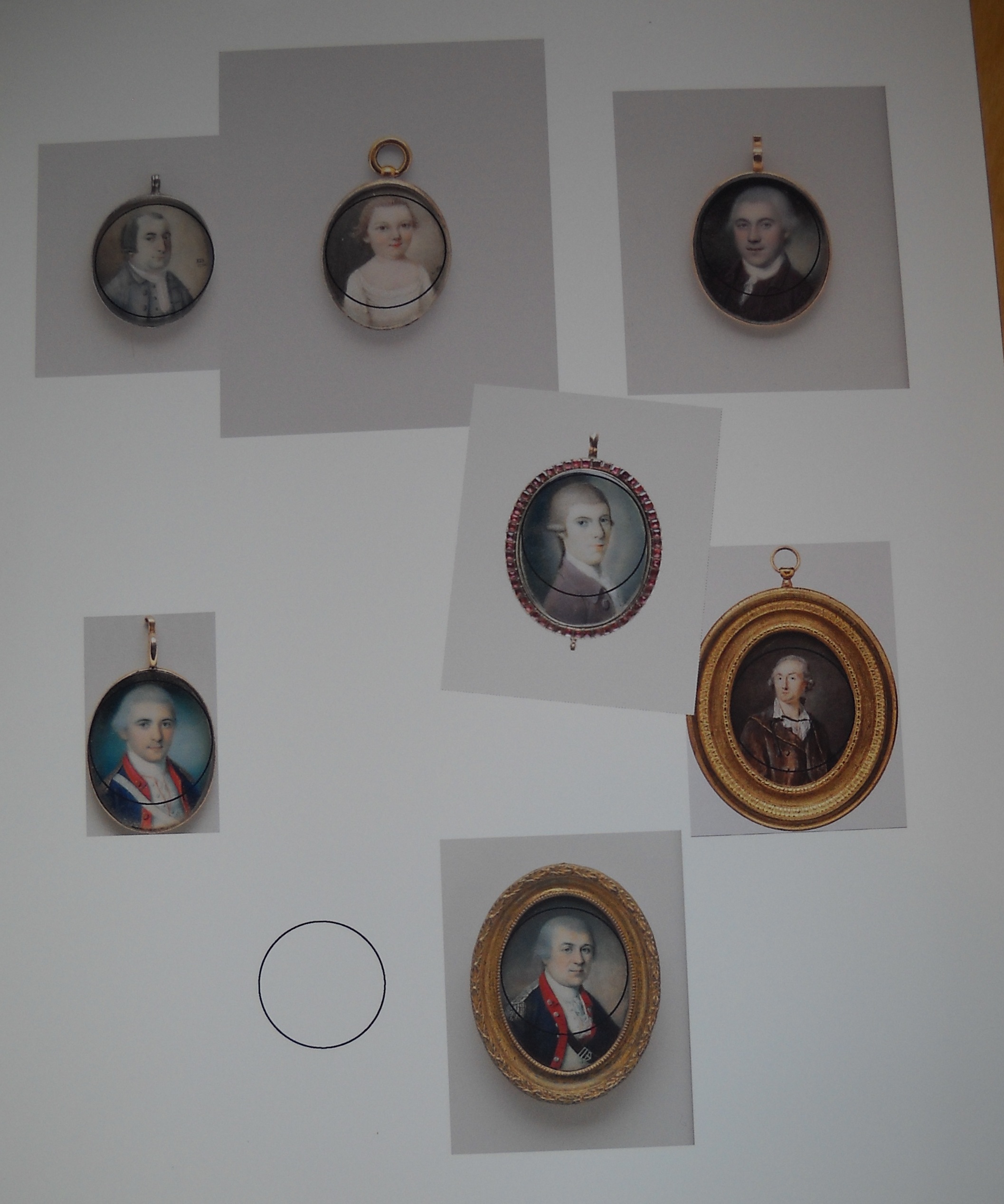
Images arranged in Illustrator

I admired the Pragmatic Costumer’s post on painting miniatures, but recognized that my desire for immediate gratification was going to run headlong into the small workspace formerly known as our dining room, where it would crash into my lack of practice at painting and result in unhappiness for all.

In recognition of my family’s right to peace in our time,  I made like an ’80s artist and appropriated images.

Separated and ready for trimming

After selecting gentlemen and an infant from 1761-1776, I downloaded the files and placed them in Illustrator where I could size them to one inch diameter circles. Why so small? Because to test this plan, I used rawther cheap little cabochon kits from Michael’s, and they were only to be found in the one inch size.

After cutting the images out generally, I trimmed them to the black line I created in Illustrator. (I don’t yet have a non-Illustrator answer to this process; I am lucky enough to have an ancient copy of CS Dawn-of-Time; let me think about a workaround.)

Henry Knox, the first trial

Here’s Henry Knox, my first trial. I was willing to ‘sacrifice’ him because although I admire his fortitude in dragging artillery across Massachusetts, he was a beast to Joseph Plumb Martin about post-war bounty land in Maine. I’m Knox-conflicted.

Some squishing and fiddling with the self-adhesive fronts later, here are three of the four miniature miniatures.

Three sandwiched images
Finished tiny miniatures

Yes, this is so ridiculously easy as to be evil.

What would I do differently next time?

I’d order proper cabochons and fronts in a larger size (I may convert these to bracelets).

I’d give painting a try, perhaps over the winter break at work. I’ll need time to get that right.

I’d string them on actual silk, and not polyester, ribbon. (It was handy, and the proper size).

But for a cheater’s way to miniature jewelry in under an hour, I suppose they could be worse.

Whatever you do, if you follow this example and “appropriate” images, don’t sell them. The Met may have millions in revenue, but it’s still wrong.
Hunting Frocks, Again

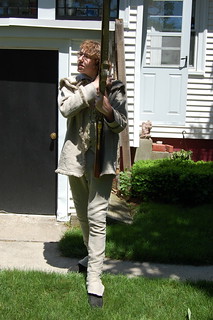
They’re not Mr S’s favorite thing, and I can understand why. Hunting frocks lack pizzazz, buttons, tape, lace, lapels, skirts and all the things that make him so fond of the Ugly Dog Coat worn by the 10th Massachusetts in 1782. (I think these are the coats captured from British supply ships and dyed at Newburgh and West Point in tanner’s vats.) But what he has right now is a hunting frock.

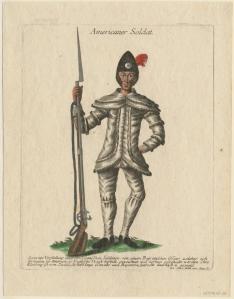
Here’s the kid in his new hunting frock, and a hand colored copper engraving by Johann Martin Will from 1776.

You gotta hold your tongue just right when you drill.
Americaner Soldat, Johann Martin Will. Ann S. K. Brown Collection, Brown University.

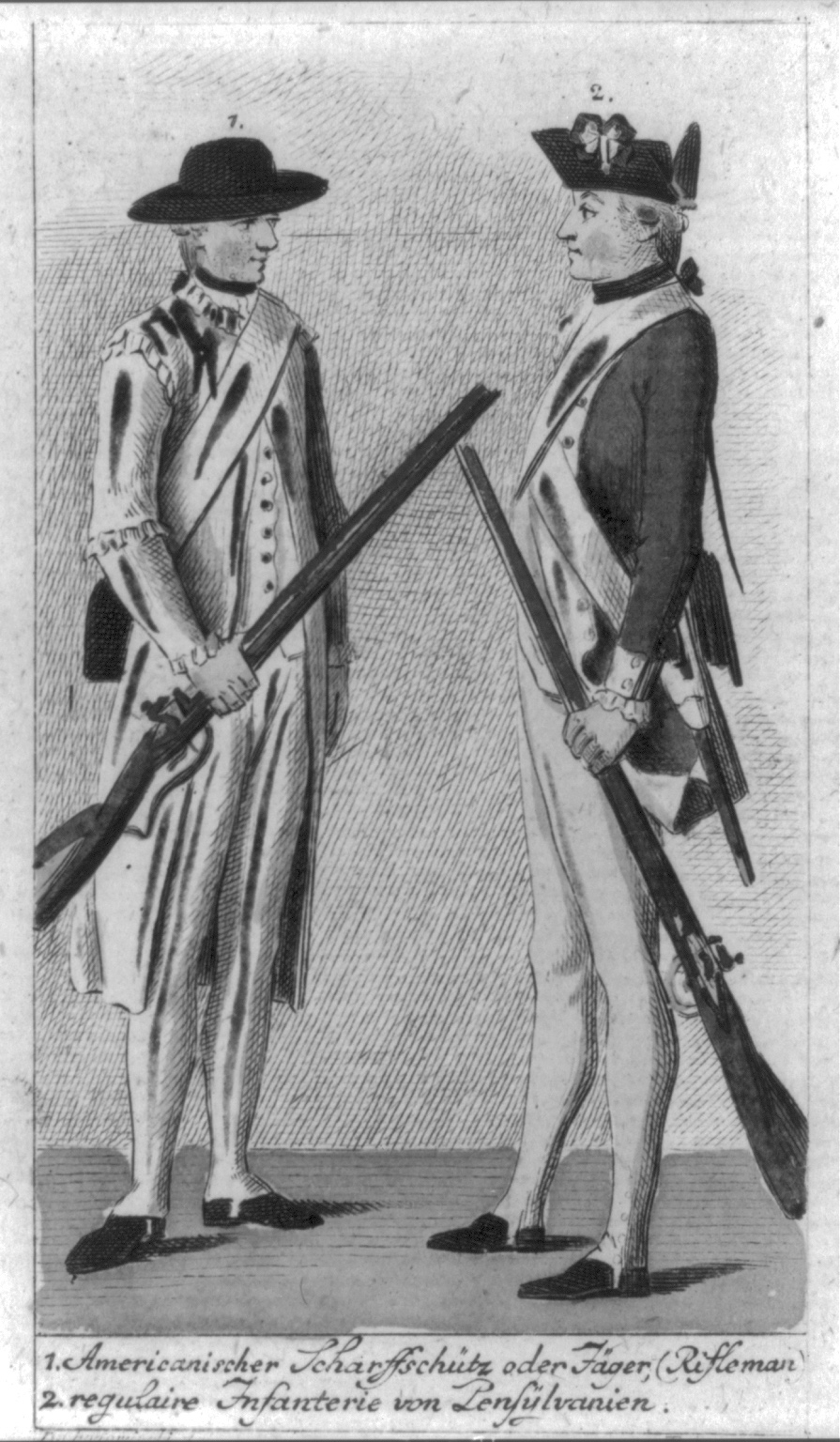
And then there are the colored and plain engravings, “1. Americanischer scharffschütz oder Jäger (rifleman) 2. regulaire infanterie von Pensylvanien,” engraved by Berger after Chodowiecki.

 Library of Congress
Library of Congress
Berger after Chodowiecki, Ann S. K. Brown Military Collection, Brown University
Ann S. K. Brown Collection

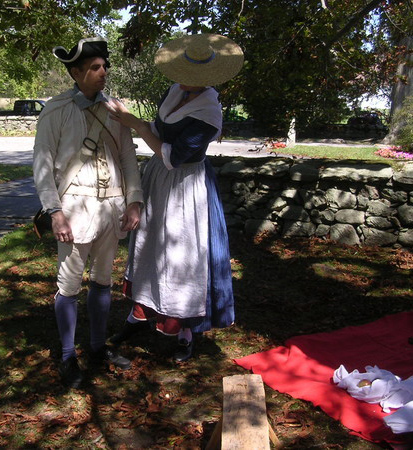
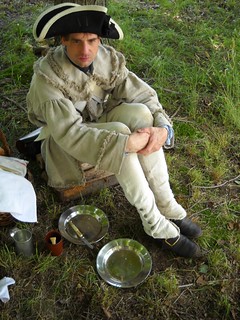
I started thinking about these again because not only am I reading Hurst’s thesis, but I’m fresh from helping the guys get dressed and arrange their capes and straps. I have been doing that as long as Mr S has been wearing historic clothing.

Early days of draping

Drapey capes

The hunting frock drifts if it does not have some kind of fastening at the neck. The two halves migrate in opposite directions, and while belts help, the light infantry bayonet shoulder belt does not contain the hunting frock as well as one might like. So the thing to do, I think, is to attach a loop and button at the neck to hold the garment in place. From the period engravings, I think that’s acceptable. The garments all look as if they are closed at the neck. From the evidence in the field, and from the images, I plan to make loops and attach buttons, and hope that will limit some tendency to wander.

The image of the two soldiers together suggests another wrinkle in the hunting frock quandary, since the left hand soldier’s out garment looks like a long pocket-less coat with applied fringe and only a very small cape at the neck. Thank goodness that soldier is a rifleman, and thus outside the realm of immediate relevance. (And on a side note, I know a gentleman who very much resembles the Pennsylvania infantry man: identical calves, and even a similar face.)

Getting Better, and Giving Back

Mr Cooke, Mr S and the Young Mr.
10th Mass fittings: Mr Cooke, Mr S and the Young Mr.

There is good, if slightly terrifying, news about how to get better at sewing. It took me two years to get to a decent place, but this sped up considerably in the past year because of the weeks when I sewed for 30 or 40 hours a week. This business is about practice, looking, and patience … and also asking for help. Some of the help you can get online, some of the help you can get from whatever human is handy, and some you need a master for.

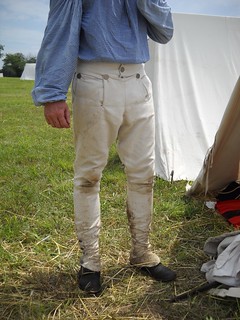
The Rhode Island pair, pattern by me based on Mill Farm breeches.

Online tutorials have saved my bacon: I make gowns with Koshka’s tutorial handy because after intensive menswear, I forget how this gown business works. The random human help I get comes from Mr S, who patiently takes photos as I try to fit backs or see what’s wrong. Trust me: you cannot see your own back in a mirror, so take a photo, or get someone else to. The masters who have helped me are Sharon Burnston and Henry Cooke. From both of them I’ve learned how to look and how to think about historic costumes. Sharon’s workshop really helped my sewing, and watching Henry has taught me a lot about fit. Also from both: patience.

When it came to Mr S’s overalls, I needed a professional bail out. Mr Cooke offered to help after watching me basting the things at MMNHP, and here’s what I wrote in reply:

[the] overalls have reached a rather bad place, and are now only half-basted on the legs after a third fitting attempt. He appears to have lost more weight. The fit in the seat confounds me, and when I get one leg right, the other twists. Your help would be deeply appreciated…

In the end, my basting was ripped out and Mr Cooke sat on the floor and basted the overalls on to Mr S. The process took a bit more than an hour, during which time Mr S became very familiar with the curtain material in Mr Cooke’s workroom, and realized that it was identical to the curtains he’s had as a child. This memory transported him back to a childhood trip to Williamsburg, when he yearned to be one of the costumed interpreters at CW. It was a transformative afternoon for Mr S and his overalls.

Now that they’ve been worn, I know that I need to:

  1. Adjust the waistband and seat
  2. Add a leather strap under the foot
  3. Finish the in-and out-seams (with fit proven, felling can begin)
  4. Switch ankle buttons from plain and RI mix to all plain or 10MA
  5. Take a pattern from the legs!

There is hardly any seam allowance over Mr S’s single-speed bike-riding-up-hills calves, so a pattern from the legs would make the next pair that much easier. He has two pairs, so why should I bother? Because he will undoubtedly wear these out doing as many belly crawls, stream fordings, nettle bush tangoes and other light infantry activities as he possibly can. At some point, mending will cease to be an option.

So how would I pass on the lessons I’ve learned? In some ways, by writing honestly about the struggles and successes in getting these things right, and to let you know that practice really does make a difference. It’s also become clear that maintaining an open, curious mind willing to accept criticism and new ideas will make you a better sewer, and maybe even a better living historian/reenactor…dare I say person?

Shoulders and Sleeves

Dante's Own Infernal Sleeve of Poof
Dante’s Own Infernal Sleeve of Poof

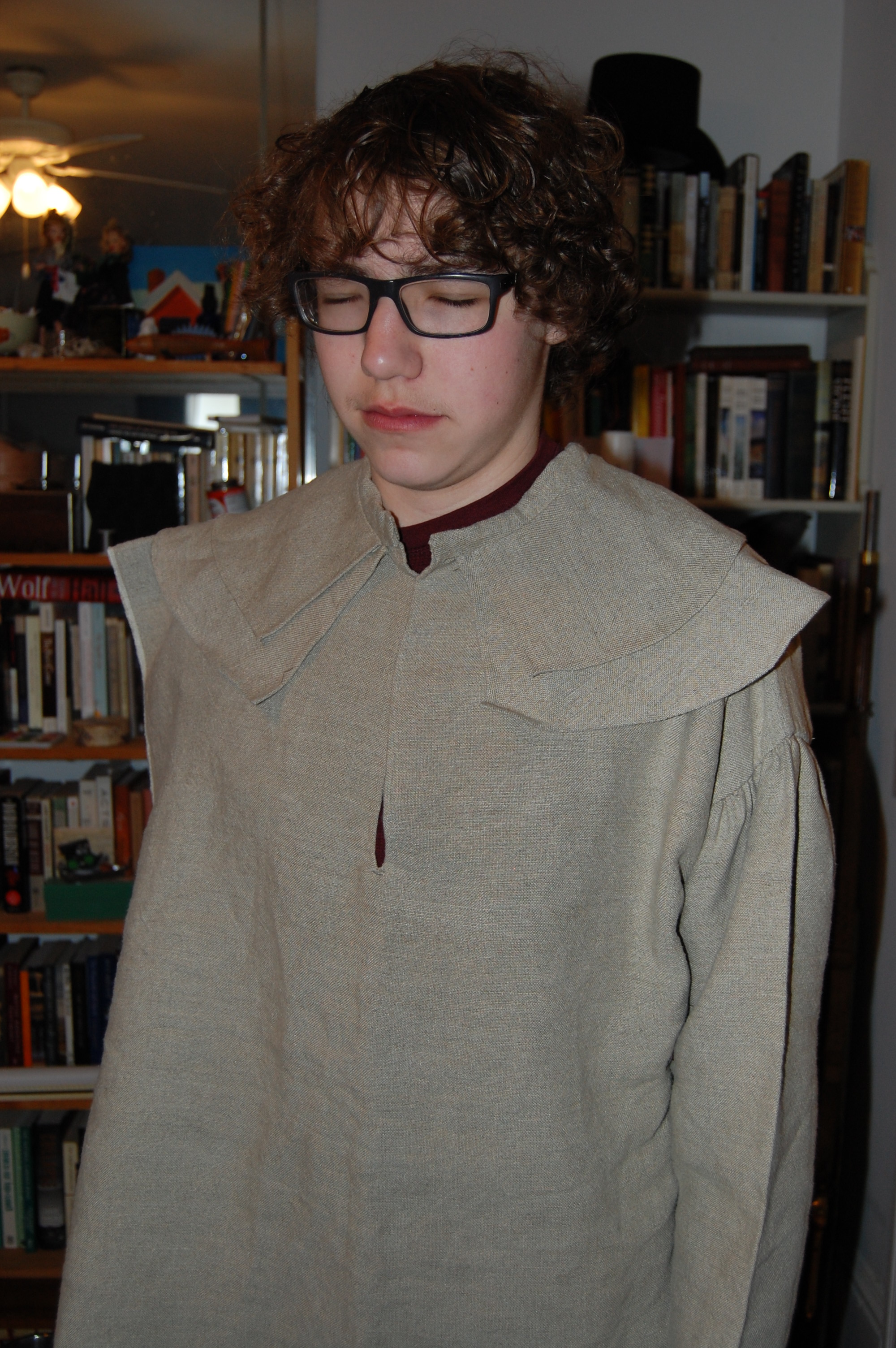
Twenty-four hours on, this is where we are: Poofy, shoulder-popping sleeve of doom. How can that be a uniform sleeve?

Well, Pilgrim, this is how:

Oh. They're all Infernal Sleeves of Doom.
Oh. They’re all Infernal Sleeves of Doom.

So glad I have that near-feral hunting shirt, because without it I would have ripped this out completely. Could the Poof of Doom be there to allow movement?

Subject was detained for photography.

Before school, even.

Arm out, doubts remain. Arm down, less terrifying.

I do feel sorry for him, but at the same time, I have to fit it to him.

It’s possible that the poof at the apogee of the shoulder is due to the intense pressing I gave this to retain the center line, and the fact that, despite washing, the linen is still pretty stiff. When I compare the two– the completed shirt and the in-progress shirt, I can see that while both display a tendency to drift up, the gathers on the adjutant’s shirt are more evenly distributed. You know what that means…and that’s why the sleeve is only basted in. Might as well change it now as on Sunday, because it must be done. So in the end, I am ripping it out completely, but with the knowledge that 1) the upward angle seems to be correct as shown in the finished garment, and 2) evening out gathers may reduce the Poof of Doom.