Reap what you Sew

Too big!

Lampshade: She’s been the Holy Grail of bonnet making.

There were several failures in the winter of 2016, and some revisiting of the Whale-Safe Bonnet as I tried to figure out the brim and the caul. My first efforts made a caul that was waaaaay too small. That’s not necessarily a bad thing, as I’ve made plenty of too-big bonnets. (Too small did not make the move from RI to VA, but trust me: too small a caul was far too small.)

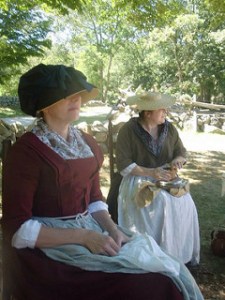
This morning, I took another look at George Stubbs’ paintings of working women. I know the lampshade-like bonnet is pre-1770, but where are we at the end of the Revolutionary War period? Well, BIG was in, obviously. (We can have a healthy debate about the likelihood of these gowned women depicting actual working women, but for now, let’s stick to bonnet brim shapes.)  They’re a little cone-like, aren’t they? With generous (yuuuge) cauls, though.

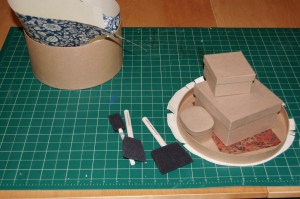
Now, I have gone about this all a bit backwards, which is to admit that I picked up the shellacked brim of yesteryear that did make the move down to VA, and decided to make it up as a bonnet yesterday. The brim is easy– trace and cut with a seam allowance– but the caul? I winged it, using a selvage edge for the inside of the back drawstring (I like my headwear to be adjustable and pack flat) and economized on fabric to leave plenty of taffeta left over. So there’s nothing particularly well-researched about this, except for all the years of looking and thinking and drawing and making that came before the moment I threw this all together yesterday afternoon watching North by Northwest and drinking a Manhattan.*

Making this up raises more questions: how individually fitted were bonnets to wearers? Did caul and brim size vary depending on wearer? What’s the class line below which a woman doesn’t have a bonnet, but only a hat? How quickly did styles change? The sort-of-conical black bonnet is seen on “older” women in paintings well past the height of the style. But as I’ve asked before, what do we really understand about the portrayal of age in art? Are we really reading the symbols correctly? How well do we grasp the semiotics of the 18th century? All of those questions are present when we try to replicate the past using only visual sources. Yes, there is an extant 18th century black silk bonnet at Colonial Williamsburg, and we can use that in conjunction with images to make the things we wear. But pondering all of these questions makes me think it’s time for another troll through collections in Great Britain, just in case new cataloging has put old bonnets online.

*See my other blog, TipsyMilliner, for more.

Headspace: Where I Work

An Ikea secretary of my own keeps most stuff organized.

I haven’t had a proper studio since I was just out of grad school and living in a three room apartment with one room dedicated to making. Since then, as I’ve taken on the baggage and responsibilities that come with two- and four-legged associates, I’ve given up a room of my own. Instead, I have have a desk of my own. And the dining table when I need it, which is most days until it’s dinner time. It works within the space we have, and best of all, the secretary can be folded closed when we go away, protecting delicious feathers and tempting beads and ribbons from marauding cats.

And the dining room table, of course.

Whatever space I have, or you have, I find the most important space is the one in my head. That’s where projects are born and die, where they’re planned and tweaked, where problems are solved. It’s the first space you have to get in order if you’re going to do your best work. Walks help. When I get stuck writing or sewing, walking usually shakes loose the next idea or solution.

A break from sewing, coming soon to the shop

To keep that headspace clear and organized, and happy working, I find music more helpful than TV, though many a Nazi Mega Weapons or screwball comedy has eased an evening of backstitching long seams. Lately, Spotify has been my go-to, thanks to these playlists. Listening to them is listening to how someone else’s brain works, which is incredibly enlightening. Whatever your art form, stepping outside your usual genre can be more inspiring than endlessly revisiting the same galleries and sources. Who better than the writer of Hamilton to show us the way?

Fitful Friday: Art Still Has Truth

Pitt and Napoleon carve up the world.

It’s been one of those weeks, hasn’t it? Up and down, emotionally, as we all prepare for change. Whig or Tory, these are turbulent times.

I’ve been surprised by recent fabric arrivals in the mail, disappointed when I waited a day too long to register for a dance, and now I’m at loose ends. What comes next?

Last weekend I cut out a black wool Spencer to line in lettuce green silk because why not? And teeny tiny backstitches later, I have one sleeve finished. Focus is hard to come by of late.

I meant to join the Historical Sew Monthly to give my sewing life some structure, and I still can, though I cannot seem to settle down. Clearly, I have Firsts & Lasts that could be made (not always in the time remaining, mind you, so I would have to choose wisely).Re-Make, Re-Use, Re-Fashion? Probably much there as well– at least if one counts the quilted petticoat worn at Princeton, which was remade and altered from its original form.

July: Fashion Plate, could become the shawl gown I’ve dreamt of for years, since, as you can see above, I’ve found one that might work, lured by a fair price on a sizable piece of wool– but wherever shall I wear it? Why can I not get past utility? The Dreamstress’ Kashmiri shawl gown and her research are there to emulate, and explain.

Oh, I have projects and events to research and plan, housework to complete, and plans to execute. But they all seem abstract and unreal at the moment when we hang on the pivot point between the future and the past. It’s been a strange year in many ways and places, and constructive projects help focus.

Art Still Has Truth Take Refuge There

Long ago, in the first turbulent times I was old enough to understand, I lived in St. Louis. Then, as now, I think the Art Museum’s motto holds, and reminds those of us who work in or appreciate sometimes frivolous-seeming fields and hobbies that all our actions have meaning. I’ve thought for a long time about the utility of sewing historic clothing, cataloging objects, and running around recreating the past.

Getting outside one’s own experience is incredibly hard; it’s hard to have an open heart, and to encourage openness to others. But that’s one of the most important roles museums and libraries play: we help people develop imagination and empathy. I know it’s part of why I do the work I do. I like to think that ultimately, helping illuminate the complexity of the past will help us all understand the present and make a better future.

Criss Cross, or, My Checker’d Past

Every now and then I look up from what I’m doing (tiny stitches, usually, though sometimes budget math) and realize that Objects in Mirror are Closer Than They Appear. Oops. It was just yesterday I was daydreaming about miniatures, and now I shall want a paintbox and brushes in a mere six weeks– and those six weeks are punctuated by a courier trip, a couple of exhibits, not to mention shepherding The Young Giant through prom and finals.

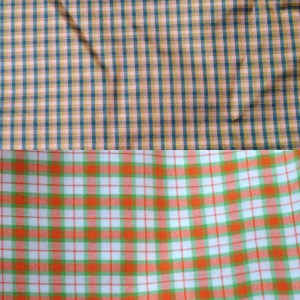
Top: check silk taffeta, Artee Fabrics Bottom: check cotton, Mood Fabrics
Top: check silk taffeta, Artee Fabrics
Bottom: check cotton, Mood Fabrics

This weekend, thanks to the SFR hunt for collar interfacing of an appropriate weight, I realized I’d better get a wiggle on my own sewing, and managed to hunt up the orange check from hell, pop it in the washer, and hunt up the pattern I intend to use.

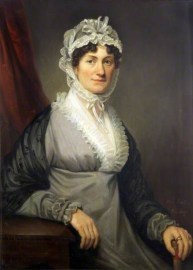
Mrs Catherine Morey oil on canvas by Michael Keeling, 1817. (c) Walker Art Gallery; Supplied by The Public Catalogue Foundation
Mrs Catherine Morey oil on canvas by Michael Keeling, 1817. (c) Walker Art Gallery

I’m stuck on that 1817-1819 range because of someone’s eventual and particular Mode of Transportation, so I was super pleased to find this portrait while trolling the BBC’s Your Paintings site. Actually, I’m pretty over the moon about this image, since it places that cross-over front firmly in 1817. I’ve made a version of this form already, so I can but hope the next iteration will be even closer to correct for the period, once I tweak the pattern a bit.

The pattern: therein lie so many rubs, often going the wrong way. Still, I remain enamored of the check and of the cross-front gown. Any checkered doubts were dispelled when Alison for reminded me of the sort-of-cross front check gown at the Met, whose catalogers are hiding behind circa 1820 which allows leeway back to 1815. Behold, of course, the ruffled neck of the bodice (I do expect mine will fit a bit better since I am squishier than a mannequin, and possess appropriate infrastructure).

Speaking of infrastructure, the appropriate stays are finished, entirely hand-sewn, and ready for deployment in pattern fittings before they debut at Genesee.

File_000 (1)

Six weeks to Genesee: at least one 1817 dress, another sheet, a portfolio and paint box, followed immediately by 18th century stays, a front-closing gown, and a bucket repair. Surely that’s all manageable, right?