cross-posted from A Lively Experiment, all images copyright RIHS.
This coming weekend, I’ll be joining in at the Coggeshall Farm Harvest Fair, along with my co-worker who helped clean the museum 18th-century style. She will be helping with cleaning and laundry and ironing (must remember to pack the lavender and vinegar solution), while I will tackle a quilted petticoat.
At first glance you might think I’ll have the easier weekend, and in some ways, I will, sitting in a parlor with a quilting frame. On the other hand, I booked myself a weekend with worries that have pestered me since we were invited in mid-August. Is the fabric I’ve chosen going to work? Do I know enough about the quilted petticoats in the RIHS collections? What kind of quilting frame is correct? And where did I stash the batting?
 Research is always the place to start. I compiled a Pinterest board of quilted petticoats in other collections to build my visual literacy, and tracked down articles by Lynne Zacek Bassett in PieceWork[i] and in the Textiles in New England II: Dublin Seminar for New England Folklife Proceedings[ii]. From the Textiles in New England proceedings, I learned that September is the second-most common month for quilting mentions in diaries for the late 18th and early 19th century in New England (May is the most often mentioned, Octobe is third). This was a relief as I wondered if quilting in September was even appropriate. With that resolved, I was able to move on to aesthetics.
New England and Rhode Island quilted petticoats share some general characteristics: the overall skirt is quilted in a diamond or diaper grid of about 1” square. Below this is a decorative band or border, usually about 12” deep. The top of this is set off from the grid by a cyma curve or wave pattern. Some examples use an undulating feather border, and others have a stylized arc and clam shell border. The background of the border is stitched in diagonal lines. Sometimes the direction is set from center front, and lines radiate to the left and right, and in other cases the lines radiate to left and right from the center line of each arced segment.
 Within the border, floral and animal motifs are quilted. Animals seem prevalent in New England quilts—there is even a mermaid in Connecticut—but none of our quilts have a mermaid. We have sunflowers, pomegranates, and carnations similar in form to the stylized flowers that appear in samplers and embroideries of this time period. Animals include deer, lions, squirrels and a creature that looks like an oryx but may be an elk. Birds are represented as well, peacocks and stylized songbirds as well as an owl, and even what seem to be roosters.
I drew these conclusions not only from reading, but from examining two quilted petticoats in the RIHS Collection, the lighter one made ca. 1745 by Alice Tripp [Casey], accession number 1985.7.1, and the darker one made in 1770 by Anna Waterman [Clapp], accession number 1982.76.3. In the catalog record, the images for 1985.7.1 are incorrect–they are for 1982.76.2, and the confusion testament to cataloging and linking records in a building several blocks from where the petticoats are stored. Now, at least, we can work on correctly them.
 The quilted petticoat that I plan to make will use the typical Rhode Island elements. The top portion will be quilted with an overall diamond pattern, while a feather border will set off the bottom band. Within that, I will quilt squirrels, chickens, and probably an owl and a cat, because they are favorite creatures in my household. I’ll also quilt in my initials, just as Anna Waterman did in her quilt.
You can join us at Coggeshall Farm Museum this weekend, September 15 & 16, starting at 10 each day, and see RIHS staff members in action! We think it will be a good warm up for What Cheer! Day, coming to the RIHS on Saturday, October 13.
[i] “Sarah Halsey’s Mermaid Petticoat.” PieceWork. January/February 2003
[ii] ‘..a dull business alone’: Cooperative Quilting in New England, 1750-1850.” Textiles in New England II: Four Centuries of Material Life, The Dublin Seminar for New England Folklife Annual Proceedings 1999. Boston University Press, 2001.

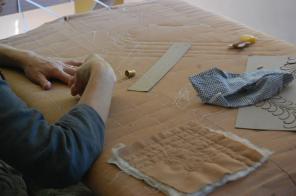 It is going to take a long time to finish, and longer because I’m doing it alone, have little room for the frame in our apartment, and have a family to sew garments for. But if I just keep stitching, it will get done.




 Kirsten Hammerstrom
You must be logged in to post a comment.