Serving Delaplace

dscn4628

With 400 miles between us, Drunk Tailor and I have few chances to explore the past together, so I was both delighted and nervous when he agreed to join the British Garrison 1775 event at Fort Ticonderoga as one of Captain Delaplace’s servants.  Even better, we were also joined by the itinerant Deep North Yankee who wandered around the Fort (possibly seeking roofing shingles, of which he is much in need).
dscn4631

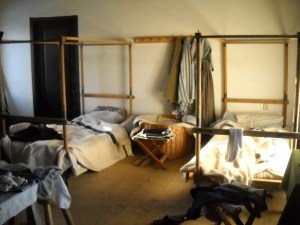
Friday nights are always magical, candle and firelight (and only the warmth of the fire) as we drink cider and talk about history. But morning always comes: Saturday, cold and clear, Mr S and I woke and blinked across the room at each other, and I wondered to what degree I really wanted to ever crawl out of bed…only hunger and an eventual need to pee (and fear of a Sergeant) propelled me.
Yup, you cook 'em on a board.
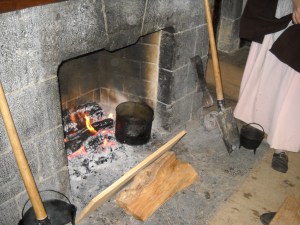
Yup, you cook ’em on a board.

First order of business: breakfast. Mr S, supplied with his corn meal of choice, made us johnnycakes, which provided perhaps more interpretive than nutritive value. Still, they were warm and tasty and he is the only person I know who can make them; my efforts end up as FEMA disaster sites.

Captain Delaplace’s servants were tasked with cooking for his mess, so Mr S and I got a start. We had a chicken, an onion (I traded onion # 2 for some bacon), butter, carrots, potatoes, a butternut squash, salt, and some port. I don’t know where this English serving woman of 1775 encountered mis en place, but she accidentally introduced coq au vin to the Captain’s table with the dinner meal.

Captain and Mrs Delaplace dining, manservant in attendance

The Captain and his Lady dined on chicken braised in butter and bacon with root vegetables in a port sauce; we servants waited until they were done before we could eat. (Confession: I need to eat a lot, and have a sensory overload problem, so when visitors fully crowded the room, I had to dash across the parade ground for a Clif Bar and an Ativan before I could continue to wait for my dinner.) In the afternoon, dishes were washed at the table, as was common (at least in early New England), dried, and set away, while the Captain’s lady and child played in the cabbage patch between the beds.

dscn4657

When the room was empty, servants were able to eat (huzzay!) and found the meal very tasty indeed. I would certainly make this again, and learned more about cooking– a typically female task I generally try to avoid– than I had expected to. Then we had yet another round of dishes before it was time to tidy the room and make ready for tea or supper.

To that end, we cleared the table and broke it apart to reveal the floor and hearth, which needed to be swept of bread crumbs, squash peels, dead leaves, and other detritus. The best way to sweep an unfinished floor in the 18th century (per Hannah Glasse et al) is to strew the floor with wet sand and then sweep. I mixed sand with lavender-infused vinegar and threw it on the floor; this keeps the dust down as you sweep months of dust and dirt out of the corners and from behind tables and chests.

The trick is to sweep in one direction (more or less) from the back of the room to the front, and then to gather up the sand (here in a shovel) and pitch it off the landing. Much was thrown out the door and over the stair rail, just as servants would have done in 1775. (And I am told it is soothing to nearly hit the sergeant, but perhaps that’s merely hearsay, if not heresy.)

img_9478

When we were done, we restored the table (Drunk Tailor noticed the height of the ceiling, and wondered about hanging birds in cages whist awaiting the return of the tabletop), fully reset with cloth, candlesticks, plates, and knives, ready for the supper we didn’t cook, as we skipped away at the close of the day to find our own meal in Glens Falls, where live music is inescapable on a Saturday night.
“Exteriorizing,” or, Showing the Past: Part II

Part II of the two-part guest posts by Sharon Burnston. Part I is here. ( Just below, if you are scrolling)

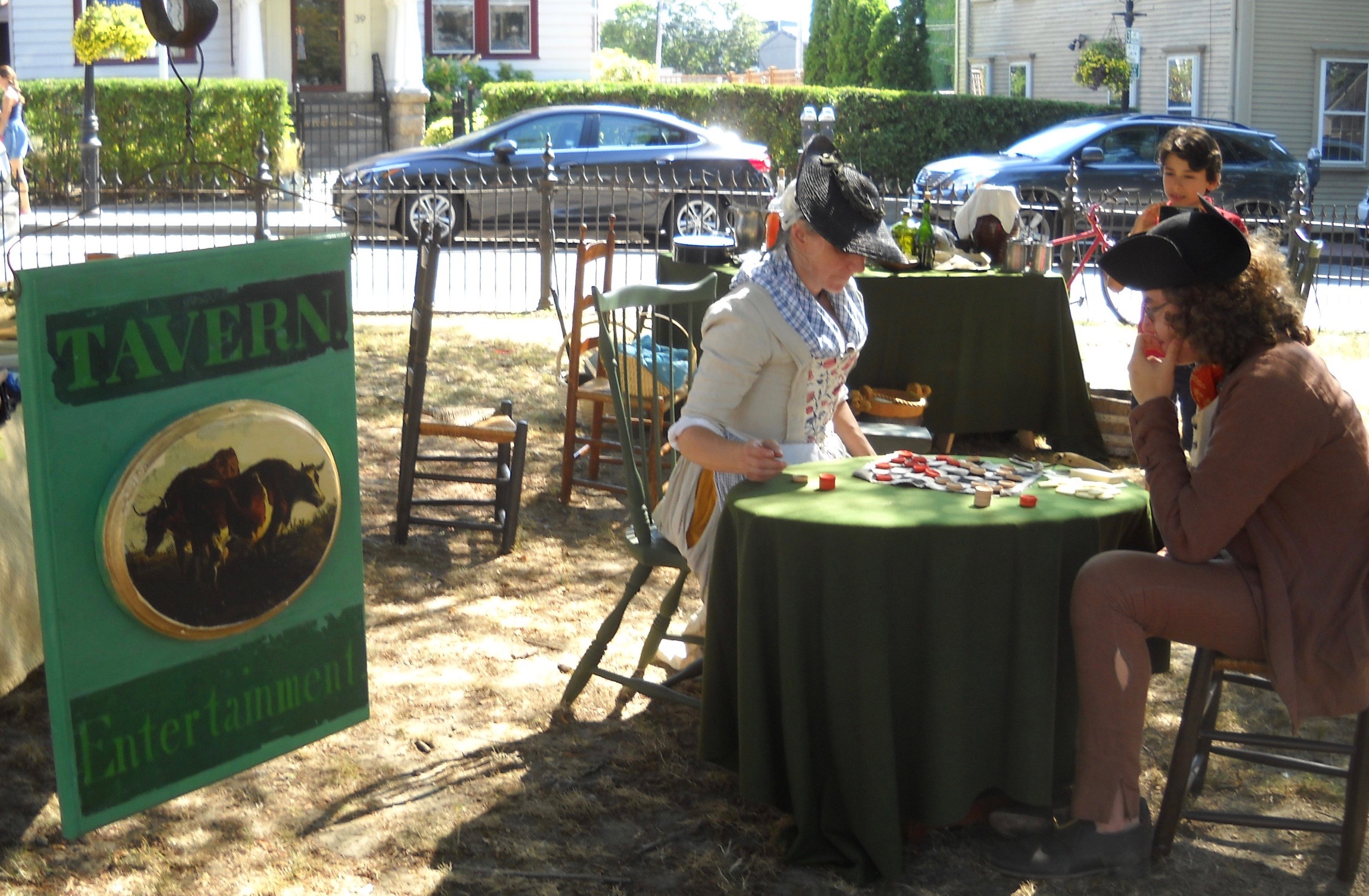
In the previous blog post, I explained the concept of “Yes, and”. But in the case of the naval press gang reenactment last summer in Newport, the “Yes, and” dialogue that I expected didn’t happen. When the press gang invaded the tavern I was mistress of, and started grabbing sailors, I attempted to intervene. This would have allowed me to put into words, for the benefit of the public watching, what this intrusion into our community would do to the town, in terms of the loss of the local men both collectively and individually.

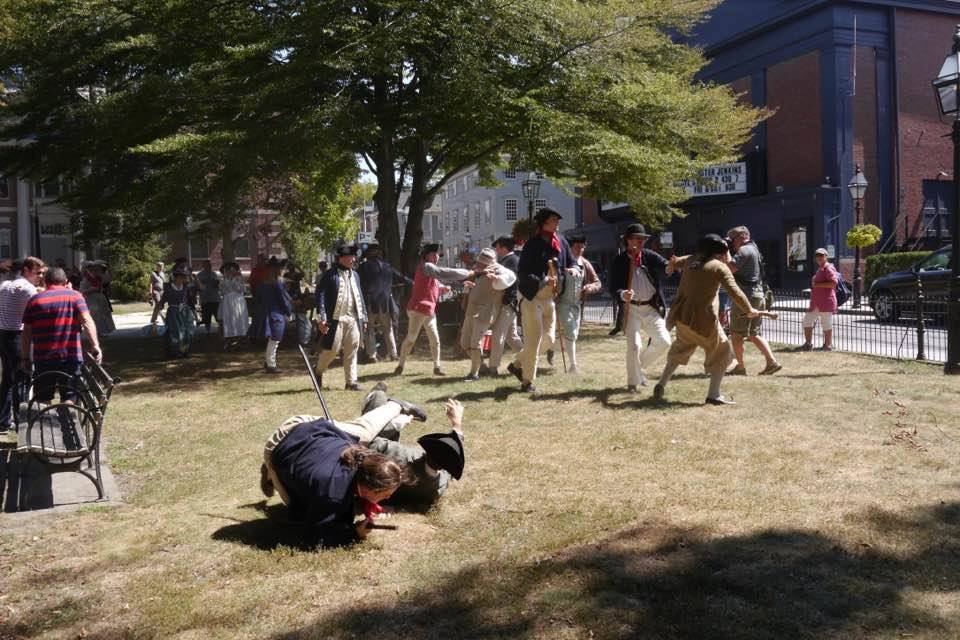
Melee in the Square, Newport RI, August 2016

In attempting to defend my customers, I as tavern mistress could have functioned as a token representative of all the other women of Newport, all of whom had economic, social, and maybe personal ties to the impressed men. The public would have had a better chance to grasp what the impressment actually meant to the people of Newport. But this failed to happen. Nobody in the press gang picked up on my gambit, they went about their business with a very convincing and no doubt authentic silent ruthlessness. One brandished his club and snarled, “Silence, woman!” which effectively shut down my efforts entirely. However one of my “customers” picked up on my gambit and began pleading to be released on account of his wife and children, but he got essentially the same response that I did, and he was also shut down.

Alex Cain impressed in Newport, August 2016. Photo by Philip Sherman, Newport Daily News

I didn’t put all that effort into my tavern and tavern mistress impression just to be a scenic backdrop for the press gang. It was my expectation that there would be interaction between the tavern owner and the naval crew, which would serve to better educate the public by exteriorizing what we roleplayers were thinking and feeling about what was happening. My mistake was in taking for granted that this would be obvious to the other role players, and that the naval crew would give me a “Yes, and” response for the benefit of the audience.

In short, I think we could have done a better job of *interpreting* what was happening if we hadn’t all been quite so focused on doing it as *authentically* as possible. I do not in any way fault the guys who were portraying the naval crew. To their credit, they played their roles with superb accuracy. If anything the fault was mine for assuming we’d be all on the same page, and ready to interact with one another. It is my opinion that as an interpretive exercise, this living history scenario would have benefited from being just a teensy bit less “authentic” and a little bit more theatrical.

A Cribbage Party in St. Giles. Thomas Rowlandson, 1787. Royal Collection Trust.
A Cribbage Party in St. Giles Disturbed by a Press Gang. Thomas Rowlandson, 1787. Royal Collection Trust.

In talking afterward with members of the public, I found too many of them confused, they saw the action but didn’t really understand what was going on, nor what was at stake for the various individual characters involved. It would have been so easy to get the essential points across while the scene was unfolding, and it doesn’t take long, a few sentences exchange is enough. But all participants have to understand in advance the merits of this, and be prepared for it when it happens.

DSCN4459

In my opinion it’s great, but not enough, to know the best possible historical information on the event we are presenting, and to replicate the clothing and equipment so meticulously. We also should be prepared to join together to learn how to portray it in the most informative and articulate way possible. This can only make our first-person historical reenactments even better than they already are.

“Exteriorizing,” or, Showing the Past: Part I

This guest post was written by Sharon Burnston. Sharon and I will be co-teaching an interactive workshop on first person impressions this June. “Exteriorizing” is an important part of developing an impression that works not just to represent a character, but to tell a story. Part II will appear tomorrow.

John Gilmary Shea, The Story of a Great Nation (New York: Gay Brothers & Company, 1886)after 444, says "page 475" University of South Florida clip art collection.
John Gilmary Shea, The Story of a Great Nation (New York: Gay Brothers & Company, 1886)after 444, says “page 475” University of South Florida clip art collection.

The first time I was ever “abducted” at a living history event was during an F&I scenario 35 years ago. I was dragged off into the bushes by scary looking strangers, and it was all very well researched and convincing.

But one thing I realized, upon reflection afterward, is that a really accurately portrayed scenario isn’t always in all ways the “best” scenario, for the participants or the public. In real situations that are terrifying, the usual physiological/behavioral responses are those described as Flight, Fight or Freeze. That’s what real people do when that sort of thing really happens. At the time I was abducted by “the French and the Indians”, I put myself into the moment, imagined how I would really feel if it were actually happening, and I froze. I portrayed terror so well, my abductors looked at me oddly, wondering if I was okay. But y’know what? The spectators, standing 30 feet or more away, couldn’t see my face, couldn’t hear my shallow breathing, and they got nothing out of it.

The Abduction of Daniel Boone's Daughter by the Indians. oil on canvas by Carl Wimar, 1853. Washington University Kemper Art Museum. Gift of John T. Davis, Jr., 1954 WU 4335
The Abduction of Daniel Boone’s Daughter by the Indians. oil on canvas by Carl Wimar, 1853. Washington University Kemper Art Museum. Gift of John T. Davis, Jr., 1954
WU 4335

I realized that I had actually failed to do justice to the interpretive moment, I should have done something less lifelike and more communicative. I should have screamed for help, in detail, loudly, and at length. In real life, this would have been a risky thing for a captive to do, but in a reenactment interpretive setting, it would have been useful. I mean, I knew precisely why my character was terrified, but did the public? If I had screamed and carried on, it would have given me an opportunity to put into words what the 18c abducted woman knew about what was going to happen to her. It would have been a better scenario in terms of educating the public if I had, in a word, exteriorized what my character was feeling into words, for everyone present to hear.

The problem with my having learned this sort of thing experientially and so long ago, is that I tend to blithely assume that other folks whom I regard as skilled 18c role players also know it, because to me it is by now so obvious.

DSCN4448

Last summer I participated in a brilliant re-creation of a different kind of abduction, a reenactment of the British naval press gang that abducted American sailors out of Newport RI harbor in 1765. Over 60 of us from all across New England worked hard for months to research and develop our impressions in order to make this event as convincing and accurate as we could. For the most part, we succeeded magnificently. But I came away dissatisfied and I think some of the public I talked to did also. That was a helluva scenario, meticulously planned and carried out, and we did it so well! But I think we could have done it one or two notches better, and here is why I think so.

First person role playing has far more of theater about it than perhaps we living historians care to admit. Drawing upon theatrical strategies can allow us to better communicate our knowledge to the audience, by exteriorizing our characters’ thoughts or feelings into dialogue the public can hear, even if doing so might slightly violate the strictest historical purity of our role playing. After all, don’t we claim to be doing this in order to educate the public?

The strategy I have in mind is the collaborative trick referred to in improvisational theater as “Yes, and”.

“Yes, and…” refers to a basic concept in improv theater. If a participant throws a gambit at you, don’t shut it down. Accept it, whatever it is (“Yes”) and then add something of your own (“and…”) to expand on the idea and keep it going. “Yes” means being receptive to the contributions of others. “And” means offering something back, to further the collaborative process.

How would this notion apply to a living history role playing scenario? Stay tuned to find out!

Fitful Friday: Art Still Has Truth

Pitt and Napoleon carve up the world.

It’s been one of those weeks, hasn’t it? Up and down, emotionally, as we all prepare for change. Whig or Tory, these are turbulent times.

I’ve been surprised by recent fabric arrivals in the mail, disappointed when I waited a day too long to register for a dance, and now I’m at loose ends. What comes next?

Last weekend I cut out a black wool Spencer to line in lettuce green silk because why not? And teeny tiny backstitches later, I have one sleeve finished. Focus is hard to come by of late.

I meant to join the Historical Sew Monthly to give my sewing life some structure, and I still can, though I cannot seem to settle down. Clearly, I have Firsts & Lasts that could be made (not always in the time remaining, mind you, so I would have to choose wisely).Re-Make, Re-Use, Re-Fashion? Probably much there as well– at least if one counts the quilted petticoat worn at Princeton, which was remade and altered from its original form.

July: Fashion Plate, could become the shawl gown I’ve dreamt of for years, since, as you can see above, I’ve found one that might work, lured by a fair price on a sizable piece of wool– but wherever shall I wear it? Why can I not get past utility? The Dreamstress’ Kashmiri shawl gown and her research are there to emulate, and explain.

Oh, I have projects and events to research and plan, housework to complete, and plans to execute. But they all seem abstract and unreal at the moment when we hang on the pivot point between the future and the past. It’s been a strange year in many ways and places, and constructive projects help focus.

Art Still Has Truth Take Refuge There

Long ago, in the first turbulent times I was old enough to understand, I lived in St. Louis. Then, as now, I think the Art Museum’s motto holds, and reminds those of us who work in or appreciate sometimes frivolous-seeming fields and hobbies that all our actions have meaning. I’ve thought for a long time about the utility of sewing historic clothing, cataloging objects, and running around recreating the past.

Getting outside one’s own experience is incredibly hard; it’s hard to have an open heart, and to encourage openness to others. But that’s one of the most important roles museums and libraries play: we help people develop imagination and empathy. I know it’s part of why I do the work I do. I like to think that ultimately, helping illuminate the complexity of the past will help us all understand the present and make a better future.