Style Council

National Gallery of Art furniture gallery, May 2017

One of the critiques leveled at historic house museums is that they’re often “frozen in time,” specifically a particular moment, rather than reflecting the changes that happened over time. This charge is sometimes leveled at period room installations as well, when all the furniture in a room is from a tight time span– a year, maybe five– when for most of us, the furnishings in our homes and the clothes in our closets reflect a number of years, rather than a tight twelve or eighteen months.

So, when we go out “into the field” (or the house or the milliner’s shop or the tavern), shouldn’t our belongings reflect the multiplicity of years of objects? If I’m a woman Of A Certain Age, won’t I have possessions, from jewelry to ceramics to clothing, from multiple decades? Well…. yes and no.

It’s true that as far as we can tell, John Brown moved his 1760 furniture into his 1788 mansion, but we also know he bought new furnishings, including a large (188+ piece) set of Chinese Export Porcelain (see above).

Up-to-date, stylish, expensive: table settings signaled wealth and sophistication as much as clothing and manners, so whatever JB had before 1788, he wasn’t setting his new table with it. What might he (or Mrs B) have done with it? Consigned it to use by grandchildren and servants? Given it to less fortunate relations? Possibly. And if they had creamware, it would not have been singularly out of place in 1788 or 1800 on any table– it was only 40 years old, and heaven knows my “best” china is from the 1930s– but would they have used earlier pottery, even in the kitchen?

All pottery is not the same: North Devon pottery, while imported to North America in the late 17th and early 18th century, is not what you would expect to find in a late-18th century farm kitchen. It’s here, sure, into the mid-18th century, but in 1799, it’s not the form you would expect to see. So what does that mean for living history folks? Does it matter what you use?

You know what I think: there ain’t nothing like the real thing and that means paying careful attention to details. If you’re portraying a camp follower in 1778, or tenant farmer in 1799, you are not likely to have, say, a Jackfield-type figured tea pot, just as you are not likely to have a salt-glazed squirrel-relief cream jug, no matter how much you adore it.

Time and style matter. The people of the past read each other the same way we read each other. Remember Clarice Starling, with her “good bag and her cheap shoes”? Get on a train anywhere, and you can read your fellow travelers: you can guess income and education levels, marital status, and sometimes interests and hobbies if you look closely. You make assumptions about people based on their appearance, whether you’re conscious of it or not– and so did the people of the past. To portray them accurately, and to help the public learn to read the past, the details matter.
Everything Old is New Again

I could be making bonnets. I could be applying for moar jobz. I could be finishing the soup that’s on the stove. But instead, I’m annoyed by a museum’s social media posting. For the sake of all that’s holy in history, is there nothing more to an 18th century soldier’s life than his weapon? Now, to the museum’s credit, only 50% of the posted images could truly be said to focus on the musket or some musket-related tool.

But what’s so damned annoying is that the organization in question, all brand-spanking new and on everybody’s “must-see” list, falls back on the same old tropes on social media, which makes me want to know more about their educational mission. If the social media message continues to reinforce the same messages (guns are important) instead of expanding to include a soldier’s daily life, or even his inner life, the public has trouble moving past that simple message to ask more questions.

Museums and their representatives cue the questions visitors ask by framing objects, writing labels, even aiming the lights, to focus on what the museum believes is important. Put guns front and center, that’s what the questions will be about instead of about hygiene, clothing, literacy, or diet.

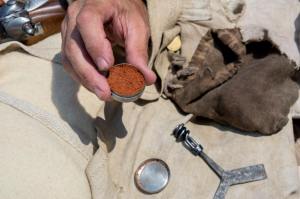
This image got me really excited, until I read the caption.

“Brick dust for polishing the brass elements on his weapon.” Dammit! It’s not tooth powder!

I understand full well that the museum’s interpretation of our national founding is far more inclusive than many museum visitors have previously encountered. I understand that the educational program currently lacks a permanent director, and is not yet fully fleshed out.

Museums are among the most trusted sources for information. Presentation matters. What museums emphasize matters. If museums — in their exhibits, programs, or marketing– continue to “give the people what they want,” the people will not know that they can want something different, or even that there is something different to want. Inclusivity is constant: in the galleries, in the labels, in the programming, in the staff, and in the marketing (which this museum did, in fact, do, masterfully, at a major train station).

But I’m picking on them for this post because they are the top of the game right now, and if they can do better in the galleries and in the train station, they can do better on social media. They’ve had some of the best female interpreters around working this month and the end of last, and yet the first social media post on that program is of a soldier, and focuses on his weapon. The past– and the present– deserve better.

Rethinking Reenacting Redux

Some of you may recall my friend from the antediluvian age, Dread Scott. He was in town briefly and while I wasn’t able to attend his talk, I got my own special artist’s talk over breakfast.

Scott’s working on a Slave Rebellion Reenactment, (additional info here) so we had a lot to talk about.

Scuffle in the Square, Princeton, 2017. Photo by Wilson Freeman at Drifting Focus Photography

He had some great questions about what we do, and why we do it, especially around Princeton, and in talking about my end goal (getting the public to understand how the past informs the present), I said something about how in Newport in 2014, the cars disappeared and we forgot we were in the present.

Scott’s great reply was about keeping the present present, occupying two time periods simultaneously, to recognize that the past made the present. I know that seems obvious, but it isn’t always when we’re out in our funny clothes. It’s another layer of interpretation that we can build onto our reenactments and recreations, particularly when we are trying to talk about slavery. Slavery built the institutions we have today– like Aetna Insurance and Georgetown University– so if we acknowledge our surroundings in a place like downtown Princeton or Newport, we can talk about more than just the moment we are recreating.

Some of us seek historical transcendence. Some of us enjoy a social experience. And some of us seek ways to connect the present to the past in ways that help us understand how we got here, and how to make a better future.

The more I contemplate what matters to me, the more I think I’m seeking that last more than I am even transcendence.

History Hurts

We have been here before: terrible stays, stays in need of minor mods, and “it isn’t history till it hurts.” New this past weekend was the Busk Bust Blister (Bursting) which didn’t make History hurt, but sure did bring a sting to the wind-down afterwards.


These new stays are, so far, the best I’ve ever had and well worth the blood, sweat and swears it took to make them. Gowns do seem to fit better over these stays; they held up well at muggy Monmouth and in polar Princeton, but the last two rounds at Ti left me feeling like I’d taken a hoof to the ribs.

What gives, kidneys? At least this time I made it past Fort Ann and all the way into a private room in Glens Falls before I had to free the sisters and release the lower back.

IMG_7298

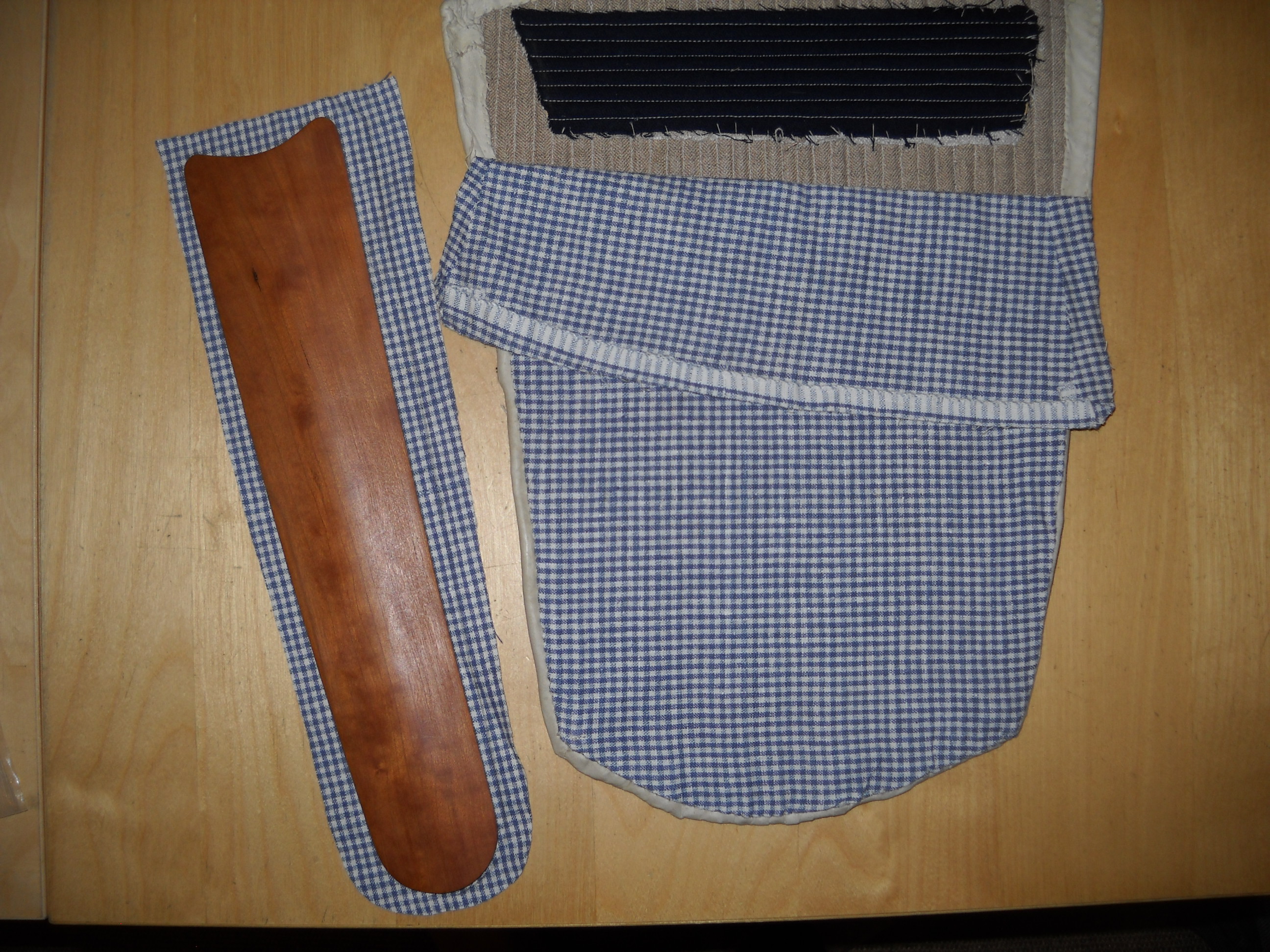
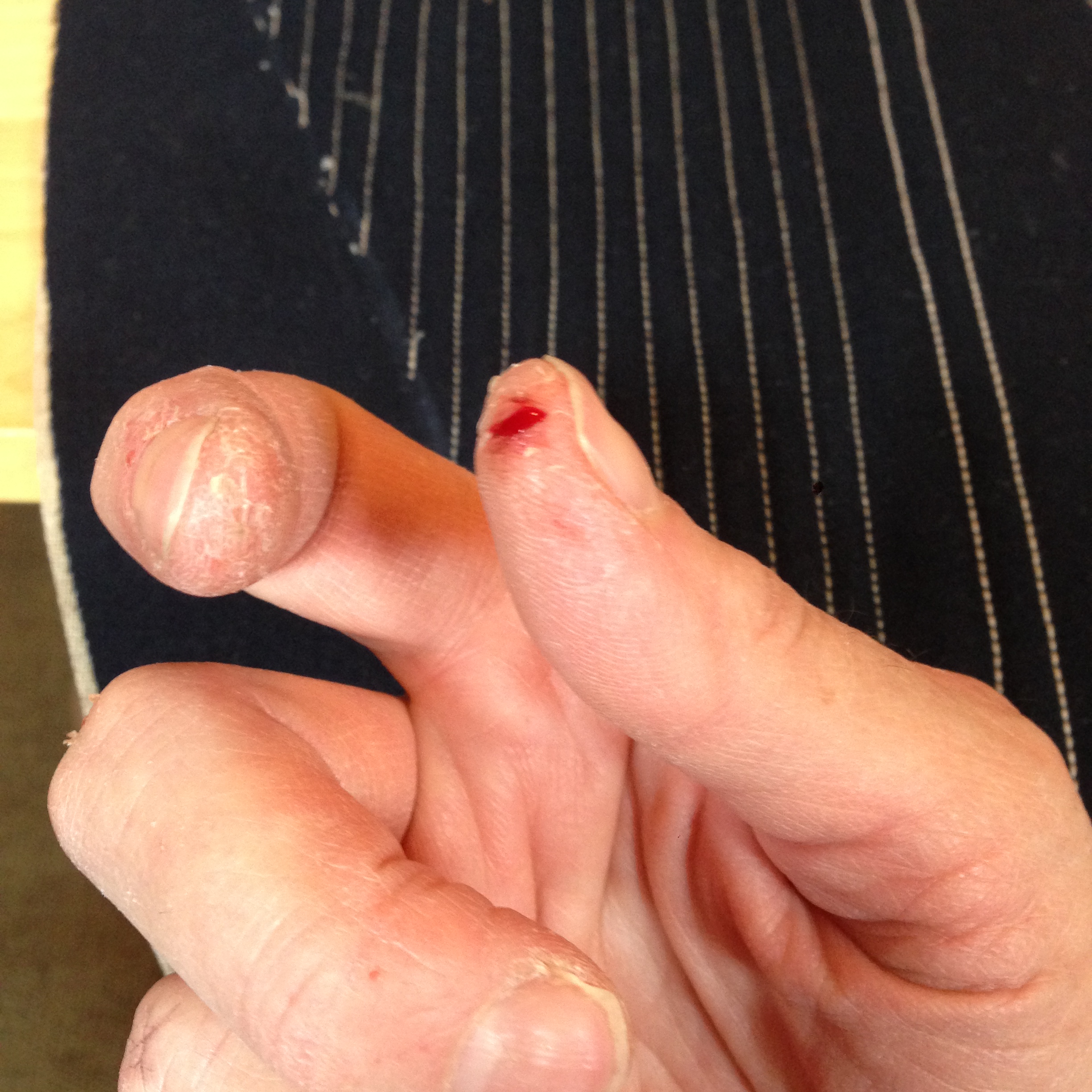
But this time, there was a bonus: the previously indicated Bust Blister. On the left side (I’m right handed), I developed a fairly robust .25” x .125” blister that crowned the top of a nearly 2” red mark, mirrored on the right by a less red and slightly less long mark. The culprit?

The Busk of Doom, of course.


dscn4568

Strictly speaking, I should not sport a busk when I desport as Captain Delaplace’s serving woman, or as a refugee cooking up the last of the bread, eggs, and milk. I’ve earned these marks and (potential) future scars by dressing above my station, and need to adjust accordingly.

Step one: Rounding down the busk edges (now in the capable hands of Drunk Tailor).
Step two: Foregoing the busk when working.
Step three: Wearing partially-boned stays when working.

Two is the easiest; three is the hardest. Which do you think I am, therefore, actually contemplating as a necessary next step?

But of Course: Step Three, Pathway to Finger Cracks and Stained Stays.

d'oh! surgical tape made this *much* better later.
d’oh! surgical tape made this *much* better later.

Fortunately I have people close to me who will ensure that I work through steps One and Two before embarking upon step Three, but I certainly want to know more about (and will look much more closely at images of) working women in the third quarter of the 18th century. My suspicion is that women who are performing labor that requires movement– up and down before a fire, back and forth across a floor, bending over a tub– may not be wearing stays made in exactly the way high style stays are made for ladies who bend over an embroidery hoop, glide back and forth across a ballroom floor, or move up and down the stairs of a well-built home they supervise.

Or my busk pocket is too big, my busk edges too square, and my actions too fast and continuous.

Paul Sandby. At Sandpit Gate circa 1752 Pencil, pen and ink and watercolor. RCIN 914329
Paul Sandby. At Sandpit Gate circa 1752
Pencil, pen and ink and watercolor. RCIN 914329

What are these women wearing? They certainly look fully boned. What can I change to make my stays work better for working? No matter what, where there are variables, there are experiments to run, and that’s what really makes history fun (even when it hurts).