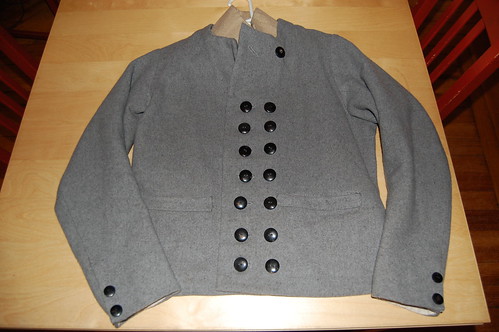
HSF #0: Waistcoat, Bloody Waistcoat

Challenge garment peers from jacket. Calm thyselves, fellow authenticity hounds. New buttons for jacket are on order.

(Actually, the jacket was bloody where I jabbed myself with the needle inserting the sleeve, but that’s fun for another day. And how you know your historical sewing project is complete. I bled for this, man.)

The Challenge: #0, Starting Simple

Fabric: Body: ¾ yard remnant from Wm Booth Draper WWB816 Broadcloth, light brown. Lining: Left over heavy-weight linen. Might also have come from Booth, I forget.

Pattern: Kannik’s Korner Man’s Waistcoats, 1790-1815

Year: Call it 1799. That’s the year where it will be worn.

Notions: 9 brass buttons from Wm Booth Draper
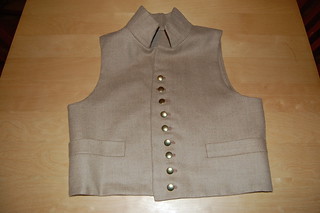
What monkey did those buttonholes?

How historically accurate is it? Well…the pattern has good documentation and the fabric is within reason for the period. The waistcoat is entirely hand-sewn, but the button holes were apparently accomplished by drunken crack-headed monkeys, which is what you get for trying to finish a garment on New Year’s Eve. I was neither drunk, nor on crack, and have no helper monkeys, but all the same…thank god for jackets to hide the sins of my buttonholes.
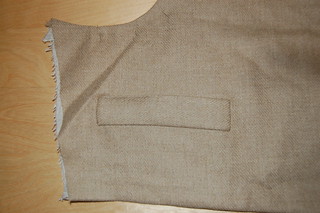
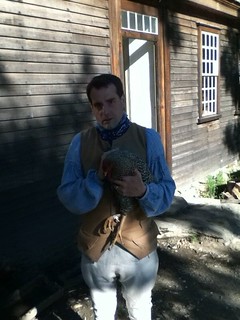
Best welt I ever made–aside from butting heads with a colleague once.

Hours to complete: Don’t ask. It’s a soul-robbing number. The buttons and buttonholes alone took 1 full and two half Abbot & Costello movies, and two “Monarchy” episodes. Probably 25 hours total (I started in November, but stopped sewing after December 2). Total time may include naps taken when I fell asleep while sewing.

First worn: To be worn by the new owner (Mr S) January 19, at the Winter Frolic.

Total cost: Blood, sweat, tears… sorry, wrong war. Buttonholes bring that out in me.

  • Fabric:  $13.50
  • Lining: Leftover, hence not factored in.
  • Buttons: Used 9, but bought 10 because I’m not as simple as I look, so $12.50
  • Pattern: Also from Wm Booth, $16.

That puts the cash outlay at $26 for materials, and $16 for pattern, which I will use again starting yesterday. Yes, sports fans, another bloody waistcoat to sew. Lucky for me, it’s red, so the blood won’t show. Checking the HSF schedule, I can see that the only 1813 garment I can make is another waistcoat (1790-1815, remember?) for the Young Mr, who needs a full set of clothes made by January 19. Waistcoat underway, pattern pieces assembled and two more pieces of broadcloth remnant order for a jacket, leaving trousers to wrestle with. At least I have fabric. 

Sweet Little Dresses

Bellville Sassoon rang no bells for me, being American. So I did the google and ended up at the V&A, of course. They have a Bellville Sassoon evening gown, which is a lovely column of froth and beads, but not my taste.

V&A T.17-2007
V&A T.17-2007

This led me to gifts from David Sassoon,including this miniature dress, a quarter-scale couture reproduction of a Jean Dessès dress.

Whoa. That’s really interesting!

There’s a Madame Grès as well, and the V&A catalog record notes:

“These scaled copies use the same fabrics and show the superb craftsmanship as their full size equivalents. The V & A have four of these miniature dresses which the donor acquired from the archive of the wholesale house of Dorville. Wholesalers would buy the copyrights to couture dresses so that they could sell modified ready-to-wear copies. It is thought that these quarter-scale dresses were sold alongside the patterns to show how the dress looked when made up.” Ever see the Newman-Woodwar movie A New Kind of Love?

What I love about the the Dessès dress is how much it reminds me of these dresses:

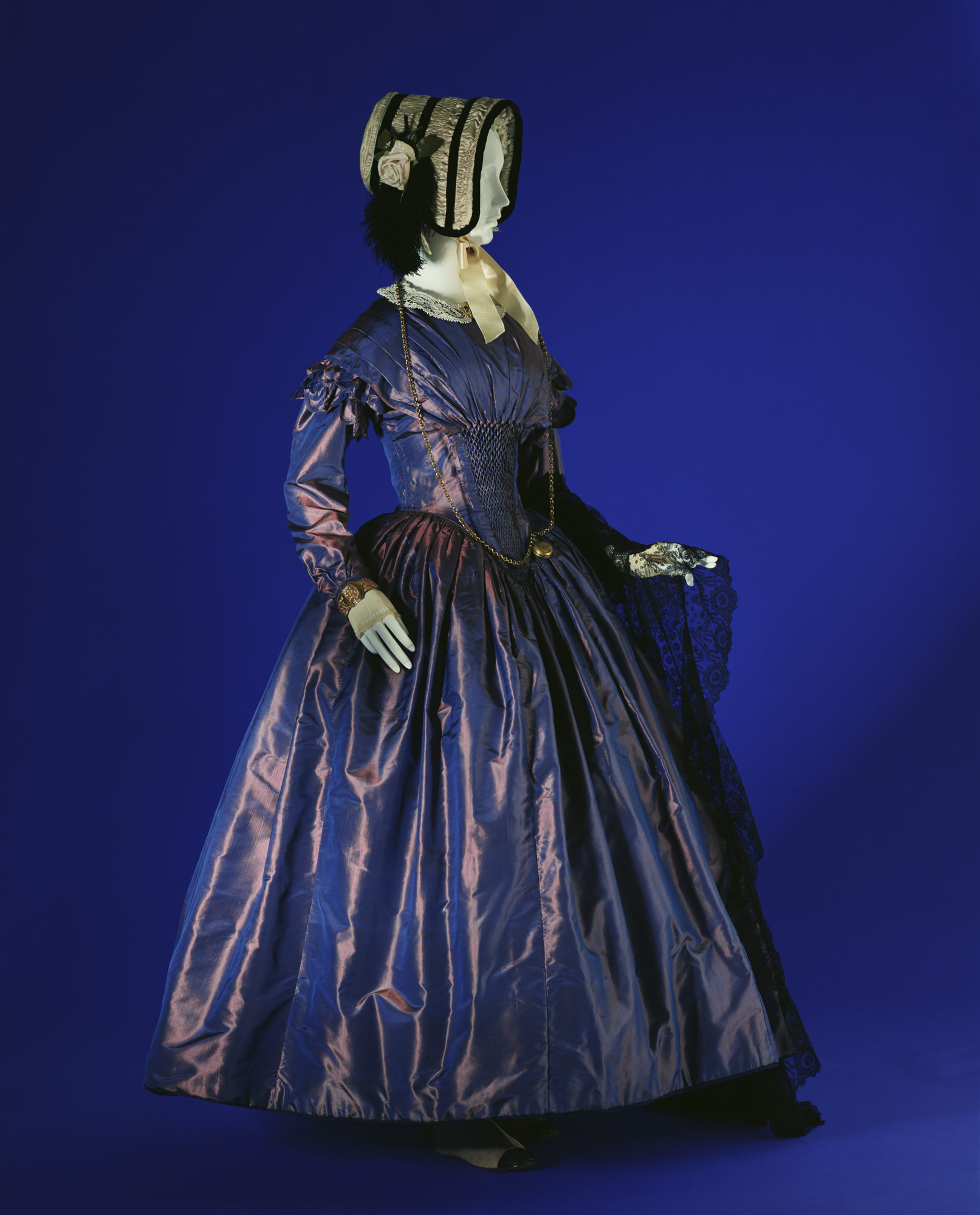
KCI 1845 English Day Dress
V&A ca. 1895 T.17-1985

That’s one of the fun things about fashion, and about history. Details emerge and re-emerge in style and design (yes, historicism) and connect our present with the past. Museums strive to do that every day, but fashion can do it on the street and in your closet. That’s another kind of living history.

Consider the Chicken

https://i0.wp.com/farm9.staticflickr.com/8311/7995409969_f925f8a7eb_n.jpg
Nobody puts Dumber in a pot

With apologies to the late David Foster Wallace

The majority of us do not consider the chicken. We may consider whether the package of chicken we purchase is free range, organic, cage-free, grain fed, cruelty free. But we are unlikely to think about the implications for the physical being, the essence of chicken-ness, that the chicken’s conditions create for it.

And I am here to tell you that the cage-free, organic, free-range chickens and chicken parts that you purchase at Whole Foods or your other large vendors bear little to no relationship to the actual free-range, catch-as-catch can, ne’er-do-well chicken of the historic barn yard. For one thing, living history chicken is ripped.

https://i0.wp.com/farm9.staticflickr.com/8205/8243387583_072e352ff9_n.jpgIt’s well-developed physically, with strong, sturdy bones and robust ligaments. Its musculature is tight: this is not a bird in need of a personal trainer. Its meat, when cooked, is not white. It is dark meat, not so dark meat, and sort-of white meat. Its taste was described to me as gamey, but I disagree. It was chicken, but earthy, sweet and fresh and rich.

But all that came after the meeting of human, knife, and chicken.

Disassembling the chicken fell to me; I declined rubbing butter into flour having prevented a fall down cellar stairs by putting my hand in fresh goose guano, so I after I washed my hands, I addressed the chicken in its bowl, and took up a knife.

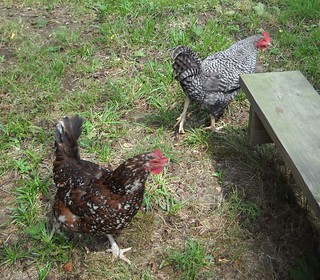
Dumber & Friend

By this time, post-carrots, -parsnips, -squash, -string, -tallow and -suet, the knife lacked the purest essence of knife, that is, sharpness. But it functioned well enough for the task, with some persuasion. The skin was much thicker and more resilient than a store-bought chicken, and greasier, though not in an unpleasant way at first. The muscles were well-developed, and pink. Rosy pink, deep pink, dark like wine. There were no large slabs of the shiny, flaccid, pale meat you find on the chickens in the store. Those aren’t chickens any more: those are products.

The process of quartering the chicken took strength and pressure on the knife, and the strength of my hands. I did have to rip joints apart, and break the carcass’s back. All of this had a sound, and a mild smell of chicken, mixed with the melting tallow. But it was the sound that, with the greasy, slick knife, and the grease that soon covered my hands and wrists, that kept bringing me back to what I was doing, and that, when the bird was broken apart and in the pot and my hands washed, again (they itched), send me outside and up the hill for air and sky.

We boiled the chicken in a kettle we’d already boiled crook neck squash in; later, we added sage, thyme, parsnips and carrots. It was delicious. The broth was incredible, and the whole meal very simple. That’s the whole of the recipe: boil a chicken, add herbs and root or fall vegetables, boil until done, serve. Use any uneaten broth and bones/meat for  stew, pie or other dishes. That’s it.

The product chickens from the market are bred to fall apart. They haven’t got what a running, pecking, eating everything chicken’s got in muscle, ligament, and tendon.

On Sunday, after we came home, I looked at the food in our cupboards. There were boxes, cardboard, plastic, layers of packaging. The cheese was square. These things came from the good market, but were they food, or were they products? I felt like a passenger on the ship in Wall*E, and I was appalled.

Working Weekend

https://i0.wp.com/farm9.staticflickr.com/8482/8239978492_81e339d5fe_n.jpgThis is the house at the farm museum where we went to work on Sunday. That bright orange under the window is squash. The part painted red is an office addition and not interpreted space.

This is the view from the site.https://i0.wp.com/farm9.staticflickr.com/8062/8238909459_f9165ff136_n.jpg It is not exactly what the tenant farmers would have seen, even discounting the power lines and road surface.   But even with the caveats of constant change in mind, I do not have access to a better lab for understanding the past. There are times when even the smart and sophisticated among us cannot come up with a better (just between us) interpretation than, “1799 sucked. And it was greasy.”

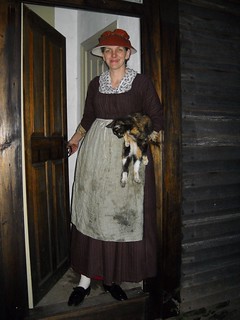
https://i0.wp.com/farm9.staticflickr.com/8210/8238912881_454a7e8b67_n.jpgThat’s not what we want the visitor to learn (everything in the past was hard) though sometimes I fear that is all they take away. Callie, seen here swearing in my hand, was trying to take away leftover chicken and so was taken away herself.

The more time I spend stooping to reach a vat of tallow, or tearing a chicken carcass apart with my hands and a dull, greasy knife, the more I think that what we fail to grasp is not that people thought differently in the past. It’s why they thought differently.

Lives could be a great deal smaller: tasks were hard and all-consuming. Even as I realized that work would be faster with greater familiarity, I also saw that repetition would not breed enlightenment, because increased speed would only make the next task come more quickly.