What’s in your pocket?

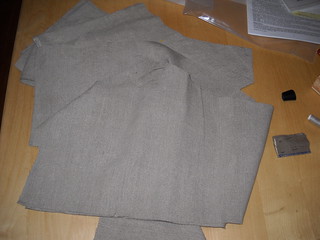
A typical rough linen lining

My son’s pockets used to be full of acorns: he collected them at the bus stop, but I don’t know if it was because he planned to feed the squirrels, or if he thought he was a squirrel. Later, he moved on to rocks. Now, rocks, fish hooks, a pocket knife, change and a hankie fill the pockets of his 18th century breeches.

We’ve had some moments of unhappiness when things have gone missing from the pockets, though we’ve usually found them again. When you look at the contents list, you wonder how the linen stands up as well as it does.

There’s a clever way to upgrade pocket bags in menswear, and it’s authentic: leather bags, instead of linen. Original garments have leather bags, probably deerskin, and they’re deliciously soft and very durable. Stuff all the heavy, sharp things you want to in that pocket, and it will probably take it.

1895.4.3A-C
1895.4.3A-C

Based on a suit in the RIHS Collection, I decided to modify the pocket bags on the Young Mr’s new workman’s jacket-in-progress, which I plan to have finished by March 11 for HSF #5, Peasants and Pioneers.

Made of a heavy, rough-finished brown broadcloth (possibly manufactured in New England), both jacket and breeches pocket bags are made of deerskin.

Pocket bag in progress.

To recreate this, I took a trip to the auto parts store, and purchased a large chamois.  Instead of cutting the bags from linen, I cut them from the chamois and trimmed the seam allowances: chamois won’t ravel, so the seam won’t need to be folded over at the top.

A little fuzzy, but you get the idea

I backstitched the bag seam, and in general, I’m pleased with the way it has turned out. I think I’ll look into additional leather options, but otherwise, it seems like a fairly successful experiment.

The real test, of course, will be user testing. How many sharp, heavy things can the kid load in a pocket before it gives out?
Dressing and Undressing in Newport

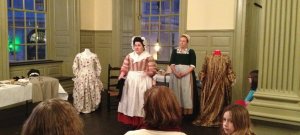
A lady and her maid
The Ladies, Dressed, in Newport

Last Thursday evening, my friend and I went to the Colony House in Newport  for the “Undressing History: What Women Wore in the 18th Century” program presented by the Newport Historical Society.

There were excellent questions from children (I loved, “What would you wear for pajamas?”) and adults, including:

If you were not a wealthy woman, or you were an enslaved woman, what did you wear on laundry day?

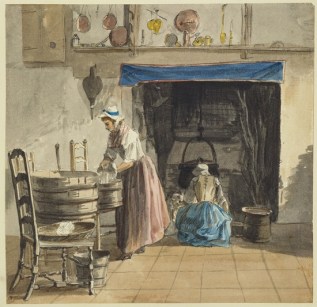
At Sandpit Gate, Paul Sandby, 1765. RCIN 914329

The image that sprang into my mind was Paul Sandby’s women at Sandpit Gate, doing laundry work. They’re wearing their shifts, stays, petticoats, neck handkerchiefs, caps and shoes. (I particularly like the woman working at the tub; you can see the angle of her stays diverging from her spine as she bends forward; it’s a fine little detail and very accurate.)

So women wore one of their shifts, their stays, petticoat(s), stockings and shoes.

And that brings us to the question, How many shifts did they have?

Several months ago I had the luxury of doing some research in the manuscript collections at work, and found MSS 957, the Stafford Family Papers. In those papers there is an undated estate inventory, thought to be from ca. 1780-1799. It’s extensive, and while I have a hand-writen transcription of the whole, I’ll quote the most relevant entry:

5 shifts [illegible]

Yes, five shifts. A woman who owned five slaves had five shifts. They were not for her slaves (though that leads to yet another set of questions about people who were property owning property…and where might that be enumerated?). And if she was laid out in a shift, or wearing one when she died, was it counted, too?

With five shifts, this unidentified woman could have worn each for two days and managed a washing every week–or rather, managed for another day or two or three while her slave women washed, dryed, and ironed her clothing.

In The Dress of the People, Styles points out in Chapter 2 that the largest differences between what the rich and poor wore lay in “numbers, quality and value,” (p. 31) and tables in the back lay out the different number of shifts lost by different women in a fire on an afternoon in May, 1789, in Brandon, Suffolk, England. A blacksmith’s wife lost six shifts, the mantua maker lost one. We can’t know if that emphatically means the mantua maker had but two shifts, or if she saved more than the blacksmith’s wife; one servant lost seven shifts! What we can tell is that women had more than one shift.

We can’t take one undated inventory as typical of 18th century clothing inventories in Rhode Island, (more research lies ahead of me) but counting shifts would be an interesting exercise. Based on my own experience, I can verify that one wants more than one shift. I think it likely that inventories will turn up multiple shifts for women, and shirts for men, no matter where we look, and that this will probably hold true even for slaves. Styles reminds us that the differences are not just numbers, but quality and value.

Three sticks, two kettles, no matches

Soldiers Cooking, 1798 National Army Museum (UK), 1983-11-63-1

Here’s some visual evidence for why we travel with three sticks, two kettles, and no matches. (We bring the sticks as we suspect the sites where we camp & cook don’t want amateur logging on their grounds.)  I stumbled upon this at the National Army Museum in the UK. Here’s what they say about the image:

Soldiers from an unknown unit attend to their cooking pot on a break from their duties during the Wars of the French Revolution (1793-1802). They are accompanied by their womenfolk. Although only a few men from each unit were officially allowed to marry and have their wives and families accompany them, women would have been found in almost every British military camp. Some worked as cooks, laundry women and sutlers (camp followers who sold provisions), while others were prostitutes.

One of the things one learns when reading about women who followed the armies of the Revolutionary War is that prostitution–at least for those following the American army– was not high on the list of occupations for women.

Why not? Lack of ready cash, folks.

Working for the Army would get you rations, and that literal meal ticket was desirable in a time of shortages and want. If you’d been burned out of your home or farm (I’m looking at you, 54th Reg’t of Foot, Aquidneck Island torchers) what would you eat? What would you do? It depended, of course, but one thing to do would be to follow your husband if he had enlisted.

I know less about the women who followed the British Army, but for a Continental Army start, I recommend the following books:

Belonging to the Army. Mayer, Holly A. USC Press, 1996.

Liberty’s Daughters. Norton, Mary Beth. Cornell, 1980. (My edition, 1996)

Revolutionary Mothers. Berkin, Carol. Vintage Books, 2005.

In Pursuit of Liberty. Werner, Emmy. Potomac Books, 2009.

The last title is about children in the time of the Revolution, not women, but considering who was left home with the children, and in trying to understand what the time might have been like for the Young Mr, I’ve given it a read as well.

As for the camp gear? We keep it at a minimum based on period images. We don’t all sleep in one tent, but we pack as light as we can. It’s nice when authenticity and ease are the same.

Bloody Overalls

Just started backstitching, already bleeding

But that’s still better than the story I heard yesterday about the incredibly authentic, effluvial-field dipp’d overalls that gave a mender dysentery…you come here for this, right, not the pretty dresses?

My thumb has split– yay, winter!–so everything will be a little trickier. Guess I’ll lay off handling white silk gowns at work, and documents, but the sewing will continue.

The Line of Truth

We went up to the Adjutant’s house yesterday, now that the roads are cleared again, and the lads got measured. Best of all, Mr S got fitted. He has what I ungenerously call “The Hump,” and what the Adjutant describes as “Shoulders Roll Forward.” The Adjutant has tact; I’m the wife, I calls it like I sees it.

It was really helpful. I knew the coat was too big (Mr S is built more like an 18th century soldier than a 21st century office worker), but I knew it had more wrong with it that too much fabric. At left, see the chalk line? The sleeve seam sits at the shoulder point, where I am told it will be uncomfortable as it rubs, which will also wear out the shirt faster. I knew what to do it the sleeve had been on a gown– unstitch it and re-align it under the shoulder strap, mark it and trim the excess off the head. In a way, that’s just what I will do here. There’s also excess to take out of the upper arm, but that’s not too bad for a garment that I made in a hurry and never really fitted to the wearer. And I have until mid-April to do it.

I have two of these greige stacks to transform.

At the same time, I also have to transform two of these piles of pieces into well-fitted, hand-sewn overalls. Despite the pride I’ll feel in accomplishing what I expect will, under guidance, be the best-fitted, most authentic garments I’ve made, saving my green checked apron, there’s a minor measure of terror mixed in to all this…hope those back stitches hold…