Living Deliberately

WCD: The Original

A friend of mine recently wrote about replicating the domestic life of the past (specifically the 18th century) and how much meaning that had for her.

Being so deeply embedded in the rhythms of life there, it became my home in a very real sense that has never left me.

I read that quickly, and what I read was that the place she had spent so much time was home to her because the place never left her– she carried its rhythms and seasons within her. Perhaps that isn’t quite what she meant, but that’s the risk of writing: the reader reads what they need to.

It made me think of home, and of living deliberately, and of a very bad year I had a long time ago, before I even imagined doing living history, when I thought I would spend my life making new things, like cities and buildings. (This makes me think of an album I listened to at the time, More Songs About Buildings and Food, which seemed all the more important because I’d gone to RISD, too.
Food, in a Building, in Rhode Island

The year I turned 25 was particularly bad not because a man broke my heart, though that didn’t help, and not because I had a miscarriage, though that was the catalyst that led to the man breaking my heart, but because the miscarriage shattered my sense of purpose and self. Somehow, everything that I had ever wanted to be — a sculptor, an architect, a writer– was gone, and I didn’t know what to do or how to be. (Read The Year of Magical Thinking if you want a well-written take on this kind of loss.) I didn’t know what to do next, but the man who eventually broke my heart gave me a book to help me figure it out: Chop Wood, Carry Water
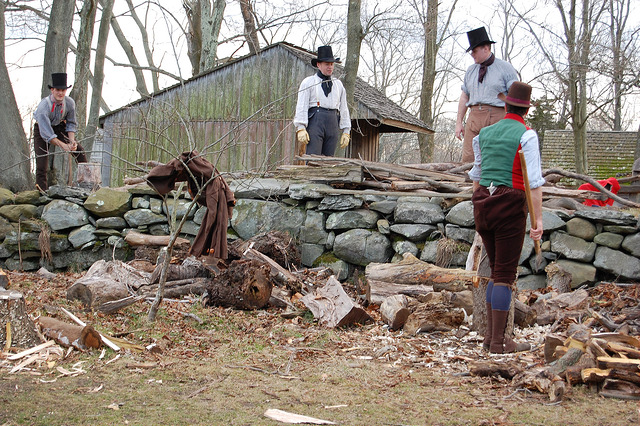
Chopping wood.

Two years ago, I wrote a piece called Zen and the Art of Living History, in which I extolled the virtue of the everyday: Embrace the everyday, bring everyone back into history. Since then, I’ve thought more about how history and historic house museums can be a catalyst for change, how domestic sites can create “homes for history,” where we can have the difficult conversations that must be had to make the change I think we need as a nation, and as humans. These changes are happening, slowly, in museums and at historic sites, but even at the personal level, there’s meaning and change to be had through the business of “doing history.”

I suspect that among the reasons people really enjoy immersive, civilian (non-musket) events is because the work brings them into the rhythms of the natural world in a way that industrial life precludes or even prohibits. Consciously or not, interpreting the domestic life of the past forces us into mindfulness, into being as much as or more than doing. That’s the point of “chop wood, carry water:” to live deliberately. To cook without a clock, with only the color of the coals and the smell of the food to guide you; to notice the changing light because, as it fades, you must act to create light; to find the flaws and shifts in a floor as you scrub it, because there’s no machine between you, just your hands and a brush or a mop: all these tasks force you to be in the moment, noticing your environment, noticing yourself. You. A corporeal presence in a material world. How does that feel, moment to moment? Physically, emotionally: the challenge of living in the past is to live an unmediated life.
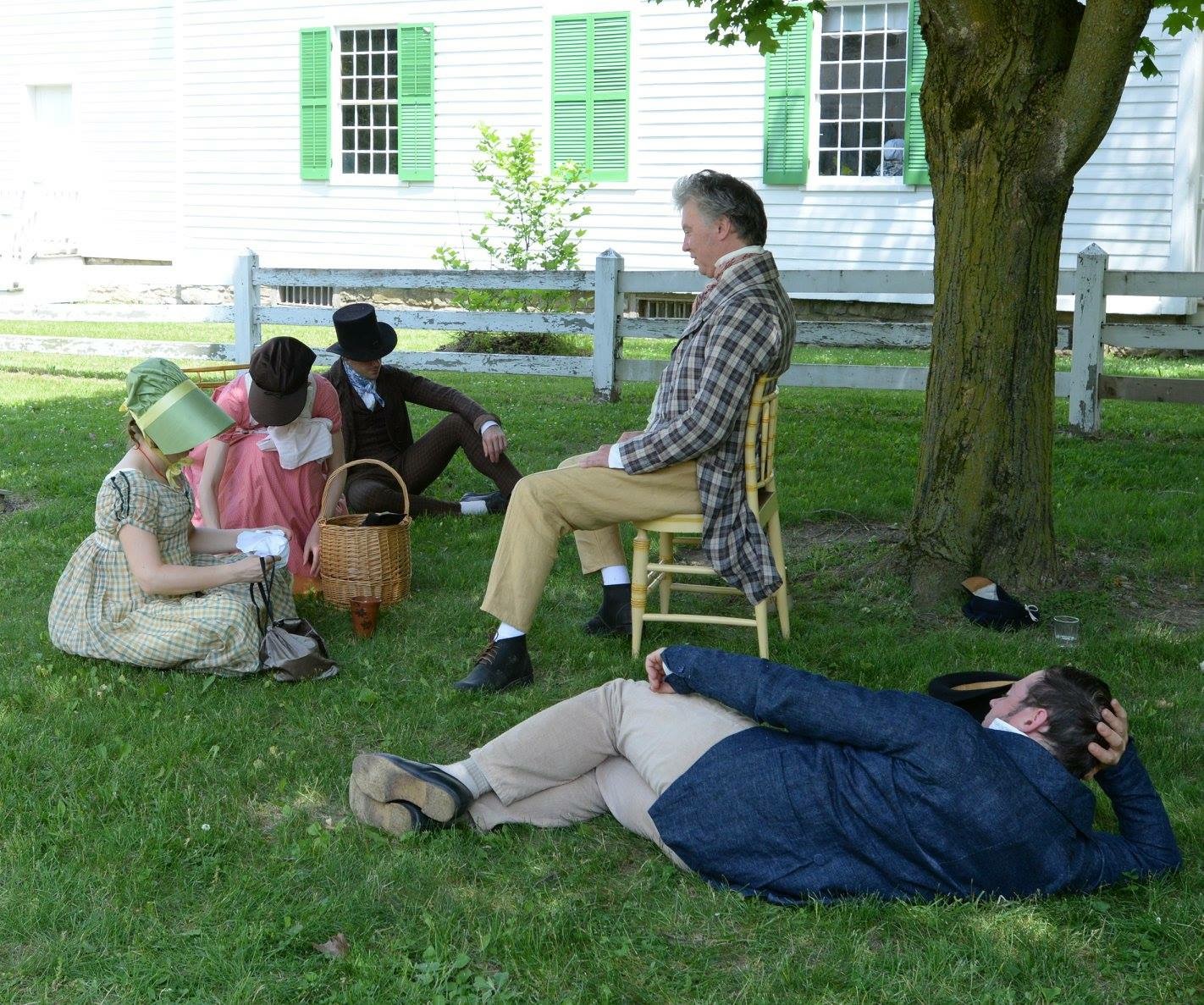
To go back to basics the way we do with civilian or domestic-site based living history brings us back to our base: we face our physical needs and the challenge of meeting them. We face emotional tests that help us imagine how people in the past endured– I often wonder how everyday people coped with “melancholia,” grief, and disappointment– and help us endure. It brings us home to ourselves, to our individual histories and our shared histories, and that’s what really matters. The connection to the everyday that we experience in a place in time puts us in a continuum with the people of the past, and gives us a place to be, a thing to do, a meaning. And that is what every one of us needs.
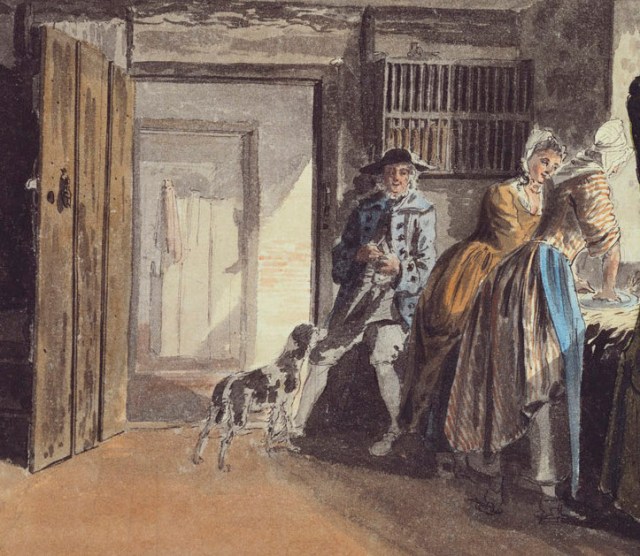
Sandby in Salem (New Jersey)

The Kitchen at Sandpit Gate (detail). Watercolor on paper by Paul Sandby 1754. Royal Collection Trust, RCIN 914331

The best times are always those when we are the least self-conscious– not that we can necessarily choose those times. Often they simply happen to us, but if we are lucky enough, we will notice, or someone else will record those moments for us. Last weekend, without even meaning to, we came as close as I may ever hope to get to recreating Sandby images of the Sandpit Gate kitchen.

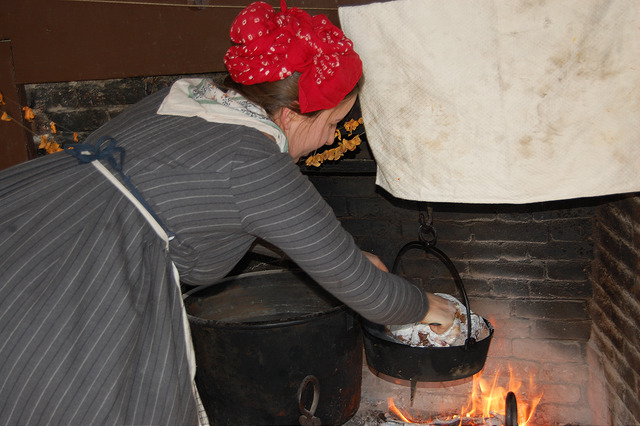
Mistress F commanded the kitchen: I served as her reasonably able scullion, and, with assistance from Drunk Tailor and the company of the B’s, we managed to produce enough food for several dozen people.


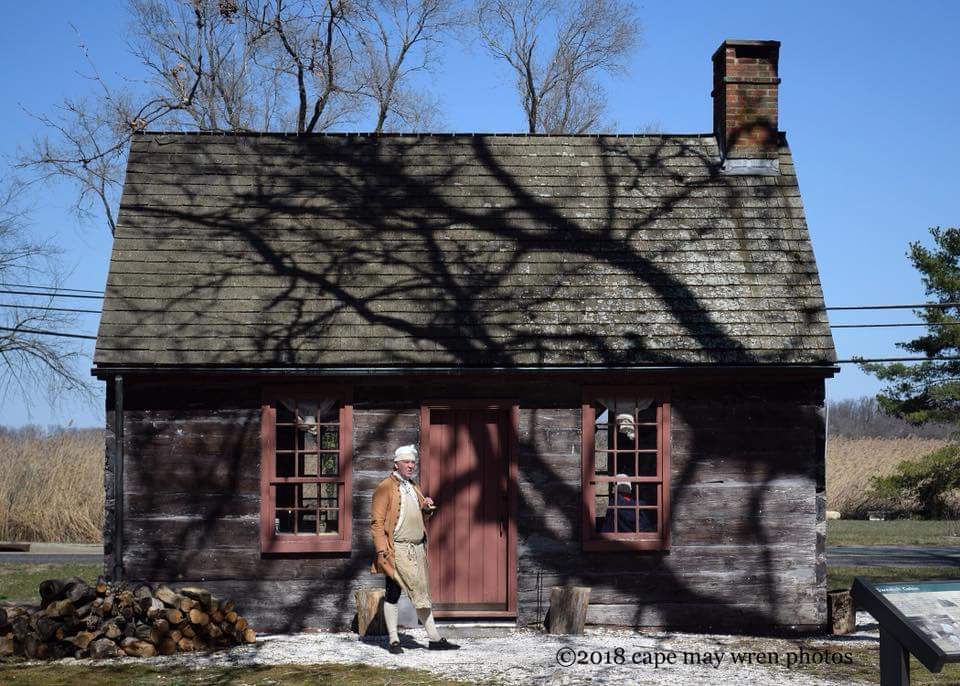
(I baked the pound cake at home, but the egg and onion pies were made on site. I lack historically correct baking apparatus aside from one pie plate.) Cooking in the cabin at Hancock House reminded me of good times long ago— and not so long ago–and how much I enjoyed throwing refuse out a window, and using a soapstone sink. The weekend also brought to mind “show, don’t tell” as it applies to interpretation, and made me think again about how to create more immersive educational experiences for visitors, without becoming ritualistic.

There’s not much time to think those esoteric, grad-school-seminar thoughts when you’re in the midst of cooking, and that can actually be a relief. Instead, better to think of the light, and the landscape, and the time remaining until a pie is cooked through.


The landscape and the light: redemptive, all that space, the blue sky and the grasses. I thought of The Witch of Blackbird Pond, which I haven’t read in decades, for in some ways, the coast of New Jersey resembles the coast of Connecticut. It’s one of the first historical novels I remember reading– it is probably one reason I have ended up doing the work I do, and spending as much time as I did in New England. (You can read it here.) It’s not brilliant literature, and it was nearly two decades old when I read it, but it was certainly memorable.

Photos courtesy of HM 17th Regiment, Al Pochek, and Cape May Wren Photography.

Didion, Despair, and Not Looking Back

Not everyone develops a relationship with a place that feels romantic, a relationship so intense, even when tortured, that when you leave, at last, as leave you must, you are torn apart by knowing the place abused you– and knowing you must go. Still: you love the place and cannot quite bear to not be there. It’s a complicated thing, and as with most tempestuous relationships, this tug of a place on one’s heart must be analyzed, objectified, studied, and understood. I thought I was making progress that way until I was given a chance to look back– don’t ever look back– and even though I did not look the basilisk full in the face, I was nauseated: waves of sadness and anger broke over me at reading a head line and image caption.

I stepped back to consider just what it was about the place and the situation that affected me so. Reading almost always helps. This time, I pursued literary criticism as a means to understanding. Van Wyck Brooks absent from the shelf at my local public library, I took hold of Joan Didion, and found myself rewarded.

The Seacoast of Despair” described my place perfectly.

‘Happiness’ is, after all, a consumption ethic, and Newport if the monument of a society in which production was seen as the moral point, the reward if not exactly the end, of the economic process. The place is devoid of the pleasure principle.

Devoid of the pleasure principle? In Freudian psychology, the pleasure principle is the instinctive seeking of pleasure and avoiding of pain in order to satisfy biological and psychological needs. Specifically, the pleasure principle is the driving force guiding the id. Didion states, “To have had the money to build “The Breakers” or “Marble House” or “Ochre Court” and to choose to build at Newport is in itself a denial of possibilities; the island is physically ugly, mean without the saving grace of extreme severity, a landscape less to be enjoyed than dominated.”

Indeed. Mean with the extreme severity, a landscape to be dominated. Those phrases define the principles that shaped my relationships with a few denizens of Newport, who, in truth worked and did not live there, but who seemed fully to embody, embrace, and imbue their personages with non-pleasure principled forces drove them to dominate others, and to consume, for their own use, much of what they encountered. Didion described my experiences and observations of Newport in language better than I could ever hope to conjure.

Three years ago this week, I came to a realization, first on a drive to Newport, and then on a train to Boston. I saved the tweets from that train trip.

I went to Boston that Saturday–it snowed; the train was an early one–to make a presentation at History Camp on work that related to Rhode Island and to Newport history. Earlier in the week, I’d had a vision in Newport that unsettled and delighted me, and informed those tweets.

“There was a for sale sign on one property (Sotheby’s Realty, of course), and for an instant, I imagined walking into the house and owning it, starting a life completely different from the one I live, with different people and places.”

Between that vision on Bellevue and Saturday’s train trip, I had enough exchanges with the object of my desire to form a fuller notion of what that vision meant. That understanding led to the tweets, which I posted as #fiction to protect the vision, and the desire, from the reality of my seemingly-unalterable situation.

The miracle here is that I had a vision, and have very nearly carried it out, despite not fully understanding how much of my standing life I would have to burn down to achieve that kind of freedom. It had not occurred to me that moving and changing  to achieve what I wanted–to no longer have a secret, to grasp those lapels nearly every night when I arrive home from work, and taste that accent on every kiss– it had not occurred to me how much I would have to destroy, or leave behind, and that in doing so, I would leave bones of my former soul to be picked over by opportunists ready to exploit an opening.

The consumption ethic: they have grabbed what they could not get while I was still there, and they run their paws over the work without fully understanding it. And that is where I can take my sole pleasure: the schadenfreude of watching them strive and fail, or perhaps the pleasure of watching them reach and grasp. Either way, I know I cannot look back. Something might be gaining on you, and it’s best to outrun those monsters.

Didion, Joan. “The Seacoast of Despair,” p. 157-158.  Reprinted in We Tell Ourselves Stories in Order to Live, New York: Everyman’s Library, 2006.

Compare and Contrast

Boston Massacre planning is underway for everyone involved at every level, including me.

I’ve made changes to what I plan to wear, in part because I have a newer gown that fits better and keeps me warmer, and because I have learned more, and looked at more, in the intervening time. Since 2016, I’ve made/upgraded a quilted petticoat (in a bronze silk, a color documented to Rhode Island quilted ‘coats), settled in to wearing my cap tied under my chin, and made both a new apron and a new bonnet.

Cap and bonnet shape and shoes help make time period distinctions between 1777 and 1770; if I could find the wool I made the gown from, I would add the cuffs it desperately needs. The heeled shoes skew earlier than 1770, but they are the only heeled shoes I have….if the weather is wretched, I will wear the flats for safety and comfort.

The bonnet, which I affectionately call “Lampshade,” is meant to have the shape of pre-1770 bonnets as seen in Sandby’s illustrations, and which I have been working on for a while.

Martha Collins, Thomas Sandby’s Cook. watercolor on paper by Paul Sandby, 1770-1780. RCIN 914339

I know from reading the standards that the understanding of mitt material has evolved, and my time this morning looking for an elusive apron shape raises questions for me as well. Here’s Martha Collins, painted by Paul Sandby. What’s that black thing on her arm? A mitt? An arm warmer? Is it knit, or woven? There’s always more to figure out, and more to make.

Cuffs on my gown don’t seem like a big enough deal to warrant buying wool for a whole new gown (with only six weeks to go), so my choices are live with no cuffs, alter the red gown of 2016’s event to fit properly, or initiate an extensive search for the scraps left over from the green gown…which may or may not be buried in storage. Tick tock.