It’s always cold, though, and I could use a day sewing various projects or vacuuming. But it’s also the last event of the season. Of course, in the slack time, I always stand on the NJ shore wondering how feasible it would be to run over to Manhattan for trim, fabric, or a trip to a museum. In kit. Because…. why not?
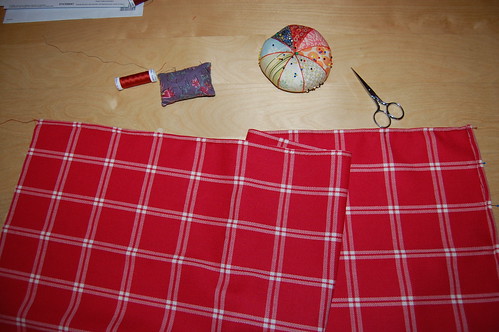
But Mr S wants me to come, so I’ve stirred myself to cutting and pressing and starting to hem a wool kerchief. This is made from some crossed-barred wool found in Somerville on the shopping expedition with Sew 18th Century.
She kindly sent me the image above, which is a good thing because I get distracted and think, “you know, that image with the duck and the girl and the bonnet,” which will give you 71,000,000 results in Google, but fortunately includes this one.
Three hems: I should be done by now.
It’s an easy project, but sometimes those are the hardest because you’re not learning anything. That, of course, is what Netflix is for: ghastly murders or sophisticated dramas keep you going on repetitive hems. (I do my best backstitching to BBC crime dramas– go figure.)
So, a November Saturday up on the Palisades means wool, in fact, requires wool, and for the first time I think I have enough wool to stay reasonably comfortable. That’s a cloak, kerchief, gown and two wool petticoats, plus wool stockings and, if they fit, sheepskin insoles for my shoes. We have a wool shift at work, but at about 50 years later than the Fall of Fort Lee, it provides no justification for a wool flannel shift. Still, a wool shift is a tempting thought, and suddenly that kerchief hem gets more interesting, as I start to think about where to look for documentation of wool or flannel shifts.
The Laundry Louis-Adolphe Humbert de Molard (French, Paris 1800–1874) 1840s, Salted paper print Credit Line: Gilman Collection, Purchase, Ann Tenenbaum and Thomas H. Lee Gift, 2005 2005.100.1241
How many men does it take to know what kind of wood a laundry tub should be made of?
For now, one woman. Yes, I’ve got a new obsession.
It started innocently enough with an exchange about future laundry tubs and an existing tub described as large, made of pine, and badly shrunken. Somehow I found myself burning to know, What is the appropriate wood for a laundry tub made in southeastern New England between 1775 and 1785?
Luckily I work in the kind of place where you might find an answer to that kind of question. In the Miscellaneous Manuscripts Collection, I found George Dods Cooper Accounts (MSS 9001-D Box 4). Mr Dod worked as a cooper in Providence between about 1790 and 1820, so he’s later than I need for this specific application, but I’m not sure the form changes radically before 1850, so Mr Dods seemed like a good place to begin.
While I did not find the hoped-for a receipt for purchases of specific kinds of wood, I did find that Dods was coopering with both iron and wooden hoops, and that he was making barrels, tubs and buckets of unspecified kinds of wood as well as cedar tubs.
1813 Mr Holroid
Nov 19
Sating 4 iron hoops on a Poudering Tub 0=6 0
Sating 6 Wooden Do- on another – Do- 0=3 0
1810
Oct 3 Satting 3 hoops on a large cedar tub 1 firking hoop 0=1-6
Poudering or powdering tubs were used for salting meat; satting is how Mr Dods spelled setting, and the firking is a firkin. His spelling was idiosyncratic but consistent.
Enslaved Girl, 1830 America, Virginia, Arlington County Watercolor, pencil, and ink on wove paper Museum Purchase Acc. No. 2007-34,1
So, 1813: a cedar tub. But was it for laundry? I found well buckets and house buckets, ‘poudering’ tubs and pounding barrels, barrels for meat and rum and ‘flower,’ cedar tubs and a ‘tub for Cora,’ but no tub specifically described as a laundry, washing or dish tub.
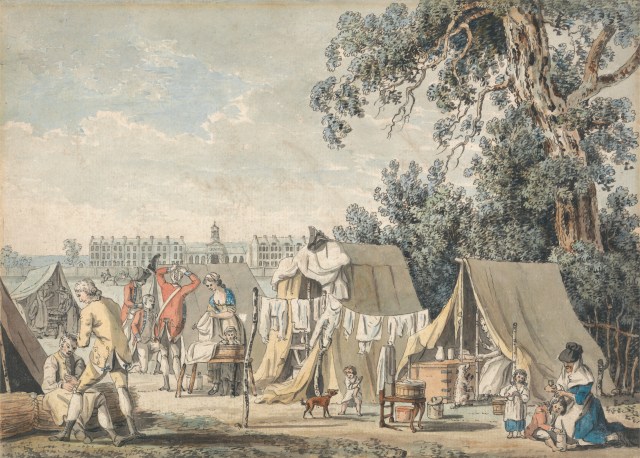
Searching local library and special collections databases using the appropriate Library of Congress subject terms proved fruitless as well, though eventually I ended up at Williamsburg, where I found an 1830 watercolor drawing of an enslaved girl with a tub on her head. (They call it a tub; you and I might call it a piggin.) This at least confirmed the persistence of the tub style seen in the 1785 British Encampment drawing. I suppose that’s something.
Domestic Engineering and the Journal of Mechanical Contracting, Vol. LX No. 6, page 160. 1912
But still, questions persisted: first, what wood would be right, and secondly, what size should the tub be? There was the thought that pine might not be right, since reputable coopers are making tubs from oak and cedar. Finally did what most of us do when frustrated now: I did a very simple Google search and ended up at Google Books with Domestic Engineering and the Journal of Mechanical Contracting, Volume 60.
This journal helpfully informed me that Wooden tubs are made out of 1- 1/4 inch white pine grained or dovetailed together at the ends and held together by means of iron rods and went on to explain that Great latitude was generally allowed in the making of wooden tubs as they were usually made on the premises by the carpenter who had no standards to follow. No standards! Doesn’t that explain a lot.
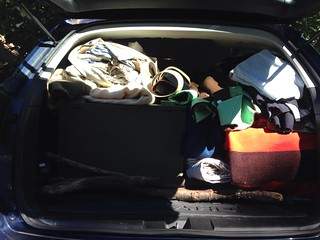
Fully loaded for Saratoga
Do I have any clearer direction? Well, clear as mud, maybe. It appears that one could have a tub of unspecified wood, hooped with wood or metal, in which one could do laundry. Or one could follow Domestic Engineering, and consider the current pine tub acceptable, if perhaps in need of mending. (I have not seen it, so I do not know.) I suppose the question is really whether or not all of this business will fit into the supply wagon known as our Subaru.
James Malton, 1761-1803, A Military Encampment in Hyde Park, 1785, Watercolor with pen in black ink, with traces of graphite on moderately thick, moderately textured, beige, laid paper, Yale Center for British Art, Paul Mellon Collection
This Saturday is the BAR event at Putnam Park in Redding, CT. This is an event with an early set-up time, one of those “early enough to be worth packing the car Friday night” events, as Mr S will need to depart at the time he usually gets up. I’m pouting not because of the early departure time, but because I won’t be going.
The Young Mr has his first swim meet Sunday, so Saturday he’ll have to get his homework done. That means someone has to stay home, or he’ll sleep till noon and spend the rest of the day eating meat and playing video games, all normal for a 15-year-old, but not helpful when most of Sunday will be spent marinating in chlorine.
I did a strange and awful thing to my back in an altercation with the face plate of an UPS unit for a server, and find that two weeks on, I still have a mis-aligned rib and occasional searing pain when reaching for Amelia Simmons’ cookbook to find something for Mr S to take with him to Putnam Park. At first, it seemed that it would be like Fort Lee, where one does not cook.
However, it seems that a camp kitchen is planned and there could be cooking, if only someone could tend the fire during the tactical, but no. I will not be there to stir meat of any kind, in any way, and the gentlemen, if one can call them that, will have to scrounge in the corners of their haversacks, take pot luck from the Boy Scouts, or find other means of nourishing themselves. I’ve also been told that it might be as well for me not to lace up my stays and push my ribs around, though on the whole, I think I might be better off wearing them more often. No matter what, home I shall I be, and the gentlemen will have to shift for themselves. Having seen them in action, I have no doubt that they will do well for themselves, and I might still bake them a pie.
Before I get any farther along in the process of making a sacque (and I have not made much progress) I thought I should start to really look at gowns, and try to understand them.
Not only do I need to understand how they’re made, I want to understand how they change over time, and what’s appropriate for different time periods and situations. This will, or could, have some bearing on what I make for the gentleman accompanying me to the celebrations for which this gown is being made. If I start from Mr S, whose best coat right now is the 1777 Saratoga private’s coat, then I ought to have nothing better than a second-hand sacque several years out of date, and that is reaching indeed.
What good fortune it is that the LACMA dress seems to be a gown in flux! This is the brown silk cross-barred gown with an assigned date of ca. 1760, which seems to have been abandoned in mid-alterations. Trim down the rights and left fronts ends abruptly at the waist, and two halves of what might have been a compère front lack any trim but boast plenty of holes. The front skirts come close together, but it’s hard to tell if they are meant to nearly close, or if the gown is fitted to a mannequin that’s too small and not adequately padded out.
Replicating a gown in mid-alterations would be interesting, but not what you’d wear to a ball, so I kept looking. In Hamburg there is another cross-barred sacque-back gown from about this era. There are similarities and differences, and never as much information as you’d like to have. Who owned and wore these? Who made them? When and where were they worn? We’ll never know, but at least with two similar gowns one can fill in some details for another, or help us understand them both.
The serpentine trim on the pink gown in Hamburg makes clear how unfinished or mid-alteration the brown gown in LA really is despite the visual interest created by the fabric itself.
So, what to do for my gown? And when will it be from? LACMA is hedging their bets with ca. 1760. I think Hamburg is pushing it a bit late with ca. 1775, but a ca. 1770 date for a gown based on the two seems reasonable. That would mean that the coat Mr S wears should also be ca. 1770, or newer than his green linen coat and older than his Saratoga coat. And luckily, I already have a plan, some fabric, and a pattern as a place to start.
While the ball itself has no date per se, it is in celebration of Washington’s Birthday, which puts it after 1775 at the earliest (think transfer of command of the Continental Army in Cambridge). Does that make a ca. 1770 gown too early? It would depend, I think on how one imagined the ball and oneself. If you’re a frugal woman who has lost much in the war, you’ll remake your gown; should the flounces become the shirred cuffs of later gowns? Could the kind-of compère front of the LACMA gown be a stomacher cut in half and stitched to the sides, with the pin hole indicating where trim had been removed from a once-was stomacher? Is it reasonable to make a compère front for a ca. 1770 gown? I want one mostly to avoid the stomacher angst I always seem to have, and in a way it marks a place between stomacher-front and front-closing gowns.
These unprovenanced gowns stand without the particular context and personality of their owners; the fun and the challenge for us, as costumers and reenactors, is in trying to bring our personalities to the fact-based garments we create.






 Kirsten Hammerstrom
You must be logged in to post a comment.