The Shurts off there Backs

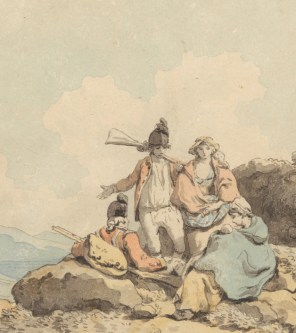
Francis Wheatley, 1747-1801, British, Soldiers and Country Women, undated, Pen and black ink with watercolor on medium, smooth, cream wove paper, Yale Center for British Art, Paul Mellon Collection

Among the things I wondered about Bridget Connor and her court martial was from whom she’d bought that “publick shurt.” Why would a soldier have an extra shirt, or be willing to sell an extra shirt?

There are some circumstances in which it is plausible.

ClothingRegs1776_77

While shirts could have been sent from home,  regulations established in 1777 called for soldiers be issued two shirts, or an equivalent bounty. A soldier who wanted cash for alcohol or other non-regulation and non-issued goods or services might sell his second shirt, or steal a shirt to sell.

With the context of what soldiers should have been issued, we can  begin to tease the story out of the orderly books.

Regimental Orders July 15th 1782

At a Court Martial whereof Capt Dean was pre
sident, was tried Paul Pendexter & Titus Tuttel
soldiers in the 6th Company 10th Massachusetts Regt
For Stealing a Shurt and Disposing of the Same
ware Both found Guilty and Sentancd to Sixty Lashes
on there Naked Backs—the Colo approves
the opinion of the Court and orders it to
take this Evening and the prisoners to Return
to Duty——-The Court Martial of
which Capt Dean is president is Desolvd

The quote above is a full seven days before Bridget appears at her own Regimental Court Martial “for purchasing a publick Shurt from a Soldier.”

Paul Pendexter and Titus Tuttel were just the guys to get caught, until Bridget was discovered. It does make me wonder if there was an extensive ring for black market shirts (and where did they go once Bridget had them? Did she try to sell them back into the public stores, i.e. the quartermaster)?

Criminal masterminds these people weren’t, but it does seem possible that the Shirt Ring was fairly busy before it was collared.

Once Upon A Time…

Betsy Ross and friends: A Child Guidance Educational Activity

This is the third set of these paper dolls (Educational Activity) I have owned. The very first set was given to me by my mother, Lo, at the Dawn of Time, in the Dark Ages known as the 1970s.

I wore them out.

A new set was purchased, probably once again at Marshall Field’s, possibly in the book department. They now reside in an attic outside Philadelphia (how appropriate).

From this Educational Activity flowed many more home-designed outfits and home-made paper dolls of historical and literary origins, which have led to this moment, when I make myself and my family into historical characters, make us outfits, and set us in motion with friends and colleagues in scenes of historical play-acting, by which I mean Educational Activity.

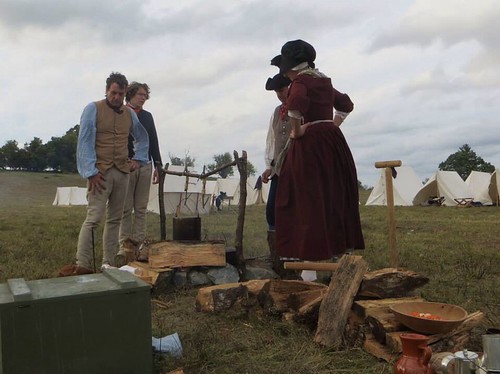
Cooking at Saratoga: very Educational. Photo courtesy D Molly Ross.

I like to think that the clothing we wear is more correct than the “Authentic Costumes” advertised on Betsy Ross’s box, but there is always more to learn. I am in no way denigrating Betsy Ross, or paper dolls, or suggesting that I see my family, friends and colleagues as paper dolls. But I do know that as long as I have been playing, I’ve been playing history and reading history, and drawing history, and using books and paintings and yes, even paper dolls, to figure out the world present and past.

If January Jones played Betsy Ross...
If January Jones played Betsy Ross…

Even though I always thought I wanted Betsy’s birthday cake gown, the one I really liked was the work gown. The “construction” of her garments confused me even as child: how the heck does that kerchief work? And the bodice front? Never mind, have a slice of dress, I mean cake. (Field’s had a cafeteria that served slices of pink-iced layer cake that I somehow conflated with the paper dolls, thanks to the shopping trips my mother and I made.)

Memory and fact, impression and citation: when we reenact the past as an Educational Activity, we should remember that some will walk away enlightened, and others will walk away thinking about birthday cake. Our job, beyond getting the facts right, is to engage our visitors, to interest them, and to excite their imaginations. What they do from there is up to them, but we will know that we have done our best to present them with a scene that can take them one step closer to being there.

Order!

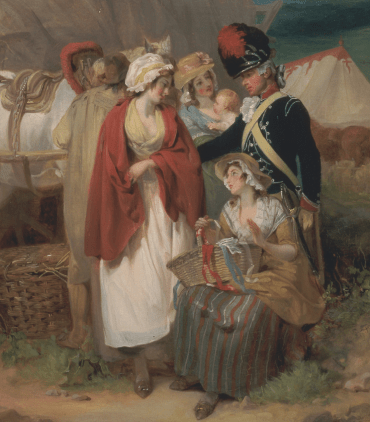
Francis Wheatley, 1747-1801, British, Soldier with Country Women Selling Ribbons, near a Military Camp, 1788, Oil on canvas, Yale Center for British Art, Paul Mellon Collection

You know you’re taking something seriously when you’re willing to pay for the privilege of reading a primary source. The microfilm I ordered from the Phillips Library arrived a week or so ago and I managed to snatch an hour or so between meetings to read and print some of the most interesting pages. I get a week or so more before the reader at work goes to storage, and then I’ll have to go haunt another library.

This is the kind of stuff I will happily read at bedtime, though it should also be noted that I will read regimental record books at bedtime, or runaway ads, so we may not share tastes in literature.

I was willing to pay for the film because I wanted to read the books in full to get a better sense of the context in which Bridget Connor was operating. (Delightedly, I realized last night as I fell asleep, of course there’s no death record for her in Massachusetts. She was expelled from camp at Newburgh, so why would she walk all the way back to Massachusetts? Why not set up a new life in New York? A whole new place to look for her!)

Beyond Bridget, there’s a wealth of detail in the Stephen Abbott Orderly Books.

Thomas Sandby, 1721-1798, British, Encampment at Maestricht, 1747, Pen in black ink, over graphite with gray wash on medium, moderately textured, beige, laid paper, Yale Center for British Art, Paul Mellon Collection

“Regl Orders 5th June 1782
the Regiment will make Every preparation
to March on Fryday the Soldiers are to
Clean there arms to Morrow and pack up
there Clothing.. The Commedants of Com
apanies are Directed to Send the tent poles
which are Finished to Morrow by 12 oClock
to the Landing where the tent Lay the Guard
with the tents will pitch a No of tents Suff
iciant to Cover the Straw and what ever Bag
gae is Brought previous to the march”

This helps us get a picture of the camp, and from the order about the tent poles, I think we may gather that there were plenty of tent poles NOT expected to be finished. (My colleagues enjoyed that part when I read it aloud at work.)

Regimnl Orders June 6th 1782
the Regiment will turn out to Morrow Morning
at the Beating of the Revelee and to March
By Six oClock they are to pack there cloth
ing and kook there provisions this Evening
when they have arivd on the Ground for Encam
ping the officer commanding on the Spot
will order a partry if Forty men from the Reg
iment a Capt and two Sub’s to Command them
to Return to the Encampment in order to asist
in Bringin on the Baggage the Soldiers
are to Carry there kittles in there hands and
are to Leave there arms and pakes &c at the
New Encampment any Soldier who is found
Plundering another pack is to be tyd up and
punished with out Trial..

Carry their kettles in their hands, their provisions cooked the night before. Now, wouldn’t that change an encampment’s appearance? Let alone tied up plunderers…

The Society of Friends

Courtesy Newport Historical Society

Last Friday, I joined my friends in Newport for a program at the Newport Historical Society.

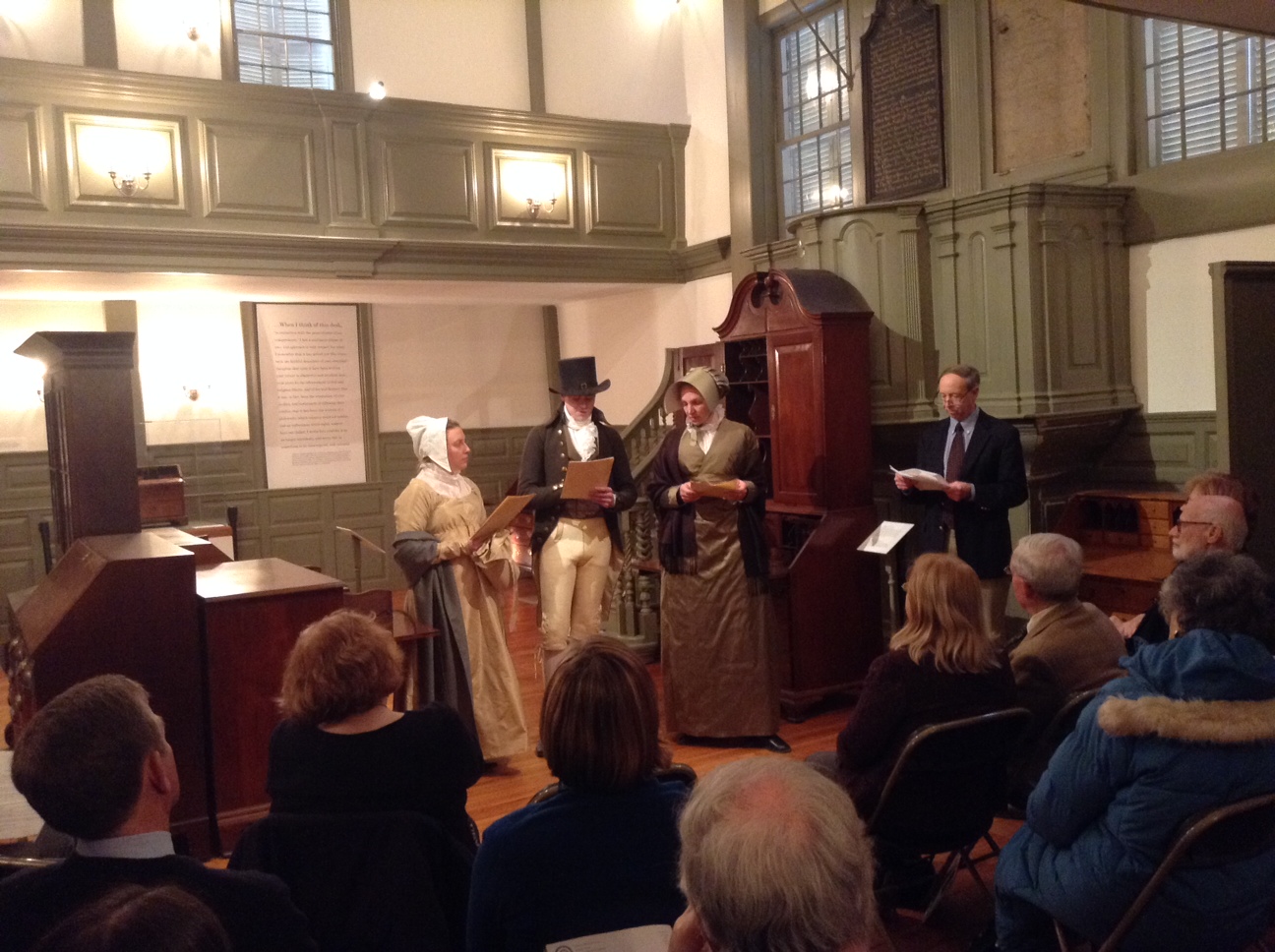
We stood in the Seventh Day Baptist Meeting House behind the NHS’s headquarters building and read excerpts of letters from the Williams Collection.

This is a simple, elegant concept for a program, and works incredibly well if the correspondence have the gift for expression that these people did. Even quotidian details–the price someone wants to get for their dining set, the likelihood of moving one’s mother, who must be carried ‘as carefully as a box of China’–take on humor when read aloud.

Courtesy Newport Historical Society

The best letter might well have been the last one, read by Sew 18th  Century. The latest of the selection, the writer described a visit to Newport around 1844, arriving at the dock to the bustle of wagons, walking streets and finding a barber who knew the old fish hawker, the enormous jaw bone of a whale on a street corner, and even lifting the latch to walk inside the Seventh Day Baptist Meeting House where we were standing.

It was a lovely way to end the program, resonant with details the audience could connect with.

My dress turned out all right, and I managed to get it on and keep it on, which seemed a small miracle requiring only two pins.

When I tried it on at home, the front panel didn’t wrinkle, so I think I pulled it too tightly around me on Friday. I kept my bonnet on because I didn’t have time to make a new cap, so made do with the housekeeper’s cap from last fall. The chemisette was made by Cassidy, and saved me from the migratory ‘charms’ of a kerchief. The ‘shawl’ was a gift  Christmas from my mother, who rightly saw it as a scarf, but those who wish to keep warm do not quibble when they cannot find exactly what they want. Before I wear the dress again, I have to attend to interior seams of the skirt and scoot the cuffs down to lengthen the sleeves. Four yards of 48-inch wide silk was just enough, but needs a little tweaking when you’re a tall as I am.