The recent BBC video making the rounds on social media got me thinking about how we live our lives, and what commitments we make to being our true selves, how we follow our bliss, if you will. It takes a lot of courage, willpower, and hard work to achieve one’s deepest inner dreams and although I have taken some steps towards mine, I have not let go all the way (as one does not when one is putting a child through college).
I think about this desire to be true to one’s own internal vision, and I think about my friend Justin, who found a place and fell in love with what he saw, past and future. It’s hard work to run a farm and a business, but Justin does it beautifully, with grace and integrity. What he achieves makes me ache with want, not for the house, or the frozen cat’s water dish, or the work, but for the courage.
Working with Justin pushed me into places where I found, if not fear, at least discomfort. As we said, It isn’t history till it hurts. The first What Cheer Day we ran, I remember standing behind the door on the second floor landing of the servants’ quarters, knowing it was show time. I looked at Justin and said, “What the hell have we done?” terrified to go out and “be” John Brown’s housekeeper. But, out we went, and it was amazing. That work inspired me to push myself harder, to try the things that scared me and made me uncomfortable. That’s where the meat is, and the truth: where things hurt.
The housekeeper was caught reading naughty novels. Photo by J. D. Kay.
As with all things I tackle, I could push myself harder, not to sew better or more authentically (that’s the easy part, really) but to live the way I want to, authentically. To decide what matters and what doesn’t, and stick to it. That’s the real lesson of these men, and why they’re inspiring. I just happen to prefer the one with mud.
The historical costuming/living history/reenacting hobby can be a daunting one to pick up. When I started, I was fortunate to have a background making things, including sewing my own clothes, as well as a career that taught me research skills, and gave me easy access to primary sources. Those factors made skill building relatively easy, though I definitely had a learning curve specific to what I was doing. As the season opens and people start to ease into new units, I thought about things I found that made this hobby a little easier to manage, and skills easier to acquire.
Same years….
different class levels
Know who (and when) you are. When you step into the past, who are you? Where are you from? What year are you representing? With answers to these questions, you can begin to sort out what you need to know, and where you need to look for answers. What you’ll wear in North Carolina is not what you will wear in coastal New England. The styles of 1750 are not the same as those of 1780– and fashion information traveled quickly from England to America. American colonists were as stylish (or more so) than their English counterparts. Wearing a gown 20 years out of date without alterations is only going to work well if that gown really shows its age (and you do, too).
Learn to do research. If you are going to strike out totally on your own, you need to be able to do research and sift through the sources you find to understand and interpret them appropriately for your situation. What is right for Costume College may well not be right for a camp follower, no matter how accurate the fabrics or construction. It seems so obvious (and in the case of a silk sacque back gown, it really is) but in other ways it’s not. Jackets aren’t going to be right in New England, and calicos are more common in Philadelphia and Rhode Island than they are in Boston.
Lance needles: the best I’ve used.
Rowenta steam iron
Buy good tools. Really: tools matter. Sharp shears, sharp thread snips, good, sharp needles, sturdy pins, a pin cushion, a cutting grid, a steam iron, a sleeve board, a sturdy ironing board: all of these things make my sewing life so much better. (I actually own three ironing boards: a full size board, a table top board, and a sleeve board and use them all.) Tailor’s hams are also useful– that’s what I steam my caps on.
Ruffle attachment in progress. Possible thanks to the material and the needle.
Use good materials. Good fabric is expensive, but what’s your time worth? If you calculate the per-wearing cost of a garment, you’ll find that the “cost” decreases over time. One of my favorite gowns is made of $2.99/yard fabric from a mill store in Rhode Island. (I was very lucky to find a woven check that matched one in a RI sample book.) I bought five yards, so $15. I’ve worn that gown more times than I can count, and it is perfectly filthy. If we calculate $450 for hand sewing, the total cost is $465. Since April 2014, I have worn that gown 12 times (that I recall), making the per-wearing cost $38.75. I’d call that a good value. If we count just the yardage, it’s $1.25 a wearing and honestly, you cannot do better that that.
When it comes to shifts, the ultimate per-wearing cost is even less. My most recent shift of hand-woven linen with vintage linen sleeves would have been $450 in materials, and $425 in hand-sewing. $875 seems crazy, right? Consider the shift I made in 2011, worn to almost every 18th century event I’ve attended (I had two); I’ve worn that shift….45 times that I can recall. That’s $20.83 per wearing, a better value over time than the $2.99/yard gown. If a soldier’s coat can cost $800, and you are going to every event your soldier goes to, an $800 shift is as good a value as the coat, and possibly more essential.
Cost aside, the value of good materials is in the time they save in making. Well-woven linen is easier to sew and will need less mending over time. Sharp shears cut cleaner. Sharp needles sew better, and smaller needles give you finer stitches.
d’oh! surgical tape made this *much* better later.
Learn to sew with a thimble. Your fingers will thank you. I use a leather thimble with a metal tip (from the quilting notions section) and it helps. Thimbles are essential when sewing heavier fabrics like broadcloth and indispensable if you make your own stays (and you can expect bleeding even with a thimble).
Practice patience. Learning a new skill, or refining one you already have, takes time. It isn’t always fun. I get sick of sewing, and have to switch to something else (like cutting out, or research, or patterning) or take a break. Recognize that frustration is often the moment before you master something new, but also know when frustration means it’s time to stop. Just as we build muscle on rest days, our brains process skills when we stop. Then, the next time we pick something up, we’ll be stronger, or more skillful, than if we hadn’t stopped. (This New York Times article was helpful, and inspired this post.)
A purchased bonnet because it’s one I can’t make.
Buy what you cannot make. I thought I needed to make everything myself (with the exception of men’s hats and buttons) but that’s just not true. If you can’t manage fine sewing, buy a cap! If you hate assembling tricky things, buy mitts or a bonnet. I bought caps when I couldn’t make them as well as I wanted, and it saved me hours of frustration. I love flamestitch pinballs, but I can’t manage that needlework yet; lucky for me, I know someone who excels at it, so I can buy from her. Other people have skills, and buying things from them will save you time and frustration, so you can focus on what you really want to do.
Print made by James Caldwall, 1739–1819, British, A Ladies Maid Purchasing a Leek, 1772, Yale Center for British Art, Paul Mellon Collection
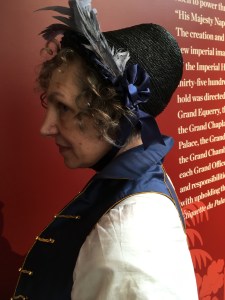
“It is a truth universally acknowledged that if a bonnet existed in the 1770s, it was black taffeta” has long been the rule reenactors have followed, particularly those wanting to adhere to the strictest standards of well-researched impressions based on primary source documents and period material culture. Truth examined is more subtle, showing that bonnet colours, materials, and shapes varied from decade to decade—and year to year—and that these factors seem to have varied by region. What worked in Boston would not be comfortable in the Carolinas, and people adjusted accordingly.
I was asked recently about Boston-area bonnets in the first half of the 1770s. My impression of this decade is that it is one in which there is a stylistic change in women’s headwear, as the “sunshade”* and “Bath” bonnet terms fade from use, giving way to plain “bonnet” or “chip” bonnets. These appear to have been made from “bonnet paper,” seen in both blue and white** in newspaper ads, though prints and paintings show brims in both boned and paper forms.
The Rival Milleners. Mezzotint after John Collet, 1772. Colonial Williamsburg Foundation, 1955-125
Brim shape and bonnet material— fabric and colour– vary by period (and region). So let’s look at Boston in the first years of the 1770s. One tricky bit is that there are fewer indentured servants and enslaved people in Boston than elsewhere in the American Colonies in this period, so runaway ads are scarce, giving us fewer clues than we get in Pennsylvania and points south. Still, there are plenty of ads to help guide us.
The best statistics around for bonnets are currently tabulated for Pennsylvania, and definitely show the preponderance of bonnets are black (52 of 75 tabulated, or 69%). So don’t give up on black silk bonnets! They are the most common color. If we extrapolate these statistics, for a Pennsylvania event in the 1770s, of every 10 bonnets, seven should be black, one should be white, one should be green, and one should be blue. In larger groups, we’d also see red and brown bonnets, but again, just one in 20 or 30.
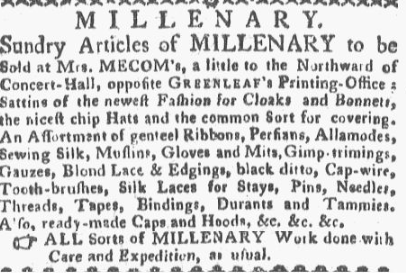
The Boston Gazette, April 4, 1774. Benjamin Franklin’s sister advertises “Sattins of the newest Fashion… for Bonnets.”“A few sarsnet taffety bonnets,” in the Boston Evening Post, September 28, 1772.
For Massachusetts, statistics are more difficult to compile, given the dearth of runaway ads and the fact that I haven’t yet dived into inventory and probate records. Merchants’ ads give us some clues as to materials, and one thing I find is that “sattin” shows up, as well as “sarsnet taffety” or pelong. Sarsnet or sarcenet was a “think transparent silk of plain weave,” according to Textiles in America. Thicker than Persian, sarcenet was woven both plain and twill, and could be plain or changeable. Pelong is a kind of silk satin, again according to Textiles in America, and in The Dictionary of Fashion History, described as a kind of “thin silk satin,” but I have also seen it described as a ribbed silk. Joshua Blanchard advertised “Pelong sattins of all colours” in 1768. Where does that leave us with materials? Probably with the need for more bonnets to be made of silk satin than of silk taffeta, though the proportions are difficult to calculate yet.
Miss Theophila Palmer (1757-1848), oil on canvas, attributed to Sir Joshua Reynolds ca 1770.
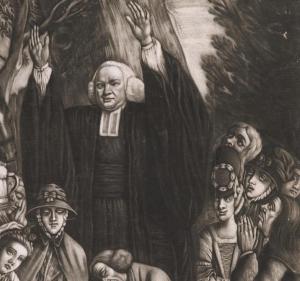
What about shape? For those dressing a la mode, we are past the deep-brimmed, small-cauled “lampshade” of the 1760s, and into a smaller, tighter bonnet with a larger caul and more trimming. In the portrait of Miss Palmer, we see how the brim stands away from the face, and the caul or crown poufs up. “A Lady’s Maid Purchasing a Leek” and “The Rival Milleners” (aee above) both depict women in similarly tight-brimmed and round-crowned bonnets trimmed with bows. These are shapes that I am confident appeared almost universally (with variations) in the American colonies in the first years of the 1770s. Now, there are different shapes to be sure, but these seem to predominate. I do think we need to see more brims that wrap around the head, as seen in the 1774 mezzotint of George Whitefield (Anglo-America’s most popular preacher) and his followers.
Detail, A Call to the Converted. Publish’d April 15, 1774, by W. Humphry . Lewis Walpole Library, 774.04.15.01+
So what’s the take away, if we are looking specifically at Boston and environs in the first half of the 1770s?
Most bonnets (70%) were black, but a few white, green, crimson, and blue were seen.
Most bonnets were made of silk satin, with others of taffeta or sarsnet (sometimes twilled silk).
Most bonnets would have a shorter, higher brim that curves across the face just above eye level, with a high, rounded crown/caul and bow trims.
Bonnet brims would vary between bonnet (paste) board and boned
Each place has a local style– which, if you think about it, is still true today. When I stand on the Metro platform in the red wool coat I bought in Providence, these folks know I’m not from here. The way we dress for the past should reflect the place and the time we are representing as best we can. And that means we need accessories to match those times and places, as well as clothes.
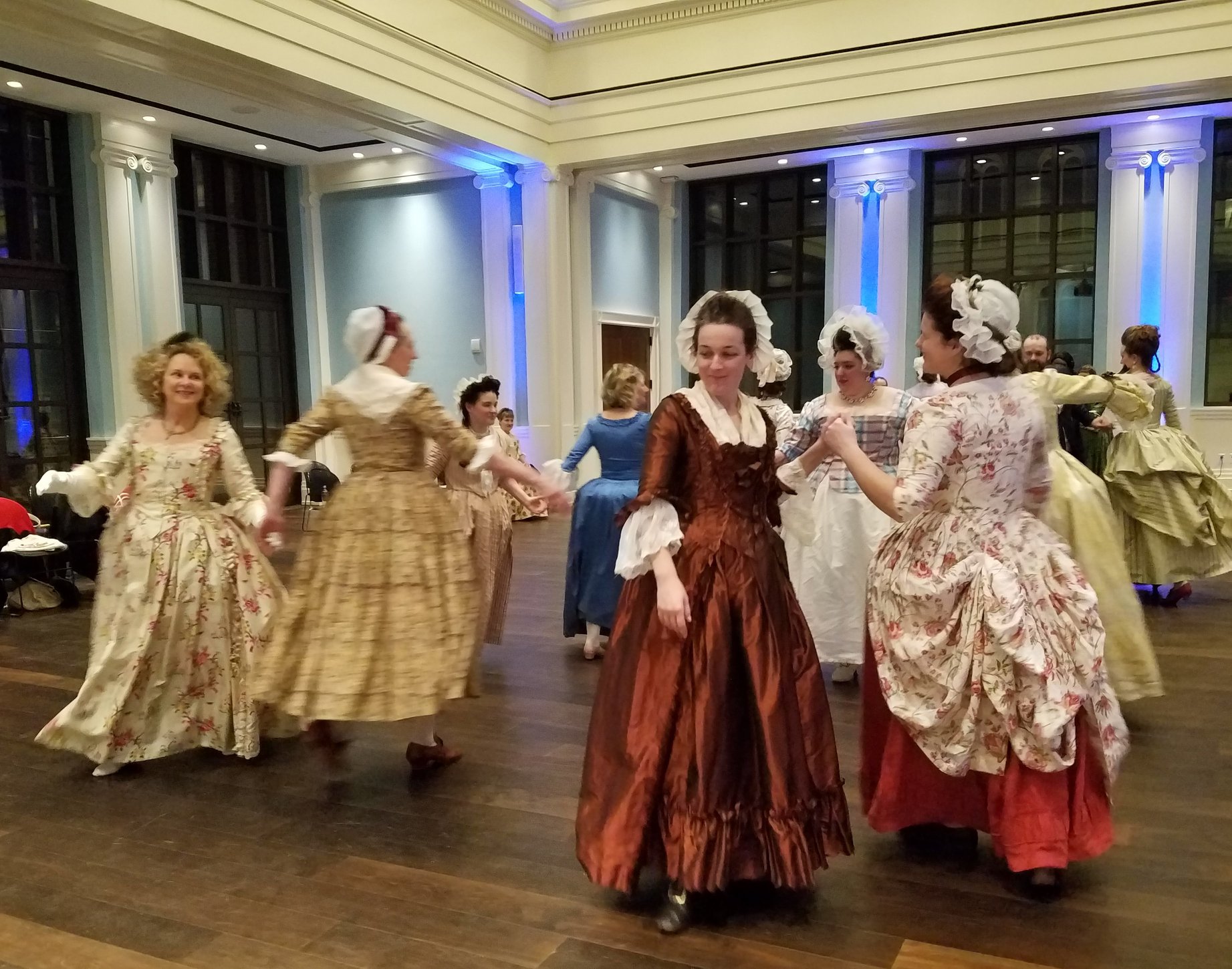
There haven’t been as many chances to dance as I’d like of late, so when I got the Museum of the American Revolution’s invitation to come dancing at their January History After Hours event, I said yes. Luckily, I had to be in Philadelphia for the next day anyway, so out came the 1780 appropriate dress and the fancier shoes, along with my resolve not to be a wallflower, and off I went. I very nearly made it on time, but I dressed as fast as I could, and managed to join the crowd with my dress pinned and my hair tamed.
As at past balls, I was rescued by a kind soul (and excellent dancer) who took me through the steps and saved me from my occasional pattern dyslexia. (Reversing can be tricky– they didn’t let me drive the forklift much in school because my brain sometimes struggles to process a mirror image.) But Miss V was a gracious partner, and reader, I confess: I greatly enjoyed myself.
One aspect of historical dancing that has always appealed to me is the relationship between classical ballet and traditional English country dances. While you won’t find tutus on Jane Austen’s dance floor, you will find balancé and glissade, and the use of positions. This connection between two things I love, and the way movement can connect us to the past, makes me enjoy these dances even more. Using steps I learned and practiced endlessly decades ago in a hobby I pursue today is a very personal reminder of the persistence of the past.
An evening of dancing, with the best dance caller and instructor I’ve yet had the pleasure to meet, was a welcome winter treat.
Many thanks to Miss G.J. for the use of the photos, and deep honours to Miss V.D. as a partner, and Mr. N.V d.M., dancing master.









 Kirsten Hammerstrom
You must be logged in to post a comment.