Half Robe or Jacket: How Do You Wear One?

Half robe, 1790-1800. National Trust Inventory Number 1348749,
Half robe, 1790-1800.
National Trust Inventory Number 1348749,

What Cheer Day is coming, and I hate to miss an opportunity to make a new gown (despite having just made one, and despite needing to make some waistcoats and trousers for the event). While I lay awake last night, I pondered my options, and whether a half gown would be suitable.

Although I have concluded it probably is not, I was curious about how these should be worn. Where can you wear such a garment? Is it only suitable for at-home use?

This is the robe from Nancy Bradfield’s Costume in Detail, replicated by Koshka the Cat here, and approximately by me, here.

Since I will be a housekeeper again, I think a gown is more correct for me, but that doesn’t stop me thinking about half robes, and whilst scrolling images by year at the Yale Center for British Art, I found this by Cruikshank:

ladies in a lending library
Isaac Cruikshank, 1756–1810, British, The Lending Library, between 1800 and 1811, Watercolor, black ink and brown ink on medium, lightly textured, beige wove paper, Yale Center for British Art, Paul Mellon Collection

There’s a lot to love in this image, even with its fuzzy “between 1800 and 1811” date. Not only do we get an array of reading material (Novels, Romance, Sermons, Tales, Voyages & Travels, Plays), we get costume tips and– special bonus– a dog gnawing its leg.

(If you are curious about some of the books in the Library at the John Brown House, check out this tumblr bibliography. I’ve been using it of late, and the representative genres are quite similar to what we see in the Cruikshank.)

We also get a chemisette on the lady at the counter, along with a very dashing hat, a fancy tiered necklace on the lady in pink, who also carries a green…umbrella? Parasol? With just a veil, that seems likelier than the longest reticule ever.

I like our Lady in a Half-Robe and her deep-brimmed bonnet showing curls at her brow. She and her companions show the range of white and not-white clothing seen in early 19th century fashion plates, and the range of head wear, too.

Undress for August, 1799. Museum of London

The last question I’m asking myself, though, is whether the yellow garment is a half-robe or a short pelisse or a jacket. And can you wear a half robe out of doors? And what did the ladies of the period call that garment?

In this fashion plate (featured by Bradfield on page 84, found by me at the Museum of London), the lady on the right is certainly wearing a short upper body garment, and I’d wager that she’s out of doors or headed that way, since she’s carrying a (green) parasol. Bradfield calls her garment a “jacket,” and until I can find the text of the Ladies’ Monthly Museum for August 1799, perhaps that is the term we should use instead.

While two images aren’t a lot of evidence, it does appear possible to wear a half-robe or jacket out of doors for informal visits in clement weather, and finding two is as good a reason as any to look for more.
Wash on Monday

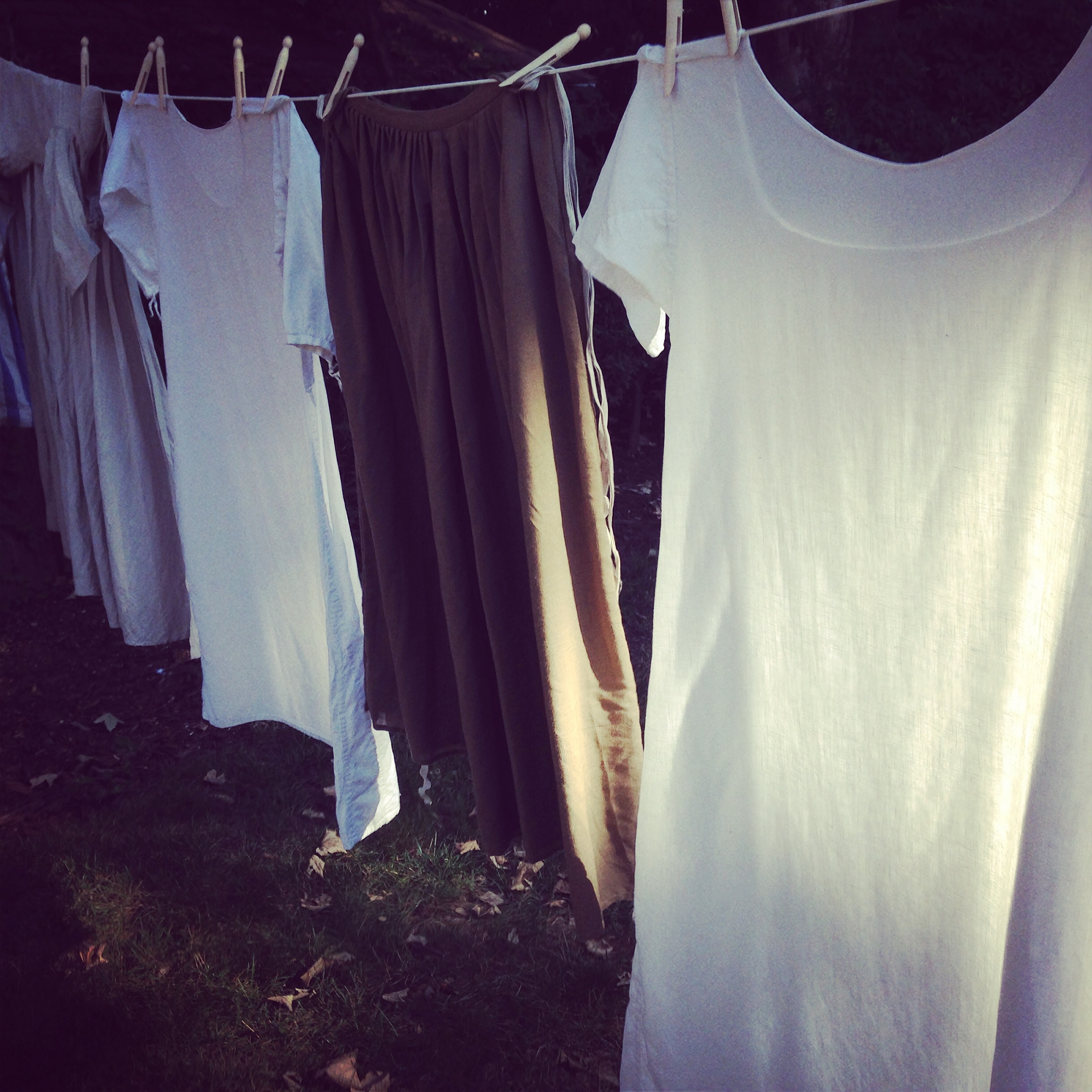
shifts and petticoats on a line
Living history laundry

We spent Labor Day laboring at home: even the Young Mr spent the day working on a five page essay (due Wednesday) for history class. I spent the day tidying the house and washing clothes from all centuries.

Of our historic clothes, I don’t often wash more than body linen (shifts, shirts, stockings) but the petticoats had not been washed in some time; in the end, I washed the tow and blue striped one, but only aired the Virginia cloth and madder linen. Since I may not wear these again this year, washing and airing seemed warranted.

It’s incredibly easy to wash in this century, with the luxuries of indoor plumbing, a hot water heater and a washing machine. At Walloomsac, though I didn’t do any laundry, we were always fetching water, and I think of how much water we use, and how easily.

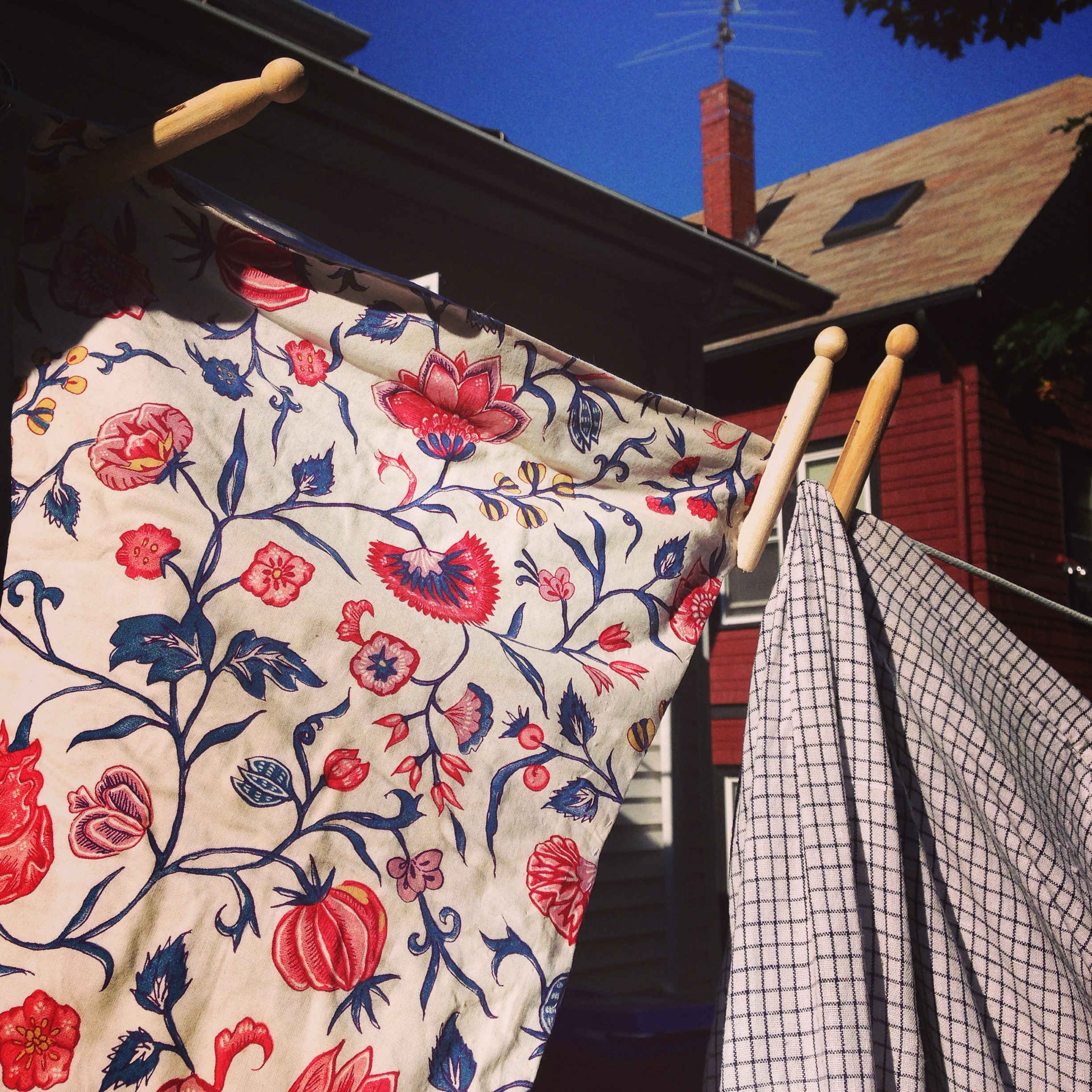
chintz and checked clothes on a  clothesline
Red, white and blue

While I stitched a dress (new, though the mending pile is growing), I listened to biography of the Buddha, and thought about mindfulness and living history.

What is there to learn from sewing a gown, or hanging my wash on the line? How much does it matter that sunlight makes my shifts brighter, or that the dress in my lap is not a exact replica of an extant garment, but rather one made using period techniques, a close analog of a period fabric, and is cut to period style?

So little remains of the vast middle and smaller lower classes that it would be stifling to limit oneself only to exact replicas. And in any case, we can never recreate the mindset or worldview of the people of the past. We can only mimic their processes, read their words, and study the things they have left behind in our best attempts to understand them.

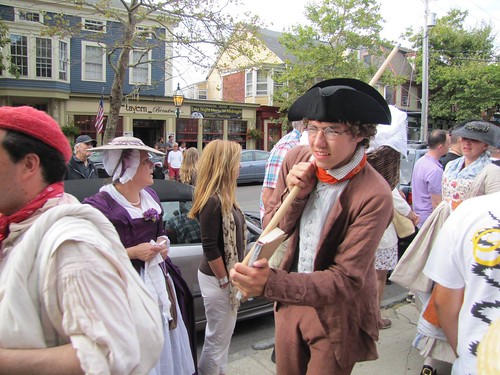
The Stamp Act Protest of 2014

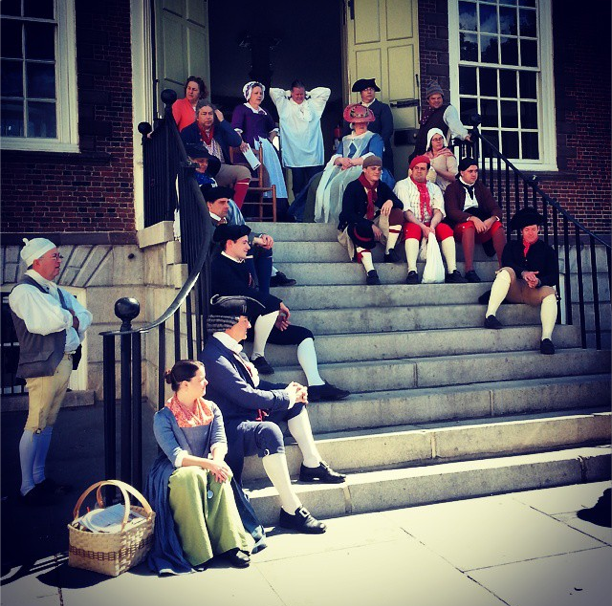
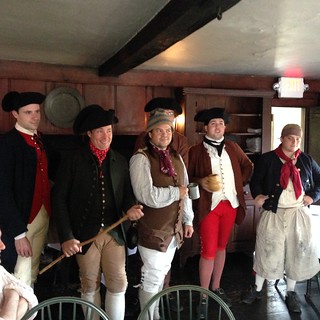
Last Saturday, we stepped back in time to 1765 in Newport. I know: Newport always seems to be in a different time than gritty Providence, but this trip was truly different.

On the Colony House steps

We were headed across the Bay for a Stamp Act Protest (no rioting, per police request). In this effort, we joined a large group of recruits from New England and even beyond, to fill Washington Square and other sites in the city.

18th century sailors prepare to sew a sail
Preparing the ‘sails’ for stitching. I never really noticed the cars till I saw the photos!

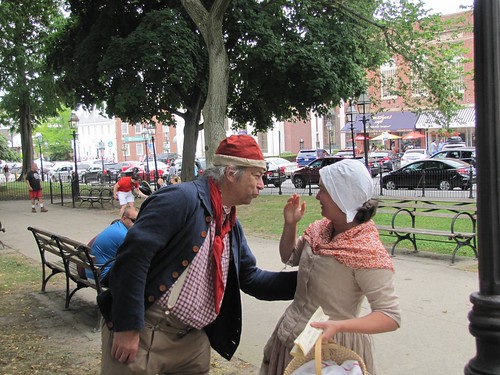
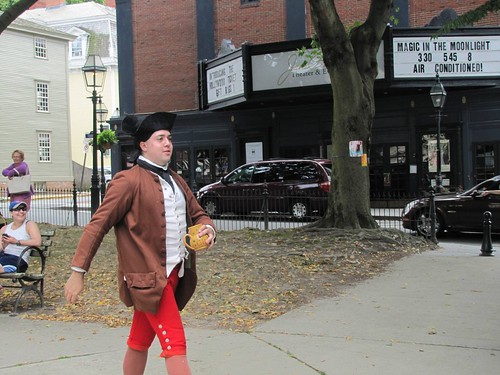
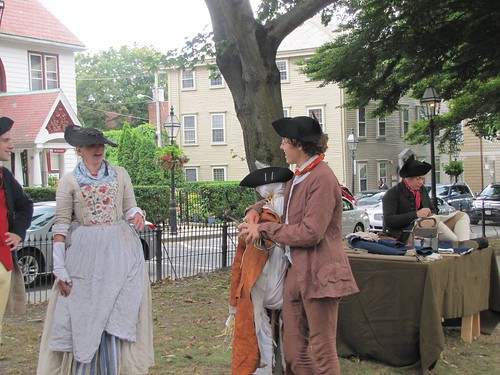
Stationed around the square were sailors mending or making a sail*, an apprentice-less printer, a sleepy apprentice boy, a tailor and his journeyman, a milliner, and leading citizens, one of whom was kind enough to read the newspaper to the apple seller, who wonders what has become of her son.

You must be very careful indeed around the sailors!

Up the street, some very fine ladies were having tea. Their refinement was evident in their appearance and dress, as well as in the elegant setting of their tables. They wanted none of my apples, as they had imported citrus fruits, far better than the apples the island’s trees produce. (Wasted on tea, truly: what one wants to do with a lemon is to find some rum and make a punch.)

18th century tea party in Newport
The Ladies’ Tea
Ladies at a tea table
Seated for tea
Mr Robinson marches forth

The news was very bad, and tempers flared in the square. Mistress Ellery told me that dinner parties had become impossible to hold: parties nearly come to blows over discussions of taxes, customs, stamps, and the oppressive policies of Mr Robinson, who insists on enforcing the very letter and penny of the law. (He was quite insulting on the quality of my apples, indeed, spitting one upon me even as he continued to eat it!)

The apprentice boy had charge of the effigy; the tailor sewed on.

As the afternoon wore on, the debate grew more intense and the crowd more heated. And effigy of Mr Howard was made, paraded, and hung, and then the crowd of protesters dispersed to the White Horse Tavern.

18th century men at the White Horse Tavern in Newport
Fortified!

Tensions seemed to dissipate, though when the runner came, the protesters– now fortified with ale, porter and cider–ran down the street to “plunder” Mr Howard’s house, played here by the Wanton-Lyman-Hazard House.

18th century people at Want-Lyman-Hazard House
Ignoring the mistress of the house, protesters dashed to the back.

Although the mistress of the house tried to reason with them, the crowd would not be dissuaded, convinced of their mission (and perhaps more fortified than you would expect after just one glass). They carried their loot to the front of the Colony House, and heaped it up, glorying in their success.

The goods!
More goods!

In the end, the house was not looted, tensions were dissipated, and the protesters dispersed into the afternoon. We were well-rewarded with cheese and ale at the Colony House, and enjoyed discussing the events of 1765 and 2014 with the public and Newport Historical Society staff members.

*Yes, Virginia, they do look like tents. That’s because they are tents. Someday, Light Infantry soldiers will sleep beneath that canvas. But for now, keep stitching!

Camp Life

The Ks, Mr C, Mr McC, and the Ss in camp

When I don’t manage to write up the weekend quickly, I risk forgetting what happened, which is sad when you think how intense the time can be. This past weekend was a little different from others as there were more of us in camp than usual. I locked the camera in the car along with my car keys, and never remembered to ask Mr S for his key when he was present…so the images are all from other sources.

Last week I was party to the Great Oatmeal Debate by Text Message as I tried to determine whether or not oatmeal was correct in period, and if so, what kind.  Let’s call it Hannah Glasse’s “oatmeal flummery” and move on.

To make Oatmeal-Flummery. GET fome oatmeal, put it into a broad deep pan, then co ver it with water, stir it together, and let itftand twelve hours, then pour off that water clear, and put on a good deal of fresh water, shift it again in twelve hours, and fo orrin twelve more ; then pour off the water clear, and ftrain the oatmeal through a coarfe hair-fieve, and pour it into a fauce-pan, keeping it stir ring all the time with a stick till it boils and is very thick ; then pour it into difhes ; when cold turn it into plates, and eat it with what you pleafe, either wine and fugar, or beer and sugar, or milk. It eats very pretty with cyder and fugar.

We were very lucky to have hard wood for fires, and I was very lucky indeed to have Mr McC on hand to tend to the fire, especially on Sunday morning, when I did not get up and start dressing until 6:00 AM. He joined us early Saturday morning with a kettle of hot coffee in hand, proving long experience with the un-caffeinated reenactor in the wild.

We ate very well this past weekend, with contributions from Mr McC, Mr L, the family C, and purchases from the Georgian Kitchen and Sugar Loafe Baking Company.

The Georgian Kitchen and Sugar Loafe Baking Co at Walloomsac

The Young Mr eventually bought his own loaf of bread, stuffed it in his haversack, and ate from it fairly continually on Sunday. If there had been a ginger cookie as large as a loaf of bread, I expect he would have bought that instead, but bread was a reasonable choice (though I think it proven tricky to hold a musket and a loaf of bread simultaneously….)

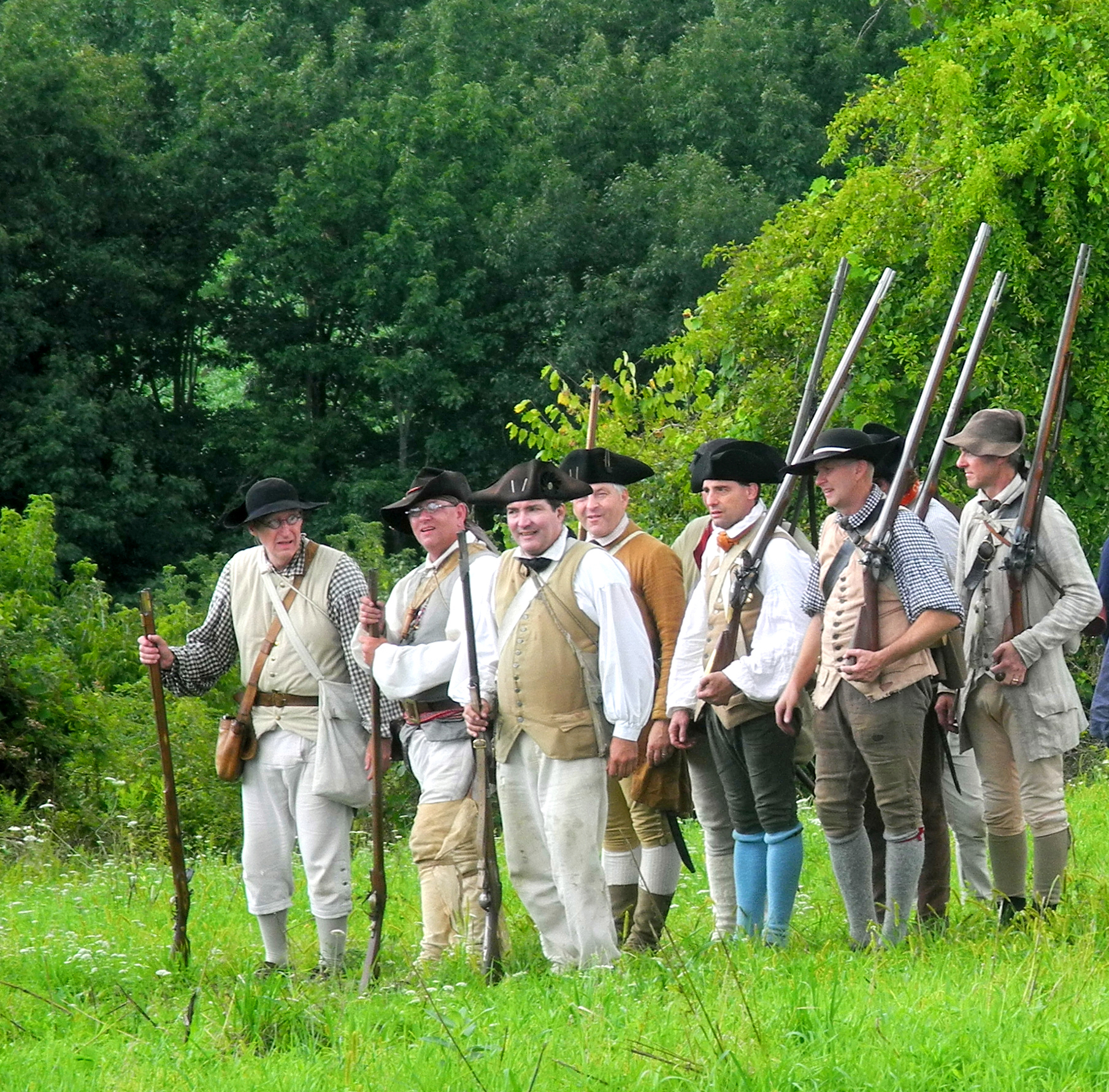
18th century militia in small clothes
Militia in Small Clothes
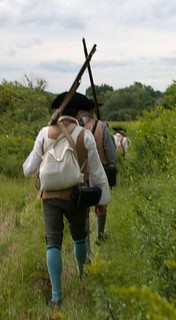
18th century militia marching in New York countryside
Mr S (left handed, as you can see) following MrMcC

The 10th Massachusetts, fielding as militia, are in the second and third rows above; I was shocked–shocked!– to see them fielding in their small clothes, but it is documented, and as they said when they lay down and even left ranks before fielding, “We’re militia. We’re not listening.” (Left to right, that’s Mr FC, Mr S, Mr McC and, in the rear, Mr L.)

For me, the best part of the weekend was, as it always is, being outside of time. (I even had a nap on Saturday, when the gents were up at the battle: more delicious than stew or cookies or even quince cake.)

At Sunday’s divine service, I was reminded again of why I enjoy this, and why we keep doing this, even when it all seems ridiculous in the face of the larger world.

The old service from the Book of Common Prayer is not that different from what we used in church. The formal rhythm and familiar words always remind me of how different the 18th century was from our own time, and how small people could feel in the face of a world without electricity, internal combustion engines, and modern weapons of war. As we lined a psalm and recited the liturgy that hoped for peace, I thought of Ferguson again, and of the ways that people bind together in beliefs without regard to class or color, and had some hope (even as I recited om mani padme hum internally). A moment of grace is often more easily found stepping outside yourself, and stepping out of time and out of doors can help.

Speaking of stepping out…

woman undressing in stays and petticoats
Almost steppin’ out of the 18th century…

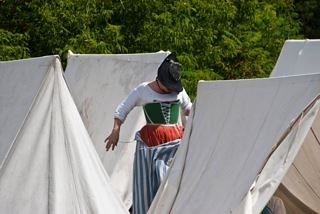
We had to pack up and flee back to the 21st century on Sunday afternoon, and I was caught getting partially undressed outside our tent (between my height and Natural Gace, I find outdoor dressing easier). No matter what you do, or when you do it, a healthy sense of humor about oneself is always useful.