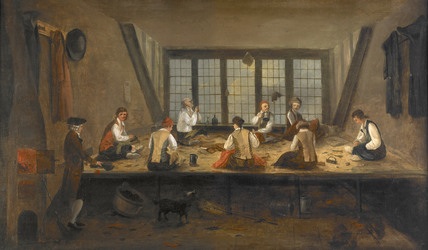
Come sew with me! Well, you’ll be sewing with Henry Cooke, but I’ll be there, too.
Check the Newport Historical Society’s website for more information about workshops and conversations this winter designed to for anyone with an interest in early American history who wants to expand their understanding of material culture interpretation.
Though it may seem contrary to previous posts, there are times when I really believe less is more, and that’s when we’re out in the field.
Each year I’ve tried to improve our kit and impression by replacing or removing items, mostly to increase our accuracy but also to reduce what we carry. The less we have to carry, the less I have to pack and clean and think about and the more I can think about the history. This iteration of “What the heck can I quit?” was prompted by reports of a conversation with someone I respect, which caused me to rethink what we were hauling along and how I could change it.
The Box of Doom with the Pitcher of Inaccuracy
We have stripped away most of what we used to bring for the comfort of the kid; as he has grown up, he’s needed less to feel comfortable and “at home.” We traded ground pads for bed sacks* very quickly, and we never had any iron to begin with. I’ve tried to keep within seasonal and historical cooking guidelines, but the largest hurdle and heaviest literal burden is the wooden cooler box.
Feeding the Young Mr is a tricky thing: he likes what he likes, and he likes a lot of it. What he likes are carrots, apples, and meat. There’s some swapping that can be done with seasonal fruit, but the largest hurdle is meat: if I can scrap fresh, needs-to-be-kept-cool meat, I can leave the cooler box at home. (At this moment, several gentlemen are suddenly feeling empty inside, with a taste of ash in their mouths. Dirt stew, boys: it’s coming.)
No iron, but what goes into the kettle?
I had gotten about as far as pease porridge when, in a completely costuming context, I came across links to The Sewing Academy.
The squeamish and childless may writhe at the handouts on dealing with nursing babies, hygiene, and winter clothes for children, but these Civil War resources have utility for all of us trying to be more accurate in our portrayals of the past.
I had not thought about packing frozen meat and storing it underground, and though I like the idea very much, it will not suit in cases where digging is forbidden. But it is certainly a way around the cooler box, and one I’m willing to entertain. (Check “No Refrigeration Required.”) “The Progressive Questions” help sketch out a responses to a variety of situations.
“Quoth the Mavens” contains this excellent definition: A truly progressive mind-set tries to figure out the logic of what was indeed used, rather than rationalizing modern logic into a period situation.
There’s nothing more to add to that pithy statement, but a renewed sense of dedication to accuracy and “less is more” thinking.
*As accurate as my attitude would be after resting arthritic bones on the ground, no one really needs to experience that. Call it a safety measure.
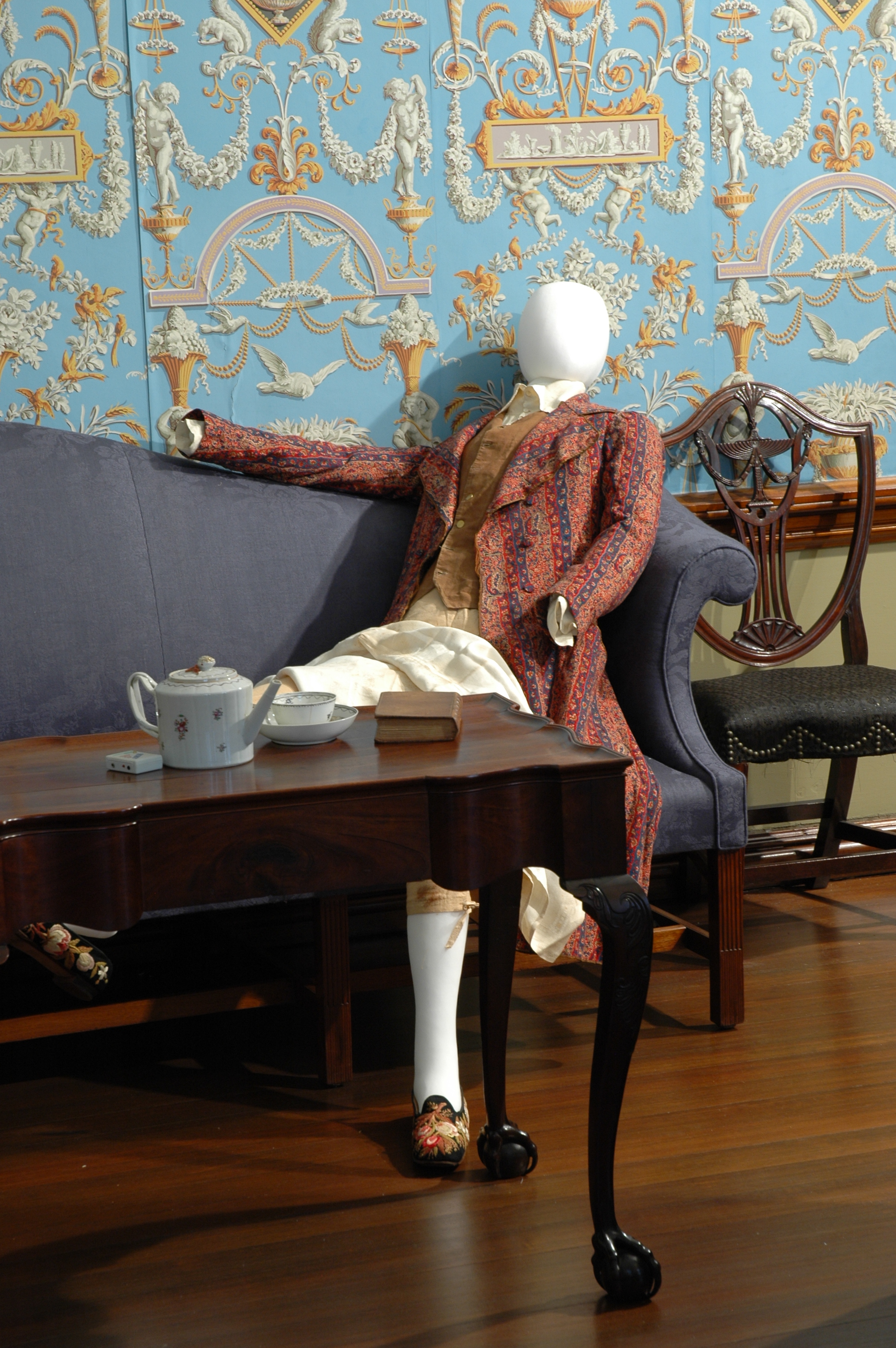
For almost ten years, I’ve been working on the re-interpretation and re-presentation of the HHM that is part of my employer’s stable of properties. We’ve had mixed results: guides who refuse to look me in the face, guides who quit because a piano got moved, guides who hissed “hedonism!” at the site of a lounging mannequin, and guides who were made incredibly sad by the representation of a sick (dying) child.
James, recovering from a party the night before, angered some guides (2007)
Me, I consider all those things successes.
The people who had to deal directly with that fall out, maybe not so much.
Change is hard and scary, and every one has a different tolerance for risk. As you have probably guessed, mine’s fairly high. I blog, I go out into the world in some pretty funny clothes, and inhabit characters I am not. I expect to fail regularly: it’s a reliable way of learning.
Change is hard to maintain, it’s hard to continually evolve and push an interpretation forward. It takes time, focus, and money; it takes cross-disciplinary collaboration and communication between curators, educators, and docents or guides.
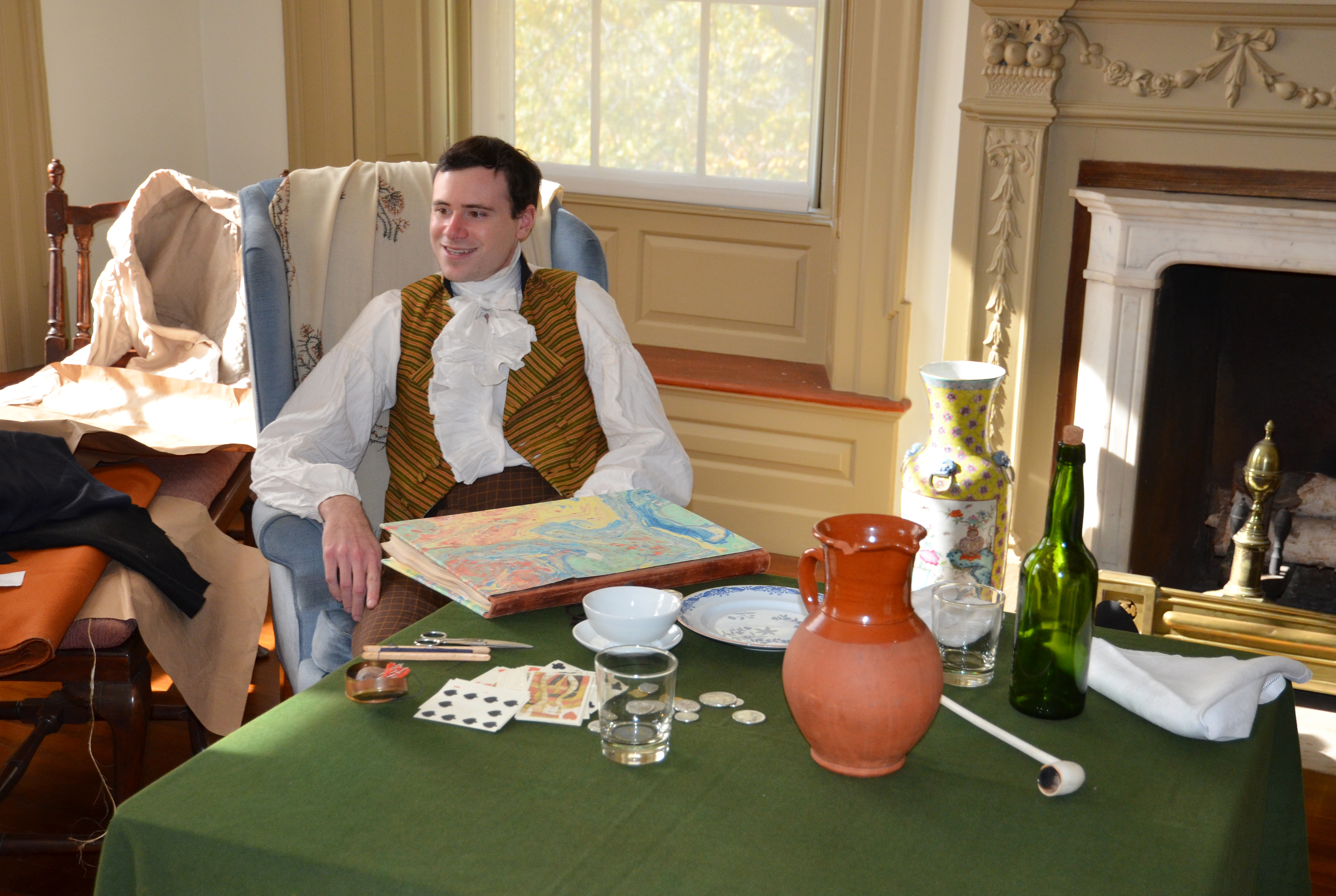
Taking risks in spaces full of very expensive furniture is particularly daunting, but especially rewarding when you see how a house looks, inhabited and, to a degree, used.
They’re sitting in real, accessioned chairs. (2014)
The job of museums is to preserve, but we sometimes seem determined to petrify, to freeze a perfect moment in amber, to freeze our visitors with fear of touching, photographing, asking, and to freeze and understanding, all in a fluid world.
If we reject the beautiful and untouchable past to embrace the messy human past, we can juxtapose the fine mahogany-furnished rooms of the merchant elite with the work to create those rooms and make the picture more whole by including slaves, servants, workmen and tradesmen.
More of us would have been working than lounging (2006)
Most of us would not have lived the way the merchants did: to a degree, our historic house visits are backwardly aspirational, as we wish for nostalgia that is more false than most nostalgia.
I am not advocating favoring the smelly past, or descriptions of unpleasantness, over exultations about carvings and upholstery—except that I am—because I see these pendulum swings as a part of the process of creating more complete and honest representations and recreations of the past, in museums, at historic sites, and in living history presentations.
It’s past time for me to work again on re-imagining the house under my care: I acknowledge that. Synthesizing what I learn in living history with the work I do in museums, and vice-versa, will improve and enhance the public experience of history inside and out.
In the past decade, museums, particularly historic house museums, have been challenged to refresh and reinvent their interpretations and presentations. The most notable challenge has come from the Anarchist Guide to Historic House Museums (AGHHM), and the Historic House Trust of New York’s executive director, Franklin Vagnone.
I re-read a number of Vagnone and Deborah Ryan’s papers recently (including this one), thinking not just about What Cheer Day in a historic house, but about reenacting, living history, and costumed interpretation.
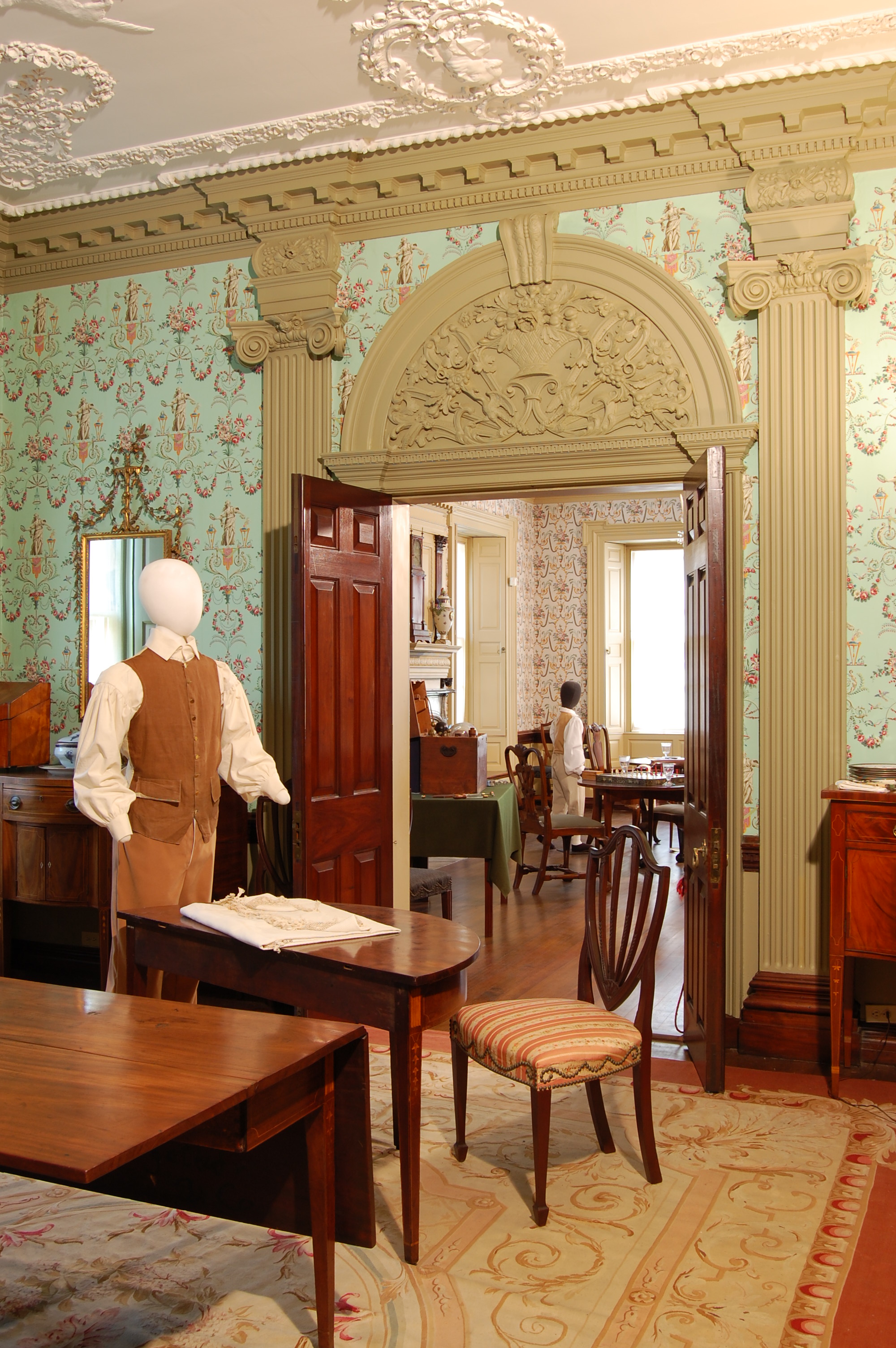
To make a historic house museum (HHM) seem more inhabited and real takes a lot of stuff: clothes, dishes, shoes, stockings, toys— all the stuff that surrounds us now, but correct for the time of the HHM, and arranged in a plausible manner, not like a sitcom set, where chairs before a fireplace face the visitor and not the hearth.
Stuff makes a house
To a degree, this is set-dressing, but set-dressing for a still-life, or real life, if the habitation will be by costumed interpreters. It has to be accurate to be authentic, whether it’s a HHM or a living history event that is striving to create a moment, or series of moments, in time– immersive moments.
We cannot step into the past unless we believe the representation we’re seeing, and that’s true no matter where we are: that’s why fabric matters, sewing techniques matter, tent pins and kettles and canteens matter. The world is made up of tiny details that we do actually notice without even knowing it: we see more than we realize, faster than we think. We’ll trip on the different, and stop.
A variety of coats can tell a variety of stories
But what we want to do, as interpreters, is to have the visitor catch the right difference: not the one about which canteen and why, but the larger interpretive point. In one hypothetical example, wooden canteens are a way to talk about defense contracting and supplying the American army, just as over-dyed captured coats are a way to talk about the American Revolution as an international, and not just a civil, war.
An encampment is, in a way, a neighborhood of HHMs turned inside out, with each regiment a separate family within the larger neighborhood. Each regiment tells a story about itself and its history, and is a lens through which visitors see the larger story.
That’s why accuracy matters: you don’t want to debunk Ye Olde Colonial craft in camp, or cotton-poly polonaises (poly-naises?) worn by purported women on the ration: you want to focus on the larger interpretive point. When not everyone plays by the same rules, it is better to focus on your own accuracy and authenticity and to ignore Ye Olde Annoyances.
Tell the larger story, the story of your own regiment’s people: that’s your interpretive goal.







 Kirsten Hammerstrom
You must be logged in to post a comment.