Peale’s Progress, or, High on History

No, we didn’t go, and I have regrets. Six weeks before the event, I thought I was working on January 3rd, and by the time the schedule changed, it was too late. Instead, you can read about Drunktailor’s experience.

Reenactors portraying Philadelphia Associators take part in the real time tour of the Battle of Princeton, Princeton, NJ, January 3, 2015. Beverly Schaefer, Times of Trenton
Reenactors portraying Philadelphia Associators. Beverly Schaefer, Times of Trenton

The background is interesting, similar to the kind of events and projects we’ve been talking about here in RI: site- and time-specific events that combine commemoration, history, and experimental archaeology, or an emotional and social archaeology, if you will.

From event co-organizer Dave Niescior, quoted in the Rutgers-Camden News Now: “The goal is to gain a better understanding of the hardships endured by individuals who lived and made a critical moment in history.It is one thing to write ‘the troops marched overnight to Princeton,’ it is yet another to understand what that physically and mentally meant to the men who had to put one foot in front of the other all night long.” Co-organizer Matt White told NJ.com, “We’re trying to stage a number of vignettes to give people a sense of what was going on in the Continental Army in this period between late December and early January of 1776 and 1777.”

that’s cold. From Daily Reenactor

These and other collected images help convey a sense of the event,  which–as far as I can tell– did provide participants with the kind of transcendent experience I know I enjoy and hope to find at events.

This is the kind of event that I think proves a belabored (and elsewhere belittled) point: accuracy matters. It is just about ALL that matters.

On a now-defunct phone, I had an old video of the Young Mr with a now-deceased reenactor of whom I was quite fond, despite our wildly divergent politics. In it, Mr D shows his Charleville to the Young Mr on the front porch of an 18th century home and asks, “Do you know what this is?” The Young Mr shakes his head, and Mr D answers, “It’s a time machine.”

Although I remain committed to reducing the degree to which living history is musket-centric, there’s truth in that statement: Mr D had an original, period Charleville and a fairly well-cut uniform, considering his generous figure. Using, showing, and interpreting actual period pieces and well-made, correct replicas is the single best way to connect the present, and the public, to the past. Accuracy matters because it’s the literal key to the past: you have to cut the pattern right.

Accurate impressions rendered in a place of shared value will transport you to the past, and give you insights you did not expect. That is the point of these exercises: insight and understanding. It’s how to get high on history.

Maid to Order

DSC_0572 I play the maid a lot, or one the lower sort, both at home and abroad.

I’ll be a maid in Newport again this February, and for that event, I’ve made the skritchy rust brown gown.

Not quite finished, it still requires hemming and something to finish the sleeves, but in three days, I got pretty far, considering.

This back-closing bodice with bust darts was pretty awful to fit– strange relationships developed between the bodice neckline and a waistband now discarded and on its way to Johnston.

DSC_0573

The back closes with a drawstring at neck and waist, as simple as possible. Mr S and I discovered that fitting a bodice back was deleterious to our relationship, so drawstrings won over buttons. I can tie the lower string, but not the upper– annoying, as I was trying to make a gown that was easy enough to put on solo at 4:30 AM. Vanity won over a pinned apron front gown, though I know they exist in Rhode Island collections. The skritchy rust-brown cotton pays homage to that extant garment, which is a rough homespun brown wool. I may not be stylin’ extant, but I’ll be itching correctly.

The Unbearable Sameness of Dressing

One of the arguments I hear against changing the way people dress as civilians at reenactments, particularly the women but sometimes the men, is that “if we all use the same pattern, we’ll all look alike, and that’s not how people dress now or then.”

I have news for you: that is how we dress[ed].

I know, we can’t apply modern thinking to the past– that’s crap historiography. But why do we resist using the same correct patterns for historic garments when we are clearly dressing alike today?

I’ve not yet read a paper on the similarity of women’s dress in Robert Feke or John Copley’s portraits that really convinced me, but if you look at enough of them, you might think there’s only one woman and one dress in all of British North America, because Badger and Greenwood are painting her, too.

Even if those clothes are studio props, what does it say that the sitters wanted to be portrayed in the same clothes? Look, if that’s the only means of getting myself into a Charles James, you bet I’d take it. Or, for a more contemporary analogue, Alexander McQueen.

Luxe et Indigence. Le Bon Genre, 1817

Dressing is about status as much as it is about self-expression, and in the 18th century, dressing signaled refinement, sensibility, and status through the quality of fabric as much as through the cut of clothes. Air Jordans do the same thing today, or North Face jackets, or Kate Spade purses. They show what you can afford, even if you’re eating oatmeal for dinner behind closed doors.

We dress the same now, and we dressed the same then, with variations according to pocketbook. We can’t all afford K&P superfine wool today any more than we could have bought the best wools or prints in the 18th century. But using accurate patterns and fabrics appropriate to our station will create the best impressions possible– even if my gown is cut to the same pattern as my wealthier acquaintance’s.

Scabbers Paints

Perhaps you know him as Timothy Spall, but the actor playing Mr Turner is best known in my house for his role as Scabbers, AKA Peter Pettigrew, in the Harry Potter films.

I am anxiously awaiting the release of Mr Turner, and have watched the trailer multiple times in anticipation of material for the authenticity and accuracy fires.I’ve also watched The Power of Art again, because I love Simon Schama as the David Attenborough of fine art, and I’ve enjoyed the way that Mr Turner’s titles appear to use a similar color-into-liquid trope as TPOA’s bleeding titles. Just go watch it.

Why am I so excited to see Scabbers paint? Because the trailer looks so damn good.

The color, the set dressing, the intensity of the colors, all suggest that the film team paid close attention to the material culture of the past, and to those tiny details that create a satisfactory, accurate closed world that helps us achieve experiential and even transcendent authenticity.

Of course I enjoy costume drama: you’d expect that, right? And messed up costume and material culture details can wreck a film or TV program for me, but what you might not expect is that there are some films I enjoy despite their apparent inaccuracy.

Take the Muppet Christmas Carol. That’s one of my favorite adaptations of the Dickens’ work, because it creates a world true to itself filled with believable objects and characters (even the ones I can’t stand), and returns authentic emotions. Scrooge’s headmaster was never an enormous eagle muppet: but the shabby school room works, much the way Beatrix Potter’s anthropomorphic tales work.

In The Pie and the Patty Pan, Duchess can’t bake– what dog can bake? But we can believe that Duchess is a greedy eater, and might well think she swallowed the patty pan. The touch of hypochondria in a greedy dog is intensely satisfying, I think.

Cat and dog at a tea table
Where is the Patty Pan?

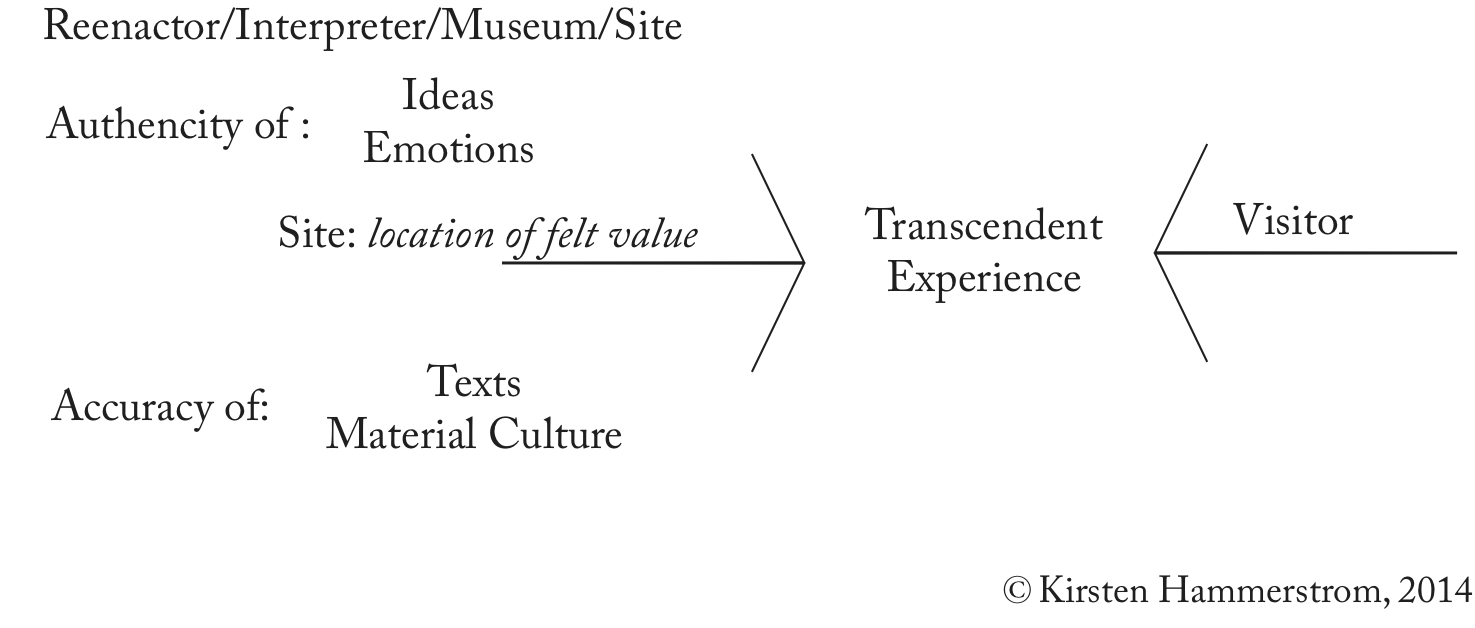
What does this mean for historic house and living history interpretation? It means furnishing a believable world with accurate clothing, goods, and accouterments, based on primary sources with characters who convey authentic emotions and ideas to create a transcendent learning experience.

I even have a diagram:

The experience equation

And that’s why I want to see Scabbers Paint. Because anything that creates a believable historical experience is worth learning from.