Because I’ll be spending Valentine’s Day in 1820, I thought I’d try to replicate this token. News on how it turned out later… I don’t feel clever enough to write my own verse, but here is the Rhode Island example transcribed.
My love is true to none but you My heart expires for your sake And if you don’t me pity show My true and tender heart will brake
Here a question you will find A sweet question you will find Sweet is the question mark it well Heart upon heart and so farewell
My Dearest dear and Blest Devine I’ve pictured here your Heart and mine But Cupid with his fatal dart Has deeply wounded my poor heart
There between us sat a Cross Which makes me to Lament my loss But I am in hope when the Cross is hone That both our hearts will be in one
My heart is fix’t no more to Range I like my Choice to well to Change Oh that my Heart to yours could meet Then all my joys would be compleast If you take this in disdain Pray send it back from Whence it Came L M
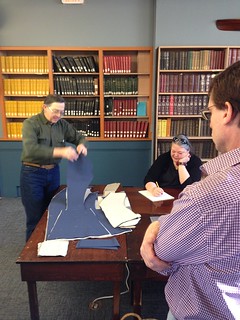
Scheduling being what it is, we plunged right in to hands-on work with Easy Grace and Comfort, a two-day man’s frock coat workshop with Henry Cooke. We saved enormous amounts of time in the workshop by having Mr Cooke cut coat kits for participants, and I know it was well worth every penny.
There is much less on-body fitting when Mr Cooke cuts a coat for the kid than when I do. (I think the Young Mr grows while I am trying to figure it out, but Henry cuts fast enough to head him off.)
Buckram and button stands
The most painful part of the whole thing (if fitting is largely done) is stitching on the buckram interfacing and the button stand. The zig-zag stitch as demonstrated by Henry was fairly easy to get the hang of when you caught the rhythm, but the tightness of the Red Edge stand tested my needle and even my fingertips.
There were some complaints at one table, largely voiced by the Fifer Formerly Known as Lambchop, who awaits his 10th Mass name.
Sleevils!
We made it all the way to sleeves, which is impressive, considering that some of the gentleman had not made more than a haversack or knapsack before. But if you can backstitch, and have some help with your fitting, you can make a coat.
I happen to like sleeves, myself, stitching them up and setting them in the garment. I think it’s the three-dimensionality of them that appeals to me– and I like a good challenge.
And here we are: sleevil one.
It’s critical to pay attention, though, so you make one left and one right sleeve, and to keep track of them as you set them to the garment body. I sometimes mark mine with chalk, and have even pinned notes to the pieces when feeling especially daft.
I’ve made it to an assembled coat body and sleeves, with one sleeve basted on. Before Saturday, I plan to baste on the second sleeve and test fit sleeve set on the boy. I’ll also try to get pocket flaps made. Since I have a talk to write and a bedgown to finish as well, I’m probably dreamin’ big.
When this suit is done, the Young Mr will have a very nice blue ensemble that includes breeches (join in the fun here) and a waistcoat. I think he’ll look rather nice, and better than he has previously. I still want to make lower-class* clothes for him, but first he does need a nice suit.
*I said urchin, but Mr Cooke said urchins can’t be over 6 feet tall. Basking sharks are big, but in this blue-grey suit, perhaps the Young Mr will finally be a grey reef shark.
We were doing some preliminary planning for an event this fall, and we were considering recreating the 1803 funeral of Important White Guy. Our event is in October; the funeral was in September. Somebody asked me, “What does it matter when we do it?” and I didn’t respond nearly as gracefully or eloquently as I could have.
Why does it matter? Does it matter to anyone but me and my cohort?
It does, and here’s one reason why: When interpreting the funeral in late October, perhaps a member of the public will ask, “When did he die?” Can an interpreter really say “September 20” and not expect a slew of questions about how long the body was kept and why the funeral was delayed and wasn’t that a health hazard? Can the event orientation start out with “We’re doing it in October because that’s when we want to do it,” without fundamentally changing the event?
August is hot. Can we riot in September? No!
Moving the recreation of a specific event by more than it takes to get to a weekend* seems dishonest to me: do you really want to celebrate your birthday 5 weeks after the actual date for someone else’s convenience? July 4th: Gosh, it’s not working for me this year. Let’s do that in August.
For a historical organization to suspend caring about accuracy for living history events but not for published articles, catalog records, or finding aids just contributes to the greater problem in and of living history.
When asked about the goal of a living history event, I have been told, “Well, we want families, right? So we should have some hands-on activities, you know, immersive, like candle dipping.”+
It took a bit, but at last I grasped the core of the angry-making: Kids like living history, therefore it is less sophisticated than other forms of history.
The right place for immersive string activities.
Living history is not as sophisticated, nor need it be as accurate, as traditional (written, orated, curated) historical presentations: I think that is the background assumption a lot of people make, both in the adminstration of traditional historical organizations and in the presentation on the field. It is a complete fallacy.
Living history done well and done right is as well-researched as a paper, exhibition, or article. It draws from primary sources both written and visual, it requires the absorption of countless secondary sources to help analyze the primary sources. It is as collaborative and negotiated a process as any museum exhibition, and like exhibitions, it uses material culture interpretation to deliver its messages, i.e. meet its educational and interpretive goals.
A good living history event is beautiful, but like a ballet, that beauty does not come easily. There are no shortcuts, and beauty does not equal superficial or stupid. It indicates sophistication. Part of that appeal is accuracy: the better, the more accurate and immersive the historical setting and action you create, the more visitors can learn without asking.
Lawn games
When I organize an event in our house at work (or even on a guided tour) one of my interpretive points is always “people saw the world differently– literally– and this event/house tour helps you see the world of 1800 the way people living then saw it.” Aesthetics were different, and were underpinned by ideas and opinions. But understanding those aesthetics and the opinions people held about race, gender, beauty, work and class takes actual research and analysis. It’s not all putting on a pretty dress and cavorting on the lawn. Facts matter. Accuracy matters.
Museums are some of the most trusted organizations. If we started juicing facts like every History channel show, we’d lose that trust, and rightly so. Our trustworthiness is grounded in our honesty and integrity.
Living history events are mobile museums, and every reenactor curates his or her own impression. To retain the trust and interest of the public, we have to be accurate.
*Events are moved to weekends because that’s when interpreters and audiences can come.
+This at a house that not only lacks a working kitchen earlier than 1960 in the staff area and was owned by a partner in a candle factory. I’m thinking “bought ’em in bulk,” here, not dipping.
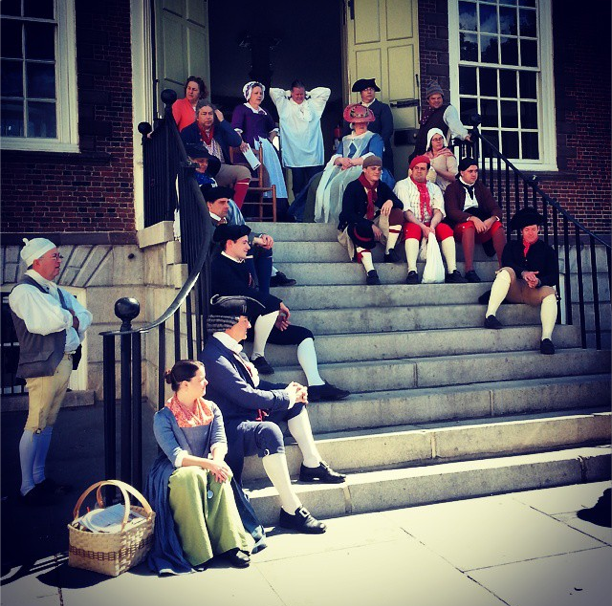
Once upon a time, I called reenactors and costumed interpreters History Clowns. The pilgrims at Plimoth Plantation 25 years ago scared me, and I did not like to visit living history museums.
History Clown
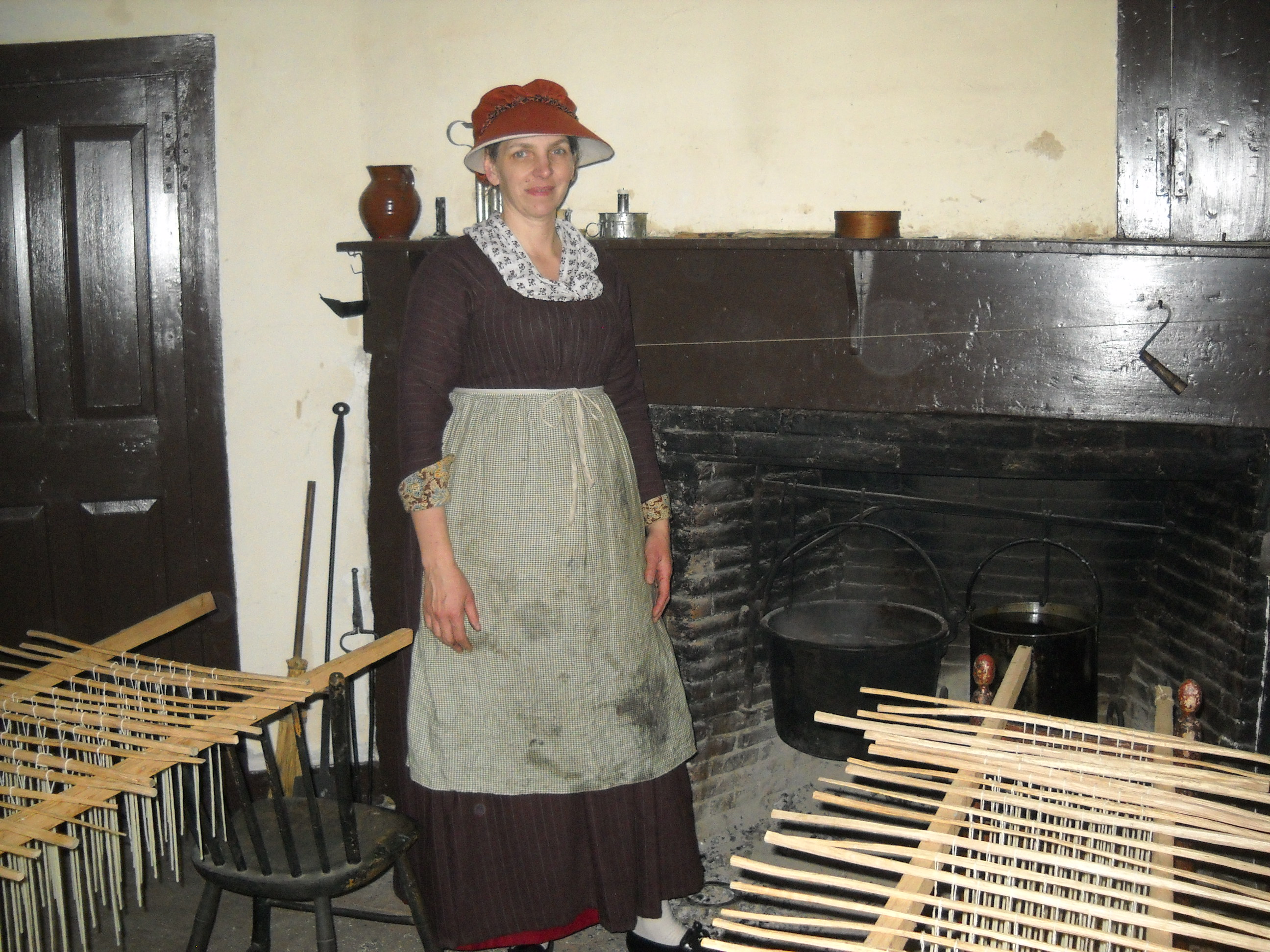
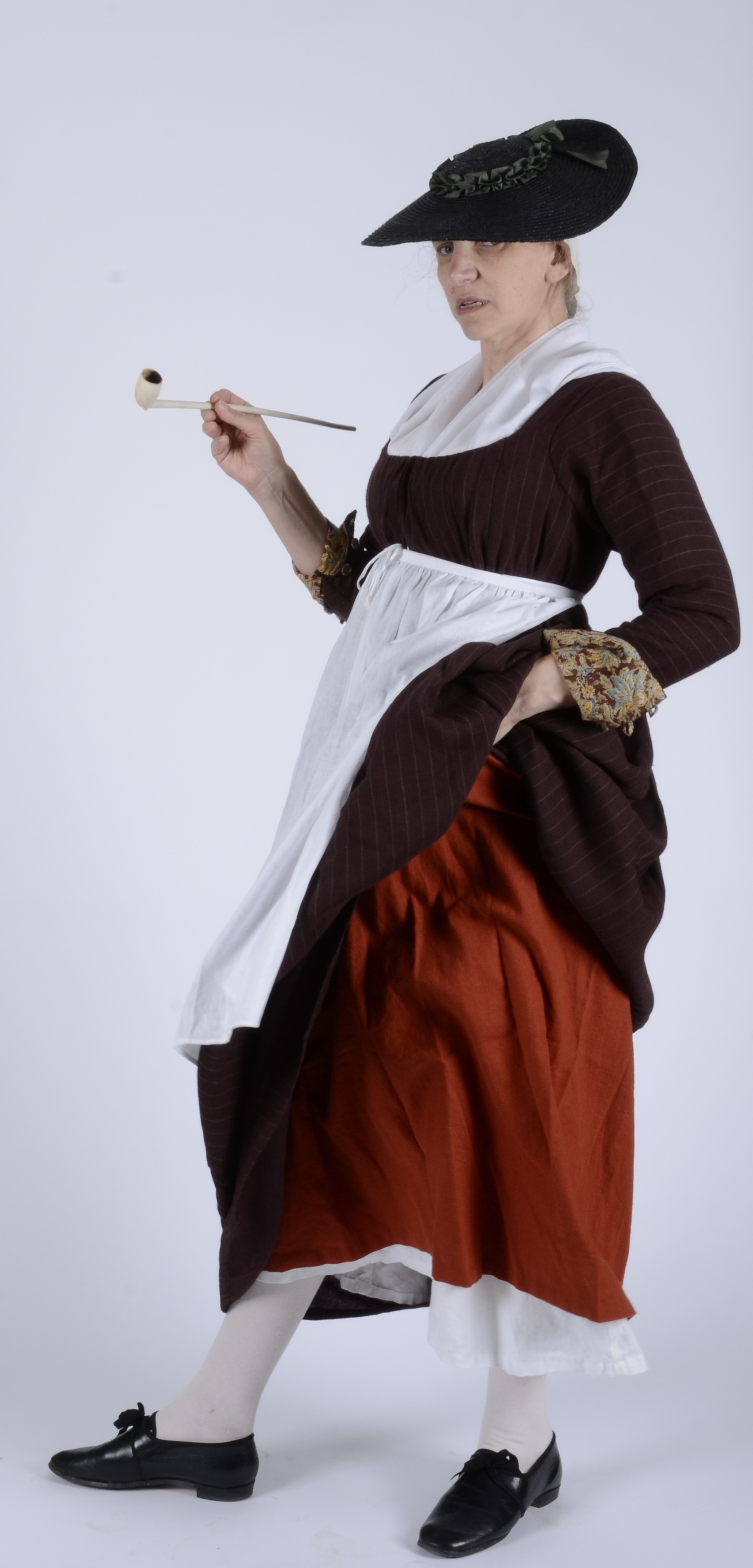
Now, I’m one those costumed clowns.
What changed? For one thing, I did. But more importantly, living history and reenacting changed. It got better. It became more accurate, more inclusive, more specific. (Even Plimoth admitted at a Dublin Seminar that their costuming had evolved.)
When I see the fights that erupt online (there was a skirmish on Facebook last night—Peale’s march will not die), I think about the History Clowns. I think about the evolution that has taken place, and I think about the skirmishes I get into in trying to plan living history events at my own institution.
Most of these fights are not about accuracy—that FB fracas wasn’t—but do we know what they are about? We try to push back with our insistence that accuracy matters, but that’s not the argument our opponents are trying to have with us. They don’t give two rats about the cut of your breeches or the cord on your canteen or what you think of their rubber-soled shoes.
They want to be recognized. They want to be appreciated. They want to matter.
It reminds me a lot of when I first came to the place I work; I was one of three new, younger people hired within a short span of time to work on exhibits and an expansion project that never happened. As we looked at the organization, we saw things that didn’t seem right to us. But often, we met a lot of resistance to new ideas: “We’ve done that already.” “We tried that and it didn’t work.” “This is fine the way it is.” “We’ve always done it that way.”
I think those translate thusly: If you do it, you might make my attempt look bad.
If you succeed where I failed, I will look bad.
I don’t want to change.
I’m afraid to try something new.
What about my efforts? Won’t they be rewarded anymore?
I think that’s what people are saying to us sometimes, even when the words they say are, “These haversacks are fine, they’re really durable. It doesn’t matter if the fabric isn’t really right,” or “Market wallets? No, that was just a Henry Cooke fad.”*
The fight is probably not as much about accuracy and authenticity as it is about feelings. That said, I think it behooves people on both sides of this line (and it is often generational) to be equally mindful of each other’s feelings. While we can respect the work that people before us have done, they should respect the work we are doing now, as new resources come to light, and new thinking is applied to history and interpretation.
Just as we cannot live in the past of historic house museums, we cannot live in the past in reenacting/living history. And while I respect the tenure of some unchanging regiments and the work they’ve done before, it comes down to this:







 Kirsten Hammerstrom
You must be logged in to post a comment.