Mountebanks, Watchmen, and Questionable Women

Mountebanks at night. watercolor by Paul Sandby, 1758 Royal Collection Trust/© Her Majesty Queen Elizabeth II 2014

Sometimes I think I’ll forgo the dressing up and going out in public, and just do the research; the world that exists in my mind is pretty satisfactory, and within it, Boston doesn’t have the GPS-killing skyscrapers of the financial district or the motor-powered vehicles that seem bent on killing pedestrians. Instead, it has horse-drawn vehicles, equally ready to run you down.

But: in thinking about the people on the margins, the people in the backgrounds of images, the people casually mentioned– “so hard to find a cook when you need one”–in letters, I’ve been looking at even more images. Here, a mountebank, illuminated by a torch, performs on a washtub outside a tavern (Good eating every Day) for a crowd of men, women, and children. Much texture here, and many people one could aspire to be.*

Mountebanks at night. watercolor by Paul Sandby, 1758 Royal Collection Trust/© Her Majesty Queen Elizabeth II 2014

Let’s get the watchman out of the way.

Is that a snarl or he is just happy to see the mountebank he can bash over the head with his prodigious stick? He’s carrying the obligatory lantern, here apparently made of tin with horn, glass, or mica windows. It looks like he’s slung it over the stick, where it is caught by by the knob to keep it from sliding.

It’s a Great Coat, really: the button-embellished flap (pocket slit?), the deep sleeve cuffs, the taped buttonholes all serve to make this coat impressive and intimidating.

On his head, a rakishly angled black wool hat worn over…a cap? Help me out here, gents. It looks like a linen cap that covers the very crest of his ear. Is that possible? Or he is tonsured? If so, you’d think he’d want a cap for the cold…

Mountebanks at night. watercolor by Paul Sandby, 1758 Royal Collection Trust/© Her Majesty Queen Elizabeth II 2014

Next up: the girl with a basket. She raises a lot of questions for me when I zoom in close. Yes, Virginia, she really is wearing a cast-off regimental under a short red cloak. I’ve never understood how women came to possess these coats, but look closely and you’ll see the blue cuffs and plackets on the sleeves, the pocket flap sticking up just below her basket, and the long skirt of the red coat. (That’s a dog, not a killer shrew, between her feet.)

Her hair is a mess, too; we can speculate on reasons for that, but let’s go with a long, busy  day as a servant, and not freelance corner-based activities.

What’s in the basket? A bottle? A decanter? A funnel? Hard to tell. Is she someone’s serving girl, sent out to the liquor dealer? If she is, why that coat? Is the man in red next to her grasping her elbow? Possibly…(and doesn’t he have a nice red double-breasted coat?)…and if that’s a uniform he’s wearing, is that her connection to the coat she is wearing? So many questions.

In the center background, there’s a young woman escorting a male child; she may be an older sister, but I think it’s also likely she’s a nursemaid. In the background at the left, two ladies are seen from the back, clearly wearing neat caps and jaunty hats. They’re moving away from the mountebank and the crowd, probably on their way home, respectability leaving the dangerous streets.

It’s as much a mix of people as you might find outside the Pret a Manger on State Street today. Somewhere in that crowd, there is someone to be.

*In a nod to riots recent, let us note there are 5 or 6 women shown here, 14 men, 5 children, 2 dogs and 1 monkey. That’s a 40:60 ratio of women to men. Children are, in general, grossly underrepresented in living history. Let’s talk about that someday.

Undocumented but Not Alien

Cherries. The Itinerant Traders of London in their Ordinary Costume, from Modern London; being the history and present state of the British Metropolis. Illustrated with numerous copper plates - British Library
Cherries. The Itinerant Traders of London in their Ordinary Costume, from Modern London; being the history and present state of the British Metropolis. Illustrated with numerous copper plates – British Library

Sometimes it’s hard to know how a riot gets started; other times, the cause is pretty clear. I’ve started one or two myself. The latest stems from Our Girl History’s musings on the Massacre.

There’s a lot to unpack, and it’s been happening online and in private conversations. Yes, children, Aunt Kitty pays attention, even if she’s silent. This is a tough topic: how can modern feminists represent historical women in a patriarchal culture without losing their minds? How can events better reflect the actual past? The population has, historically, always been about 50-50 male-female. We understand why there aren’t women on battlefields. We get that traditional events (by which I mean the ritualized commemorations of battles) have ridiculously gender-segregated and inauthentic roles. We get that it’s hard to adapt to new ideas, even free, documented ones.

The irritation and anxiety I feel as I expand the kinds of events I attend is actually reassuring: that’s how I know I’m learning. The frustration we feel means we’re banging up against a wall that we can break down with research.

Paul Sandby, London Cries: Black Heart cherries... ca. 1759. YCBA, B1975.3.206
Paul Sandby, London Cries: Black Heart cherries… ca. 1759. YCBA, B1975.3.206

It’s not easy research: women not married to or otherwise affiliated with prominent men are poorly documented. We may never know their names– or we may have a name from a census, newspaper ad, or city directory, and nothing more. But we can fill in the gaps with interpretation. (As it happens, I’ll be talking about this very idea in just a few weeks. Come taunt me in person.)

There’s a lot to think about in recreating the past, in particular at this event. The organizers have done a phenomenal amount of research, gathered the details, sorted them out, assigned roles, scripted and timed an event, and recruited a chorus of characters that reflects the texture of a tense city in 1770.

Building an event, even one that recreates an actual moment in the past, is as much as work of theatre or fiction as it is of fact: character development, motivations, costuming, setting, all of those combine with the documented words to create a scene that conveys an interpretive point for the public. It’s similar to a museum exhibition– it’s interpreted.

Traditionally, living history has interpreted the past with a bias to men’s roles (that’s the nature of our society, folks) and with a tendency to assign roles and activities by gender (again, the nature of our society for centuries). Our task in breaking that pattern is not to right the injustices of the past, for we cannot, but to interpret them.

Playing the game at quadrille : from an original painting in Vauxhall Gardens. London : Robert Sayer, ca. 1750. Lewis Walpole Library, 750.00.00.14
What about the people in the background? Playing the game at quadrille : from an original painting in Vauxhall Gardens. London : Robert Sayer, ca. 1750. Lewis Walpole Library, 750.00.00.14

One way to do that is to bring the undocumented, or poorly documented, people of the past to light. I tried to do that in exploring Bridget Connor. I’ve tried to do that by interpreting a late 18th/early 19th century servant. It’s a long and frustrating process, reading letters and diaries for scraps of information, usually casual references to servants and cooks.  But in the frustration lies the promise: we will find the people on the margins, and bring them in to clearer focus.

Frivolous Friday: Checkin’ it Out

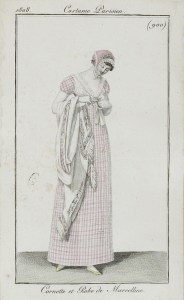
Costume Parisien 1808 Cornette et Robe de Marcelline
Costume Parisien 1808
Cornette et Robe de Marcelline

One gets ideas. I often get ideas about checks. In particular, I get ideas about loud checks. The gown in the fashion plate is appealing, when you’re looking for checks, and all the more so when you know how similar it is to an extant garment in your actual location.  The cornette I can do without– that’s the headgear, which looks like she’s crammed a sugar Easter egg on her head– but at least it could hide a short hair cut or the melting pomade of humid summer.

Costume Parisien 1808 Chapeaux et Capotes en Paille Blanche et Rubans
Costume Parisien 1808
Chapeaux et Capotes en Paille Blanche et Rubans

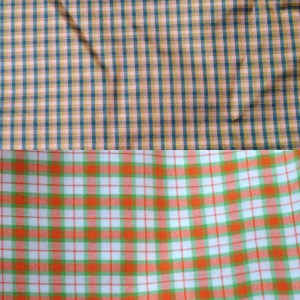
But wait! What check through yonder tastefulness breaks? It is the fashion plate, and  the checked bonnet is my sun. My goodness, that bonnet on the lower left is satisfying. It appeals to me the most because it is by far the most check-heavy bonnet I’ve seen, and making it would not involve plaiting straw, which I know nothing about. It’s a direct trip to obnoxious via silk taffeta, and that’s a trip I’ll buy a ticket for.

Top: check silk taffeta, Artee Fabrics Bottom: check cotton, Mood Fabrics
Top: check silk taffeta, Artee Fabrics
Bottom: check cotton, Mood Fabrics

Actually, as the result of a train ticket last August, I am the proud possessor of some delightfully bright lightweight cotton check in search of a fashion plate. The year I’m targeting (which is not 1808, but 1818) hasn’t yet provided published inspiration, but there are more places to search. In any case, an orange check gown with a blue check bonnet is pretty much crying out to be made. Bring your hanky, in case your eyes water, but make sure it’s check, too.

Transparent Visions

With armloads of cash, the NPYL has, as I’m sure you know, digitized thousands of items which are now available on a ridiculously procrastination-worthy (it’s research, I tell you) site.

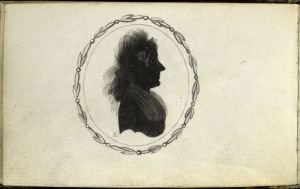
Carl H. Pforzheimer Collection of Shelley and His Circle, The New York Public Library. (1795 - 1834). Portrait silhouette.
Carl H. Pforzheimer Collection of Shelley and His Circle, The New York Public Library. (1795 – 1834). Portrait silhouette.

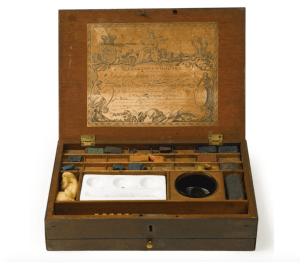
In my current quest for watercolor boxes and miniature inspiration, I found the Anne Wagner album particularly interesting. The pages in the book compile verses, mottoes, collages, locks of hair, and a portrait silhouette. In all likelihood, Anne Wagner had a watercolor box not unlike this one coming up at Sotheby’s on Thursday.

Lot 738, Sotheby's Sale N09466 REGENCY MAHOGANY PAINT BOX BY W. REEVES & WOODYER, FIRST QUARTER 19TH CENTURY
Lot 738, Sotheby’s Sale N09466
REGENCY MAHOGANY PAINT BOX BY W. REEVES & WOODYER, FIRST QUARTER 19TH CENTURY

Every young lady of some means would have had a watercolor box suited to her station (they came in a variety of sizes), and young ladies with leisure time occupied themselves with diaries, commonplace books, amateur silhouettes, and paintings. Diana Sperling is one of the better-known examples of amateur artists, with drawings occasionally appearing at auction. The best of these watercolors give us a literally transparent look at the long 18th century from inside.

 May 25th. Henry Van electrifying - Mrs Van, Diana, Harry, Isabella, Mum and HGS. Dynes Hall.
May 25th. Henry Van electrifying – Mrs Van, Diana, Harry, Isabella, Mum and HGS. Dynes Hall.

Museums try to connect the people of the past to the people of the present, and sometimes in focusing on similarities critical differences are missed.

It’s not just that the people of the past accepted racism, slavery, and sexism. They literally saw the world differently. I’ve watched contemporary amateur artists try to recreate the imagery of the past, and it’s hard. I wonder, as I try my own had at the task, if we can manage it. Color sensibilities were different; taste was different (checks from hell, remember?). My own style is more graphic and bold than an 18th or 19th century artists’– more Fairfield Porter than Edward Malbone.

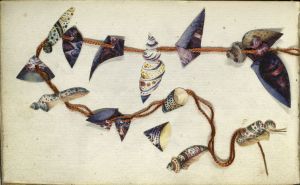
Carl H. Pforzheimer Collection of Shelley and His Circle, The New York Public Library. (1795 - 1834). Threaded shells.
Carl H. Pforzheimer Collection of Shelley and His Circle, The New York Public Library. (1795 – 1834). Threaded shells.

We are, each of us, products of our environment and our time. Can we really recreate the past? We can dress correctly, carry the right stuff (or almost no stuff at all), but how can we overcome our own thought barriers, our own vision? I think it’s by attempting that effort that we can do better at replicating the past whether we try in four dimensions, or in two– and acknowledge the unbridgeable gap to the past.