Georg Friedrich Kersting: Briefschreibende Dame im Biedermeier Interieur, 1817
If you’re curious about the process I go through developing characters for living history programs, or best practices for women of the Revolutionary War-era armies, among other topics, there are some tickets left, and you can register online here.
But before I can compile what I’ve found about food markets in 18th century Boston, I have to go back to writing for this weekend.
Those Providence servants don’t research and describe themselves, and the housekeeper is particularly unreliable.
The Hare. Watercolor on paper by Albrecht Durer, 1502. The Albertina, Vienna.
The Witch. I had to go see it after Mr JS sent me a link to this article, and of course I was captivated. (I also needed a break after what was very nearly the Worst Week Ever, starting Wednesday at 4:30AM.)
“The recreation of farm life in 1630s Massachusetts is so complete it pulls you into the pocket universe that exists inside the characters’ minds. As you experience their fear, you experience your own. The barrier between you and the people on film disappears, and their terror consumes you. And that is how you make a scary movie!”
That pocket universe: that’s what some of us are after when we go about this living history business, creating a world so seamless (or so meticulously hand-seamed) that you, the interpreter, appear to inhabit the past and the present simultaneously.¹
So how does it work? How did it work in The Witch?
Here’s Eggers on authenticity:
“…authenticity for the sake of authenticity doesn’t really matter. To understand why the witch archetype was important and interesting and powerful—and how was I going to make that scary and alive again—we had to go back in time to the early modern period when the witch was a reality. And the only way I was going to do that, I decided, was by having it be insanely accurate.”
Got that? Authenticity for the sake of authenticity doesn’t really matter.
But the only way to make the witch powerful was to be “insanely accurate.”
The only way to make living history powerful is to be <ahem> insanely accurate.² If we’re not, the points where we are not accurate will stand out, the spell will be broken, and the visitor will be lost. The real thing is the right thing for your time and place. Context: It really does matter.
That means that just because you perfectly replicated a silk gown from a French fashion plate it may be wildly incorrect for the streets of Providence, Boston, or Philadelphia– much less a military camp– even if it’s the same year as the event you’re attending. It means that just because you got every buttonhole perfect on your 1765 frock coat, it won’t be right for an 1803 funeral if you’re only 30.
Don’t take an anecdote to a data fight.
When you’re wearing and carrying the right clothes and objects for your portrayal, you can focus less of the what and more on the why. As interpreters, re-enactors, enactors, whatever you want to call yourself, we lead the visitor to better questions and a better understanding of not just events but the meaning of the past if we are thoroughly convinced and convincing. And that only happens by questioning ourselves.
The Witch is a horror movie, and while it was tense, the world it portrayed felt pretty close and natural to me and to Mr JS. Maybe that’s because we spend so much time trying to understand that vanished world—it’s Roger Williams, baby—maybe because we engage in living history and material culture. I don’t know if it’s scarier for folks who don’t have that level of context, don’t assume a world where hierarchy, acceptance, succumbing to a higher power, is normal. Where everything is a matter of faith, and belief. It’s a tiny world, that past. We were so immersed in that world that walking out into the mall was a shock: colors, noises, smells. And the world was so immersive because the details were so correct.
Ultimately, what we do with living history is interpretation, and interpretation is provocation.³ But what should be provoked is not a question about what you have, but why you have it, and what you’ll do with it. And that only happens if you have the right thing.
………………….
1 Your mileage may vary. It’s my dream goal. “Man’s reach should extend his grasp” and all that.
2 That is, as accurate as possible, recognizing the limitations of modern materials and access to primary source documents. More on that later.
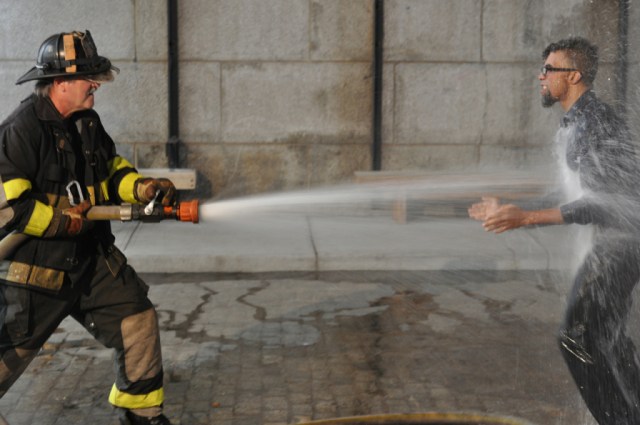
Dread Scott performing “On the Impossibility of Freedom in a County Founded on Slavery and Genocide” under the Manhattan Bridge (photo by Hrag Vartanian for Hyperallergic)
So I know a guy. Where I live, everybody knows a guy, but this guy I went to high school with, and stayed in touch with off and on over the years– we’re both art school refugees, looking at “America” in very different ways.
The work he’s done over the years has been controversial. But it’s his latest stuff that I’m thinking about– yeah, I know, I missed it: he’s always scheduled for when I’m at Fort Moonrise Kingdom, or, you know, tearing my life apart and rebuilding it.
Dread Scott. Images of Oppression. After a whirling dervish of a weekend that culminated in some fancy early-morning driving in Boston, I’ve almost forgotten why I was thinking of Dread Scott and living history, but here’s the short version:
Why do we choose to reenact or enact the moments or events we do? We are, by default in our selections, limiting our characters because of the script we choose. In the main, we continue to choose to re-tell and enact the dominant stories that align with common myths about the founding and history of the United States. Until we choose to enact other stories about our collective past, we will continue to enact the same arguments that Our Girl History and I have made in the past. That’s too meta even for me.
As a friend asked a few weeks ago, “Why do we commemorate massacres and not Mondays?” Let’s commemorate some Mondays, shine a light on some moments, and reimagine what enacting history can mean.
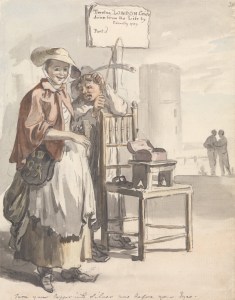
Paul Sandby RA, 1731–1809, British, London Cries: “Turn your Copper into Silver Now before Your Eyes” (Title Page Design), 1760, Watercolor, pen and gray and brown ink over graphite on medium, cream, slightly textured laid paper, Yale Center for British Art, Paul Mellon Collection
Not everyone who’s standing on the corner is up to no good. Some have legitimate business.
In the London of the past, just as in, say, the Manhattan of today, street vendors hawked a variety of goods. Having gone through multiple versions of Cries of London, I’ve come up with a basic list of the items sold on the street.
Love songs
Stationery
Oranges
Boot laces
Reeds for chair mending SaloopSee also salop.
Gingerbread
Muffins
Hot cross buns
Doormats
Cats’ and dogs’ meat
Coal
Lavender
Ribbons
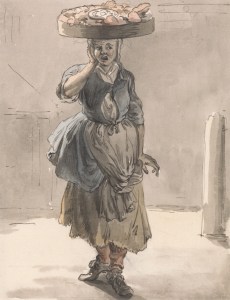
Paul Sandby RA, 1731–1809, British, London Cries: A Girl with a Basket on Her Head (“Lights for the Cats, Liver for the Dogs”), ca. 1759, Watercolor, pen and brown ink, and graphite on medium, cream, slightly textured laid paper, Yale Center for British Art, Paul Mellon Collection
Boot black
Brushes
Flounders
Rhubarb
Walnuts to pickle
Cucumbers
Bandboxes
Baskets
Brooms
Rabbits
Pins
Mops
Wash balls (soap)
Strawberries
New peas
Rosemary and bay
Strings of onions
Turnips and carrots
There’s seasonality to this, of course. Strawberries and cucumbers are not being hawked on the streets of London, Boston, Newport or New York in February. I’ll tell you: being a Cat’s-meat-[wo]Man is practically a childhood dream, since I knew I could never really learn to speak to the animals, and as it happens, Sandby depicts one. It seems there was gender equity in supplying food for pets and stinking of meat.
Paul Sandby RA, 1731–1809, British, London Cries: A Milkmaid, ca. 1759, Watercolor, pen and brown ink with graphite on medium, cream, slightly textured wove paper, Yale Center for British Art, Paul Mellon Collection
I’ve long been fond of the milkmaid, probably because she’s relatively clean, has a cloak for warmth, and I can understand what she does. As much as I love “Turn your copper into silver,” I lack real skill at charlatanry. And gambling. I don’t play poker: my face is too easy to read. Still, if you’re doing this right, there’s a lot to invest in being a milkmaid: kettles (likely pewter), measuring cups (tin? or possibly pewter), and a yoke. It’s a commitment. Cat’s meat– if you’re good with stank and have the right basket*, you’re pretty okay.
If not stank or drank, then gaming. It looks like the object of the game is to knock down the three balls at left in the background by hitting another ball, or perhaps a stone, with the stick. Ha’penny a throw? Maybe you just throw the stick.
Paul Sandby RA, 1731–1809, British, London Cries: Throws for a Ha’penny Have You a Ha’penny, undated, Brown wash, gray wash, graphite, and black chalk on medium, cream, slightly textured laid paper, Yale Center for British Art, Paul Mellon Collection
This is another instance wherein I am faced with historical things I don’t know nearly enough about: gambling and street games, pet care and keeping. Cat boxes: when we were they invented? We know cat litter is a 1947 invention, and that sand or ashes were used in cat boxes when cats were kept inside, but for the most part, they went in and out, and mostly out, until cat boxes and neutering became common, though an 1895 manual recommended that “the cat in civilization must be fed, looked after, and guarded in its moments of freedom.“**
Yes, I went there. I looked it up.
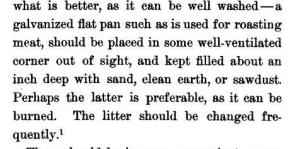
It’s more than 100 years after the time I’m investigating, but I don’t want to fall too far down this cat’s meat rabbit hole– but this does tell me that the historical images of indoor cats come with oat or straw filled baskets in sunny corners, and recommendations for galvanized pans filled with sand, clean earth, or sawdust, which may be ideal, as it can be burned.
My point is, there’s a lot to sell on the streets of any town, images to support the material culture and reference books from which we can derive contextual clues to the impression of something as random as a cat’s meat man or woman. I don’t know that I’m leaping to be a Cat’s-meat-Woman, but it leads to a lot of interesting interpretive points about domestic life, pets, and families that visitors can relate to much more easily than street sales. Of course, if you choose to be the Cats-meat-Man, I won’t stop you from calling yourself Mr Friskies.
**Huidekoper, Rush Shippen, 1854-1901. The cat, a guide to the classification and varieties of cats and a short treaties upon their care, diseases, and treatment. 1895: New York, D. Appleton and company





 Kirsten Hammerstrom
You must be logged in to post a comment.