15 Ways to Have a Bad Living History Event

The Enraged Musician. Chaos has a long history, and often I am for it.
The Enraged Musician. Chaos has a long history, and often I am for it. But not always.

For Organizers

  1. Do not advertise. Having no audience makes an event super-lame.
  2. Have no attendance limits on a closed site. Intense crowds and no security makes an event scary. Add alcohol for intensity.
  3. Do not publish participant standards or a schedule. Confusion and laxity breed chaos.
  4. Publish standards, but do not enforce them uniformly. Creating the appearance that standards are only enforced for people you don’t know erodes trust and credibility and discourages participation, reinforcing adolescent clique behavior.
  5. Do not highlight (or provide) participant amenities like water, toilets, or dry firewood.
John Greenwood, Sea Captains Carousing in Suriname. Good times, no?
John Greenwood, Sea Captains Carousing in Suriname. Authentically bad behaviour.

For Participants

  1. Don’t bring your own lunch, water, or powder.
  2. Don’t follow the rules at a new event. Standards are for chumps. Text your friends while minding a rope line and acting as an interpreter.
  3. Get drunk. Who doesn’t love an inebriate around gunpowder? Safety, schmafety. Besides, drunkenness is authentic.
  4. Smoke cigarettes on the field. You can always hide your hand behind your back, next to your cartridge box…what can go wrong? The captain will never notice.
  5. Make critical comments about the public and other reenactors just within their hearing. Don’t smile.

For the Public
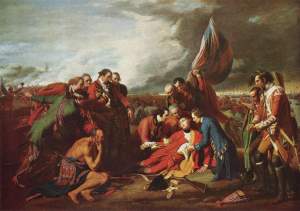
The Death of General Wolfe, Benjamin West. NGC
What, no dogs? The Death of General Wolfe, Benjamin West. NGC
  1. Bring a dog. Dogs love guns, drums, and cannons. “Cry Havoc! And let slip the dogs of war,” right?
  2. Ride your bicycle through the crowd. Make disparaging comments about the crowd interrupting your ride.
  3. Touch things and people. Touch reenactors’ tools, weapons, clothes, children, food. Heck, use their tools. It’s not real, it’s history, so it has to be safe–right?
  4. Interrupt people answering your questions, or better yet, someone else’s questions, and answer yourself.
  5. Get drunk, especially on a hot, humid summer day or night.

Stop.

Breathe.

Think.

Then speak or act. Think about what you’re doing. Is it sensible? Is it kind? Is it how you would like to be treated? Does you behaviour foster a pleasant and welcoming environment?

If not, don’t do it.
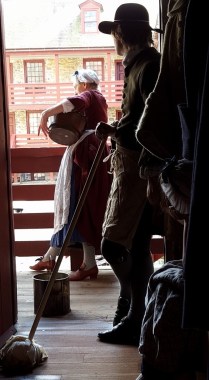
Wicked Inspiration

You know that musical? The one you can’t get tickets to unless they were willed to you by your grandmother because she was lucky enough to stumble out of the Tardis right at the box office on opening day, but had to buy them for, like, six years from now, and they’re actually for the Kansas City production? The one in which the founding fathers are, you know, brown? My friends and family assumed I’d hate the whole idea, but I don’t. Like so many people, I love it, and not just for the music, though my preferred method of psyching myself up for GeeDubs1790 or What Cheer Day is listening to the Stones or the Beastie Boys all the way up.

So, what then, interests me in “Hamilton,” and why do I think it relates to interpretation? This: the way that the show filters the concerns of the late eighteenth century through the lens of the twenty-first could make for enlightening listening.

My Shot gives me goosebumps: why? Is it because history and civics are finally sexy?

Maybe. But “Hamilton” as a whole, per Rebecca Mead in the New Yorker, “is a hymn to the allure that America promises the immigrant who aspires to reach its shores; it is also an argument for the invigorating power that this nation’s porous borders, and porous identity, have always offered.”

Porous identity. That’s part of why I’m fascinated. But just as “Sleep No More” and Occupy Providence (really really) were partial inspirations for What Cheer Day, “Hamilton” strikes me as the kind of production worth paying attention to. No, I am not suggesting that the paunchy reenactors start channeling their inner Biggie, though I might well pay to see that.

No, what I’m suggesting is that we reconsider what it is we’re doing out there on the field and in the historic houses, and not just what but how and why. Hamilton takes an unexpected approach to history and it’s going gangbusters, while Amazing Grace tanked. So it’s not about the costuming authenticity, though I implore you not to give that up. It’s about the passion. It’s about coming at things sideways.

What makes you love doing laundry, drilling with precision, telling local gossip, making soap, or whatever it is that you love best about your place in the past? Why does all this matter to you so much? What is it that we can learn about today as you teach us about the past? Let loose that love and passion, share those insights, and ten to one you’ll have more fun and excite more visitors.

Maintain an Even Strain

IMG_6471

Dude: I am conflicted. There are folks out there doing excellent work, but after reading some recent posts around the interwebs, I kept thinking, “Stockholm Syndrome much?”

I’m as much of a narcissist as the next person, and I think I recognize some of the folks being called out in various places for being critical of women’s roles in living history events. So, organize my own events? Come up with my own things to do?

Cool: challenge accepted.

I am, in fact, throwing down for the pleasure and pain of running a farm in late June. No, I didn’t organize it, but I was asked to take on a challenge and I have accepted, roping my favorite tailor into the effort as well. It’ll mean a bunch of studying, but in a pinch, I can always clean the house. We can rake, make refugees stay in the yard, and try as hard as we can to keep Quakers from putting radical ideas in the slaves’ heads. I think it will be hard, unpleasant, and uncomfortable—and that’s what I don’t like about the suggestions in the otherwise honestly well-intended and meant-to-inspire posts.

Playing at Quadrille. Oil on canvas by Francis Hayman. Birmingham Museums and Art Gallery

They’re so nice. They reinforce women’s subordinate roles in the past and present. Children’s activities? I might die, really, I might. If that’s your bag, go for it, please! We need it. It’s simply not something I can do.

No more can I talk about What People Wore. It’s not that I don’t care (y’all know I do) but that I want to move past the surface.

It’s not enough just to look great.

The Heir: Tom Finds New Wealth. William Hogarth.

Dive deep: find the dirt. Find the hard stuff. You don’t have to be nice. That’s my personal problem with what I’ve been reading: between the lines I keep hearing a voice suggesting that we be nice girls, that we simmer down. No, I’m sorry. I can’t. Reader, if you can, go for it.

But if you can’t, I want to tell you: Keep pushing. Keep asking. Keep speaking up. Challenge the status quo. Our Girl History did a great post on Well Behaved Women, and I fully support the work people are doing to represent the Well Behaved and the marginalized (shout out to the veteran with the knife-grinding cart: well imagined, sir!).

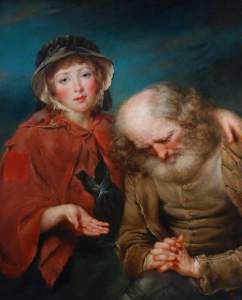
Russell, John; The Blind Beggar and His Granddaughter; The Bowes Museum;
John Russell. The Blind Beggar and His Granddaughter, oil on canvas, 18th century. The Bowes Museum UK.

Bring it. Bring the ordinary.

But if you can’t be ordinary or run the children’s games or be subservient or show how women dressed, that’s okay. For the love of god, someone, be desperate.

Be hungry, be angry, be resentful, be religious.

Whatever you do, don’t be afraid to speak your mind.

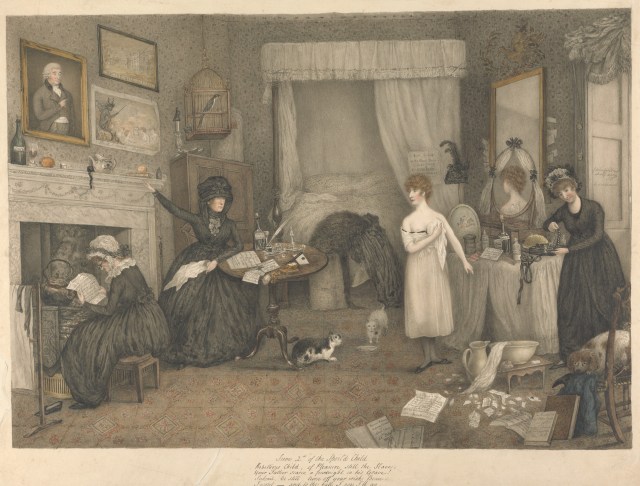
After Dark: Bedtime for Kitty

Lewis Vaslet, 1742–1808, The Spoiled Child, Scene II, ca. 1802, Watercolor with black ink and gray wash over graphite on moderately thick, slightly textured, cream wove paper, Yale Center for British Art, Paul Mellon Collection. B1977.14.4342

In just about a week, we’re running a pilot program in the historic house where I work (tickets available here). After Dark, or What Cheer Night, are programs we’ve wanted to do for a couple of years, but all good things take time.

Error
This video doesn’t exist

I’ve drawn the lot chosen to talk about getting ready for bed and sleeping: lighting devices, bedding, washing, chamber pots* and what people wore to bed. While already in possession of candles and candlesticks, and the proud new owner of exhibition and interpretation grant-funded LED candles, there are things I needed to make. Of course.

Print made by Guillaume Philippe Benoist, 1725–ca. 1770, French, Pamela Swooning, after having discovered Mr. B. in the closet, He (frighted) endeavouring to recover her, Mrs. Jervis wringing her hands, and screaming, 1745, Etching with stipple engraving on medium, slightly textured, cream laid paper, Yale Center for British Art, Yale Art Gallery Collection, Gift of the Library Associates.

A banyan, for one thing. And you know that will (one hopes) be followed in short order by a night cap. After all, you can’t talk about Pamela if you haven’t got a banyan and a cap in the house. That’s a simple and relatively fun project to tackle when brain capacity is somewhat limited: some piecing, straight seams, setting in facings and sleeve linings can all happen before I must assault the collar.

Collars are devilishly tricky for me sometimes– oddly, a pad-stitched collar set onto a tailored jacket seems easier to me than a bedgown collar– but I suspect the eventual recipient will manage to enjoy the garment no matter what minor construction errors a tipsy milliner or half-seas over housemaid might make (not, of course, that I am either of those things).

It’s been a fascinating exercise in having a staff-and-docent study group that has taken a decidedly feminist bent (calling Our Girl History!) as we explore what happened in Providence After Dark. Brothel riots in 1782. Warnings by the Baptist Church not to visit the “theatre, circus, or Green Cottage” on pain of punishment. No, I do not yet know what or where the Green Cottage is, but the best researchers I know are working on it. Is this the 18th century answer to the Green Door? We can but hope.

Reading The Coquette? Thomson’s The Seasons? Come experience an 18th century house on a night when people will know what you’re talking about! Or you can watch  that questionable housekeeper prepare a room for the night while she talks about sleep patterns and shares tips for 18th century pest control.


*Pro tip: put it on a chair. I fully expect to run an intimate workshop some evening called “Will Humiliate Self for History, or, Everything you ever wanted to know about the 18th century, but were too well brought up to ask.”