Split Shift

img_7748
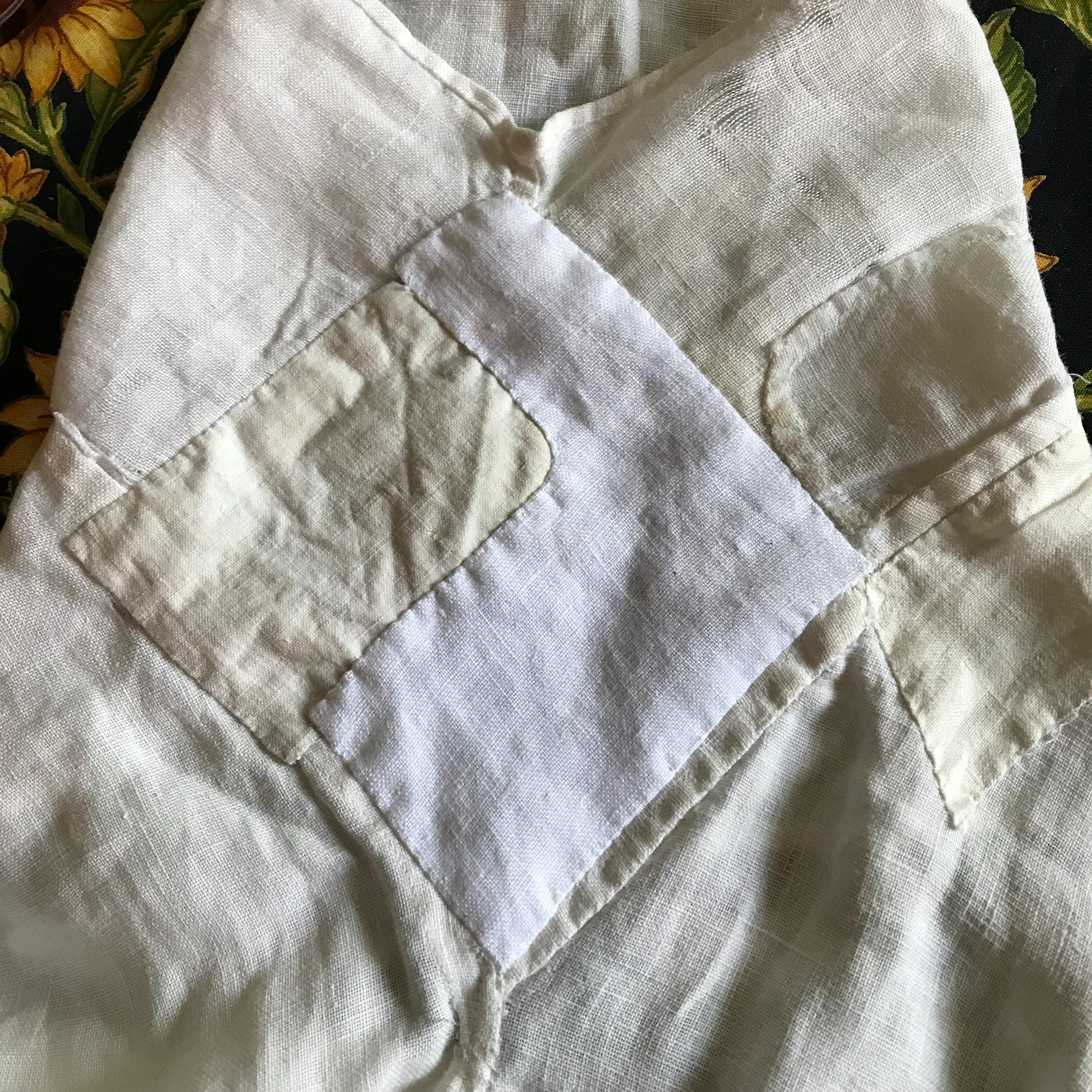
A well-patched underarm gusset

Once upon a time, I made a shift for the early 19th century– and promptly had to mend it. I have been mending that shift ever since (8 years!) whilst complaining that I need to make a new shift. 

Never mind that I could commission one. Never mind, never mind. 

Over the intervening 8 years, I learned more about sewing and shifts, and made a shift for the 1770s that I’m pleased with. That shift combined unbleached linen hand-woven by Rabbit Goody and purchased by my partner at a prop sale and white vintage linen found in a shop in Stockbridge, Mass.

56951198_10214538359594041_1091022036504936448_n
Underarm gusset of vintage linen

The vintage linen has a stain running along the center fold, but is otherwise white, soft, and more densely woven than most linen available today. It’s true that the more you make something, the better you get, and the better you will understand what you’re making. 

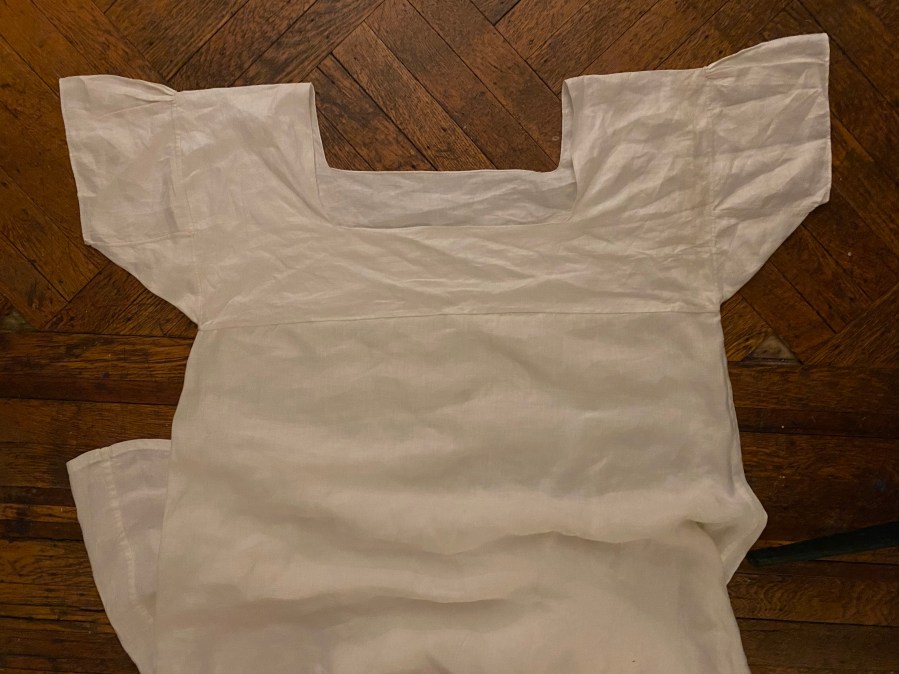
Another path to understanding is looking at originals (yes, reading counts, too).  I’ve been lucky enough to find and acquire two antique shifts, both from the early 19th century. While they’re not documentation for the period I interpret most often, they do provide clues to construction methods, and those clues are that aside from seams being felled for strength and durability, shifts are inconsistent. One shift uses the selvedge as the hem– which means the grain runs counter to the usual vertical orientation– while the other dispenses with the notion of bodice necklines to double down on the squares-and-rectangles trope.IMG_4592

Shifts are hard to date since they’re so basic (squares and rectangles) and don’t necessarily follow the lines of fashion. The sleeves here place this in the 19th century, though it could just be late (after 1785) 18th century.  I’m pretty sure it’s not, but the possibility points to the staying power of the basic bag-like form. 

Using this shift as inspiration, I decided that instead of patching that worn shift one more time, I would chop-and-top, that is, I would replace the top, worn section, and append it to the perfectly fine lower body of the shift. 

I measured the extant top, measured my bicep, and cut the pieces accordingly after drawing threads to create straight lines. I had one rectangular piece with a slightly shaped neckline, two rectangles for sleeves, and two squares for gussets. Although I started this process in December, I was “overtaken by events” that included a yard sale, teaching a workshop, preparing a presentation, and taking a workshop. With a possible outing in late April and an 1820s dress workshop coming up in early May, I decided it was time to finish this.

Most of the work was in the gussets, four seams in all, two to attach the gusset to the sleeve, and two to attach the gusset to the shift body. Once the seams are backstitched, the offset side is folded over and felled all the way around the gusset. It is best not to count the number of seams you stitch for each sleeve and just keep sewing instead.

Over the course of a couple of days (Monday afternoon, and Tuesday and Wednesday evenings) I finished the neckline hem, attached the gussets, cut off the top of the old shift, and grafted the new top to the old body.
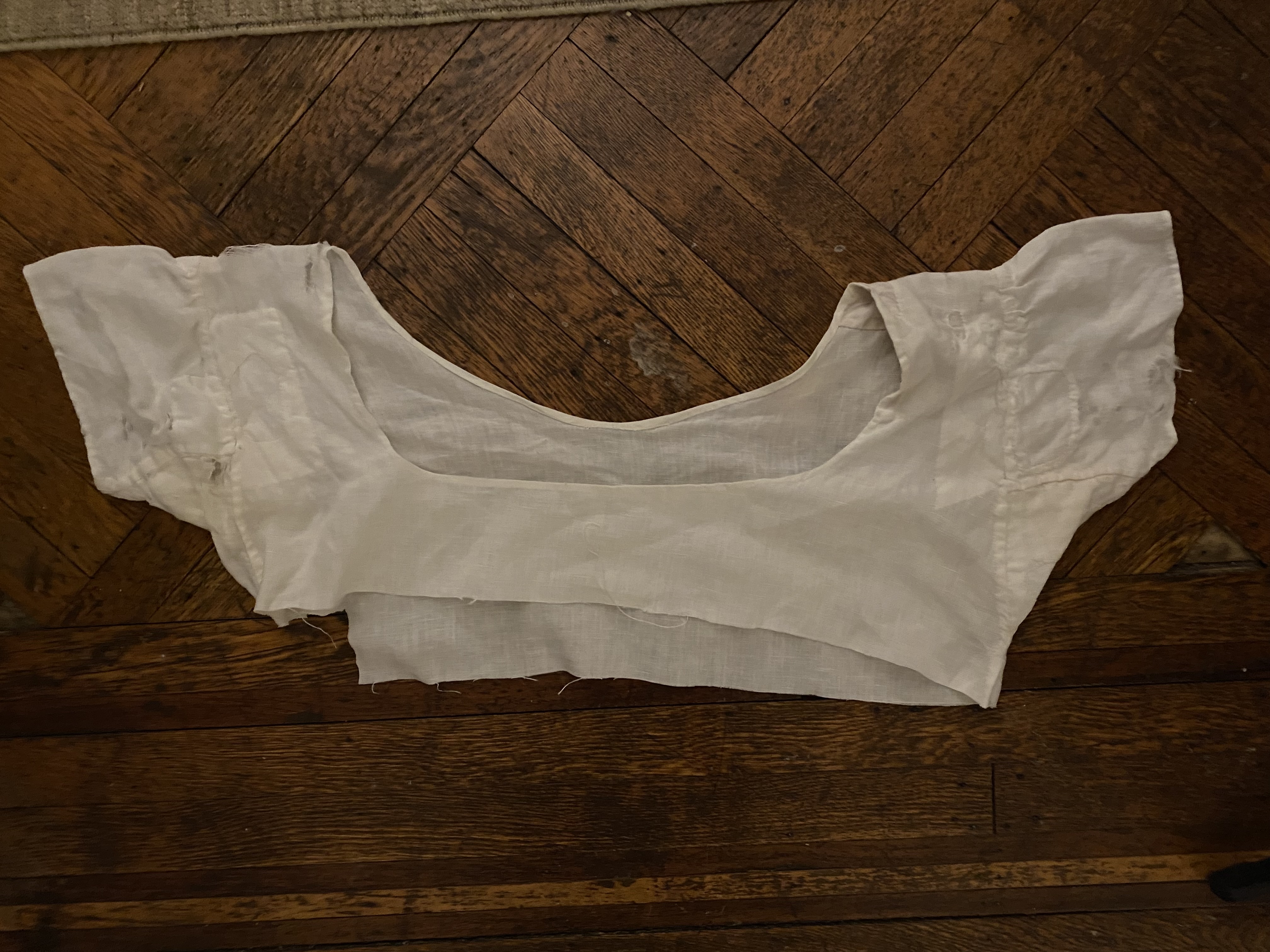
IMG_5396Removing the old top was not the neatest job, as I discovered part-way through the task. I decided to pull a thread across the bodice starting just under the underarm gusset. This worked well across one side but drifted badly across the other. (In which I discovered that I did NOT, in fact, cut that shift strictly on the grain.) I managed to fudge the situation but there’s no guarantee the seam and the hem don’t wander. They won’t be visible when worn, thank goodness, so I decided to live with the wobble and do better next time.

IMG_5395

Check’d Bonnets

Here’s a question: what about those linen bonnets? Am I making that up?

As it happens, nope.

Linen bonnets appear in ads from the 1760s to the 1780s, sometimes described as white, and sometimes as check. There’s even a white diaper bonnet! The thing to remember is that so far I haven’t found these in New England, but that’s because I’m using runaway ads, and those are far less common in New England. There’s plenty of check linen fabric in New England– but if there were bonnets, those references may be in inventories I haven’t had a chance to dig into.

Maryland Gazette, (Annapolis)June 4, 1772

Another possibility in the regionalism of linen (checked or white) is climate. A friend and fellow blogger sees the linen bonnets in coastal North Carolina, which makes sense in terms of weather. It’s warmer and even more humid on the North Carolina coast than it is on the Rhode Island coast, and I’ve found linen to be much cooler than silk. This same regionalism may apply to what we see from Philadelphia to Frederick, Maryland.

Maryland Journal, August 21, 1776. I love this one because Rosannah is as tall as I am!

As I tabulate data, trends will emerge; as it happens, I’ve already seen that half the bonnets I’ve entered are linen and half are silk. Those references are from the Mid Atlantic and coastal South, with only one from Rhode lsland (and that a “blue cloth” bonnet), so there’s lots more data entry to come. For the moment, though, it’s safe to say that a checked, white, diaper, or dimity linen bonnet is documentable from 1758 to 1780 from Philadelphia south to Wilmington, North Carolina. The fiber persists, but shapes will change.

Mending: Check

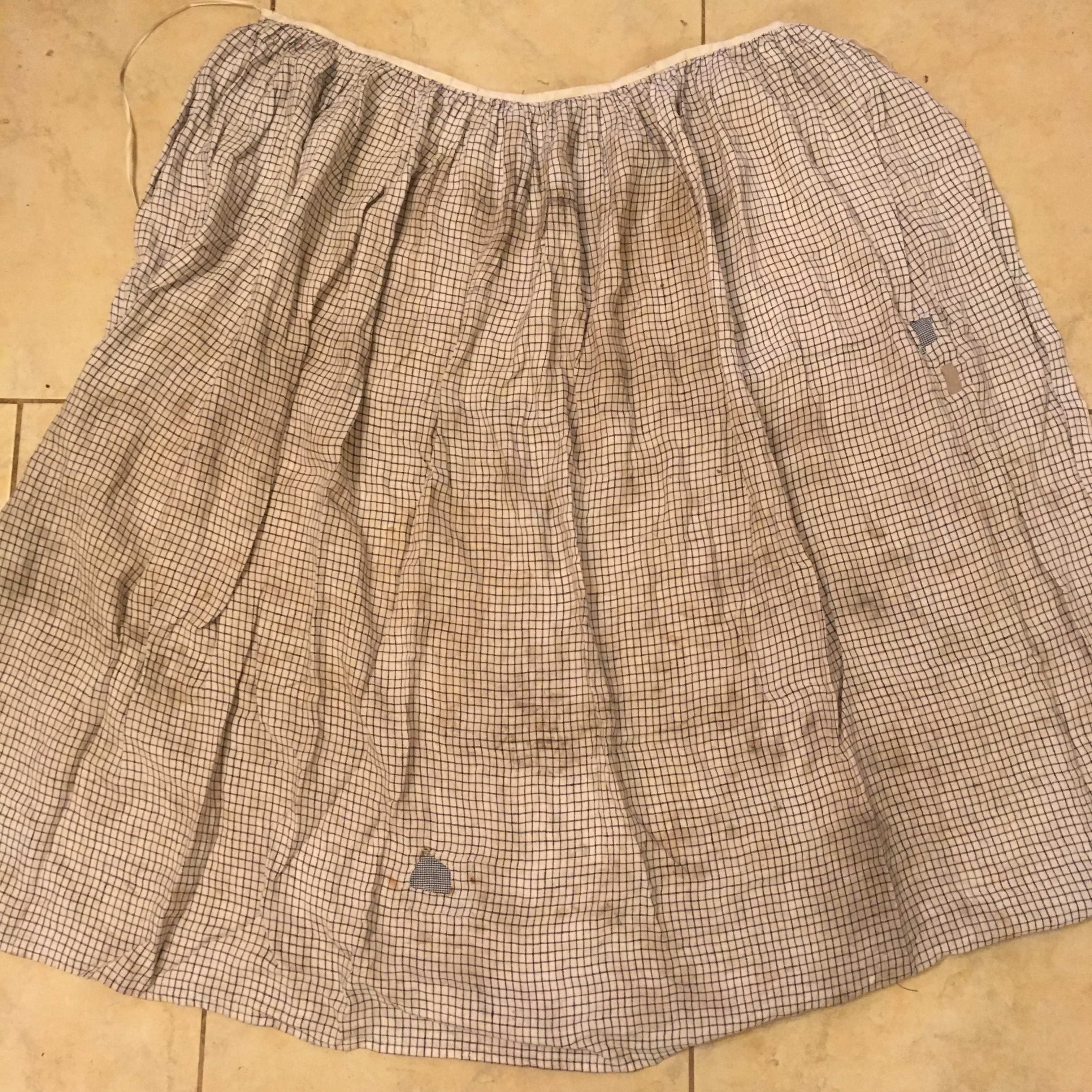
My poor old apron. It’s almost– but not quite– the firstarticle of historical clothing I made. (The first was a shift. Infrastructure and fundamentals, people.) It acquired some new wear (actual holes!) in New Jersey, and required mending.

First, it needed to be washed. I hadn’t taken a objective look at my apron in a while, but after we got home from Salem, I knew I had to mend it, which meant washing.

Reader, it smelled.

You get used to smells, and even enjoy them: wet wool, gunpowder, wood smoke. And then there’s tallow. I’ve never gotten used to the smell of tallow, and I don’t remember when this apron encountered hard fat, but the odor is unmistakable.

So is the water.

This past weekend, I had a chance to mend this favorite apron while I peddled luxury goods at Fort Dobbs’ War for Empire event.

Although I have a sturdy plain linen apron, I’m fond of checks, and of the hand this apron has achieved after much wearing and some washing.

It will never be really clean again, but for now, the apron is mended and back in rotation.

On & Off the Grid

It’s been a very busy time chez Calash, with many changes underway and to come. It’s hard to keep up with all the writing I’m doing everywhere, but eventually I’ll be back on topics of authenticity, standards, and whimsical Wednesdays.

This week, though, is all about checks. (Most weeks are, in some way, aren’t they?) Not paychecks, silly: linen checks.

We are headed out to Eastfield Village Friday afternoon where Mr Hiwell and the Young Mr will join in the 1833 militia muster, and Mr JS and I will occupy a house as a shop/tailoring business/punch-making and cooking establishment of one kind or another.

Mr Hiwell has been warned to expect a diet unlike his norm, and since his roundabout is white, we will quickly know if he is smuggling Oreos and barbeque sauce.
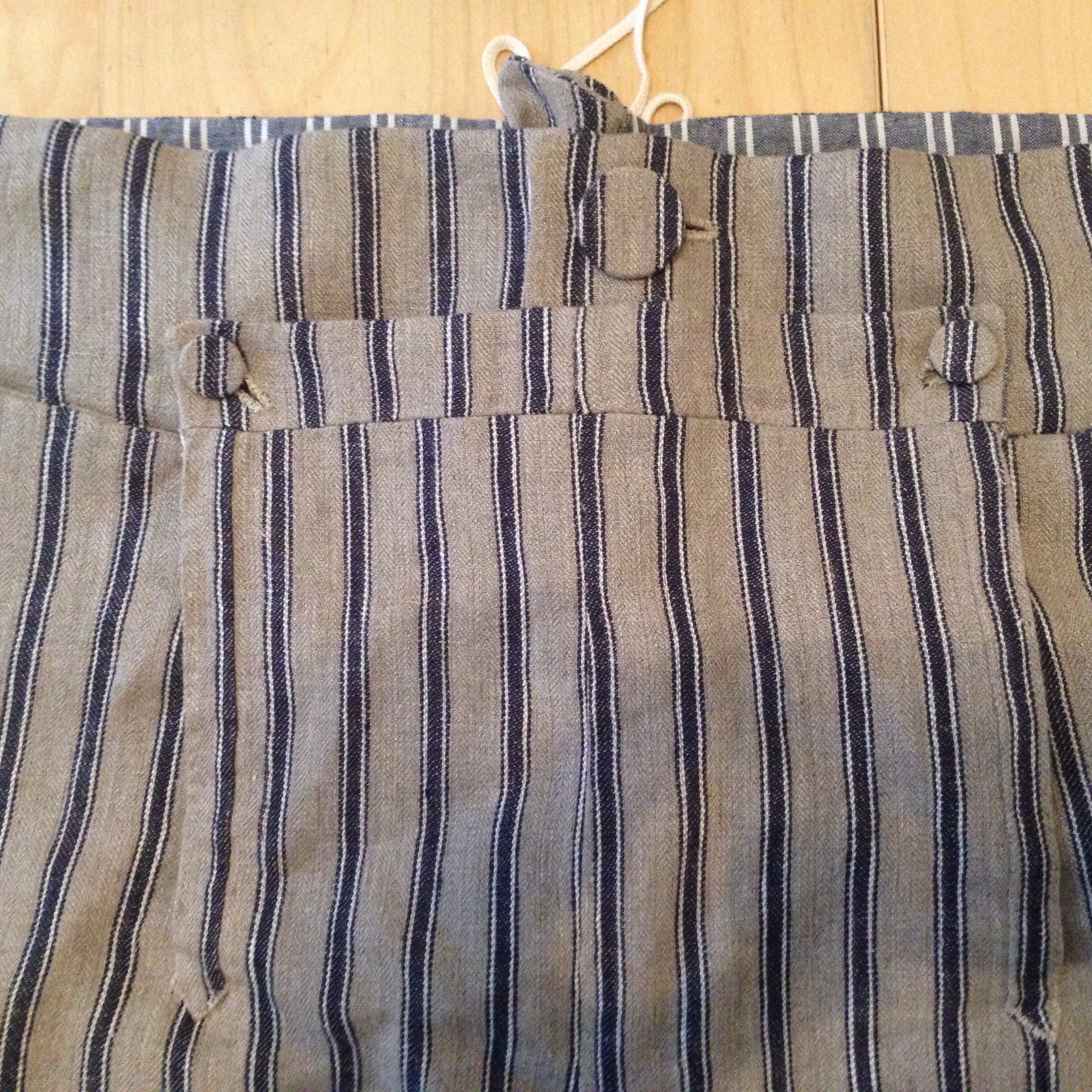
 For the Young Mr, I have been making trousers. Yes, I do like things to line up. I wasn’t even paying that much attention when I cut these, but apparently that was  was enough.

Yes, even the buttons.


Sigh. It’s a thing.

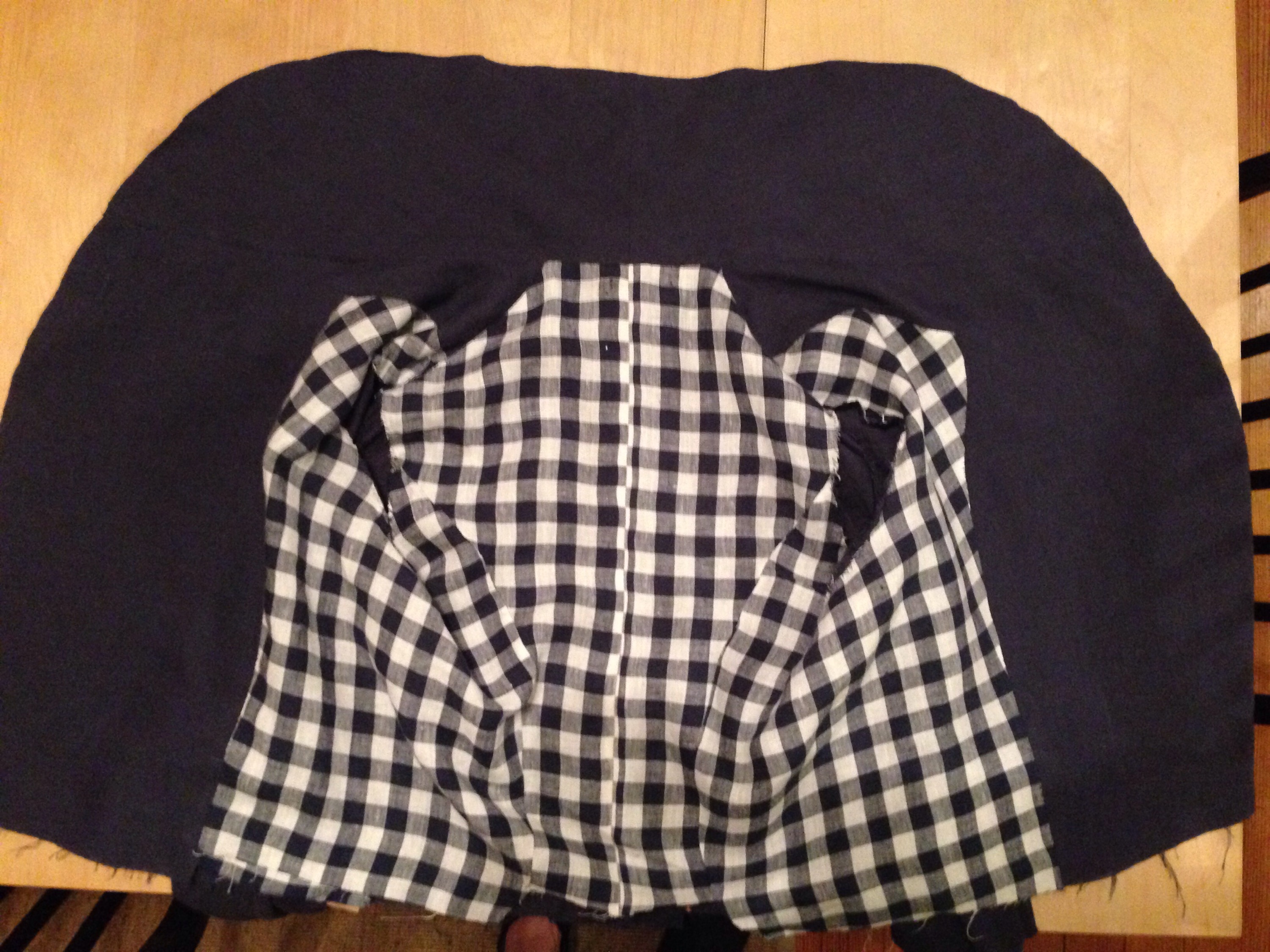
He’s also got a roundabout in the works, which I must focus on more closely to finish. This is patterned from an original in Henry Cooke’s collection, but… Mr. Cooke and I, on a very sticky Tuesday afternoon, did not have the Young Mr at hand to measure again. The original was too small: that we knew. What we did not know was that the boy had taken on a man’s shape– or, as a friend says, “he’s dude-shaped now!”–and the additions we made were not enough, except (barely) to the sleeves.


Oh, well. There was just enough to make it all work, and after some trials I realized it needed a lining. What kind of lining? A checked lining, of course!

It seems okay, but these collars are strange to  me.


Well, at least he will be clad.

Let you think  I’m sewing only for the lad, I am in fact working on a gown for myself. There’s a hopeful yard or so of another check’d  linen from the stickiest fabric store on 39th Street lurking, but I do not think that apron will happen this week. Perhaps John Brown’s housekeeper will finish it someday.

At least there are already gowns and aprons ready-made that can travel with me. Someday soon I’d like to finish my new stays… winter will come soon enough, and more sewing then.