Frivolous Furry Friday

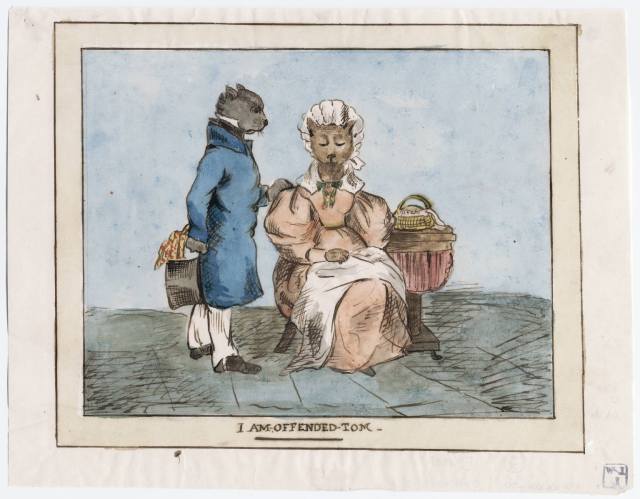
I am offended Tom. Watercolor, 1830s. Lewis Walpole Library, Drawings Un58 no. 29 Box D108

I don’t know the backstory here, but the summary is satisfying: A standing cat attired in men’s 19th century fashion rests his paw on the shoulder of a sitting cat attired in women’s 19th century fashion. The latter declares “I am offended Tom” while engaged with a sewing project.

Really, the lolcat is a historic tradition, and it’s research I’m doing when I wander over there on lunch break, honest. So, let’s research this up:

Judging by the lady’s sleeves, we’re probably looking at ca. 1830 for a date- circa gives you so much leeway–but the details of collar and cap are quite nice. Tom has a nice blue coat, straps on his trousers, and a spotted neck or handkerchief in his paw; I think we’re seeing a black waistcoat lapel under the large blue coat collar. The pedestal work table is a nice touch, and not extremely common in collections today.

Whatever has happened between these two (I don’t need to tell you about a tom cat’s reputation), the watercolor does a nice job of depicting a fairly common domestic scene in which only the trappings change. Those anthropomorphic emotions have played out, and will play out, in many a parlor, drawing room, chamber, living room and studio.

Let us hope we all avoid domestic stresses this weekend, except when truly warranted.

Many thanks to Sew 18th Century for the image link!
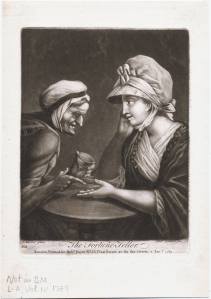
Hat Face

The Fortune Teller, 1789. Lewis Walpole Librray. 789.1.2.1

I like hats; I think it’s been made clear here before that I have a bit of a bonnet problem. As it stands, I have something in the neighborhood of a dozen bonnets, and really need to get my Etsy store up and running…

But as in life as in the Richard Scarry story, there’s always room for one more, and more to learn, so my collection hasn’t stopped me. I blame my Grandmother Elsa, who owned a dress shop, collected shoes, and had a particular face for trying on hats.

Black silk bonnet, 1770*1780. Colonial Williamsburg 1993*335

I’ve been thinking about bonnets because I lately came across some engravings showing what might be called baleen bonnets. At left above, a bonnet that is clearly reminiscent of the bonnet in the Colonial Williamsburg collection on the right. The CW bonnet (1993-335) has seven baleen bones, and a baleen rib around the bonnet brim.

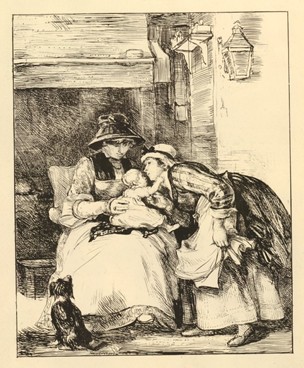
It is strikingly similar to the bonnet in the 1789 engraving, down to the decoration. In “Kissing the Baby,” a lithograph in the collection of the British Museum, the older woman appears to be wearing a ribbed black bonnet in the style my friend calls “lampshade,” and that others call “bucket.”

Kissing the Child. Lithograph by David Wilkie, 1800-1841. British Museum, 1852,1211.134

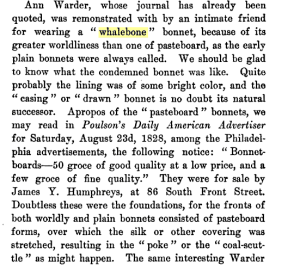
There are more bucket or lamp-shade-like bonnets depicted in engravings and paintings, and it is possible that flamboyant style was the one that got Ann Warder in trouble in 1788. I remembered this passage on page 223 of Amelia Mott Gummere’s book, The Quaker, A Study in Costume,:whalebone quote

Whalebone bonnet? Interesting… so, having an interest but no whalebone, I send the Young Mr to the basement for the remaining stock of caning I’d used for stays, and came up with a plan to replicate a “whalebone” bonnet, which I will describe and show you next time!

Tea Story

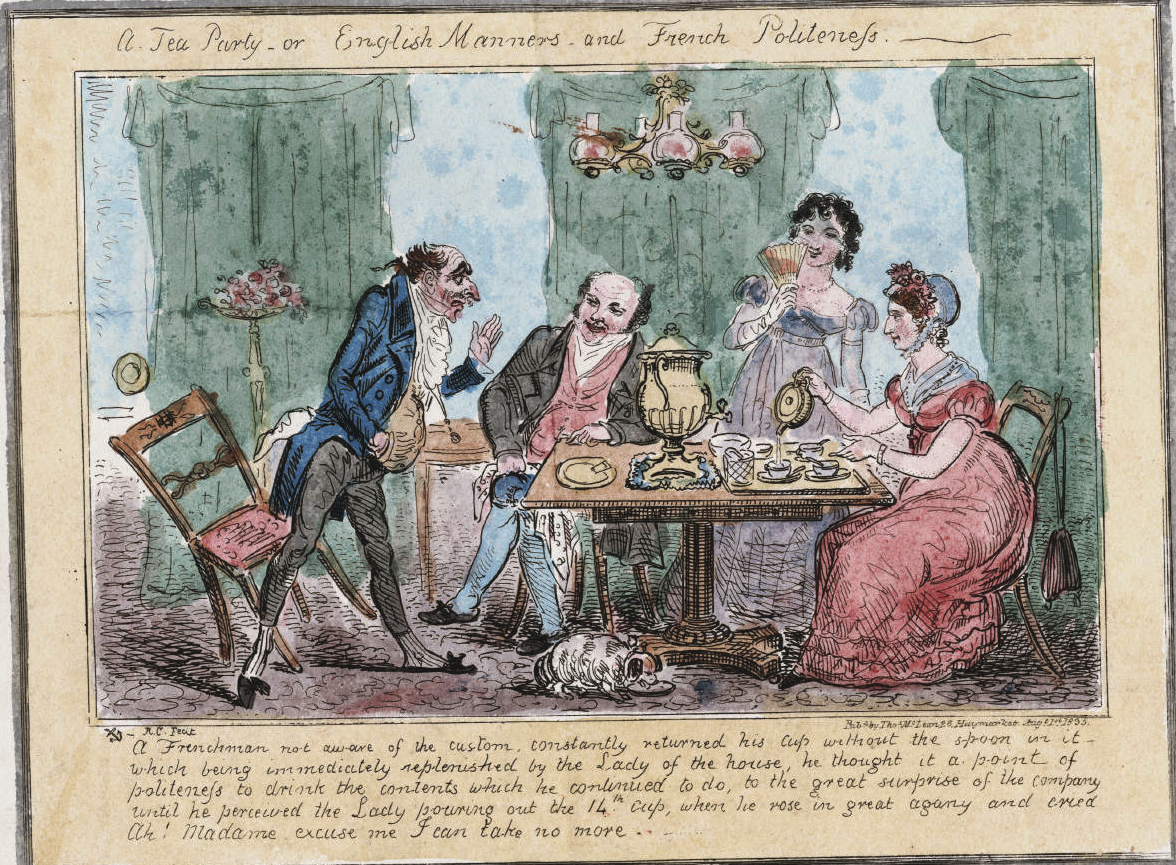
A tea party, or English manners and French politeness. Hand-colored etching on laid paper by Robert Cruikshank, 1835. Lewis Walpole Digital Library, 835.08.01.19

The story of the Frenchman who did not know the customs for refusing more tea may well be apocryphal. I cannot find the citation for the “French officer” whose cup was continually refilled by an 18th-century Providence hostess, but did find this cartoon from 1835 illustrating the same trope. Cliches and stereotypes, always with us.  If there’s a lesson in here, it may well be, Don’t believe everything you remember.