Who was Bridget Connor?

Detail, James Malton, 1761-1803, A Military Encampment in Hyde Park, 1785, Watercolor with pen in black ink, with traces of graphite on moderately thick, moderately textured, beige, laid paper, Yale Center for British Art, Paul Mellon Collection. B2001.2.999
Detail, James Malton, A Military Encampment in Hyde Park, 1785. YCBA Paul Mellon Collection. B2001.2.999

Who knows? She’s hard to find, though I am told and have real hope that the microfilm of the Abbott orderly books that chronicle her misdeeds in wending its way to me down the dirty, salt-and-sand covered highways of southeastern New England.

Where have I looked for her and Francis Connor, whom I presume is her husband?

Francis appears in Soldiers and Sailors of Massachusetts, for seven months’ service. That’s all I can find.

Well, crap, right? This genealogy stuff in Massachusetts is hard work—there are so many more people and towns than we have here in Li’l Rhody—but diligence and method pay off, and when you figure you’ve about exhausted the primary sources you can access for now,[1] you turn to secondary sources.

Lest you think I dislike Deborah Samson, note that I found her life a useful source in thinking about Bridget, as well as Book of Ages and Jane Franklin Mecom’s life. I’ve also been re-reading Holly Mayer’s Belonging to the Army.

Crippled soldier with family. Etching, London (?) ca. 1760. Lewis Walpole Library, 760.00.00.16

The common denominator: poverty, and the resulting lack of choices. This is useful for Bridget, because her story is probably one of necessity. Most women who followed the Continental Army, and worked for it, were from the lowest ranks. [2] These are women who would do what was necessary to survive, and as Mayer notes, “would rather steal than starve.” [3]

I’m not suggesting that Bridget, who would likely have received rations, needed to steal shirts to survive: I rather think she was attempting to leverage her position and profit by ill-gotten gains. But how did she end up in the Army to begin with? Massachusetts in 1782 is not New York in 1780, or Rhode Island in 1778.  What drove her to (presumably) follow Francis Connor?

Late in the war, maintaining troop strength is more difficult. The fervor of patriotism has cooled, and recruiting sergeants find it harder to fill the ranks.[4] There are bounties to be had, and the economy has suffered. Could Francis have been a property-less laborer who enlisted for the bounty? Nothing talks like cash. And, if the couple were tenants somewhere, without Francis’ income, Bridget might not have been able to maintain a home. Laundry doesn’t pay that much.

Why didn’t she stay with family? Could they have been indentured servants? Could they have been immigrants? My guess is that Bridget had no family, and if Francis had family, Bridget got on with them as well as she did with the officers of the 10th. I think she had nowhere to go, no way to survive without Francis.

Did they love each other? Did they like each other? Were they grifting together? I don’t know—but Francis Connor deserts the same day Bridget Connor is expelled from camp, so they’re bound together in some way. No matter what, Bridget was assuredly dependent on Francis.

Knowing so little about them opens up a world of possibilities, and the “opportunity” to do a great deal more research on the context of 18th century Massachusetts populations and enlistments. My best guess is that they’re an unpropertied laboring class couple from Boston, source of many of the relatively unstable and non-homogenous companies that made up the 10th Massachusetts. I also think they don’t have family, and might be former indentured servants. I have guesses about their religion and country of origin, which could be why the records are so hard to find. [5]

Looking for Bridget, and not finding her, leaves me with more and more questions, and I’m happy about that.


[1] She’s in the Abbott Orderly books, at least. Other Orderly Books to follow, as time and funds permit.

[2] Mayer, Belonging to the Army, page 122.

[3] Mayer, page 127

[4] How do you think Deborah Samson got in, passing as a boy? That’s 1782 for you.

[5] The Catholic Diocese of Rhode Island maintains separate historical vital records, and when we cannot find someone in the usual town records, we ask the genealogist if their family is perhaps Catholic or Quaker. Lack of evidence can be a suggestion of faith in my home state. But could these two be Irish Catholic in Massachusetts in 1782? I have no idea, but it seems a great stretch and a great question all at once.

Pinner Aprons

Mr & Mrs Thomas Sandby. Watercolor by Paul Sandby. RCIN 917875, Royal Collection Trust.

On Saturday, Sew 18th Century and I went out for lunch and fabric shopping. Along the way, I brought up pinner aprons, and that I’d seen them in British prints. She said, “You should blog about that!” and I went back to check my sources. Fail! There was an English print after a French original, and that doesn’t count!

So I shelved that idea, and went about looking for more Paul Sandby images of soldiers and maids and tents, and found instead Mr and Mrs Thomas Sandby. Ahem. Pinner apron alert.

Fluke, right? Well, no, not exactly.

Lady Chambers and child. Watercolor by Paul Sandby, RCIN 914409. Royal Collection Trust.

Because here is Lady Chambers and child, with Lady Chambers in a pinner apron.

The thing to note, though, is that “apron” here is a decorative, almost ceremonial garment made of black silk, while the maid engaged in Domestick Employment is wearing a working garment of [probably white] linen.

Domestick employment, washing. Mezzotint by Richard Houston after Phillipe Mercier, 1736-1775. British Museum 1876,0708.23

Well, can I wear a pinner apron as a Continental army laundress or not? Probably not, though I will be going back through all the images of laundering I can find. It would be so useful and protective a garment!

No, instead, it looks as if the black silk pinner apron was a fashion adopted by the British upper class probably in imitation of the aprons worn by young girls. These fleeting, black silk accessories were probably adapted to some other use when the fashion had fallen from favor. (You could make a lot of mitts out of one of those.) Sadly, I don’t care enough about the elite to go chasing inventories and more images, but someone else can. I think I have seen a few other examples of this style, but cannot immediately place them. My sense is that these are not common.

I’m much more interested in laundresses and maids. Doesn’t she look sassy? We could call her Bridget. 

A country girl, full-length, facing front, leaning against a fence & a tree. Watercolor by Paul Sandby. RCIN 914438. Royal Collection Trust

Camp Life

The Jolly Landlady in Hyde Park. Paul Sandby, 1780. British Museum 1904,0819.622
The Fair Stationer in Hyde Park, 1780. Outline engraving by Paul Sandby. British Museum 1880,1113.1915

Still wondering what to do in camp that’s not cooking or sewing? Technically, you shouldn’t be cooking if you’re a woman: that was a soldier’s job, though I recall seeing a reference to women cooking when all the men were pulled into the line during an engagement. A card file would help me, but for now, all I have is my scattered memory.

But if you’re tired of mending and making shirts (one of the most boring tasks, I find– all straight seams and very predictable), there’s more to do than laundry.

If the event represents a longer encampment, you could run a traveling coffee house or tavern. There’s the Widow Black in the Mid West, but I haven’t encountered this yet in New England. You could be a Jolly Landlady, or as the British Museum has it,  “a voluptuous lady stands in foreground to left, holding up a glass to a soldier on horseback.”

The Fair Stationer in Hyde Park 1780. Outline etching with watercolor, Paul Sandby. British Museum 1904,0819.576

The Fair Stationer shows us Lloyd’s Coffee House and what looks like a carriage body on blocks, converted to a news stand. You could sell newspapers and writing paper, pamphlets and poem and songs. It’s an impression that would take a lot of thinking and research for the American colonies, but could be very interesting. the transmission of news and information and the transport of mail and packages presented challenges. How were they overcome?

I’m also struck by the number of dogs in Sandby’s images. If it’s not the same dog, over and over, I would guess that in the 18th century as in the 20th, soldiers had pets that traveled with them, both common soldiers with common curs and officers with hunting dogs. The camps must have been disastrously messy, with fatigue details to clean them.  We can’t have dogs at reenactments, but we could have more outraged sergeants. It’s hard, though, because to do these things well, you have to know and trust the people you’re doing them with (and that includes yourself).

Ironing on Grass

Paul Sandy, The Laundress, 1780. British Museum, 1904,0819.624

This print makes me think of Gertrude Stein, “Irons on the grass alas” because I think I would be pretty alas if I were ironing on grass. Still, I’m glad to know that ironing in camp is plausible, because it’s one more thing I can do, though also one more heavy item to pack.

I continue to chase laundry in my spare time, with a Pinterest board of collected images, which will give you a sense of the timeless drudgery of washing clothes. There will be stooping.

A Washerwoman, by John Varley (1778-1842). Tate Britain, T08695

In this sketch by John Varley, he has helpfully given notes to supplement the lines.

“neckhandkf
spots Drab stays
blue check apron”

The symbol in front of ‘spots’ suggests the neckhandkerchief’s pattern, a dot in a square, much like the ones you can today from Burnley & Trowbridge.  “Drab stays” suggests a very utilitarian pair of wool stays, and that the washerwoman has stripped off her gown or bodice, and is working in shift, stays, and petticoat(s). This seems to be the same woman is in the “Woman with Wash-Tubs” drawing, and I’d guess her hat is straw.

A Scotch Washerwoman. Crayon drawing by Pauil Sandby after 1745. British Museum, Nn,6.61

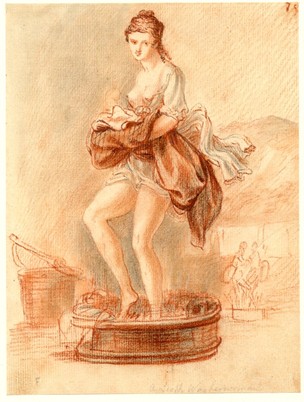
There’s a remarkable consistency in the English drawings, though Varney and Sandby are about two decades apart. The tubs, the tools, the stooping: laundry is hard and unglamorous work, Sandby’s Scottish laundress aside. I can guarantee you that the 10th Massachusetts would have to outsource laundry in that style. (In any case, Scotland typified poverty and backwardness for late-eighteenth century Englishmen, so Sandby’s drawing, in addition to being titillating, is perpetuating English stereotypes of Scottish dress and practices and is, thankfully, not a reliable source.)