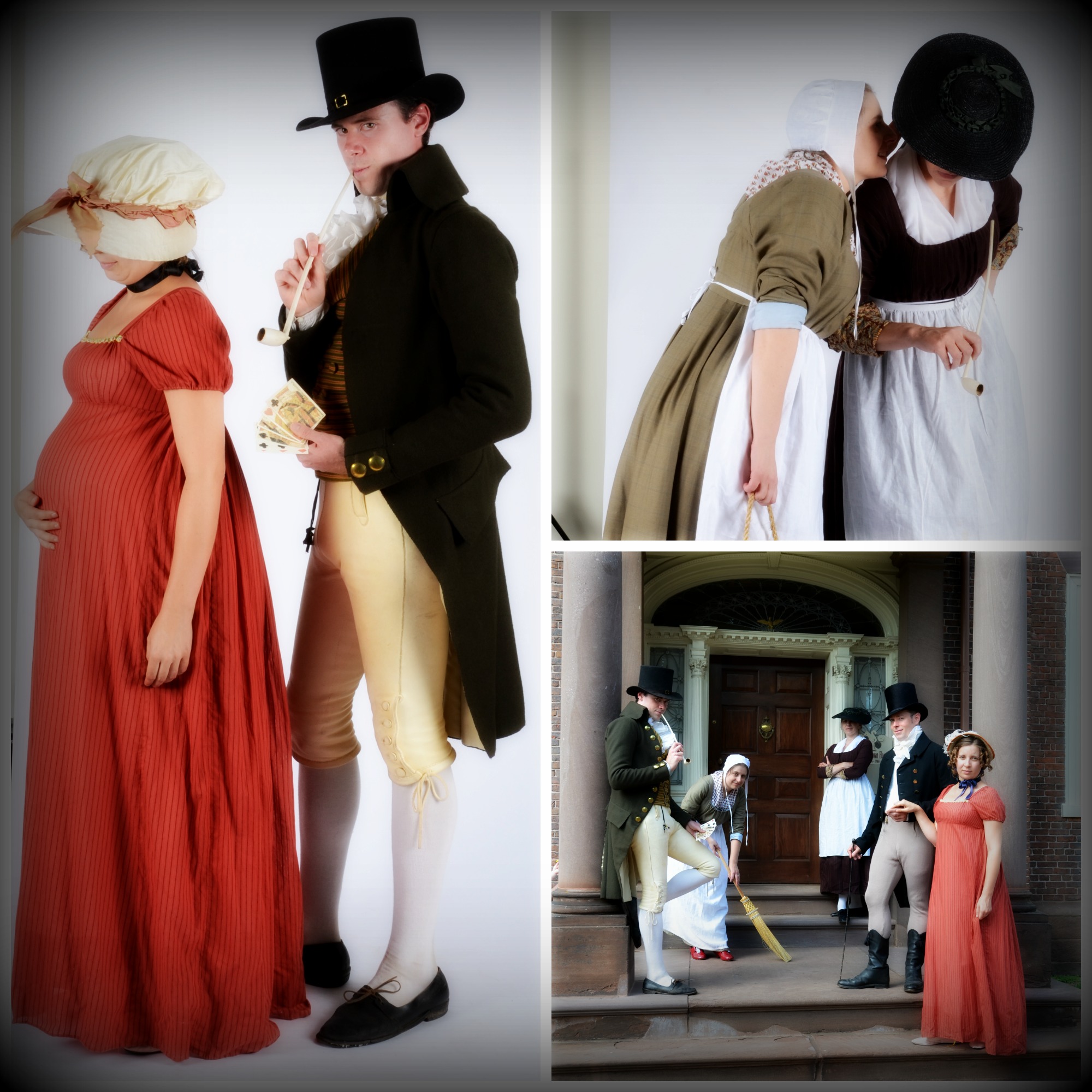
Friday afternoon we did a photo shoot at work for promotional materials for our upcoming What Cheer! Day program on Saturday, October 5. We’ll be occupying the house in first person for a day, with members of the Brown family and their servants. I think we’re all a little overwhelmed by the prospect of playing real characters about whom we know less than we’d like, but too much not to pay attention to.
There are a lot of details in building a character, and I’m very lucky to be playing the housekeeper, who really is anonymous. We know the names of some of the servants, but not all. It’s liberating, but it’s also making a character up out of the whole cloth. This just means imagining someone new, and that’s where the aspiring fiction writer in me gets to play.
I’ve written about the process here and here, and there will be more to come. But for now, we request the pleasure of your company on Saturday October 5, where you can learn what secrets those maids know, and find out why the gentleman in the blue coat so hates the man in the green coat.
It’s quite the poem, isn’t it? In October, I’ll be part of an 1800 event at work, and I will be portraying a housemaid, if not quite the housekeeper (we are still trying to sort out the domestic staff; what we can document is far too small a staff for the size of the house).
One of the things I will need is a name, and I thought perhaps I should check my instinct that “Kitty” was an acceptable name for women in the 18th century, and not just for sloops. So to the newspapers I turned, and among listings of the graduates of Philadelphia Seminaries for Girls, and ships cleared through the custom house, I found this poem. It reminded me of Mr S, and I recommend you read it aloud.
The early nineteenth-century maid. By William Brocas (1762-1837), pencil drawing c.1800 (National Library of Ireland)
So, a name: we’ll go with Kitty for now, and I can imagine building a complicated back story that pulls together all of the things I do, from running away outside Philadelphia to encountering soldiers and following them, to ending up a maid in a house in Providence. Except that what I believe about a life like that is this: It would be highly improbable, and I would look wa-a-a-y older than my actual years.
Instead of getting carried away with extreme historical fictions, let’s look at what we can know.
For one thing: clothing. Do you find yourself concerned, ever, that you focus so much upon your historic clothing? Well, you can stop. After a long and excellent conversation this week, think of this: the historical clothing you wear to events of any kind requires a lot of lead time. So you do have to think it through carefully, because every minute will count. It is also a visitor’s first impression of you, from a distance and up close. Getting it right matters, and since that takes so much time, you have to think a lot before you commit scissors to cloth. It does not necessarily mean that you’re a shallow, clothes-obsessed freak. There’s no 18th century mall to go hang out in and watch the leather-breeches boys posing while they smoke clay pipes.
Benjamin West, Characters in the Streets of London, 1799, YCBA, Paul Mellon Collection, B1977.14.6314
I’ve just about convinced myself that the silhouette we’ve been wearing at the house and formerly at the farm is acceptable. I went looking through the turn-of-the century images I have on Pinterest and I think that a maid would have worn the fashionable silhouette. Another question is age (sigh); all the women in the Benjamin West are younger than I am.
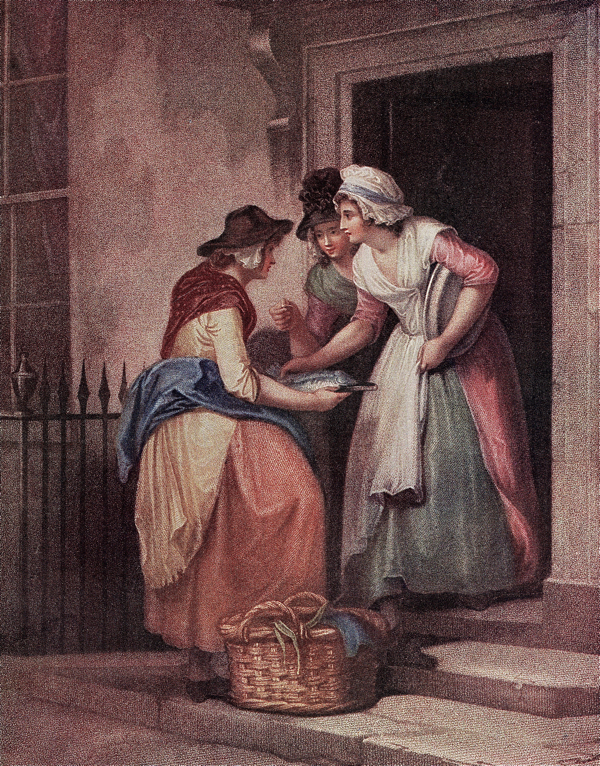
Francis Wheatley, Cries of London. New Mackerel, New Mackerel.
This print from a Wheatley (1792-1795) is useful, though he is such a genre painter and idealizes so much that I use him with caution. (Think of how much grittier–and funny–Sandby is: I trust Sandby more.) But, what can I learn from this? One thing is that I often think and dress more like the people in the street than the people in the houses. This will happen when you spend a lot of time outdoors, with soldiers: you are one of the people in the street. It can be a bit of a trap, historically speaking, and it’s good to challenge yourself to think about another class from time to time.
Back to the doorstep: what I learn here is that I need a white apron that I haven’t spilled on, a white kerchief, and a fancier cap. That cap will tie under my chin, because that’s the cap I see in Providence most often, and that’s the cap that will stay on. I’m not sure if these are maids–I think they are– but they’re women in a brownstone city house. And I can see from the clothes around me that they’ve been made for a woman who sells milk in the street, or works on a farm, or cooks over a fire. They’re not what the richest man in Providence would want his maid to wear answering the door.
You’ll have noticed, too, the different waistlines. The drawing from the National Library of Ireland and the Benjamin West have higher waistlines than the women in the Wheatley. Some of this will depend upon the available corsetry: I have stays that will work for the higher waistline, and I have stays for 1770. I have a not-quite-right 1790s pair that need revision, but that’s not likely to happen: I have a brown and sea-green coat to make.
Faith & Freedom Case 2: EstablishmentFaith & Freedom Case 2: Establishment
It starts with words on a wall, and then we bring in the objects. They get hung up, placed, arranged, listed, reported. They’ve already been photographed and cleaned.
Faith & Freedom Case 4: Thomas Wilson Dorr
This might be my favorite case, though it is very brown. We’re adding a daguerreotype today. The Dorr Rebellion was a local phenomenon, but then, all politics is local.
The biggest goal this time? Washing the inside of the glass!
What a great find, a wunderkammer in the 21st century. After this weekend, I was thinking even more about the ways in which museums engage (or fail to engage) their viewers. Working where I do, I can’t light a fire in a fireplace and hearth cook: for one thing, it wasn’t done in that house (and chimneys are all capped now, anyway).
But wait: isn’t there some place other than a living history museum where people have immersive and transformative experiences? Perhaps art museums? The last time I went to the MFA I did have to keep convincing my companion to stay a little longer–but even the 13-year-old was convinced when each gallery led us to a new surprise.
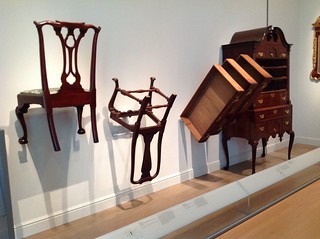
MFA: American Wing, with replicas
Take away lesson: surprise. wonderment. unusual presentations.
My colleague at work said one of the best things we ever did was to install a post-party room with a broken plate on the floor. You don’t see broken things in a museum! You don’t see messes. But that’s normal for a house, so why not for a house museum?
In preparing a room for a display change, we removed the manservant mannequin, and stashed him temporarily outside a storeroom (former bedroom) door. There’s a niche, and he was partially hidden, and looked guilty, as he reached for the door knob. That’s another kind of surprise, the hidden history of of a house–not just the servants, but also the gossip– that could be brought to life.





 Kirsten Hammerstrom
You must be logged in to post a comment.