Taking Tea

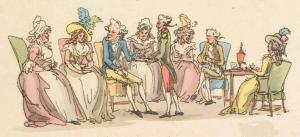
Detail, Picturesque studies and scenes of everyday life watercolor by Thomas Rowlandson, 1790. Royal Collection Trust. RCIN 810396
Detail, Picturesque studies and scenes of everyday life. Handcolored etching by Thomas Rowlandson, 1790. Royal Collection Trust. RCIN 810396

Hat tip to Jane Austen’s World for the image at left, which helped me start visualizing another program I’m involved with, this time ‘at home’ in Providence.

When we started reinterpreting the house museum, we began going back through primary sources to figure out how rooms might have been used, and furniture arranged (we don’t have inventories, so we read the house and diaries and letters– but that’s for another post).

Detail, The Tea Party. Oil on canvas by Henry Sargent, 1824. MFA Boston, 19.12

One of the things I remember most vividly was the description of the uncomfortable tea parties Providence women gave, where the guests sat in chairs against the walls of the rooms, balancing a tea cup in one hand and plate in another. Several hard drives later, I’m not sure where that primary source is (the hunt begins tomorrow) but it conjured images of every hostess in Providence a Hyacinth Bucket, and every guest a quivering Elizabeth Next Door.
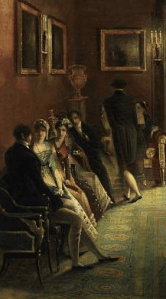
Detail, The Tea Party. Oil on Canvas by Henry Sargent, 1824. MFA Boston, 19.12

Surely that couldn’t be true? I thought I must be making it up, but then the Rowlandson turns up on the interwebs and there they are, in a row. More famously and closer to home, Henry Sargent’s painting of a Boston tea party in 1824. (The catalog description is rather nice.)

Here’s an 1824 tea party in Boston. While this is later than the tea party we’ve planned at work, it is still full of useful hints about how early, formal tea parties were conducted. We think– or I do, anyway– of ladies in frilly hats seated a tables with cakes heaped on stands and floral tea pots. I hear “tea party” and I think “doilies,” but this is not your grandmother’s tea party. It’s a different kind of social occasion, both more formal and more relaxed.

Detail, The Tea Party, oil on canvas by Henry Sargent, 1824. MFA Boston, 19.12

There’s not a central table to sit around, but instead chairs lined up against the wall, groups of guests, chatting. Others guests stand close to the fireplace, and a pair of ladies have taken a settee and a stool for their close conversation. We can just make out the tiny tea cup in the lady’s gloved hand.

In many ways, this depiction reminds me more of contemporary cocktail parties or open houses with the guests in small, changing groups, and no place to put your cup. Of course, most of us don’t have waiters (that’s who you see in the detail above with his back to us) or fabulous houses on the Tontine Crescent in Boston.

In so many ways, the social customs, habits and mores of the past are lost to us, and as we try to recreate them, the we excavate them from a combination of unlikely sources. Accounts, paintings, diaries, and etiquette manuals serve as sources, but it’s easier to recreate the economics of tea than the structure of a tea party. And once we do have an approximation, will it be a party anyone wants to go to?

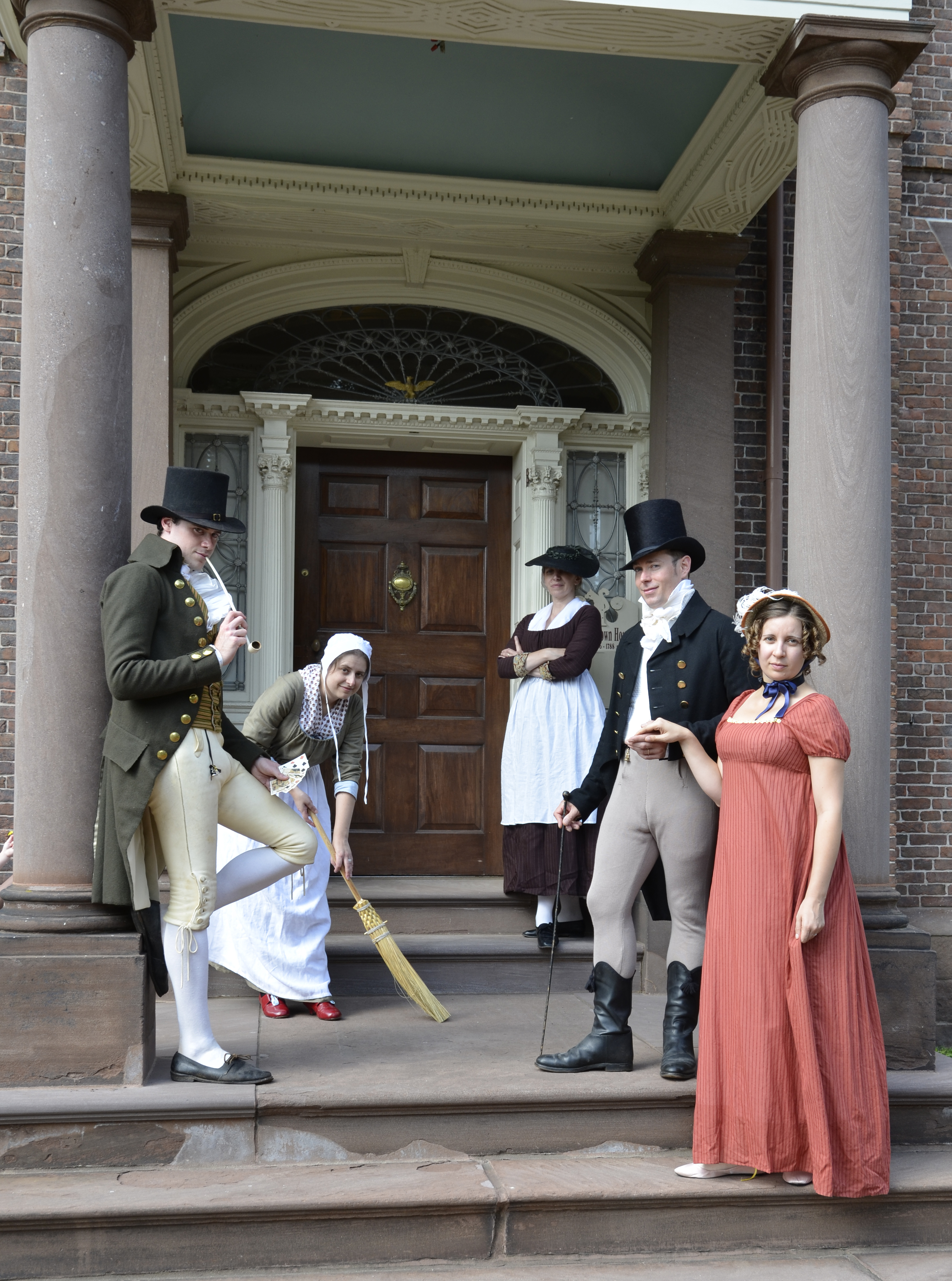
What Cheer Day Photo Gallery

Good Help is Hard to Find

Esther helps Mrs Smith with her bonnet

Esther Hudson here has a terrible fascination for knittin, and an abundant fascination with sheep.I fear sometimes for her sanity, as she spends much of the evening sketchin cats on her slate and showing em to me. Cats, sheep, and knittin are much of her conversation and I wonder if she will ever be settled in a home of her own. I durst not send her away, as her father is at sea, and knowing what might befall her, given her simple ways, I think it best to keep her close. She is fond, as you can see, of dressin, but refuses utterly to quarter a fowle. She will beat a fine pound cake, but the coarser tasks of the kitchen she finds distasteful, preferrin to dress the ladies’ hair. Of her future, I do sometimes despair.

Mrs Smith and Miss Smith

My cousin, Miss Eliza Smith, has donned her new dress to come up to town from her beloved Newport to see about a position. The family with whom she has found employment these many years has suffert in that city’s decline since the late war, and she seeks a new future in Providence. She writes a fine letter, and with excellent references, Miss Smith would be well suited to manage a household for Mrs Brown’s youngest daughter, the recently married Mrs Mason. Miss Smith seems also to steady Esther, whose conversation grows more sensible when she is not with me. Perhaps after speaking with Mrs Mason, Esther, Eliza and I can slip away to enjoy some of the newly pickt apples she has brought up from Rhode Island.

Mrs Smith, ready for some ale
Mrs Smith at day’s end

At the end of a long day filled with visitors– every stage has stopt at our house, some mistaking it, I think, for that questionable establishment operated by ‘Mrs’ Mary Bowen on South Main Street–I was ready to remove my soild apron (thankfully Esther has a spare) and venture down the hill to seek refreshment with my frinds. I may chanst to hear some news of the Ann & Hope, bound for Canton, and on which my son is a sailor. Or perhaps, before the light fails, I may read a bit of Mr Defoe’s most moral tale, Moll Flanders, and think in gratitude that my late husband’s family has seen fit to give me employ. I cant read at home, for if Mrs Brown catchs me readin that book agin, I will surely be trouble.

(Top photo thanks to the Providence Journal; bottom two thanks to Sharon Ann Burnston, our Mrs Brown)

Places!

places_pleaseI don’t think we can be very much more ready. It’s a bit of madness, really, when the actors are also the stage managers, press agents, prop masters, and set designers, but that’s how these things work. (The local paper says we’re presenting a play; it’s somewhere between a reenactment in the larger, looser sense and improv theatre, but never mind.) I have only myself to blame, and Mister Mason and his interest in Sleep No More, for all this. Aware of Mister Mason’s interest, I should have realized what might happen when I said,  “Can’t we just occupy the house for a day?” with all the fluidity of the Occupy movement in mind.

My compatriots, I apologize.