Last night, as I lay in the tester bed we slept in on What Cheer Eve, I wondered again what it was like to live and work in the house over the course of its life, and how the servants had been treated. In the late 18th and early 19th century, the notion of “service” was still evolving in New England. Help was common, and while northern and urban slavery existed, and we know the Browns traded in and owned enslaved people, we have no evidence of them in the house.
We know there was a white woman between 45 and 60, and four “all other free people,” we have names –Mary, Jonathan, and Gideon– for some of the people associated with the family, but don’t know their details. How did the Browns treat them? What was the relationship like? Were they invisible? Thanked? Chastised?
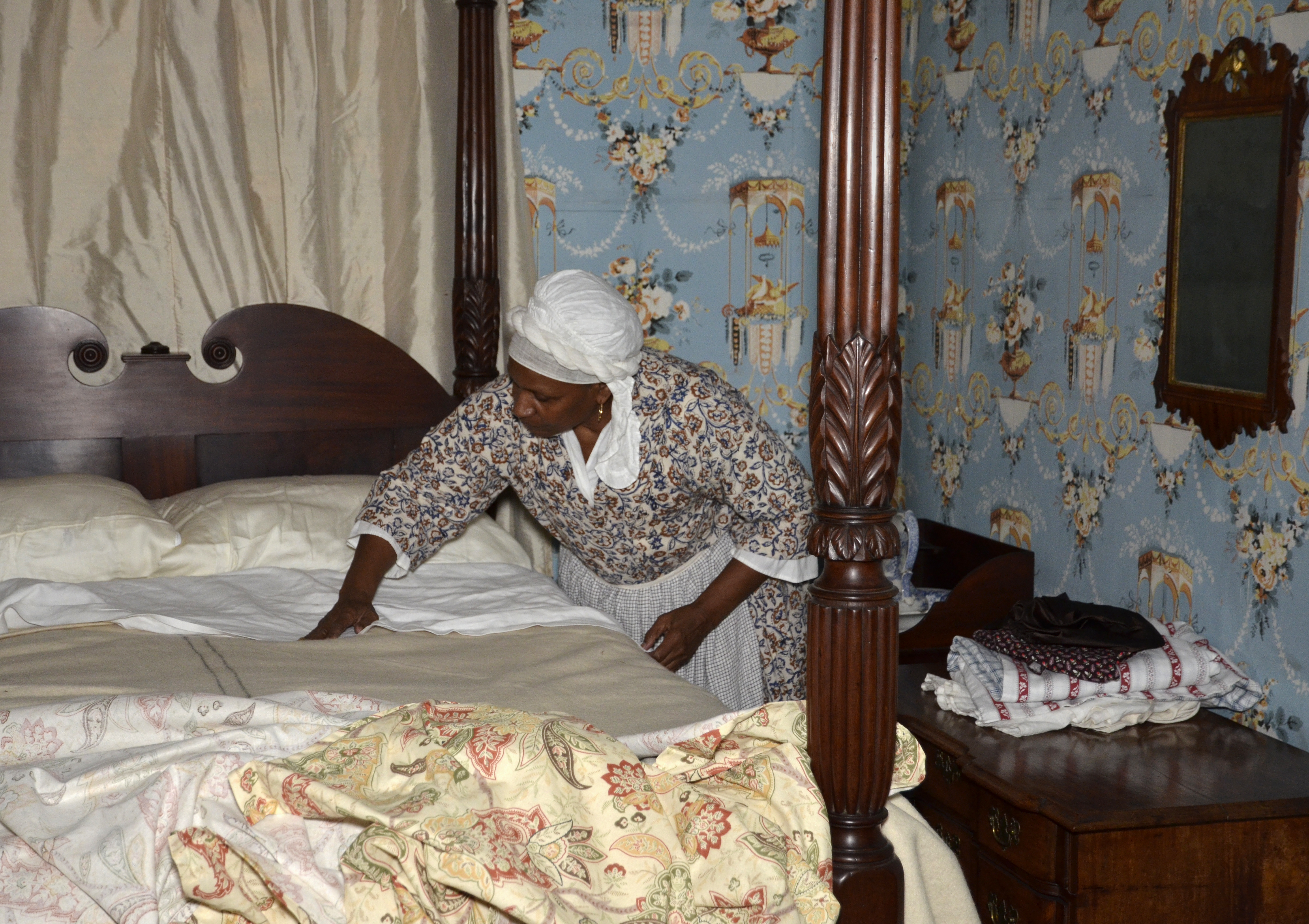
Goody Morris makes up a bed. Photograph by J. D. Kay
Diary entries that record “my babe takes tea with Ma’s Mary” suggests that there was some level of familiarity, and hints at the friendly relationship children and servants sometimes had in these houses, when both were seen as less civilized, less refined, and (clearly) less educated than the adult homeowners. Physically, service stairs kept chamber pots, laundry, food, servants, and children out of view, sequestered into smaller, dimmer, less-finished spaces.
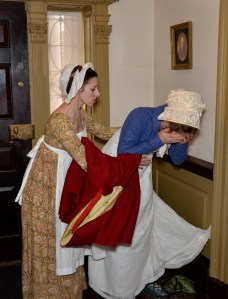
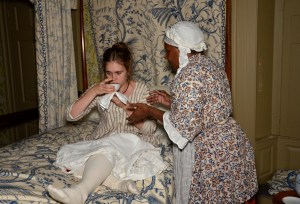
Petulant Alice faces her first hurdle, Kitty and Goody Morris. Photograph by J. D. Kay
We’ll never really know how the Browns really treated their servants, or felt about them; these are people who matter only enough to be remarked upon in passing. Perhaps even more frustrating is that we’ll never know what the servants thought of the Browns, of their businesses and moods, loves and appetites. These barely-documented people could tell us so much, if only the past could talk.
One night stands: no, not that kind, this kind: the Anarchist kind. I’ve been following Mr Vagnone’s work for some time now, and while museum professionals are not all in agreement about his techniques and approaches, I find them intriguing and thought provoking. I’ve also found that the best way to accomplish anything is by baby steps, as annoying as that can be. That’s how we got to this What Cheer Day: incremental progress over a five-year period. What was so different? Well….
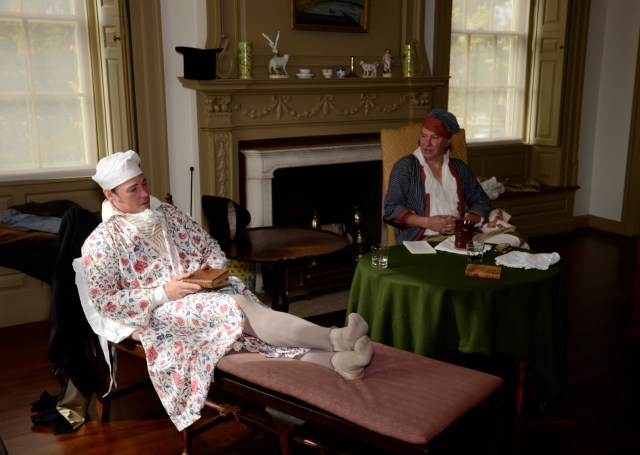
Jimmie and Billie, unwell and unable to dress themselves without Gideon’s aid. Photograph by J. D. Kay
To begin with, we slept in the house. Eight of us. In the period beds and on the period sofas. No harm came to anything, except the gentlemen, who seem to have contracted mild, possibly mold-based, ailments from ancient feather beds.*
We scampered around the enormous house (I swear the front hallway would contain my entire flat, both floors!) in bare feet and period night clothes. I has a regret about that, because the floors could be cleaner, and I forgot to ask for my slippers back.
Anyway:
Big house. Dark night. Flickering candles. Rain storm. Cantonware cider jug.
Mind blowing.
Why? Why do it? Why risk it? Why, when I’ve been there after dark? Why, when I’ve slept in other historic houses and historic beds? Because to really understand someone, you have to walk in their shoes– or sleep in their bed, as the case may be.
Goody Morris makes up a bed. Photograph by J. D. Kay
I lay in bed in an enormous mansion house, the first one built on the hill in Providence, completed in 1788. Almost every week, I tell the story of the house, the family moving, James complaining about the June heat as he walked up the hill from Water Street to move into the new brick edifice. I tell the story of Abby’s wedding, the longways dances on the second floor of the unfinished house, candles and dancers glittering in the enormous mirrors at either end of adjoining rooms. But I’d never seen it. I’d never heard it. I’d never really thought about service circulation and stealthy maneuverings in the house.
Now I have.
Now I have lain in the enveloping warmth of a feather bed and heard the rain pouring outside, and nothing else. I’ve heard the deep quiet of thick brick walls. I’ve seen the utter darkness of the house at night, and, padding up the stairs to bathroom, been comforted by the presence of my companions even as they failed to sleep across the hall.**
A dreadful night: almost too much to bear. Photograph by J. D. Kay.
To enter the room as a maid, I’ve used the doorway from the former service stairs, and silently carried in a jug to serve the occupants. I’ve gotten closer to the near-invisible role of servants, in a period when full invisibility hasn’t yet been established. I’ve watched someone I love sleep off a migraine in a room where we interpret illness and 18th century medicine.
Best Maid/Bad Maid. Photograph by J. D. Kay
All of that is mundane. And because I did all of that in a historic house with period furnishings, all of that is magical. My job now is take what I have learned and felt, and find new ways to use those personal experiences to connect our visitors’ personal experiences to a larger (and a smaller) story about Providence, early Federal Rhode Island, and a family.
* Most amazingly comfortable feather beds ever. Drunk Tailor’s review is unprintable on a family blog, but hilarious.
** Sorry about that… I slept pretty well, considering.
Petulant Alice faces her first hurdle, Kitty and Goody Morris. Photograph by J. D. Kay
I think about three or four things most of the time: food, sex, museums, and clothes. That seems pretty adequate, but from time to time I am forced to consider intersections between these rather broad topics. The intersectionality of clothing and museums seems pretty obvious: from accurate costumed interpretation to proper packing and storage, easy. Food and museums will be much on my mind in the coming year, as we work on “Relishing Rhode Island,” and I’m continually harping on how eating locally and seasonally is the core of eating historically. Sex and museums is a little harder (yes, I know about the Museum of Sex), though one gets a chance even in a historic house museum, and really, it’s not just about the act: it’s about the feels.
Mary assists Alice in the hallway as she prepares to face her mother. Photograph by J. D. Kay
In the main, I am not particularly good at the feels aside from some very hands-on experience with anxiety, but a number of things have coalesced recently to make me reconsider the intersection of emotions, museums, and history.
Hamilton is one, and if you read this, you probably watched the Hamilton’s America documentary on PBS last Friday. If you didn’t, go do it now. Really: I can wait. And here’s why:
In the thinking I’ve been doing for some time about Hamilton,* I’ve reached the conclusion that what makes it so damn good (aside from the brilliant writing) is how Lin-Manuel Miranda has captured the emotions. The quotes I wrote down from the documentary are about emotion and drama, because I’m looking for them (confirmation bias for the win) but here they are:
“Each piece of music is specific to an emotion and a character”
“I got into the history through the characters”
“Research is over and you write the character defined by history”
“Write the parts you think are a musical”
Goody Morris helps Alice drink lemon water to soothe her stomach. Photograph by J. D. Kay
What is a museum exhibit but “the parts you think are a musical?” While Our Girl History struggled with being Alice (I know a bit about the part where your ego gets connected to a character), she had to portray a character defined by history, but also by emotion. And in thinking about Hamilton, about What Cheer Day, and about the exhibits that give me pleasure, and art that brings me joy, I have reached a couple of conclusions.
I believe that museums, where we currently set educational and interpretive goals, and increasingly experiential goals, need to begin setting emotional goals for their programs and exhibitions. You could argue that experiential and emotional goals are the same, but I disagree: I believe that interpretation helps define the experiences that create emotional responses, and within the intersection of experience and emotion we will find the educational goal revealed, because we are always working within a content-driven context.
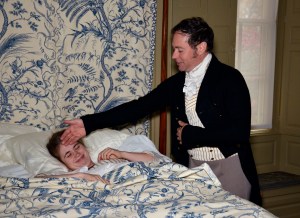
James checks on sister Alice. Photograph by J. D. Kay
I also believe the reason gun-based reenactments retain their popularity is their easy emotions. “Boom!” is exciting anywhere: there’s an immediate reaction of shock, surprise, a mild fear, and excitement. Traditional reenactments have those “boom!” emotions embedded within them, which is how they retain their potency. Until we locate the emotion within the everyday– and trust me, it’s there– we will not see the primacy of non-military reenactments and living history.
*Yes, I was aware of it when it was in previews at the Public Theatre. I am *that* kind of hipster, but really, it was because Oscar Eustis went from Trinity Rep here to the Public and there’s a PVD-NYC theatre connection.
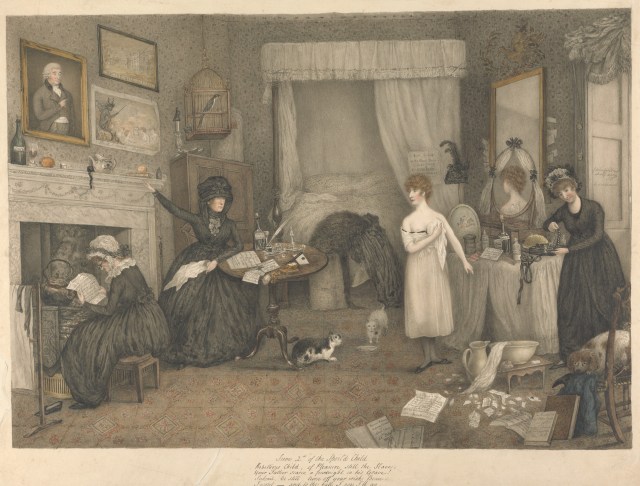
Lewis Vaslet, 1742–1808, The Spoiled Child, Scene II, ca. 1802, Watercolor with black ink and gray wash over graphite on moderately thick, slightly textured, cream wove paper, Yale Center for British Art, Paul Mellon Collection. B1977.14.4342
In just about a week, we’re running a pilot program in the historic house where I work (tickets available here). After Dark, or What Cheer Night, are programs we’ve wanted to do for a couple of years, but all good things take time.
Error
This video doesn’t exist
I’ve drawn the lot chosen to talk about getting ready for bed and sleeping: lighting devices, bedding, washing, chamber pots* and what people wore to bed. While already in possession of candles and candlesticks, and the proud new owner of exhibition and interpretation grant-funded LED candles, there are things I needed to make. Of course.
Print made by Guillaume Philippe Benoist, 1725–ca. 1770, French, Pamela Swooning, after having discovered Mr. B. in the closet, He (frighted) endeavouring to recover her, Mrs. Jervis wringing her hands, and screaming, 1745, Etching with stipple engraving on medium, slightly textured, cream laid paper, Yale Center for British Art, Yale Art Gallery Collection, Gift of the Library Associates.
A banyan, for one thing. And you know that will (one hopes) be followed in short order by a night cap. After all, you can’t talk about Pamela if you haven’t got a banyan and a cap in the house. That’s a simple and relatively fun project to tackle when brain capacity is somewhat limited: some piecing, straight seams, setting in facings and sleeve linings can all happen before I must assault the collar.
Piecing it together, as the eventual wearer is taller than available fabric.
Collars are devilishly tricky for me sometimes– oddly, a pad-stitched collar set onto a tailored jacket seems easier to me than a bedgown collar– but I suspect the eventual recipient will manage to enjoy the garment no matter what minor construction errors a tipsy milliner or half-seas over housemaid might make (not, of course, that I am either of those things).
It’s been a fascinating exercise in having a staff-and-docent study group that has taken a decidedly feminist bent (calling Our Girl History!) as we explore what happened in Providence After Dark. Brothel riots in 1782. Warnings by the Baptist Church not to visit the “theatre, circus, or Green Cottage” on pain of punishment. No, I do not yet know what or where the Green Cottage is, but the best researchers I know are working on it. Is this the 18th century answer to the Green Door? We can but hope.
Reading The Coquette? Thomson’s The Seasons? Come experience an 18th century house on a night when people will know what you’re talking about! Or you can watch that questionable housekeeper prepare a room for the night while she talks about sleep patterns and shares tips for 18th century pest control.
*Pro tip: put it on a chair. I fully expect to run an intimate workshop some evening called “Will Humiliate Self for History, or, Everything you ever wanted to know about the 18th century, but were too well brought up to ask.”







 Kirsten Hammerstrom
You must be logged in to post a comment.