“Exteriorizing,” or, Showing the Past: Part I

This guest post was written by Sharon Burnston. Sharon and I will be co-teaching an interactive workshop on first person impressions this June. “Exteriorizing” is an important part of developing an impression that works not just to represent a character, but to tell a story. Part II will appear tomorrow.

John Gilmary Shea, The Story of a Great Nation (New York: Gay Brothers & Company, 1886)after 444, says "page 475" University of South Florida clip art collection.
John Gilmary Shea, The Story of a Great Nation (New York: Gay Brothers & Company, 1886)after 444, says “page 475” University of South Florida clip art collection.

The first time I was ever “abducted” at a living history event was during an F&I scenario 35 years ago. I was dragged off into the bushes by scary looking strangers, and it was all very well researched and convincing.

But one thing I realized, upon reflection afterward, is that a really accurately portrayed scenario isn’t always in all ways the “best” scenario, for the participants or the public. In real situations that are terrifying, the usual physiological/behavioral responses are those described as Flight, Fight or Freeze. That’s what real people do when that sort of thing really happens. At the time I was abducted by “the French and the Indians”, I put myself into the moment, imagined how I would really feel if it were actually happening, and I froze. I portrayed terror so well, my abductors looked at me oddly, wondering if I was okay. But y’know what? The spectators, standing 30 feet or more away, couldn’t see my face, couldn’t hear my shallow breathing, and they got nothing out of it.

The Abduction of Daniel Boone's Daughter by the Indians. oil on canvas by Carl Wimar, 1853. Washington University Kemper Art Museum. Gift of John T. Davis, Jr., 1954 WU 4335
The Abduction of Daniel Boone’s Daughter by the Indians. oil on canvas by Carl Wimar, 1853. Washington University Kemper Art Museum. Gift of John T. Davis, Jr., 1954
WU 4335

I realized that I had actually failed to do justice to the interpretive moment, I should have done something less lifelike and more communicative. I should have screamed for help, in detail, loudly, and at length. In real life, this would have been a risky thing for a captive to do, but in a reenactment interpretive setting, it would have been useful. I mean, I knew precisely why my character was terrified, but did the public? If I had screamed and carried on, it would have given me an opportunity to put into words what the 18c abducted woman knew about what was going to happen to her. It would have been a better scenario in terms of educating the public if I had, in a word, exteriorized what my character was feeling into words, for everyone present to hear.

The problem with my having learned this sort of thing experientially and so long ago, is that I tend to blithely assume that other folks whom I regard as skilled 18c role players also know it, because to me it is by now so obvious.

DSCN4448

Last summer I participated in a brilliant re-creation of a different kind of abduction, a reenactment of the British naval press gang that abducted American sailors out of Newport RI harbor in 1765. Over 60 of us from all across New England worked hard for months to research and develop our impressions in order to make this event as convincing and accurate as we could. For the most part, we succeeded magnificently. But I came away dissatisfied and I think some of the public I talked to did also. That was a helluva scenario, meticulously planned and carried out, and we did it so well! But I think we could have done it one or two notches better, and here is why I think so.

First person role playing has far more of theater about it than perhaps we living historians care to admit. Drawing upon theatrical strategies can allow us to better communicate our knowledge to the audience, by exteriorizing our characters’ thoughts or feelings into dialogue the public can hear, even if doing so might slightly violate the strictest historical purity of our role playing. After all, don’t we claim to be doing this in order to educate the public?

The strategy I have in mind is the collaborative trick referred to in improvisational theater as “Yes, and”.

“Yes, and…” refers to a basic concept in improv theater. If a participant throws a gambit at you, don’t shut it down. Accept it, whatever it is (“Yes”) and then add something of your own (“and…”) to expand on the idea and keep it going. “Yes” means being receptive to the contributions of others. “And” means offering something back, to further the collaborative process.

How would this notion apply to a living history role playing scenario? Stay tuned to find out!

Sleeping on the Job

img_9092

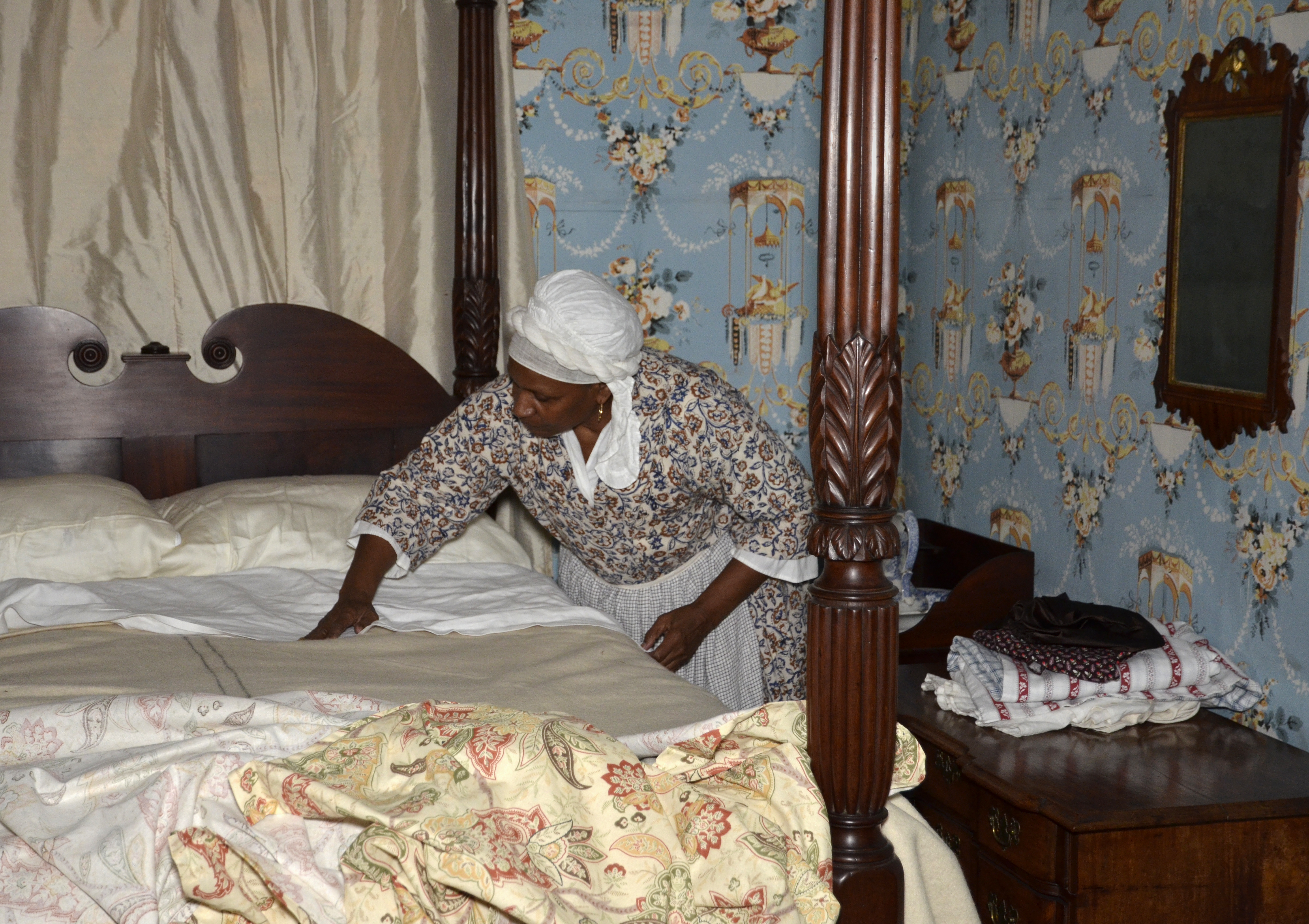
Last night, as I lay in the tester bed we slept in on What Cheer Eve, I wondered again what it was like to live and work in the house over the course of its life, and how the servants had been treated. In the late 18th and early 19th century, the notion of “service” was still evolving in New England. Help was common, and while northern and urban slavery existed, and we know the Browns traded in and owned enslaved people, we have no evidence of them in the house.

We know there was a white woman between 45 and 60, and four “all other free people,” we have names –Mary, Jonathan, and Gideon– for some of the people associated with the family, but don’t know their details. How did the Browns treat them? What was the relationship like? Were they invisible? Thanked? Chastised?

Goody Morris makes up a bed. Photograph by J. D. Kay

Diary entries that record “my babe takes tea with Ma’s Mary” suggests that there was some level of familiarity, and hints at the friendly relationship children and servants sometimes had in these houses, when both were seen as less civilized, less refined, and (clearly) less educated than the adult homeowners. Physically, service stairs kept chamber pots, laundry, food, servants, and children out of view, sequestered into smaller, dimmer, less-finished spaces.

Petulant Alice faces her first hurdle, Kitty and Goody Morris. Photograph by J. D. Kay

We’ll never really know how the Browns really treated their servants, or felt about them; these are people who matter only enough to be remarked upon in passing. Perhaps even more frustrating is that we’ll never know what the servants thought of the Browns, of their businesses and moods, loves and appetites. These barely-documented people could tell us so much, if only the past could talk.

Any Old Epaulet

Details: we sweat them in our historical clothing, our impressions, our writing. I try hard to pay attention to them, but in my work, I have a lot of details to manage. Some fall away– I can no longer tell the ranks of men in daguerreotypes immediately, or recognize a Colt revolver at 10 paces, but there was a time when I could. I have managed to retain at least a general understanding of how military units are organized, a general sense of various units from my state in wars before 1939, and the uniforms associated with those units. (And I know which side a man’s coat buttons on.)

What's wrong with this image? Missouri State Guard uniform coat of Col. Austin M. Standish (Confederate). Missouri Historical Society 1916-045-0001
What’s wrong with this image?
Missouri State Guard uniform coat of Col. Austin M. Standish (Confederate). Missouri Historical Society 1916-045-0001

This helps in my work: knowing what HBT is, knowing what various patches signify, knowing how units were structured and the campaigns they were part of helps me be a better cataloger, curator, and exhibit developer. My job is take the details and make them matter by telling stories about the people who wore the HBT or the machinists’ mate patch or carried an ensign or wore an officer’s coat as part of the 14th Rhode Island Heavy Artillery (colored) in the Civil War.

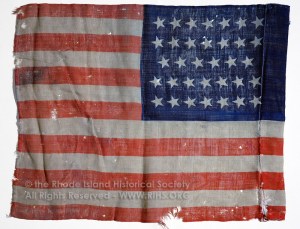
U.S. Flag, regimental. 14th Regiment Rhode Island Heavy Artillery. Belonged to Joseph Carey Whiting, Jr., 1st Lt., Co. B 14th R.I. Heavy Artillery. RIHS 1962.24.1

People matter more than things, but 154 years later, all we have are things those people owned, used, wore, and carried. The things now represent the people. So when someone working on a exhibit says, “any epaulets will do” while pointing at the shoulder boards on a Lieutenant’s coat, I’m not just taken aback, I’m upset, and reply, “If it’s just for color, you can buy them.” Because “any old epaulet [sic]” being loaned by a museum goes through a laborious process of loan approval, packing, delivery and installation. For that time investment alone, “any old epaulet” should not do: museums are not prop closets.

General's Epaulets of William Clark. Missouri Historical Society. 1924-004-0006
General’s Epaulets of William Clark. Missouri Historical Society. 1924-004-0006

I keep saying the same thing, don’t I? There ain’t nothing like the real thing.

We can’t assume that the public doesn’t know or doesn’t care– they often know more than we do, just think of the wildly detailed knowledge some of us have about very particular things– so we owe it to them, and to the people of the past, to use museum objects as more than visual accents.

Fitful Friday: Art Still Has Truth

Pitt and Napoleon carve up the world.

It’s been one of those weeks, hasn’t it? Up and down, emotionally, as we all prepare for change. Whig or Tory, these are turbulent times.

I’ve been surprised by recent fabric arrivals in the mail, disappointed when I waited a day too long to register for a dance, and now I’m at loose ends. What comes next?

Last weekend I cut out a black wool Spencer to line in lettuce green silk because why not? And teeny tiny backstitches later, I have one sleeve finished. Focus is hard to come by of late.

I meant to join the Historical Sew Monthly to give my sewing life some structure, and I still can, though I cannot seem to settle down. Clearly, I have Firsts & Lasts that could be made (not always in the time remaining, mind you, so I would have to choose wisely).Re-Make, Re-Use, Re-Fashion? Probably much there as well– at least if one counts the quilted petticoat worn at Princeton, which was remade and altered from its original form.

July: Fashion Plate, could become the shawl gown I’ve dreamt of for years, since, as you can see above, I’ve found one that might work, lured by a fair price on a sizable piece of wool– but wherever shall I wear it? Why can I not get past utility? The Dreamstress’ Kashmiri shawl gown and her research are there to emulate, and explain.

Oh, I have projects and events to research and plan, housework to complete, and plans to execute. But they all seem abstract and unreal at the moment when we hang on the pivot point between the future and the past. It’s been a strange year in many ways and places, and constructive projects help focus.

Art Still Has Truth Take Refuge There

Long ago, in the first turbulent times I was old enough to understand, I lived in St. Louis. Then, as now, I think the Art Museum’s motto holds, and reminds those of us who work in or appreciate sometimes frivolous-seeming fields and hobbies that all our actions have meaning. I’ve thought for a long time about the utility of sewing historic clothing, cataloging objects, and running around recreating the past.

Getting outside one’s own experience is incredibly hard; it’s hard to have an open heart, and to encourage openness to others. But that’s one of the most important roles museums and libraries play: we help people develop imagination and empathy. I know it’s part of why I do the work I do. I like to think that ultimately, helping illuminate the complexity of the past will help us all understand the present and make a better future.