Living Like a Refugee

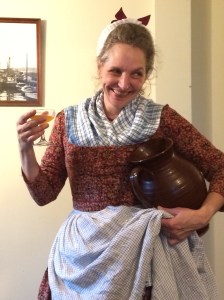
At the Speaker’s House. Photo by Drunk Tailor.

When I was in middle school, we were given an assignment that is now considered inappropriate: we were asked to trace our family history or genealogy as a way to help understand historical time, stories of immigration, and the ways in which we are all American (according to the then-prevalent “melting pot” model of being American). Exercises like that are now discouraged as educators recognize the myriad ways in which people form families, though in my middle school, what was revealed was not adoptions or absent parents but the yawning chasm of class and privilege. My people are more peasant than princess, so the women I portray in living history make sense to me. They don’t wear silk. They make things, and they sell things.

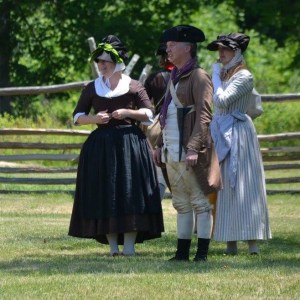
Walking back from Augustus Lutheran Church, Trappe, PA

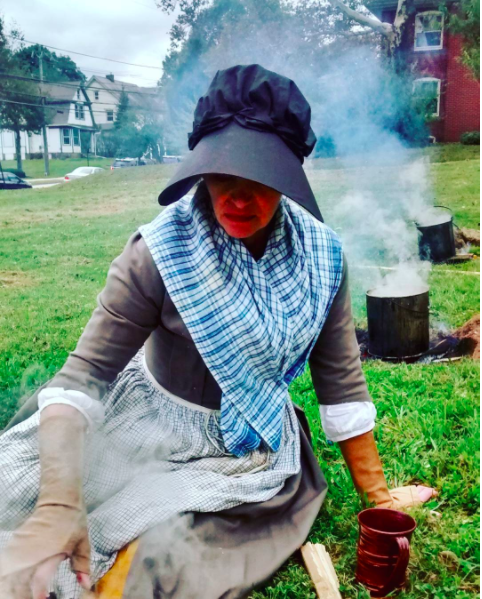
Portraying a refugee was a little trickier to wrap my head around. Whiny I can do– if I wasn’t teaching workshops in New Jersey this November, I’d be in 1587 North Carolina pining for England and wondering why I didn’t listen to my mother instead of marrying that head-in-the-sky Virginia colonist. What made being a refugee tricky for me was finding something to do. Obviously I shared in the cooking chores and the walk to Augustus Lutheran Church, but projecting “refugee” was tricky for me.

Looking back, I can see that straggling after a militia company may well have been enough– not wanting to leave their “protection,” not having a place to be, illustrates displacement. Even dressed as a middle-class or lower-middle-class woman, I am out of place sitting on grass or following armed men.

Displacement: I had not previously considered this as a means of provoking informed interpretation. Interpreting lack or absence can be as effective as interpreting presence. “No shoes” or “no musket:” these are easier, more obvious, but as a refugee, I had no home, no place, and no belonging. That seems even more important to understand and interpret today, at least for those of us concerned with making the past present, and the ways we can study the past to understand the present.
Reading Double

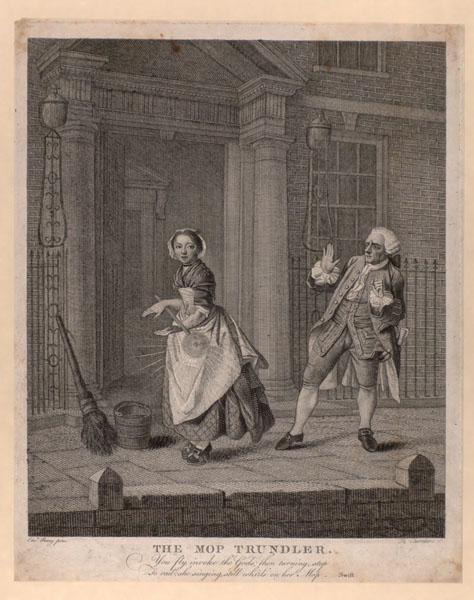
The mop trundler. Chambars after Penny. Bodleian Library, University of Oxford: John Johnson Collection
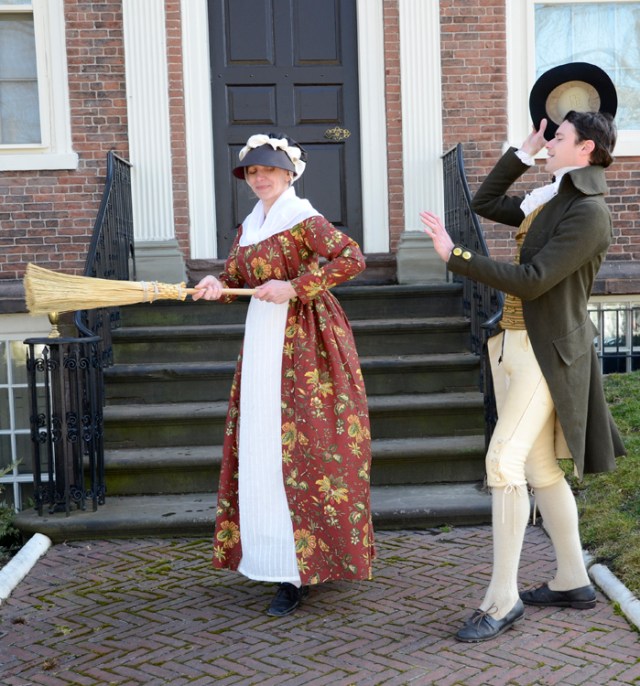
Photo by J. D. Kay, 2013

I love this image, and the original on which it is based. I love it so much that we’ve recreated it (in a later time period) whilst fooling about during a photoshoot.

But what does it really show? The image in the print depicts a passage in Jonathan Swift’s poem, A Description of a City Shower,

Such is that sprinkling which some careless quean
Flirts on you from her mop, but not so clean:
You fly, invoke the gods; then turning, stop
To rail; she singing, still whirls on her mop.

Straightforward, right?

Well, not so fast. Thanks to the wonders of ILL, I’ve been reading The Satirical Gaze: Prints of Women in Late Eighteenth-Century England, by Cindy McCreery, and looking at prints anew. Her chapters on prostitutes and old maids are particularly interesting, and confirm some of what I had been thinking about when we use prints as documentation.

Here, in the Macaroni Provider, we have what is “Probably a portrait of some (alleged) notorious procurer; perhaps Thomas Bradshaw whose portrait he somewhat resembles.” We have a pimp, folks.

The Macaroni Provider / Macaronies, Characters, Caricatures & designed by the greatest personages, artists &c graved & published by MDarly, 39 Strand. 1772 (Vol.3). British Museum

So, with this information in hand, let’s look again at The City Shower. We have a maid– one of the few classes of women found in city streets unaccompanied, and a class of women often associated with prostitution (along with street vendors and market sellers). The fashionably dressed man recoils from the spray from her mop– is he rejected the literal filth, or the implied filth of a “maid of all work,” who may have a venereal disease? Is it reasonable to wonder if Swift is using double entendres in the lines Such is that sprinkling which some careless quean
Flirts on you from her mop, but not so clean, 
so that the mop is the woman’s pubic hair, and not so clean suggests she is diseased?

I don’t know, and absent intensive research or a time machine, I may never know. But once again I wonder how we use and understand these images, and think that they pose more questions than answers. McCreery’s book (based on her dissertation) helps get at some of these issues, and is well worth a read. (I found the Amazon review hilarious, myself, once I had the book in hand. No, it’s not a compendium of prints; it’s an analysis.)

An Introduction, or Re-Introduction, of Sorts

No, I won’t say how many cups I’ve had.

What is this thing, and who am I?

It’s Costume Blog Writing Month (inspired by NaNoWriMo), and I’m Kitty Calash. I used to post much more frequently, but life caught up: I moved, which meant I didn’t sew at all for over a month* and thus didn’t have much to write about, since this isn’t a packing and moving blog.

But even before that, posting had slowed as I began to wonder why I wrote, and why I sewed. Costume Blog Writing Month, with its 31 flavors of posts, is a chance to reacquire the writing habit, and to think again about what I do, and why– and thus proved irresistible.

I’m a curator in search of a collection, a fugitive from architecture school, a compulsive editor, and a cat wrangler. I started sewing as a child with help from my mother and grandmother** who made clothes for me and my favorite doll, Moira. Although I graduated from two art schools, my interest in history is deep: I craved china dolls, collected antique quilts and tools, and insisted my bicentennial Samuel Adams costume have functioning knee bands– and yet, it’s taken me years to admit I’m “detail oriented.”


Some days Drunk Tailor asks me if I really enjoy sewing– my face betrays my frustration, and I do not play poker–but I get both distraction and satisfaction from it. Most of what I make I wear at living history events, so I hand-sew everything I can. I fall into the “progressive” reenactor/enactor/costumed interpreter camp, and strive for authenticity and accuracy in what I make, how I wear it, and what I do.

I’ve come to realize that I’m chasing art: my thesis work looked at what it means to be an American. What does “America” look like, what does the myth of America and our founding story mean? How do we portray it? Yes: I costume and organize events in pursuit of an experience for myself and participants that helps explain this nation, and how it came to be the way it is.

Not every post gets into this kind of theorizing— really, most don’t– but at core, my costume pursuits do chase the myth of an American Dream as I try to understand the people of the past, how they thought, what they made and wore, and how the past continues to inform the present.***

*During this time, I lost the distinctive callouses that will help a detective identify me as a seamstress when my murdered corpse is found in a Paris hotel doorway in the Georges Simenon novel I write in my head. I watch a lot of murder mysteries while I sew.

**Elsa turns up here from time to time; she was a style maven, the doyenne of design in a small Southern Tier town, who, for 50 years, ran the shop that dressed the maidens and matrons of the nearly best classes in a community of striving Swedes aching to assimilate.

*** And that, friends, is what working in history museums for two and half decades will get you: your own personal mission and an empty bank account.

Style Council

National Gallery of Art furniture gallery, May 2017

One of the critiques leveled at historic house museums is that they’re often “frozen in time,” specifically a particular moment, rather than reflecting the changes that happened over time. This charge is sometimes leveled at period room installations as well, when all the furniture in a room is from a tight time span– a year, maybe five– when for most of us, the furnishings in our homes and the clothes in our closets reflect a number of years, rather than a tight twelve or eighteen months.

So, when we go out “into the field” (or the house or the milliner’s shop or the tavern), shouldn’t our belongings reflect the multiplicity of years of objects? If I’m a woman Of A Certain Age, won’t I have possessions, from jewelry to ceramics to clothing, from multiple decades? Well…. yes and no.

It’s true that as far as we can tell, John Brown moved his 1760 furniture into his 1788 mansion, but we also know he bought new furnishings, including a large (188+ piece) set of Chinese Export Porcelain (see above).

Up-to-date, stylish, expensive: table settings signaled wealth and sophistication as much as clothing and manners, so whatever JB had before 1788, he wasn’t setting his new table with it. What might he (or Mrs B) have done with it? Consigned it to use by grandchildren and servants? Given it to less fortunate relations? Possibly. And if they had creamware, it would not have been singularly out of place in 1788 or 1800 on any table– it was only 40 years old, and heaven knows my “best” china is from the 1930s– but would they have used earlier pottery, even in the kitchen?

All pottery is not the same: North Devon pottery, while imported to North America in the late 17th and early 18th century, is not what you would expect to find in a late-18th century farm kitchen. It’s here, sure, into the mid-18th century, but in 1799, it’s not the form you would expect to see. So what does that mean for living history folks? Does it matter what you use?

You know what I think: there ain’t nothing like the real thing and that means paying careful attention to details. If you’re portraying a camp follower in 1778, or tenant farmer in 1799, you are not likely to have, say, a Jackfield-type figured tea pot, just as you are not likely to have a salt-glazed squirrel-relief cream jug, no matter how much you adore it.

Time and style matter. The people of the past read each other the same way we read each other. Remember Clarice Starling, with her “good bag and her cheap shoes”? Get on a train anywhere, and you can read your fellow travelers: you can guess income and education levels, marital status, and sometimes interests and hobbies if you look closely. You make assumptions about people based on their appearance, whether you’re conscious of it or not– and so did the people of the past. To portray them accurately, and to help the public learn to read the past, the details matter.