Hand-woven Linens by Subscription

In the few short years I have been doing costumed interpretation and living history, I have made three shifts and four shirts and am making up a fifth shirt, with a possible sixth needing to be made, as well as four aprons. I’m not crazy, I just sew that way…for three people (one still growing) who dress for the decades between 1763 and 1812.

linen sample
Hand-woven linen: the top edge is the selvedge

There are several annoying factors when sewing historic clothing with modern materials– mostly that the modern materials aren’t quite right, and can be quite wrong. As Sharon Burnston explains on her website, much of this has to do with selvedges— which are not hard, and rarely tucked, now. The other trouble is width: many fabrics now come 54 to 60 inches wide, which means that you have to cut them down when making shift.

There is a solution: hand-woven, period-correct linen, available now by subscription from Justin Squizzero [email to order: justin(dot)levi(at)ymail(dot) com].

Mr Squizzero will weave both plain and check to the width you want: 3/4 (27″), 7/8 (31.5″) and yard (36″) widths, perfectly correct for period clothing.
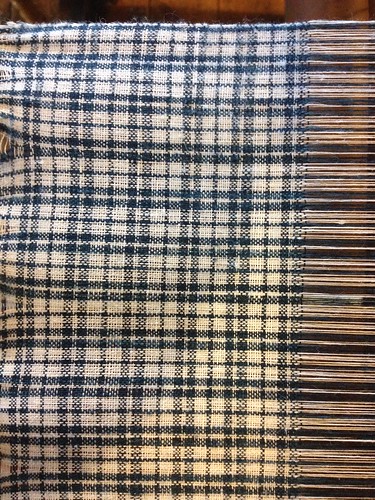
Hand-woven checked linen

The prices are $130/yard for plain bleached, $160/yard for checks– and what checks! Indigo dyed blue and white check in a pattern documented to New England at the turn of the 19th century? Oh, yes, please: I must save my allowance and sew only from my stash.

Although we debated fabric weights this past weekend, here’s what I think, and have found through wearing: shirts for soldiers and artisans– but not the elite–can certainly be made of the white and the check; I would made a shift from the white, but I prefer how my heavier shift body feels and behaves under stays. The check would be ideal, too, for an apron, which would require only one yard.

If you’re wearing a coat made from $120/yard wool dyed with documented colors, shouldn’t you wear the most correct shirt possible underneath? Entirely hand-woven (and hand-dyed in the case of the checks), you’re buying art– but isn’t that what you’re making and creating when you hand-sew your clothes and step into the past?

Ceci n’est pas une cruche

This is not a pitcher

Sometimes a pitcher is not a pitcher. In the same way that Matthiessen‘s Snow Leopard is not about a snow leopard, this was not about me: this was about the woman who approached me as I walked with Cat to the water bubbler with this white ceramic pitcher from Home Goods.

She stopped me to say, “You shouldn’t have a pitcher in camp. You should have a bucket.”

This is true, as far as it goes: but really, I should have a tin kettle (and I do). But the reasoning I was given had to do not so much with the fragility of the pitcher (which I pack in a basket or wrap in our towels and stuff into something in the supply wagon) as it did with the myth of Molly Pitcher. For an explication of the Molly Pitcher myth, I refer you to the Journal of the American Revolution, because, as I said to the woman who approached me, “It’s not my fight.”

So what’s the point? Maybe there are several:

One might be, Everyone has a hobby horse. Some of us are made mad by The Bodice. Some of us cannot abide makeup on “camp followers” who look like stragglers from a high school production of Sweeny Todd. Some of us are material culture and camp equipment fanatics– begone, ironware! Still others twitch at the baggy, off-the-rack cut and fit of some uniforms.

For another, This wasn’t about me– or my pitcher. The woman who approached me had a thing about Molly Pitcher and the myth of the woman on the battlefield with a pitcher, bringing water to the men. My pitcher and I were merely a trigger.

colonial woman with pitcher and kettle
Everybody’s got something to hide ‘cept for me and my…pitcher? or kettle?

And for a third, We all make choices and compromises. I chose not to bring the antique family copper coffee pot into the field, and also chose not to let the coffee and water sit overnight in the tin kettle. I chose, too, to use the white pitcher and a redware one for water that we drank all day long. When it’s hot, I slice lemons or limes into the water to make it easier to drink as much water as we need to in a day spent sweating outdoors, and it prevents scurvy to boot.

Fourth? We can all, always, make better choices. Few among us achieves true 18th century purity– I can assure you that even had I dashed my pitcher to the ground Saturday and dropped to my knees in repentance, I was not 18th century to the skin. There are monthly occurrences that I won’t go old school on, and on this point I shall not be moved.

But back at my ‘rock maple’ table, I could do better. We could/should have but one wooden bowl (mine), and the boys could/should have tin bowls, and we could/should swap out the redware canns with the handles broken off, but they make a nice refugee statement and until they break completely…

And there is a fabulous copper cistern by Goose Bay Workshops that I covet for its copper glory, but since it is not tinned inside, no lemons or limes would be allowed, and it would be hard to argue it for a Light Company. That puts me at another tin kettle, designated for water, and dipping our cups in. I can probably live with that choice.

But then, if I encounter someone who wants to talk about Molly Kettle, I’ll know I’m in real trouble.

Tactical Strategies

One of the things I liked best about this year’s School of Instruction was the Petite Guerre demonstration that followed a discussion of those tactics by Dr Stoltz of the 5th NY.

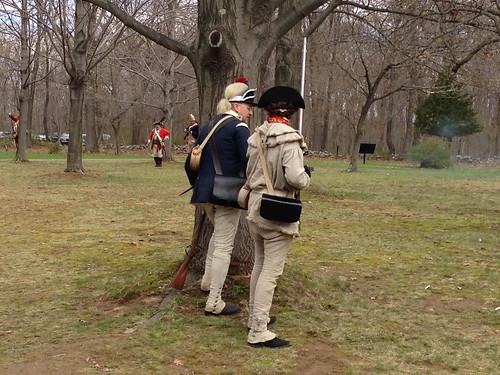
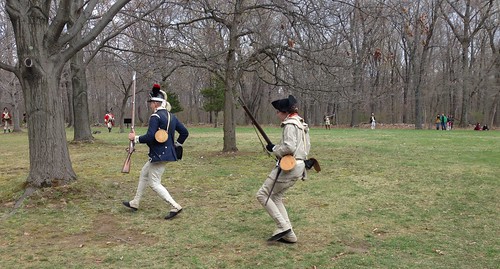
Mr McC & the Young Mr share a tree; note British officer and Hessian

Demonstrating skirmishes instead of linear warfare makes sense, given the numbers of men who take the field at events, and the smaller engagements will reflect exchanges common between the sides during the war.

What I like in particular is that using ‘petite guerre’ tactics requires the commanders and soldiers to tailor their actions to a site (site specific immersive experience: you cannot go wrong) and as the action unfolds, soldiers at all ranks are forced not only to move but also to think. Any action where the interpreters have to think is likely to create a better experience for visitors—and no great surprise, that usually makes a better experience for interpreters. It also flatters the site managers and visitors, who will appreciate that you’ve taken the time to explore and understand their place, and its place in history.

While you don’t necessarily want to fight the Battle of the Comfort Station, skirmishing around a site with buildings provides an objective, while multiple buildings and some woods or undergrowth provide cover for the Light Infantry troops and opportunities for deceit.

Of course, depending on troop size, it may be that each man needs his own tree. On Sunday, the Young Mr kept close to Mr McC, demonstrating troop [leg] length.

It’s hard to be invisible when you’re tall.

But I do mean this seriously: scaling events to available resources allows for a better interpretation.

That’s common sense, and sound museum practice, and that’s pretty much the business living history practioners (aka reenactors), are in: interpreting the past to visitors. Best practices for professionals and hobbyists are grounded in the same principles:

  • Primary source research
  • Material culture research
  • Site, resource, and audience- appropriate delivery
IMG_1386
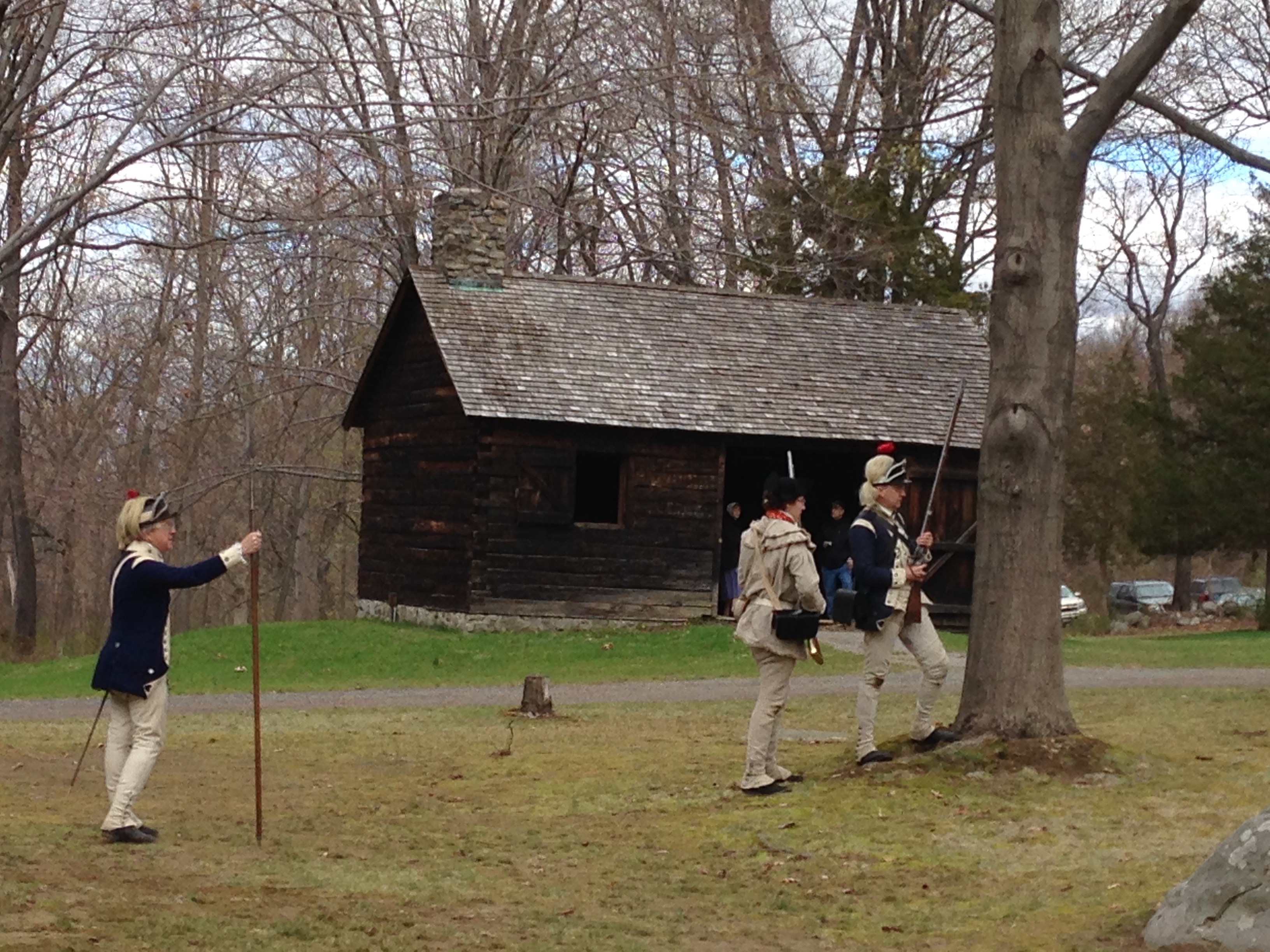
Direction provided by Mr C with spontoon.

Building an encampment and tactical demonstration on the first two principles grounds the event in in historical authenticity. Adding the third principle, and increasing the use of smaller group tactics, tailored to the participants and site, would be a subtle but strategic shift to build a more engaging experience that better educates visitors and might even attract new recruits.