Mr Herreshoff and Miss Brown hope soon to be married
Mrs Brown will be in, and receiving guests, and we hear that Mr Herreshoff will come to call as well. While he may decry the state of the roads, we expect him to have news of business conditions in New York, and his prospects for the future.
Miss Alice– Mrs Mason, now– will be at home with her sister, Miss Brown, and Mr Mason is living here now as well. I do not know how I shall keep their room in order, since he is hardly outside of it!
There are other visitors I expect as well; there is a man (I cannot call him a gentleman) who has been doing jobs for us, though he does not live here at the house. He seems extraordinarily interested in the house, and will not stay away. Whatever can be his interest? There may also be a tailor and his apprentice– though the apprentice tends to daydreaming, and looks above his station, studying Latin at all hours. I think he will not be long in his apprenticeship if he will not pay attention.
A companion pl. to BMSat 9813. A pretty young woman wearing a décolleté négligé, stands with her back to the fire, her gown raised to leave her posterior naked. She holds a book: ‘The Monk – a Novel by M’ [‘G. Lewis’, cf. BMSat 9932]; another is open on the floor: ‘Œconomy of Love by Dr Arm[strong’, 1736]. A cat rolls on its back. On a table are a decanter of ‘Creme de Noyau’, and an open book: ‘The Kisses’. On the mantelpiece are flowers and an ornate clock with embracing cupids. A picture partly covered by a curtain represents Danaë receiving the golden shower. The room, apparently that of a courtesan, is luxuriously furnished. 26 February 1801 Hand-coloured etching, British Museum, 1935,0522.7.12
I’ve left that caption intact, though it seems quite long enough for a blog post itself. This image turned up on Twitter (you can follow me there @kittycalash, expect randomness) and delighted me at the end of a long, tough week. I’m particularly taken with the cat, which resonates with an lolcat that floated about the interwebs last winter. The interwebs can be a strange place…
But aside from that silly cat, there are a wealth of details in this image, some of which are explicated in the caption.
What struck me- after the cat– was the slipcover on the sofa. How lame is that– but it’s true. Floral print, I suspect, but possibly woven, it’s loosely draped and long. I’m more familiar with the checked linen slipcovers seen in representation of New England interiors, so the floral really struck me. I suppose those linen checks symbolize all the puritanical uprightness and restraint of early Federal New England dons (if you believe in that kind of thing), while the loose floral print drapery tells you everything you need to know about our Rumpford friend.
We all see what we want to see…cats, slip covers, or courtesans.
Hard to say which, but I am ill at ease and dissatisfied with my costuming. You might even call it bratty. But I don’t wanna be like Bridget Connor!
It started the week of the Stamp Act protest, when I felt quite tired of being the shabby, unrefined woman of the regiment and street vendor, and wanted a nice cozy shop like the milliner had. I was also looking forward to being a housekeeper again, and several weeks of moving boxes and volumes with red rot at work had me feeling generally filthy and unappreciated. Bratty.
When in doubt, sew. A new dress can’t help but cheer you up, right?
Well… sort of…
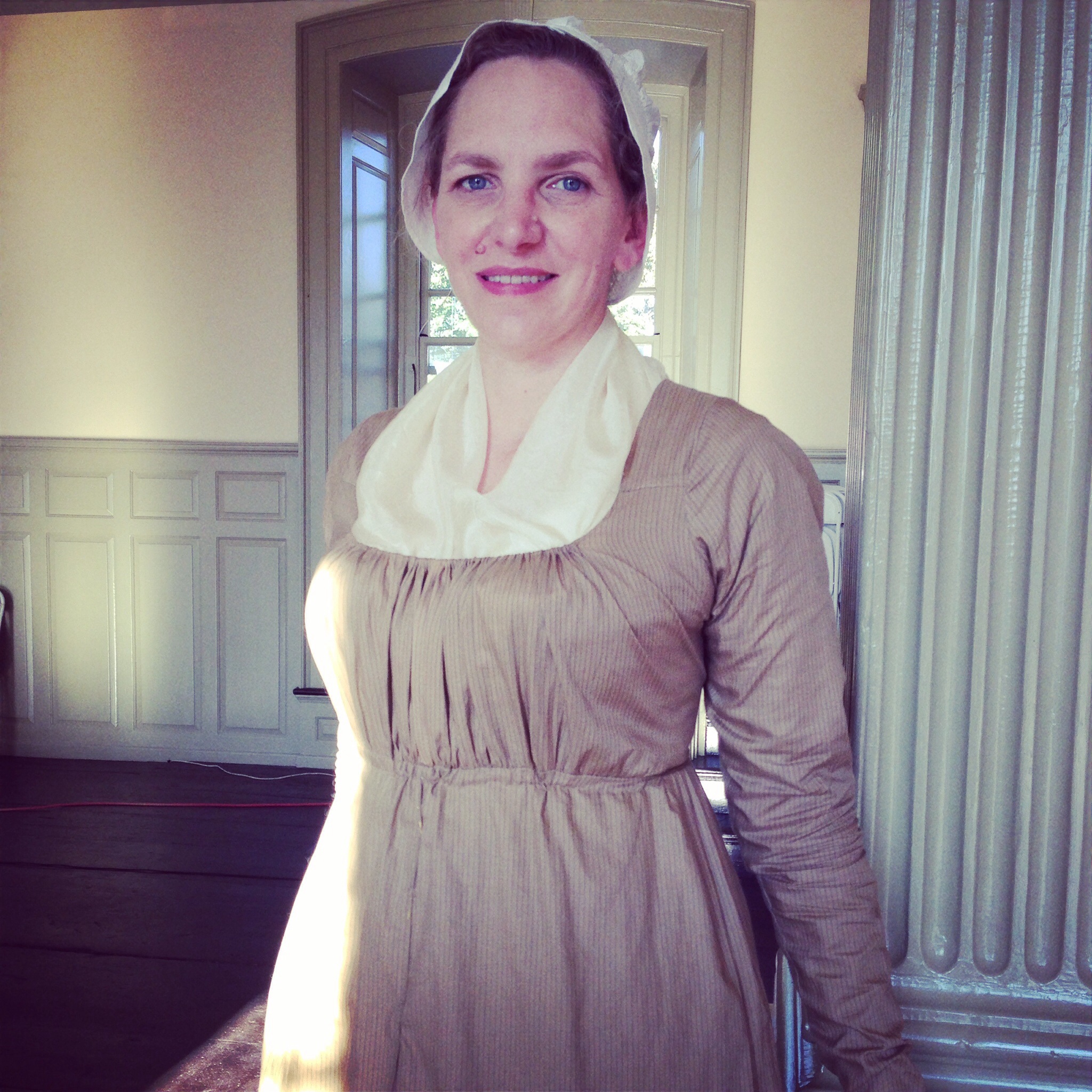
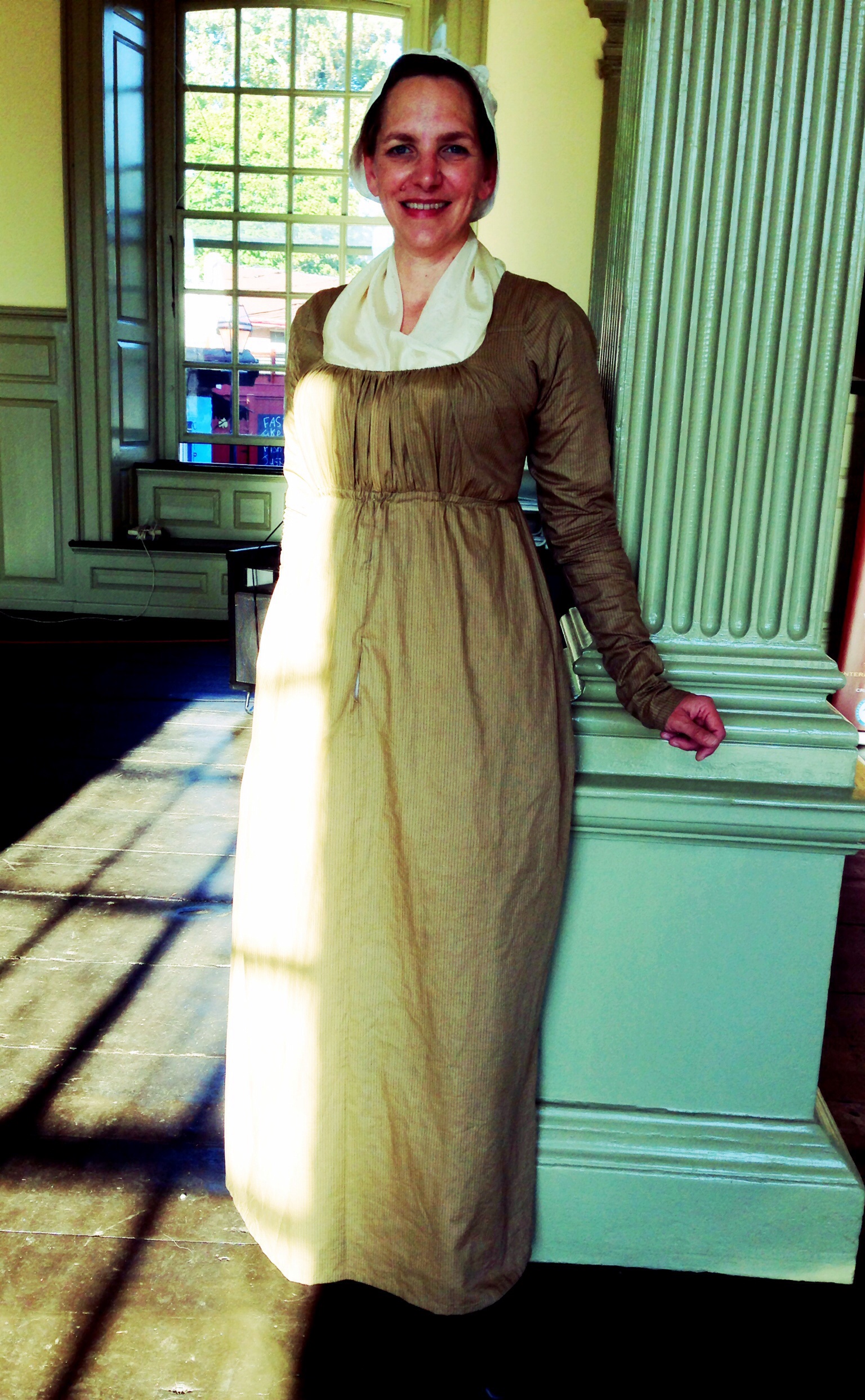
Last Thursday, we did a reprise of the Williams family letters program at the Newport Historical Society. The Williams family were Quakers, and the letters were from the early part of the 19th century, so for the program in March, I made a green silk cross-front gown based on the Quaker gown in the back of Costume in Detail. (Check out the schematic on the 19thus.come page; I didn’t see this until I was mostly done with the dress, but thank goodness I got it right!)
But it’s September, and Thursday was expected to be quite warm, so I salved my bureaucratic wounds in the $1.99 loft at the local mill store, and made a new Quaker gown, also suitable for a maid.
I ask you! Even though it’s my very own pattern based on sketches of original drawings, even though it fits, even though it cost $10, even though every seam is overcast and the whole thing is made with period correct stitches, it still fails to make me happy and cheerful and delighted.
This brattiness has resulted in a reappraisal of my approach– and a trip to Sewfisticated in Framingham. What did I buy there? Yards and yards of pink taffeta? Gold taffeta? Blue taffeta?
No.
Because they didn’t have the right colors in the right weave– too slubby– or in enough yardage. Brace yourselves: I bought brown.
Many thanks to Sew 18th Century for taking the photos!
It appears I do not learn from my mistakes. When I think, “Gee, I’d like a pretty dress,” I end up buying fabric based on the texture as much as the color, and I have to tell you, that brown taffeta has the most wonderful l hand and sheen, and I will look much more like a Copley portrait than I ever have before, so that’s something.
It seems I have created a set of mental rules for myself, a mission, if you will, for the historic clothing I sew and the roles I take on, and I only play within those rules.
Solving romantic troubles is not my forte, but just as your first crush may not be the person you spend your life with, the first living history/reenactment group may not be your last.
Some folks are serial joiners, just as there are people who engage in a series of medium-term relationships: as long as everybody knows what’s going on, things should be fine and no one will be set anyone else’s goldfish free and leave each other twisting in the wind. But some of us want a long-term home in history: what should we consider?
In no particular order, I offer the follow areas to examine:
Communication Style & Frequency
Surprised to discover members of your group at an event you thought they weren’t attending, so you went with someone else? Find yourself alone at an event that people said they were attending, but dropped at the last moment? Just because all life is like middle school, there’s no need to recreate scenes from Gidget in historic clothing: communicate.
Everyone requires different amounts of information, but after considerable time working, I think it’s hard to over-communicate. Folks, if it’s too many emails, hit the delete key. But if you do not get the basics– a list of events and potential attendees, reminders as the event approaches, coordination of food, canvas and powder supplies– and end up powderless and alone at an event, you may want to reconsider your allegiance.
Level of Activity & Engagement
“It’s just event after event after event,” whined the Young Mr last summer, and I hadn’t even made him march to Fort Ti and sleep under a brush arbor. Some people need to mix primitive camping in funny clothes with a few days at the beach, others spend their entire summers living life as old-school as they can. Some perform the classic turn-your-back maneuver described on Peabody’s Lament (pro tip: don’t do that!) while others actively seek opportunities to engage the public. Some like to be in first person, and others are always and only in third person.
How many activities can you fit into your year?
What’s your preference? If you want to try immersive, first-person interpretations, you need a unit that will support that, and opportunities to try it out. And if you want to go out often, you may need some flexibility in time period and activity.
But even beyond the times when you’re dressed in historic clothing and working with the public, you want to be with a group that includes people who are set a variety of RPMs. If you’re all super-intense original garment/gear/methods copying maniacs, you might not be balanced. As a newcomer, you need an environment that mixes challenges and support– like a good kindergarten.
Authenticity Standards
On that super-intense original garment/gear/methods copying theme, if the group doesn’t manage to meet a certain level of authenticity, or is not striving to improve, and to learn and try new things, is that the right group for you? I find that a curious mind is a necessity, one willing to accept that research advances and what we thought was right in the past may be proven wrong.
The other key here is, how does the group help you meet standards? Are there workshops to help you make up kit or improve what you already have? How deep do the standards go: clothing only, or to camp set up? What about how you cook, what you eat, and what you eat it with?
“Furniture”
Are the compromises people make balanced and understood? My family and I ar among the people who go to events in “wearable but not done” clothes, and that’s OK in our world. While we have period shoes, they are not always perfectly correct: the gents wore buckles in 1812 and the Young Mr definitely doesn’t get a second pair of shoes until we know his feet won’t grow larger than they are now….
Interpretation and Imagination
Did you have one, maybe two, really-really best friends in grade school? Did you play dress-up, imaginative games, engage in narrative play? Did you enjoy the school play (and insist on leading the writing of a research-based script)?If you did, you are probably looking for folks who played the way you did as a child.
What kind of interpretation do you prefer?
Good interpretation requires that someone in the group have an active and vivid imagination, and that people are willing to take risks. Interpretation is a risk: will this portrayal of a captain’s death, a washerwoman’s trial, a wayward apprentice’s punishment, actual work? Do we trust each other enough to slip into new roles?
Trust is key: will the other people in the group bail you out if you freeze, encourage you if you run with an idea, and meet you in the same moment? You will have to spend time with people to find out how well you can all play together but, happily, you will quickly learn if you cannot. If your questions about who you are, why you are in a place, and if you should be wearing a 1781 coat at a 1777 event are rebuffed, you may need to consider other options.



![A companion pl. to BMSat 9813. A pretty young woman wearing a décolleté négligé, stands with her back to the fire, her gown raised to leave her posterior naked. She holds a book: 'The Monk - a Novel by M' ['G. Lewis', cf. BMSat 9932]; another is open on the floor: 'Œconomy of Love by Dr Arm[strong', 1736]. A cat rolls on its back. On a table are a decanter of 'Creme de Noyau', and an open book: 'The Kisses'. On the mantelpiece are flowers and an ornate clock with embracing cupids. A picture partly covered by a curtain represents Danaë receiving the golden shower. The room, apparently that of a courtesan, is luxuriously furnished. 26 February 1801 Hand-coloured etching, British Museum, 1935,0522.7.12](https://kirstenhammerstrom.com/wp-content/uploads/2023/03/0cd30-rumpford.jpg?w=640&h=898)



 Kirsten Hammerstrom
You must be logged in to post a comment.