The recent BBC video making the rounds on social media got me thinking about how we live our lives, and what commitments we make to being our true selves, how we follow our bliss, if you will. It takes a lot of courage, willpower, and hard work to achieve one’s deepest inner dreams and although I have taken some steps towards mine, I have not let go all the way (as one does not when one is putting a child through college).
I think about this desire to be true to one’s own internal vision, and I think about my friend Justin, who found a place and fell in love with what he saw, past and future. It’s hard work to run a farm and a business, but Justin does it beautifully, with grace and integrity. What he achieves makes me ache with want, not for the house, or the frozen cat’s water dish, or the work, but for the courage.
Working with Justin pushed me into places where I found, if not fear, at least discomfort. As we said, It isn’t history till it hurts. The first What Cheer Day we ran, I remember standing behind the door on the second floor landing of the servants’ quarters, knowing it was show time. I looked at Justin and said, “What the hell have we done?” terrified to go out and “be” John Brown’s housekeeper. But, out we went, and it was amazing. That work inspired me to push myself harder, to try the things that scared me and made me uncomfortable. That’s where the meat is, and the truth: where things hurt.
The housekeeper was caught reading naughty novels. Photo by J. D. Kay.
As with all things I tackle, I could push myself harder, not to sew better or more authentically (that’s the easy part, really) but to live the way I want to, authentically. To decide what matters and what doesn’t, and stick to it. That’s the real lesson of these men, and why they’re inspiring. I just happen to prefer the one with mud.
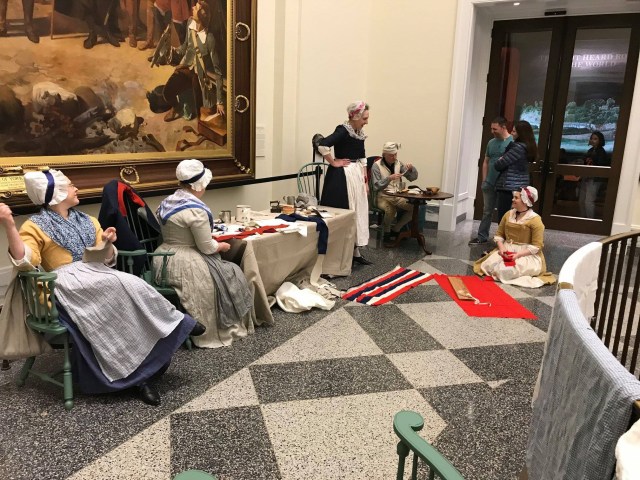
Saturday’s arrangement. Image courtesy of the Museum of the American Revolution
The biggest challenge in interpreting Rebecca Young and the shop she ran was not how flags were made (an appointment at the Cultural Resource Center of the National Museum of the American Indian answered that question*), but rather how to make sewing interesting, and how to create a more interactive experience for ourselves and for visitors. Some of my favorite living history experiences involve playing off other interpreters and the public, especially when trying to convince visitors to pick a side, carry a message, or share a secret. Saturday’s set up made that harder, with Rebecca’s shop of women behind a table (we wanted to be sure to be open to visitors, and not make the dreaded reenactor circle), and with Drunk Tailor rolling cartridges in a niche.
Nobody puts Drunk Tailor in a niche.
But what we saw on Saturday– a day with 800 visitors–was that boys between roughly six and 16 skipped from Drunk Tailor to the tailors, bypassing a table of women altogether. Older men (say, 45+) visiting alone also skipped our table, while the majority of our visitors were girls and women. This was not a surprise. Children begin to develop gender segregation around ages five to six, and sewing is often dismissed as “women’s work,” as the table of tailors experienced. These cultural biases were somewhat compounded by the nature of our work.
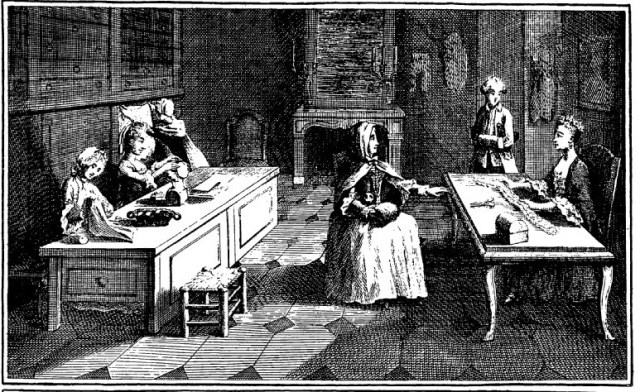
Tailor’s Art: Containing the men’s suits tailor, the skin breeches, the women & children’s body suit, the seamstress & the fashion merchant / by M. de Garsault, National Library of FranceSunday’s set up. Image courtesy of the Museum of the American Revolution
Sewing is one of those tasks that is downward-facing, internal, and meditative (until the thread tangles or snaps). It’s dull to watch, really; the exciting parts of sewing and making are draping, fitting, and cutting. Cutting. There’s something to that.
Combining the desire to interact more with our co-interpreters and the need to disrupt expectations of sewing, we rearranged the tables on Sunday, moving Drunk Tailor to our end of the atrium, postulating that his tea table and powder keg were in the yard of the townhouse, while we pushed our table closer to the tailors and against the railing, pulling our chairs to the side. We also draped shirts and fabric over the railing to display shirts and their component parts, along with bunting. While this “messed up” the atrium, it helped create a context for our work.
Sunday, workshops in a row (house). Image courtesy of the Museum of the American Revolution
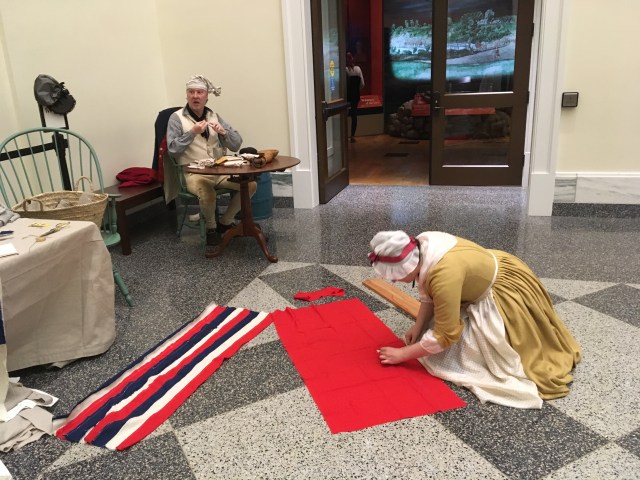
But the best, most participatory change was Mistress V cutting flag strips on the floor, with the help of two young boys. This literally disruptive activity (you had to walk around her) changed perceptions of what we were doing, and helped people imagine assembling a large item (a Continental Standard) in a small rowhouse room.
If we take the Betsy Ross house** as an example of a Philadelphia rowhouse, , its exterior dimensions, roughly 16 x 25, yield an interior per-floor area of not more than 400 square feet. The Star-Spangled Banner was 30 x 42 feet; a second “storm” flag was 17 x 25 feet, large enough to cover the floor of a room in Betsy Ross house.
Dining Table (drop-leaf, gateleg table), probably Pennsylvania, 1750-1770. Walnut, oak. Philadelphia Museum of Art, 1994-20-60
While we do not know the exact dimensions of the flags Rebecca Young and her shop produced, it seems likely that any flag would have exceeded the size of a domestic table, since even drop-leaf dining tables of the period are not usually more than 52” x 41” or about 15 square feet (4.3 x 3.5 feet). The limited size of the table, and the need for multiple feet of cutting space makes it likely that flags larger than 3 x 5 feet were cut and pieced on the floor.
This combination of thought experiment and interpretive change up was reasonably successful, giving us greater understanding as we talked about assembling goods in pieces and working in a small shop while interrupting the visitor’s expectations.
*More on this another time.
**You have to start somewhere– and while I’m on #TeamYoung when it comes to flag making, Rebecca’s rented house has long been razed.
Research and primary source materials on Rebecca Flower Young were provided by Matthew Skic of the Museum of the American Revolution; compiled information used by gallery educators at the MoAR was compiled and provided by Katherine Becnel of the MoAR.
Without wading into the murky waters of canceled reenactments (not my time periods– yet!) and the politicization of historical facts, I advocate the recreation of the “bad” people of history. Not the Hitlers and Himmlers and Stalins and Amins, but the everyday bad. The lazy. The feckless. The annoyed. The I’m-just-now-waking-up-to-the-bad-choice-I-made.
The Female Orators. Printed for Jno. Smith, No. 35 Cheapside, & Robt. Sayer, No. 53 Fleet Street, as the act directs, Novr. 20, 1768.
I think about these people– the ones who slack off while working, the ones who steal shirts, assault officers, throw bones out of barracks doors— periodically, especially when an event is being planned. It’s not that I don’t want to work, mind you: I enjoy working, even the cleaning and scrubbing of history. But it strikes me, especially in summer, that we approach the recreation of history with such excellent intentions. We will Do Our Best. We will Lend A Hand. We will be Always Cheerful.
Why? Why do we not represent the people who shirked? Why do we not represent the people who resented being told what to do, and when? Why do we not take into account our industrialized notions of labor (shifts, clocks, production levels( when we step backwards into a period where there was no factory whistle to set the pace?
The Miseries of Idleness. Oil on canvas by George Morland ca 1788. National Gallery of Scotland, NG 1836. Presented by Alexander and Lady Margaret Shaw, later Lord and Lady Craigmyle 1935
Granted, within a military environment, there are rules, regulations, clocks, and enforcers. But I cannot help thinking that the pace of labor, the speed and drive with which people tackled tasks, was different one hundred, two hundred, three hundred, years ago. Of course there were strivers and doers: the American army in the Revolution was populated by adherents to piety and discipline. But it’s clear from the orderly books that there were miscreants and slackers, too.
The Comforts of Industry. Oil on canvas by George Morland, before 1790. National Gallery of Scotland, NG 1835. Presented by Alexander and Lady Margaret Shaw, later Lord and Lady Craigmyle 1935
And I’m not saying everyone should be a slacker, but you know as well as I do that every workplace today has a slacker or two: the long-term federal employee who watches football at work; the retail clerk whose breaks last a little longer every time; the shelver in the library who catches a nap whilst shelf reading. There are consequences (usually) for those (in)actions, and that’s kind of the point. The slattern and the slacker of history throw into higher relief the purpose of the discipline an army (or housekeeper or master cabinet maker) is trying to maintain. When we all strive to do our best, we lose the depth of interpretation that doing “bad” history can provide.
A friend of mine recently wrote about replicating the domestic life of the past (specifically the 18th century) and how much meaning that had for her.
Being so deeply embedded in the rhythms of life there, it became my home in a very real sense that has never left me.
I read that quickly, and what I read was that the place she had spent so much time was home to her because the place never left her– she carried its rhythms and seasons within her. Perhaps that isn’t quite what she meant, but that’s the risk of writing: the reader reads what they need to.
It made me think of home, and of living deliberately, and of a very bad year I had a long time ago, before I even imagined doing living history, when I thought I would spend my life making new things, like cities and buildings. (This makes me think of an album I listened to at the time, More Songs About Buildings and Food, which seemed all the more important because I’d gone to RISD, too.
Food, in a Building, in Rhode Island
The year I turned 25 was particularly bad not because a man broke my heart, though that didn’t help, and not because I had a miscarriage, though that was the catalyst that led to the man breaking my heart, but because the miscarriage shattered my sense of purpose and self. Somehow, everything that I had ever wanted to be — a sculptor, an architect, a writer– was gone, and I didn’t know what to do or how to be. (Read The Year of Magical Thinking if you want a well-written take on this kind of loss.) I didn’t know what to do next, but the man who eventually broke my heart gave me a book to help me figure it out: Chop Wood, Carry Water
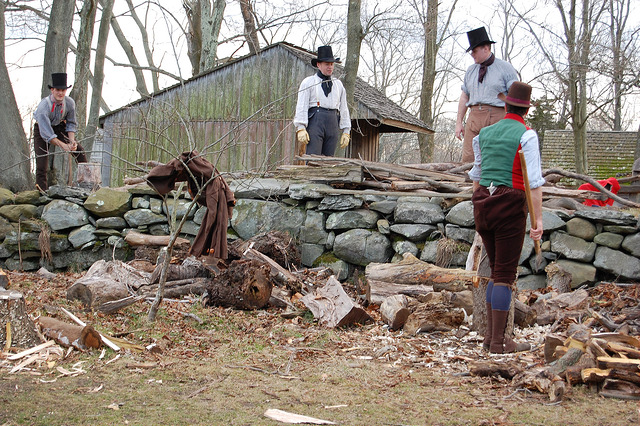
Chopping wood.
Two years ago, I wrote a piece called Zen and the Art of Living History, in which I extolled the virtue of the everyday: Embrace the everyday, bring everyone back into history. Since then, I’ve thought more about how history and historic house museums can be a catalyst for change, how domestic sites can create “homes for history,” where we can have the difficult conversations that must be had to make the change I think we need as a nation, and as humans. These changes are happening, slowly, in museums and at historic sites, but even at the personal level, there’s meaning and change to be had through the business of “doing history.”
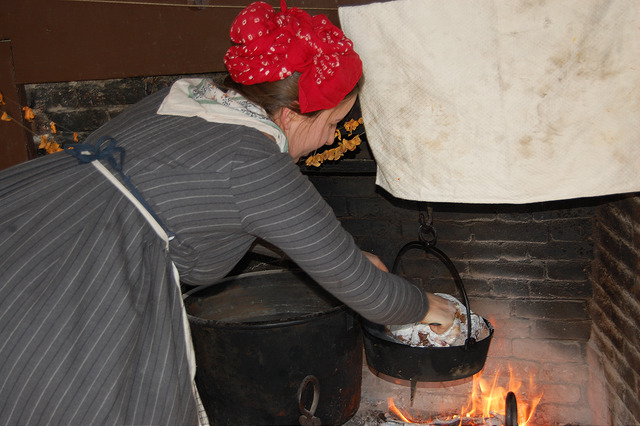
I suspect that among the reasons people really enjoy immersive, civilian (non-musket) events is because the work brings them into the rhythms of the natural world in a way that industrial life precludes or even prohibits. Consciously or not, interpreting the domestic life of the past forces us into mindfulness, into being as much as or more than doing. That’s the point of “chop wood, carry water:” to live deliberately. To cook without a clock, with only the color of the coals and the smell of the food to guide you; to notice the changing light because, as it fades, you must act to create light; to find the flaws and shifts in a floor as you scrub it, because there’s no machine between you, just your hands and a brush or a mop: all these tasks force you to be in the moment, noticing your environment, noticing yourself. You. A corporeal presence in a material world. How does that feel, moment to moment? Physically, emotionally: the challenge of living in the past is to live an unmediated life.
To go back to basics the way we do with civilian or domestic-site based living history brings us back to our base: we face our physical needs and the challenge of meeting them. We face emotional tests that help us imagine how people in the past endured– I often wonder how everyday people coped with “melancholia,” grief, and disappointment– and help us endure. It brings us home to ourselves, to our individual histories and our shared histories, and that’s what really matters. The connection to the everyday that we experience in a place in time puts us in a continuum with the people of the past, and gives us a place to be, a thing to do, a meaning. And that is what every one of us needs.








 Kirsten Hammerstrom
You must be logged in to post a comment.