Tuning Frocks

You’ve washed, mended, ironed, darned, and sorted.

Now what? Now, my friend, the hard truths: the assessments and upgrades.

The hard stuff. Winter is a good time to frankly assess what you have, what you need, and what you already have needs. Could that sleeve be re-set? Stroke gathers re-done on an apron waistband? When you’re finally not planning and packing every few weeks, you have the time to really think about what you have and what you want.

There are two primary areas to assess, fit and appropriateness.

Fit:

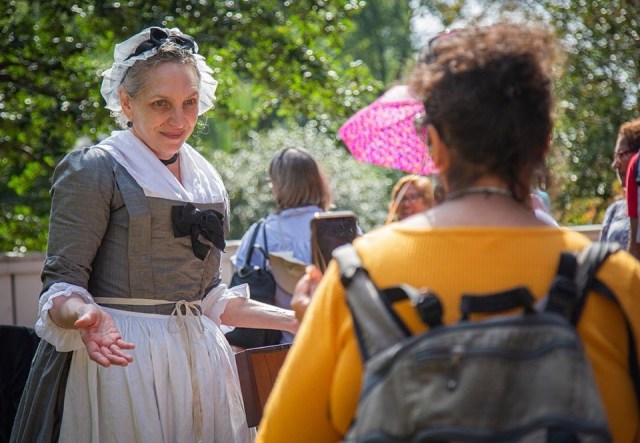
How well do your clothes fit you? Are your skirts long enough? Short enough? Are your breeches tight enough? Cut correctly? Waistcoats long enough? Getting dressed and taking a good look at your clothes can be enlightening. I find that photographs help me figure out issues with fit. As Drunk Tailor and I work, we take photos (especially of backs) so that whoever is being fitted can see what the fitter sees. This has proven more useful than attempting to turn around to see one’s own back like a cat chasing its tail. I’ve also used mirrors and selfies to achieve similar results, but even a non-sewing friend can take a picture of your back.

Period-correct clothes fit differently than modern off-the-rack clothes (you know this), so looking at period images will help you figure out what you need to change. Typically, I find that sleeves are too loose, backs too wide, or bodices too long. Making the changes you need to make can be intimidating, but even 20th-century guides can help you get where you need to go. (The Bishop Method book is super useful if you want to sew vintage clothes, or just get better at sewing clothes in general.) More online sources for 18th-century techniques include the Early Modern Dress & Textiles Research Network , and Burnley and Trowbridge’s videos.

Appropriateness:

Do you have the right gear for your impression? Are the fabrics correct? Do you have the accessories you need? You know I’m not going to tell you what you need: that’s for you to figure out, but there are some good methods for figuring how what to wear and carry. (Soldiers have it easier: the sergeant tells them, and there are manuals.) For the rest of us in the 18th century, runaway ads are helpful and can be a good source of inspiration for ensembles.

For other centuries, fashion plates and portraits can provide guidance and inspiration, and eventually, there are even pattern books and sewing guides. Small upgrades can make a big difference: in the course of a year, I improved my shoes, upgraded the scarf, and made both a cap a new and better bonnet. It took two more years, but eventually, I really upgraded everything. Sometimes it takes a while to get things right, and that’s okay.

It takes research, and there are some pitfalls (like confirmation bias) but Drunk Tailor lays out some avenues to pursue.  What you choose depends on who you are, so that’s always the place to start: who are you, where do you live, and what do you do? With those questions in mind, you can embark on making the changes to perfect your impressions.
The Charm of the Third Time

One must keep up with the news (and the competition)

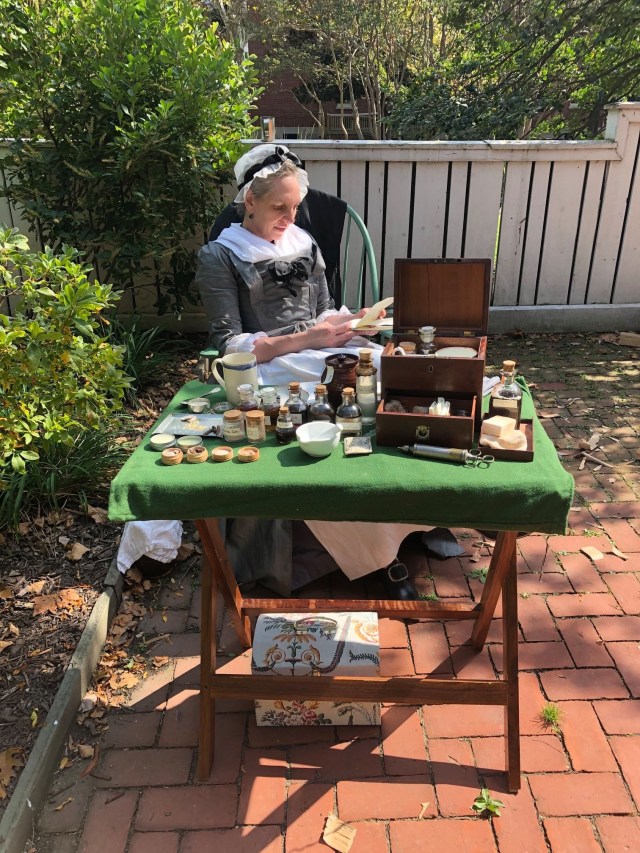
I’d call it “three times a lady,” but truly, I’ve only been a lady in Occupied Philadelphia twice. Last year and this year, I portrayed Elizabeth Weed, a widowed pharmacist living on Front Street in 1777 with her son, George. We don’t know why Elizabeth Weed didn’t leave the city along with nearly half the population. Was she a loyalist? Was her son too ill to travel? Or did she choose to stay to protect her property from the British– or the son of her late husband’s first marriage, who withheld a portion of the estate? Whatever the reason, remain she did, advertising her wares in the October 23 edition of the Pennsylvania Evening Post.

New remedies, new box, new ingredients: refining an idea

Last year, with Drunk Tailor’s assistance, I made a number of remedies using 18th century receipts, with some interesting and sometimes successful results. This year, we improved one– the yellow basilicum ointment– and added some new concoctions. The sulphur ointment for the itch (possibly scabies) worked well on the insect bites I got in the Carpenters Hall forecourt. A charcoal-oyster shell-cinchona bark-benzoin tooth powder was a new addition. I used the clove oil-scented pomatum to achieve the highest hair I’ve managed yet, but the truly satisfying work was recreating multiple recipes actually used by Elizabeth Weed.

As Drunk Tailor notes in his entry on this year’s event, we can never truly enter the 18th century mindset. Recreating the clothes, food, daily rhythms, and medicines help us experience the feel of the past, but we can never truly be those people. If you regularly cook 18th century meals, you’ll experience the palate of the past: aromatic, relying heavily on cloves, nutmeg, cinnamon, and allspice. This same range informs the aroma and flavor of the remedies from cough syrup to tooth powder.

Almost undoubtedly one of the ‘smells like Christmas, tastes like death’ tooth powders. Courtesy Jason R. Wickersty/Museum of the American Revolution

It’s a toss up which is less pleasant to the modern tongue, the Syrup of Balsam or the Syrup for the Flux. Both use the “paregoric elixir,” which some of you may recall from the medicine cabinets of old. Camphorated tincture of opium or anhydrous morphine has been used to treat diarrhea for centuries, and the ingredients for the modern version (anhydrous morphine) is remarkably similar to that for Weed’s paregoric elixir:

Weed’s Paregoric Elixir Anhydrous Morphine (Paregoric)
8 ounces opium Anhydrous Morphine, 2 mg
4 gallons spirits of wine, rectified Alcohol, 45%
1 ounce oil of anise seeds Anise oil
2 ounces Flor. Benzoin Benzoic acid
8 ounces camphor Glycerin
Purified water

There are some differences– most of us don’t want to ingest camphor, and “purified water” isn’t quite a thing in 1777– but the active ingredient makes these essentially the same compound. It’s an essential component of both Syrup of Balsam and Syrup for the Flux, so it had to be made first. Over the course of ten days, the elixir cleared from a yellow-orange slightly opaque liquid to a clear yellow liquid, with white sediment at the bottom of the jar (probably the benzoin).

With that in hand, I was ready to tackle Weed’s most famous (and well-protected) remedy. It appears more than once in the daybook, but both listings use the same ingredients and proportions.

One of the original receipts for the syrup for the (Bloody) Flux. UPenn Ms. Codex 1049

Syrup for the Bloody Flux
1.5 pints, simple syrup or molasses
.5 pint, elixir paregoricum
1 drachm each:
Essence of peppermint
Essence of pennyroyal
Essence of anise seed
Essence of fennel seed
tincture aromatic

“Mix them all together, and stop them up in a bottle for life.” (Or, as the other receipt says, “Mix and Digest.”

The resulting mixture is probably meant to soothe the intestinal cramps (with anise, fennel, and peppermint) while the paregoric relieves the endless diarrhea. Licorice-flavored molasses with a peppermint tingle isn’t unpleasant so much as odd to the modern palate.

Syrup of Balsam defied expectations.

On the right: Syrup of Balsam: -10/10 would not taste again.

Syrup of Balsam
1 pint, simple syrup or molasses
.5 print, elixir parigoric
1 ounce each:
Essence of fennel
Essence of anise seed
Royal Balsam
Tincture of Balsam of Tolu

“These must be mixed together, and then put up for use.”

If I attempt this again– to be fair, I have enough ingredients and more knowledge– I’ll try to get the Balsam of Tolu to dissolve more fully into the main mixture, though I doubt the separation is why the taste is so unforgettable. While it did mellow after several days, the basic flavor remained licorice cough drops dissolved in corn liquor with an afterburn of turpentine. Fortunately, the dosage is not by the spoonful, but rather ten or more drops in a wine glass of water, depending on the constitution of the patient. As a “cure for the whooping cough,” the syrup with fennel and anise was probably intended to soothe the throat, and paregoric might have helped the pain of damaged lungs. Living in the post-DTaP era, I’ve never had whooping cough, or been around anyone who did, so it’s much harder for me to imagine treating it without antibiotics (or simply not getting it).

“No, really, no antibiotics!” Photo by Jason R. Wickersty/Museum of the American Revolution

That was really illuminating to some people: antibiotics weren’t invented until 1928 (in the case of penicillin) and were not available for civilian use until March, 1945. Until then, diseases like strep throat could be fatal. Often, the best medicine in the 18th century was to help a patient be comfortable, and ease their symptoms.

Bag and Baggage

Shopping with a basket at Fort Fred. (photo by Denise Wolff)

The subject of carrying things at living history events never seems fully resolved. There were the fireworks I like to call Basketgate, and in the four years since, more women have been carrying frails than firm-sided baskets. But here’s the thing: baskets were not used as purses. They were used for shopping, and for babies (thanks, Ruth!), not for toting about one’s personal effects. That’s what pockets were, and remain, for.

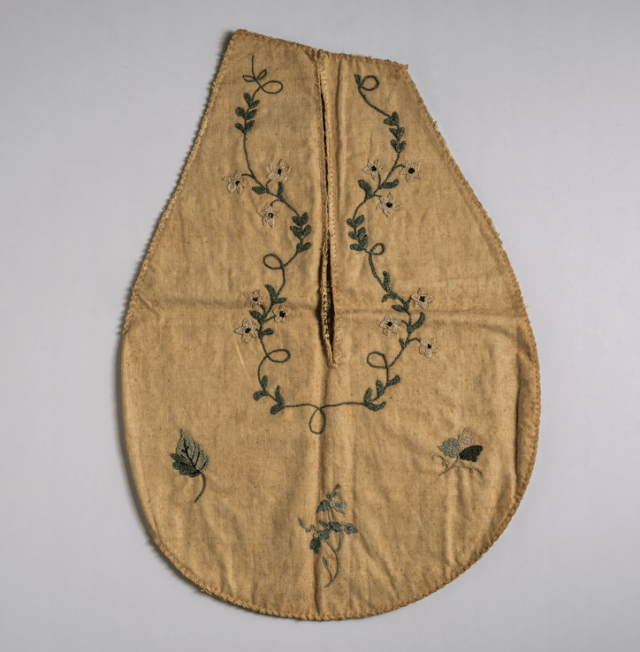
Pocket, silk on linen, ca. 1780. Martha Elizabeth Spach (probably). MESDA 2400.

18th century women were not cursed with the tiny pockets of today’s fashionable jeans. No, they had voluminous pockets capable of holding a vast array of items: pocket journals, purses (like our wallets), game tokens, an orange, keys, and almost anything else you can think of. The pocket shown in the image is 15″ long by 11″ wide, which is a fairly typical size, though some were even larger. When I made these, I described them as “large enough for a puppy,” and Facebook wouldn’t let me post them. There is now a full-length book on The Pocket and I look forward to reading it next year, when my ILL will finally request it ($50 being too dear for my budget). In the meantime, the Victoria and Albert Museum will get you started if pockets are new to you.

So, baskets for shopping and pockets for personal things. What else might you use to convey something from one place to another?

Paul Sandby RA, 1731–1809, British, London Cries: A Man with a Bundle, Old Clothes, undated, Watercolor on medium, cream, slightly textured laid paper, Yale Center for British Art, Paul Mellon Collection

A wallet, of the kind reenactors call a “market wallet,” though that was not the period term. You can read about these in an article by Charles LeCount. The man in the watercolor has a very full wallet over his shoulder, demonstrating the larger end of the wallet spectrum.

And to carry your money in? A purse or pocketbook, sometimes in leather, sometimes in flame stitch, and sometimes in silk.

Which one you choose depends on who you portray, and where. Silk wallets or pocketbooks belong to a particular class and the ones in museum collections are often from France. Flamestitch wallets are reasonably common in North America among people with the time to make them. The really neat thing about these is that the patterns show regional differences, so you can tailor your choice to your place. (I lack the patience, skill, or time to really make headway on mine, but in addition to a wonderful custom pattern, I found kits here.) I have a leather one I love, made by this fellow craftsperson and friend.

Miser’s purse, early 1800s, maker unknown. Purchased 2002. CC BY-NC-ND 4.0. Te Papa (GH009865)

Your coins? A purse. (we call these miser’s purses, though long purse or ring purse might also be used. The forms originates in the 17th century, and although it is most popular in the 19th century, it does appear in the 18th century. It’s just not common, so no, not everyone should have one. A simple bag will do for those with coins they wish to keep wrangled.

Servant Returning from the Market, 1739, Jean-Baptiste-Simeon Chardin. Louvre Museum,
MI 720

A bag, a pillow case, or even a tied cloth, as seen in the painting by Chardin.

There are lots of options for carrying chattel, lumber, and personal items, and most leave your hands free. But for women, the first place to start is tie-on pockets, and for men, the pockets in your coat. After all, the pocket bags in a typical Henry Cooke frock coat will hold a six pack between them. 

If you like this content, please consider supporting me by making a pledge to my Kickstarter.

Women in Business


One of things I’ve struggled with in living history is reconciling my own life as a 21st century working woman and feminist with interpreting the lives of 18th century women.

Mrs. James Smith (Elizabeth Murray)
John Singleton Copley (American, 1738–1815) 1769

It takes a while– and a bunch of reading– to get past the notion that these women lack agency in their own lives. Sure, there are notable exceptions: Abigail Adams, Mercy Otis Warren, and Elizabeth Murray, but those wealthy Boston women aren’t the kinds of women I’m interested in portraying. What about more everyday women? What about the women more like me? They’ve proven harder to find, but not unfindable–though even they, by dint of being findable, are more exceptional than the vast majority of 18th century colonial American women.

Elizabeth Weed carried on her husband’s business as a pharmacist, noting that she “had been employed these several years past in preparing [his receipts] herself,” and was therefore well-equipped and trustworthy to carry on in his business. Rebecca Young advertised as a flag maker, and as a contractor, made flags, drum cases, cartridges and shirts for the Continental Army, thanks to her brother Benjamin Flower’s position as a Lieutenant Colonel.

In researching Elizabeth Weed, I read about other women running businesses in Philadelphia, and practicing as “doctoresses” in nearby New Jersey, demonstrating that Mrs. Weed operated in a context of other successful women, including some practicing medicine, or at least “medicinal arts.” What I would really like is to track down the records of a mantua maker or milliner in 18th century America, and not only because I make and sell gowns and bonnets, but because in doing so, I’m carrying on with the kind of work that my grandmother and great aunts did.

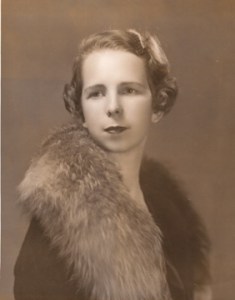
Elsa, Studio Portait ca 1935

For fifty years, my grandmother ran a dress shop in western New York state, dressing the women of Jamestown and the surrounding counties in fashionable and flattering clothes. My aunts made hats and accessories in their own shops, completing the look. I come from a family of makers (including a great-grandmother who made her own shoes), who care deeply about fit and helping people look and feel their best. My grandmother ran a successful shop for fifty years, until she sold it in the mid-1970s. I have many fond memories of sorting costume jewelry upstairs, and gift-wrapping boxes in the basement, with a rack of ribbons in all colors handy on the wall.

She was exceptional in her own way, though you will be hard-pressed to find much (if anything) about her on the interwebs, but maintaining a business through the Depression and World War II was challenging. She gave back, as a member of the YWCA and Women’s Hospital boards, recognizing the importance of sustaining the community you’re part of. When I portray Elizabeth Weed or Rebecca Young, or the Hawthorns of Salem, I think about my grandmother. Maybe it’s a step too far to say the living history work I do or the business I’ve started honors her and the other working women of my family, but I like to think that it helps make visible women who, though now forgotten, were as important to their own communities as she was.