
What Cheer Day: Emotional Goals and Historical Content

Petulant Alice faces her first hurdle, Kitty and Goody Morris. Photograph by J. D. Kay

I think about three or four things most of the time: food, sex, museums, and clothes. That seems pretty adequate, but from time to time I am forced to consider intersections between these rather broad topics. The intersectionality of clothing and museums seems pretty obvious: from accurate costumed interpretation to proper packing and storage, easy. Food and museums will be much on my mind in the coming year, as we work on “Relishing Rhode Island,” and I’m continually harping on how eating locally and seasonally is the core of eating historically. Sex and museums is a little harder (yes, I know about the Museum of Sex), though one gets a chance even in a historic house museum, and really, it’s not just about the act: it’s about the feels.
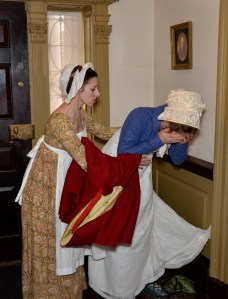
Mary assists Alice in the hallway as she prepares to face her mother. Photograph by J. D. Kay

In the main, I am not particularly good at the feels aside from some very hands-on experience with anxiety, but a number of things have coalesced recently to make me reconsider the intersection of emotions, museums, and history.

Hamilton is one, and if you read this, you probably watched the Hamilton’s America documentary  on PBS last Friday. If you didn’t, go do it now. Really: I can wait. And here’s why:

In the thinking I’ve been doing for some time about Hamilton,* I’ve reached the conclusion that what makes it so damn good (aside from the brilliant writing) is how Lin-Manuel Miranda has captured the emotions. The quotes I wrote down from the documentary are about emotion and drama, because I’m looking for them (confirmation bias for the win) but here they are:

“Each piece of music is specific to an emotion and a character”

“I got into the history through the characters”

“Research is over and you write the character defined by history”

“Write the parts you think are a musical”
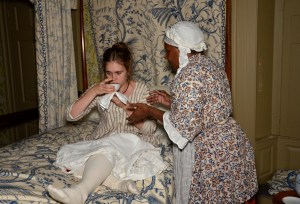
Goody Morris helps Alice drink lemon water to soothe her stomach. Photograph by J. D. Kay

What is a museum exhibit but “the parts you think are a musical?” While Our Girl History struggled with being Alice (I know a bit about the part where your ego gets connected to a character), she had to portray a character defined by history, but also by emotion. And in thinking about Hamilton, about What Cheer Day, and about the exhibits that give me pleasure, and art that brings me joy, I have reached a couple of conclusions.

I believe that museums, where we currently set educational and interpretive goals, and increasingly experiential goals, need to begin setting emotional goals for their programs and exhibitions. You could argue that experiential and emotional goals are the same, but I disagree: I believe that interpretation helps define the experiences that create emotional responses, and within the intersection of experience and emotion we will find the educational goal revealed, because we are always working within a content-driven context.
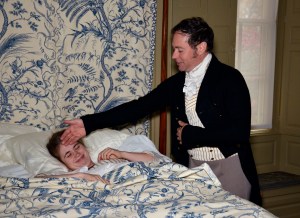
James checks on sister Alice. Photograph by J. D. Kay

I also believe the reason gun-based reenactments retain their popularity is their easy emotions. “Boom!” is exciting anywhere: there’s an immediate reaction of shock, surprise, a mild fear, and excitement. Traditional reenactments have those “boom!” emotions embedded within them, which is how they retain their potency. Until we locate the emotion within the everyday– and trust me, it’s there– we will not see the primacy of non-military reenactments and living history.

*Yes, I was aware of it when it was in previews at the Public Theatre. I am *that* kind of hipster, but really, it was because Oscar Eustis went from Trinity Rep here to the Public and there’s a PVD-NYC theatre connection.
What Cheer! Week

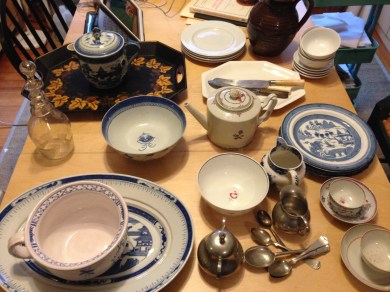
It takes a lot of china to serve a family.

What Cheer! Wednesday: that’s today, with a preview of What Cheer Day itself as props are distributed through the house, the display cases open for viewing and a talk and demonstration of early Federal-era fashion in Rhode Island at 2:30 today. Or not— since we have another program at 4:00. At least I found out before lunchtime.

It’s not the first time I’ve packed a day as full as possible– in fact, I know more is possible, because I’ve done it.

A maid and her mistress

Yesterday, in addition to packing up a small household for use on Saturday, m’colleague and I dressed two mannequins– well, one and a half, since the mistress still needs some work. I don’t know how I forgot the second petticoat when it was right there on my list, but so it goes. Mannequin dressing will finish this morning for this afternoon’s free talk and demonstration.

Saturday, though: that’s the really exciting day, when Alice tries to sneak past her mother after staying out all night at a party. Julia Bowen may not be the good influence we thought she was, if her uncle is anything to judge by.

img_8278

The fun starts at 1:00 PM and runs until 6:00, so we can take advantage of what we learned for After Dark. Extending the life of program research: is there anything better? Maybe a new Spencer, finally completed after more than a year. The weather promises to be chilly enough to make a Spencer necessary, not that I could resist flashing buttons anyway.

Shine On

dscn4553

It has been quite busy chez Calash, with What Cheer Day a little over a week away, the Warren Commission happening tomorrow, and various and sundry other things to do, like get a Young Giant into college. But results were promised and results you shall have.

Despite my lack of chemistry knowledge, I made and used the pewter-cleaning liquor with some success.

The pewter plate spent some time sitting on its edge in a basin of the liquor, and the line is pretty clearly visible in the first image. The second shows the plate after being cleaned with the liquor and a wool rag. It’s better than it was, but there are still more experiments to do. I’d apply rottenstone, but the container hasn’t made it back to New England yet, the posts being poor and the roads infernal.

As the silver bowl demonstrates, rottenstone on its own is remarkably effective at removing polish. It is certainly a fairly readily-available, non-toxic, period method of cleaning metals (andirons and fenders to plates and punch bowls) that can be easil;y employed.

The Warren Commission

Mrs Russell Warren, oil on canvas by Henry Cheever Pratt ca 1824. RIHS 1917.8.2

In addition to the Pabodie Project due in November, I recently committed to appearing at the Providence Arcade on October 14 as Mrs Russell Warren at the party celebrating the launch of the Russell Warren project. As you might have gathered, she’s the architect’s wife, a role I know something about having observed the species in its native habitat for the better part of my life.

This look seemed achievable, once a few compromises were made. To begin with, I scrapped the notion of replicating a silk taffeta gown: too dear for so short a time. I felt some comfort in  this decision as I think the sleeves indicate a rather later date than 1824, and I am, in fact, striving for an Arcade-opening-appropriate dress suitable for about 1826.

So, what to do? Well, thank goodness men like to shoot at plywood and win feathers. My plan is to wear the brown striped gown with the existing belt and accessorize with a new antique lace pelerine-collar type device, I also  plan [hope to] make a new extreme jellyfish cap and possibly a new bonnet.

I have the supplies. Do I have the time and will power? Stay tuned for the next installment of, “Yes, I may be overbooked.”