
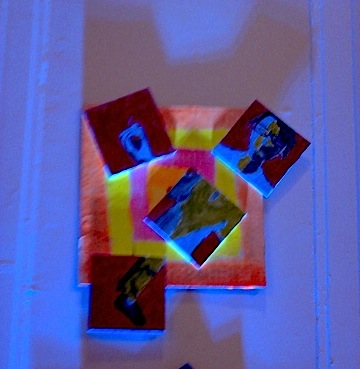
Well, it wasn’t the Met or the MFA, but it was pretty interesting. That’s the Young Mr’s self portrait, captured by my lousy arrogant phone. You will have to take my word for it that it’s as good a representation of a 14-year-old Providence kid as a Brooklyn-based hipster writer as you are likely to find in a public middle school. It was described to me by the creator as “discombobulated.”

I was quite taken with the posters created in one class of 8th graders (some of whom I know). This one, “Time Line,” struck me for the maker’s familiarity with the passage of time. From the EBT card to the prescription bottle, it seems this kid has grasped life’s progression.

I liked this one, too: Education and Success starts with Money. Everyone Should be Entitled to at least $20,000 a year. You can just hear the anti-public-school activists’ engines starting, and if this were to end up on the ProJo’s website, the anti-union comment trolls would feast upon hatred. (Those comment threads are dangerous waters.)
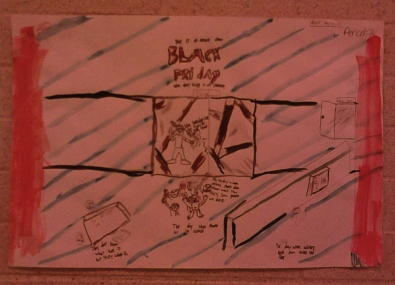
Austin, who played Toto in the fourth-grade play, took aim at consumerism and Black Friday. He likes Manga and used to play Yu-Gi-Oh with the Young Mr on the school bus. The text was hard to read even in person, but I believe there is commentary on people should be home with their families, and people don’t even know what there is to buy, but they want it. The mayhem is clear: I think this must be a drawing of the awful trampling incident. As far as I know, his parents are still a teacher’s aide and a cook, so is likely a pure expression of a basic instinct for fairness, which is probably what’s behind “$20,000 a year.”
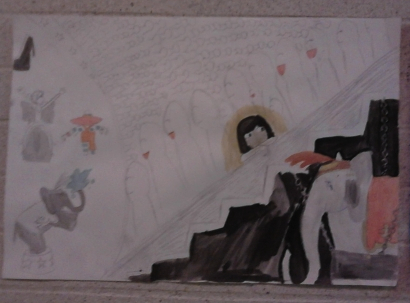
This had no caption and no artist’s signature. I like the haunting, sort of Miyazaki-esque quality of the artwork (I saw a lot of manga and anime-inspired work), and I like the contrast between the light and dark areas, though it is probably not quite finished.
There were musical performances, one a violin piece played by a girl with twig-thin arms, and another set by a jazz trio who seemed unsure of their lyrics. Still, they soldiered on, though they may have sounded better when they slipped into a classroom and played just for themselves.
The Young Mr was wound up and bossy as an Art Guide, and had to be removed from school half an hour after the event ended so that he could be made to eat his dinner. It is fortunate that we are only two blocks from school. Next year, at least there is a coffee shop across from the high school. I suspect they’ll get to know me well.
 Kirsten Hammerstrom
You must be logged in to post a comment.